Shuk Fan Tong, Disheng Xie, Hsuan-yu Lu, Dezhi Liang, Zhongping Ye, Kun Zhu, Kai-yu Tong (2024). The Effectiveness of soft brace with pneumatic muscles on posture alignment for subjects with postural kyphosis: pilot study. In: Physical Ergonomics and Human Factors. AHFE Open Access, vol. 147, pp. 138–147. https://doi.org/10.54941/ahfe1005186
Kyphosis refers to an abnormal increase in the forward curvature of the spine. Among the various types of kyphosis, postural kyphosis, also known as postural roundback, is the most prevalent. The condition arises from poor posture habits, such as slouching, leaning back in chairs and carrying heavy school bags, established during childhood, gradually weakening the muscles and soft tissues of the back. Over time, postural kyphosis can progress, resulting in a chronic deformity and persistent back pain. It typically becomes evident during adolescence, particularly in females. These effects can significantly impact the quality of life for individuals afflicted by the condition, both during their adolescent years and into adulthood. Among the treatment options available, bracing is frequently employed to prevent the progression of the deformity and facilitate correction. The Milwaukee brace, in particular, has been proven as an effective brace for subjects with postural kyphosis. However, one of the challenges associated with its use is wearer discomfort, which can contribute to reduced compliance and treatment efficacy. In this study, a soft textile brace with lightweight pneumatic paddings specifically designed for correcting the posture of individuals with postural kyphosis was developed. In order to evaluate the effectiveness of this new brace, subjects with the condition was recruited to participate in a wear trial. During the trial, head and shoulder posture were assessed including coronal head tilt angle, coronal shoulder angle, sagittal head tilt angle, craniovertebral angle and sagittal shoulder angle. The results revealed significant improvements in sagittal shoulder angle, the subjects wearing the pneumatic padding brace, compared to those without any bracing. These findings suggest that the newly developed brace holds promise for effectively managing postural kyphosis, as it demonstrated positive effects on improving rounded shoulder. By providing more comfort and potentially improving compliance, this brace offers a potential solution to enhance the overall treatment experience for individuals with postural kyphosis.
The Effectiveness of Soft Brace With Pneumatic Muscles on Posture Alignment 139
INTRODUCTION
Kyphosis, also known as roundback, is a kind of spinal deformity which there is an abnormal forward curvature of the spine along the sagittal plane. In general, postural kyphosis, Scheuermann disease and congenital deformi- ties are the three common types of kyphosis. Unlike Scheuermann disease and congenital deformity which are caused by abnormal vertebral struc- ture, postural kyphosis is caused by poor posture (Kamali et al., 2016; Lam and Mukhdomi, 2023). Postural kyphosis usually starts during the growth stages of adolescence and more girls are affected compared to boys. Previ- ous research indicated that angle of kyphosis increases with increasing age (Ze´cirovi´c et al., 2021; Park et al., 2022). Studies proved that prolonged poor posture such as slouching, irregular sitting, are the causes for postural kyphosis. Nowadays, modern children have become accustomed to a pre- dominantly sedentary lifestyle. A significant portion of their day is spent sitting while studying, watching TV, using computer or mobile devices or learning other extra static activities. As a consequence, their opportunities for physical activity have significantly diminished, leading to weakened back muscles (Feng et al., 2018; Ze´cirovi´c et al., 2021; Lam and Mukhdomi, 2023). Brzek and her team pointed out overloaded school bags, asymmetry of the straps of backpack and position of the backpack may also increase the kypho- sis angle. For example, if the backpack is placed too high to students’ back, they will lean forward, and the spine will be overloaded (Brzek et al., 2017). In addition, psychosocial factors such as depression, anxiety and embarrass- ment may also be the causes for poor posture, especially for girls who are developing secondary sexual characteristics. Researchers also indicated that kyphosis may occurs to compensate the breast development in girls due to carrying heavy school bags (Lou et al., 2012; Dharmayat and Shrestha, 2017).
Postural kyphosis not only affects the cosmetic appearance of individu- als due to forward head and rounded back, but it can also have negative effects on their physical health. Prolonged improper posture puts pressure on the spine, leading to protrusion or rupture of vertebral discs and potentially causing back pain (Lou et al., 2012; Feng et al., 2018). In addition to back pain, posture kyphosis may be associated with several health problems. It can result in decreased physical function, poor balance, impaired respiratory function, increased cervical pain, headaches, and shoulder issues like sub- acromial syndrome (Lou et al., 2012; Jenkins et al., 2021; Ze´cirovi´c et al., 2021). Exercise therapy and bracing are the two most commonly used and tra- ditional treatments for posture kyphosis. Bracing is considered an effective non-operative treatment for patients with kyphosis, as it guides the spine to grow straight before skeletal maturity (Lam and Mukhdomi, 2023). The Mil- waukee brace is one of the most widely used braces for progressive thoracic kyphosis curves, applying a three-point corrective force. However, it typically needs to be worn for 16–24 hours a day for several years (Gheitasi, Bayattork and Kolur, 2023). The compliance with this type of brace is often low due to its bulkiness and discomfort, especially in hot weather. It also restricts the
wearer’s activities, further reducing spinal flexibility (Park et al., 2022). Gen- erally, brace treatment is recommended for adolescents with kyphosis greater than 50 degrees, while milder curvatures may receive minimal treatment such as exercise therapy to strengthen back muscles and increase spinal flexibil- ity, along with instructions to maintain proper posture (Lou et al., 2012). There is a lack of adequate and suitable treatments for adolescents with mild curvature of postural kyphosis. Moreover, existing braces are bulky, uncomfortable, and conspicuous.
Therefore, the aim of this study was to develop a comfortable and low-profile soft textile brace with pneumatic muscles and conduct a prelim- inary investigation to evaluate its effectiveness in correcting the posture of individuals with postural kyphosis.
EXPERIMENT Participants
Two healthy young volunteers (age, 27–31 years; weight, 56–61.5 kg; height, 162–178 cm; body mass index, 19.4–21.3 kg/m2) participated in this study. Subjects were excluded if their shoulders or spine have been injured in past 6 months, had history of shoulder or spinal surgery, upper extremity injury limiting activities, cervical or thoracic fracture, scoliosis, or excessive thoracic kyphosis (> 50
). Informed consent was voluntarily obtained from all the subjects prior to participation in the study.
In this study, Flexicurve ruler method was used to measure the thoracic kyphosis. The Flexicurve ruler, a mouldable plastic measurement device which is a simple, reliable and non-invasive tool for measuring kyphosis index and kyphosis angle (Quek et al., 2013; Kamali et al., 2016; Spencer et al., 2019; Grindle et al., 2020; Elpeze, Usgu and Yi˘git, 2023; Lam and Mukhdomi, 2023; Youssef and Yildiz, 2023).
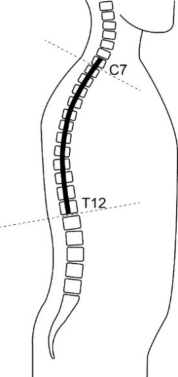
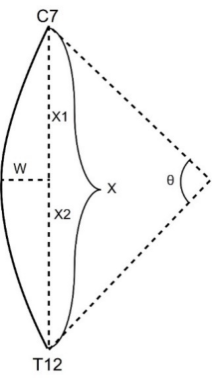
Participants stood in a neutral upright posture with feet shoulder width apart and had their eyes to gaze straight ahead at a target adjusted for body height. The seventh cervical vertebra (C7) and the spinous process of the twelfth thoracic vertebrate (T12) were located and marked by palpated. Then, the Flexicurve ruler was placed along these markers and moulded over the spine midline. The resulting curve was transformed onto paper and the locations of C7 and T12 processes were labelled (Figure 1). Kyphosis index and thoracic kyphosis angle are then calculated. For kyphosis index, it is calculated by the width of apex of the thoracic curve (W) is divided by the length of the thoracic curve (X) and then multiplied by 100 (W/X × 100). An index greater than 13 is considered hyperkyphotic (Lee, Chung and Park, 2015; Spencer et al., 2019; Lam and Mukhdomi, 2023). For thoracic kypho- sis angle, the distances between the C7 and T12 points to the point W were measured as X1 and X2, respectively. To calculate the kyphosis angle, the following formula was used: arctan (W/X1) + arctan (W/X2) (Elpeze, Usgu and Yi˘git, 2023). The calculation of kyphosis index and thoracic kyphosis angle were outlined in Figure 2.
The Effectiveness of Soft Brace With Pneumatic Muscles on Posture Alignment 141
Figure 1: Mould the flexicurve ruler over the spine.Figure 2: Calculation of kyphosis index and thoracic kyphosis angle.
Assessments In this study, a soft textile brace with pneumatic muscles was developed to address the issue of postural kyphosis in individuals. The brace design incorporated spacer fabric, chosen for its enhanced breathability and thermal conductivity properties (Tong et al., 2014; Yip & Ng, 2008). Previous stud- ies have demonstrated that spacer fabrics exhibit excellent moisture-wicking capabilities and temperature regulation (Tong et al., 2014; Yip & Ng, 2008).
To ensure adequate external force for correcting the posture of individuals with postural kyphosis, a pneumatic muscle called XoMuscle was utilized. Previous research has shown that XoMuscle, with a sectional area of 10cm2, is capable of lifting a 20kg bucket with up to 150% contraction and 175% efficiency compared to skeletal muscle (Xie et al., 2023).
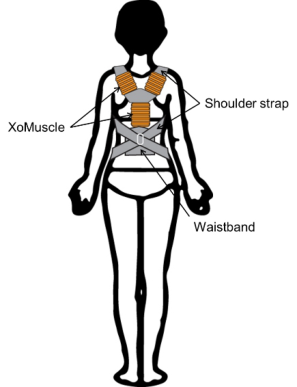
The soft brace with pneumatic muscles is illustrated in Figure 3, depicting the design and configuration of the brace.
Figure 3: The design of the soft brace with pneumatic muscle for subjects with postural kyphosis.
To evaluate the effectiveness of the soft brace with pneumatic muscle in correcting subjects with postural kyphosis, anterior and profile photographs of the subjects were taken before and after wearing the brace. The subjects were instructed to assume a comfortable standing position with their feet shoulder-width apart and hands hanging by their sides. They were asked to gaze straight ahead at a target adjusted to their body height. A trained ther- apist palpated and identified specific anatomical points, including the tragus of the ears, canthus of the eyes, coracoid processes, midpoint of the humerus, and spinal process of C7. White non-allergic adhesive stickers measuring 8mm in diameter were used as skin markers. Photographs were captured using a Sony Alpha 7 digital camera equipped with an FE 1.8/50mm lens. The camera was positioned 2 meters away from the subjects and mounted on a tripod. The tripod was carefully levelled using a bubble spirit level to ensure consistent frontal and sagittal angles. The base of the camera was parallel to the ground to maintain accuracy dur- ing measurements. The software Kinovea was employed for calculating the measurements.
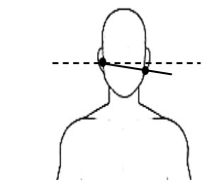
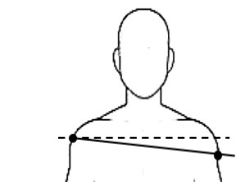
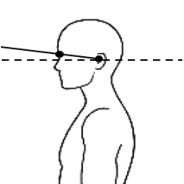
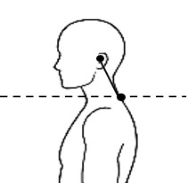
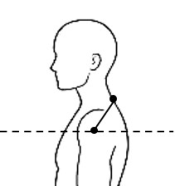
Five measurements of head and shoulder posture were assessed, namely coronal head tilt angle (Figure 4), coronal shoulder angle (Figure 5), sagittal head tilt angle (Figure 6), craniovertebral angle (CVA) (Figure 7), and sagittal shoulder angle (Figure 8). In terms of coronal head tilt, a value of 180
indi- cated a horizontally aligned head. A lower value indicated leftward head tilt, while a higher value indicated rightward head tilt. Similarly, for the coronal shoulder angle, a value of 180
denoted even shoulder alignment. A lower value indicated a higher left shoulder, while a higher value indicated a higher
The Effectiveness of Soft Brace With Pneumatic Muscles on Posture Alignment 143 right shoulder. The sagittal head tilt angle, when less than 180
, indicated forward head tilt. Regarding CVA, a lower value indicated a more forward position of the head. In the case of the sagittal shoulder angle, a lower value indicated a more rounded shoulder (Raine and Twomey, 1994, 1997; Lewis, Green and Wright, 2005; Lee et al., 2017).
Figure 4: Measurement of coronal head tilt angle.Figure 5: Measurement of coronal shoulder angle.Figure 6: Measurement of sagittal head tilt angle.Figure 7: Measurement of craniovertebral angle (CVA).Figure 8: Measurement of sagittal shoulder angle.
RESULTS AND DISCUSSION
In this preliminary study, a wear trial test was conducted to assess the effec- tiveness of the newly developed soft brace for correcting postural kyphosis. Two subjects, one female and one male, were recruited to participate in the study. The demographic information of the subjects is presented in Table 1.
Table 1. Demographic of subjects.
Table available in the original PDF paper.
Subject 1 Subject 2 Gender Male Female Age 27 31 Weight (kg) 61.5 56.0 Height (cm) 178 162 BMI (kg/m2) 19.4 21.3 Kyphosis index 13.0 7.9 Kyphosis angle 30.1 18.6
The summarized measurements of coronal head tilt and shoulder angles, sagittal head tilt and shoulder angles, and cervical vertebral alignment (CVA) for each subject are presented in Table 2. Upon analysis of the results, it was observed that the angles of coronal head tilt and coronal shoulder exhib- ited only a slight increase after the subjects wore the brace. As previously mentioned, when these angles approach 180
, it indicates a more balanced alignment of the head and shoulders. Therefore, the brace may have a minor effect on correcting the level of the head and shoulders in the coronal plane.
Regarding the sagittal head tilt angle, the results obtained from compar- ing the effects of wearing the brace versus not wearing it revealed minimal discernible differences. The observed outcomes did not exhibit any signifi- cant distinctions between the two conditions. This indicates that the impact of brace on the sagittal head tilt angle was negligible, and no conclusive con- clusions can be drawn regarding its effectiveness for improving the sagittal head tilting. However, there was a minor increase in CVA when the subjects wore the brace. An increase in CVA indicates a reduced forward position of the head.
In contrast, a notable increase was observed in the sagittal shoulder angle when comparing the results. Larger angles indicate a lesser degree of
The Effectiveness of Soft Brace With Pneumatic Muscles on Posture Alignment 145
rounded shoulders. These findings suggest that the proposed soft brace with pneumatic muscles has the potential to correct rounded shoulders.
Table 2. The measurements of head and shoulder postures of subjects.
Table available in the original PDF paper.
Subject 1 Subject 2 Without brace With brace Without brace With brace
173.5 173 177 179
Coronal head tilt angle (degree)
175 174.5 178 177
Coronal shoulder angle (degree)
Left Right Left Right Left Right Left Right
161.5 163 162 165 168 165 165 166
Sagittal head tilt angle (degree)
55 53 59 58 52 45 58 56
Craniovertebral angle (CVA) (degree)
67 65 85 85 53 45 91 88
Sagittal shoulder angle (degree)
CONCLUSION
In this study, we introduced a novel soft textile brace with pneumatic muscles designed to correct the head and shoulder posture of individuals with postural kyphosis. A preliminary investigation was conducted involving young adults, wherein five measurements related to head and shoulder posture were cap- tured through photography. These measurements included coronal head tilt angle, coronal shoulder angle, sagittal head tilt angle, and cervical vertebral alignment (CVA).
The results revealed that the proposed brace led to marginal improvements in coronal head tilt and shoulder angle, indicating a slight enhancement in achieving a more balanced alignment of the head and shoulders. However, the brace had a negligible impact on the sagittal head tilt angle. Additionally, the findings demonstrated an increase in CVA, signifying an improvement in forward head posture. Moreover, wearing the brace resulted in a noticeable increase in sagittal shoulder angle, suggesting its potential to reduce rounded shoulders.
It is important to acknowledge that this study had certain limitations, pri- marily the limited number of subjects involved. Hence, future research should focus on further refining the design of the proposed soft brace and expanding the subject pool, particularly by including a more comprehensive sample of adolescents, to enable a more robust investigation.
ACKNOWLEDGMENTS
This work was conducted at The Chinese University and supported by Gen- eral Research Fund (GRF) with project no. 14216622 by the Research Grant Council of the Hong Kong Special Administrative Region (HKSAR).
REFERENCES
Brzek, A. et al. (2017) ‘The weight of pupils’ schoolbags in early school age and its influence on body posture’, BMC Musculoskeletal Disorders, Volume 18, No. 1, p. 117. Available at: https://doi.org/10.1186/s12891-017-1462-z. Dharmayat, S. and Shrestha, S. (2017) ‘Assessment of Posture and Musculoskeletal
Pain in School Going Girls Using Backpacks’, IOSR Journal of Nursing and Health Science, Volume 06, No. 1, pp. 09–12. Available at: https://doi.org/10.9790/1959- 0601050912. Elpeze, G., Usgu, G. and Yi˘git, S. (2023) ‘Reliability of the Smartphone Application Inclinometer and Flexicurve in Measuring Thoracic Kyphosis’, Cureus [Preprint]. Available at: https://doi.org/10.7759/cureus.35886. Feng, Q. et al. (2018) ‘The effect of a corrective functional exercise program on
postural thoracic kyphosis in teenagers: A randomized controlled trial’, Clini- cal Rehabilitation, Volume 32, No. 1, pp. 48–56. Available at: https://doi.org/ 10.1177/0269215517714591. Gheitasi, M., Bayattork, M. and Kolur, M. K. (2023) ‘Adding corrective exercises along with bracing for postural hyperkyphosis among adolescents: A randomized controlled trial’, PM&R, Volume 15, No. 7, pp. 872–880. Available at: https: //doi.org/10.1002/pmrj.12877. Grindle, D. M. et al. (2020) ‘Validity of flexicurve and motion capture for measure-
ments of thoracic kyphosis vs standing radiographic measurements’, JOR SPINE, Volume 3, No. 3, p. e1120. Available at: https://doi.org/10.1002/jsp2.1120. Jenkins, H. J. et al. (2021) ‘Decreasing thoracic hyperkyphosis – Which treatments are most effective? A systematic literature review and meta-analysis’, Muscu- loskeletal Science and Practice, Volume 56, p. 102438. Available at: https://do i.org/10.1016/j.msksp.2021.102438. Kamali, F. et al. (2016) ‘Comparison of manual therapy and exercise therapy for
postural hyperkyphosis: A randomized clinical trial’, Physiotherapy Theory and Practice, Volume 32, No. 2, pp. 92–97. Available at: https://doi.org/10.3109/ 09593985.2015.1110739. Lam, J. C. and Mukhdomi, T. (2023) ‘Kyphosi’. Available at: https://www.ncbi.nlm .nih.gov/books/NBK558945 (Accessed: 27 December 2023). Lee, D. Y. et al. (2017) ‘Changes in rounded shoulder posture and forward head
posture according to exercise methods’, Journal of Physical Therapy Science, Volume 29, No. 10, pp. 1824–1827. Available at: https://doi.org/10.1589/jpts.29. 1824. Lee, H., Chung, H. and Park, S. (2015) ‘The Analysis of severity of forward head posture with observation and photographic method’, Journal of the Korean Soci- ety of Physical Medicine, Volume 10, No. 3, pp. 9–17. Available at: https: //doi.org/10.13066/kspm.2015.10.3.9. Lewis, J. S., Green, A. and Wright, C. (2005) ‘Subacromial impingement syndrome:
The role of posture and muscle imbalance’, Journal of Shoulder and Elbow Surgery, Volume 14, No. 4, pp. 385–392. Available at: https://doi.org/10.1016/ j.jse.2004.08.007. Lou, E. et al. (2012) ‘Development of a smart garment to reduce kyphosis during daily living’, Medical & Biological Engineering & Computing, Volume 50, No. 11, pp. 1147–1154. Available at: https://doi.org/10.1007/s11517-011-0847-7. Park, Y.-J. et al. (2022) ‘Effects of Combined Exercise Program on Spinal Curva-
ture and Balance Ability in Adolescents with Kyphosis’, Children, 9(12), p. 1999. Available at: https://doi.org/10.3390/children9121999.
The Effectiveness of Soft Brace With Pneumatic Muscles on Posture Alignment 147
Quek, J. et al. (2013) ‘Effects of thoracic kyphosis and forward head posture on cervical range of motion in older adults’, Manual Therapy, Volume 18, No. 1, pp. 65–71. Available at: https://doi.org/10.1016/j.math.2012.07.005. Raine, S. and Twomey, L. (1994) ‘Posture of the head, shoulders and thoracic spine
in comfortable erect standing’, Australian Journal of Physiotherapy, Volume 40, No. 1, pp. 25–32. Available at: https://doi.org/10.1016/S0004-9514(14)60451-7. Raine, S. and Twomey, L. T. (1997) ‘Head and shoulder posture varia- tions in 160 asymptomatic women and men’, Archives of Physical Medicine and Rehabilitation, Volume 78, No. 11, pp. 1215–1223. Available at: https://doi.org/10.1016/S0003-9993(97)90335-X. Spencer, L. et al. (2019) ‘Thoracic kyphosis assessment in postmenopausal women: an examination of the Flexicurve method in comparison to radiological meth- ods’, Osteoporosis International, Volume 30, No. 10, pp. 2009–2018. Available at: https://doi.org/10.1007/s00198-019-05023-5. Tong, S.-F. et al. (2014) ‘Exploring use of warp-knitted spacer fabric as a substitute
for the absorbent layer for advanced wound dressing’, Textile Research Journal, 85, pp. 1258–1268. Available at: https://doi.org/10.1177/0040517514561922. Xie, D. et al. (2023) ‘Fluid-Driven High-Performance Bionic Artificial Muscle with Adjustable Muscle’, Advanced Intelligent Systems, 5. Yip, J. and Ng, S.-P. (2008) ‘Study of three-dimensional spacer fabrics: Physical
and mechanical properties’, Journal of Materials Processing Technology, 206(1), pp. 359–364. Available at: https://doi.org/10.1016/j.jmatprotec.2007.12.073. Youssef, H. and Yildiz, A. (2023) ‘Could kyphotic posture disturb body balance in young healthy population?’, Journal of Bodywork and Movement Therapies, Volume 34, pp. 13–18. Available at: https://doi.org/10.1016/j.jbmt.2023.04.003. Ze´cirovi´c, A. et al. (2021) ‘Postural Status And Kyphosis In School-Age Children’,
Volume 5, No. 11.
LISTED IN THE AHFE DIGITAL BOOKSTORE CATALOGUE
Explore the complete digital volume
Physical Ergonomics and Human Factors
Read this individual research paper free through the original publisher, or explore the full digital proceedings book.
ISBN 978-1-964867-23-6
Explore this ISBN in the AHFE Bookstore ↗Listed in the July 2026 bookstore catalogue; search by ISBN to confirm current availability · Digital book purchase optional