Olfa Haj Mahmoud, Anthony Ribot (2024). HARI: A new approach to quantifying MSD risk factors for hands and fingers. In: Physical Ergonomics and Human Factors. AHFE Open Access, vol. 147, pp. 97–107. https://doi.org/10.54941/ahfe1005182
Musculoskeletal disorders have become a significant concern for both companies and their employees, with approximately 38% of these MSD impacting the wrists and fingers in France.Despite the essential function of fingers in industrial tasks such as handling objects and assembling parts, there's currently no established ergonomic approach to assess the MSDs risk factors for these body parts.Based on the existing knowledge and theories in physiology, biomechanics, and ergonomics, coupled with technological advancements in computer vision, we propose in this work to introduce a new method to analyze biomechanical risks for the fingers and wrists. In the first part of this work, we develop a markerless approach using MediaPipe Hand Tracking Library to track the motion of the fingers and wrists over time. This library uses machine learning algorithms to detect and track fingers and wrist movements in real time, with low-latency performance.However, it’s important to note that the hand landmarks extracted from MediaPipe are presented in the world coordinates system. So, it’s essential to implement a kinematic model that respects the parent-child relationship and provides reliable joint angles. The kinematic model used in this study includes 25-degree-of-freedom, enabling calculations to be performed in accordance with the hand's functional anatomy. This approach enables us to objectively quantify postural stresses on fingers and wrists during task execution. In the second part of this work, we propose an ergonomic risk assessment method for wrists and fingers based on the type of grip set by the operator that takes into account the different biomechanical factors as well as the aggravating factors. Key factors contributing to ergonomic risk are pinpointed through a review of the existing literature and a survey conducted among diverse companies addressing this type of Musculoskeletal Disorders (MSDs) within their organizational framework. These factors include fingers/wrist posture, exertion frequency, duration per exertion, motion speed, duration per day and force for biomechanical factors. Additionally, aggravating factors like object diameter, object length, visual precision level, vibration, and temperature are all contributors to the development of musculoskeletal disorders. Next, we establish distinct risk levels and set thresholds for each identified risk factor. Evaluators assign ratings to individual variables based on measured or observed exposure data ; then, a multiplier value is assigned to each variable based on existing knowledge and theories across various fields. Using the identified multipliers, the final global score is calculated and interpreted based on the obtained value.A software tool has been developed to automatically process the Hari method with automatic posture assessment. This paper proposes a framework for ergonomic risk assessment by developing a scoring system divided into three levels: red, orange, and green. The proposed scoring system makes it easy for the decision makers to determine whether a given ergonomic risk on fingers and wrists needs to be mitigated or not.A possible extension of this work involves conducting an experimental study to validate the method with occupational safety and health specialists. It is also possible to add functions for automatic calculation of gesture frequency using machine learning algorithms, as well as automatic detection and recognition of the hand-grip gesture.
The hand, frequently used in daily activities and industrial fields, is prone to various musculoskeletal disorders (MSDs) such as De Quervain’s tenosynovi- tis, trigger finger and BlackBerry thumb (Armstrong, 1982). MSDs affecting hands and fingers result in extended work absence and greater productiv- ity loss compared to other body parts (Barr, 2004). Around one-third of work-related injuries, one-fourth of absenteeism, and one-fifth of endur- ing disabilities stem from hand disorders (Andersson, 1999). In France, 87% of recognized occupational diseases are MSDs, with 38% of these MSDs affecting the fingers, hands and wrists (Ameli, 2020). Despite the crucial impact of MSD injuries on hands and fingers, the most widely used ergonomic assessment methods mainly concentrate on assessing risks related to other body parts. For example, the Rapid Entire Body Assessment (REBA) (Hignett, 2000) evaluates postural stresses on the whole body, Strain Index (SI) (Moore, 1995) is used to evaluate job task elements like force, repetition, posture, and duration, and Occupational Repetitive Actions (OCRA) focuses on assessing repetitive actions on the upper limbs (Occhipini, 1998). How- ever, there is currently no method available to quantify biomechanical risk
factors specifically for the fingers and hands, despite the fact that epidemio- logical studies establish a relationship between severity of hand and fingers MSDs and the performance of repetitive and forceful tasks that require hands use (Andersson, 1999). These disorders are worsened by performing such tasks in awkward or extreme postures, cold environments and the presence of vibrations (Barr, 2004).
This study introduces an innovative approach named HARI (Hand Activ- ity Risk Index) designed to analyze biomechanical risk factors affecting fingers and hands. Our method integrates a combination of factors, including posture automatically evaluated by quantifying finger joint angles using hand tracking technology. Repetition, execution speed, effort duration expressed as a percentage of the task duration, daily duration, and effort intensity (force) are also assessed. Furthermore, we consider aggravating factors such as the diameter and length of handled objects, lighting levels, vibration and ambi- ent temperature. A software application is then developed to automate the process and provide automatic risk analysis of fingers and hands.
PROPOSED SCORING SYSTEM FOR ERGONOMIC ASSESSMENT OF HANDS AND FINGERS MSDs risk factors are classified into several types, including biomechani- cal, individual, psychosocial, and environmental factors (da Costa, 2010). This study primarily focuses on biomechanical factors while also taking into account aggravating factors that potentially exacerbate the onset of mus- culoskeletal disorders (MSDs). The examination of biomechanical factors involves considerations across various parameters. We propose to analyze several factors: firstly, posture by measuring fingers solicitations based on joint limits and different finger rotation axes (movements). Secondly, rep- etition, counting efforts/actions over a technical action period. Thirdly, execution speed, estimating task pace. We then consider effort duration as a percentage of total task time. Additionally, daily duration reflects overall work duration. Subsequently, effort intensity (force) reflects the amount of muscular effort needed to perform the task once. Finally, aggravating factors with the MSDs impact such as diameter and length of object being handled, required lighting levels, vibration and ambient temperature.
The authors identified six task variables based on scientific principles and included a seventh variable, grouping a set of factors that can significantly impact on the onset of MSDs, called aggravating factors. The authors chose to assign five levels to each risk factor as proposed in the Strain Index method (Moore, 1995). Using five risk levels for all risk factors simplifies the analysis. The risk levels and associated scores are presented in each section for each risk factor, and the multipliers related to the score identified are presented in Table 15.
Posture Scoring System The human hand is composed of a thumb, index finger, middle finger, ring finger, little finger and palm which have metacarpophalangeal (MCP), prox- imal interphalangeal (PIP), and distal interphalangeal (DIP) joints, whereas
HARI: A New Approach to Quantifying MSD Risk Factors for Hands and Fingers 99
the thumb has carpometacarpal (CMC), MCP, and interphalangeal (IP) joints (Lee, 2015). The HARI method aims to assess joint angles across these fingers and generate an overall posture risk score based on observed stresses. Initially, a sensorless motion capture approach is implemented using C++ language. This application uses machine learning algorithms to detect hand landmarks and accommodate various hand sizes. An inverse kinematics calculation is then applied to respect the hand and finger anatomy hierarchy, with the wrist as the parent and finger joints as children, forming a descending hierarchy. Algorithms compute joint angles in various rotation axes (e.g., Flexion/Ex- tension or Abduction/Adduction), maintaining the parent-child relationships. A 25-degree-of-freedom (DOF) model is applied based on the approach of Pitarch et al. (Pitarch et al., 2005) to respect the hand’s functional anatomy.
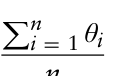
Manipulating objects with a stable hand grip is common action in occu- pational fields. To enhance analysis accuracy, we propose considering the grip type from the following list {Power grip, lateral grip, multi-finger grip and double-finger grip} for each technical action (Lo, 2021). After defining action duration and grip type, a postural score based on the HARI method is automatically calculated. The first step of the process involves transforming the continuous value of the joint angles into a single value comparable with the other single values obtained for the different risk factors as proposed by (Haj Mahmoud, 2020). We propose to describe the approach to be followed for a Flexion/Extension movement. For each movement, the mean value of the observed technical action is calculated. The approach is then generalized to all degrees-of-freedom defined to represent the functional anatomy of the hand and fingers.
Pn
Equation reproduced from the original PDF.
With θi the angle at each frame and n the total number of observations taken over the duration t The mean value is transformed into a percentage of postural solicitation using min and max values of finger joint limits for each movement. % of pos- tural sollicitation Min value corresponds to 0% of the postural sollicitation, while Max value corresponds to 100%.
% postural sollicitationFlexion/Extension = Mean Joint Angle ValueFlexion−Extension −Min Limit
Max limit −Min limit ∗100 With Min Limit refers to the minimum joint angle value, while Max Limit indicates the maximum joint angle value.
Once the postural solicitation percentage is defined for a given technical action, we suggest referencing to solicitation ranges proposed by (Shamsan, 2020) in order to define different risk levels. Based on these levels, we propose assigning a risk score from 1 when the risk is low to 5 if the risk is high for each movement. After determining the risk score for a specific movement, we apply the same process to evaluate all other movements. Subsequently, we
100 Haj Mahmoud and Ribot
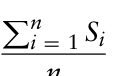
compute the mean value of all these scores, resulting in the postural score for both the fingers and the hand. Score values are rounded to the nearest integer.
Pn
Equation reproduced from the original PDF.
With n the number of body movements, Si the score of ith movement Once the postural score is calculated, a rating is assigned according to Table 1. The multiplier table values were derived using professional judgment to be consistent with the physiological, biomechanical and epidemiological considerations.
Table 1. Posture scoring and interpretation system.
Table available in the original PDF paper.
% Effort Duration (% of the Task Duration) Scoring System Effort duration stands as a crucial indicator, capturing the physiological and biomechanical stresses entailed by the sustained application of force or exer- tion (Kroemer, 1989). It signifies the proportion of time dedicated specifically to exertion within the overall task duration. This variable is calculated as follows.
% effort duration = Effort duration Exertional task time × 100 The percentage effort duration is then compared to ranges in Table 2 in order to assign a score based on the proposed approach in the Strain Index Method (Moore, 1995).
Table 2. % effort duration scoring system and interpretation.
Table available in the original PDF paper.
Technical Action Repetition Scoring System Repetition or frequency per minute is calculated by counting the number of efforts that occur over a representative observation period. Efforts per minute can indeed be calculated from the duration of the work cycle, and vice versa. For example, a 15-second effort cycle is equivalent to four efforts per
HARI: A New Approach to Quantifying MSD Risk Factors for Hands and Fingers 101
minute. The measured results are then compared with the ranges in Table 3 and assigned a corresponding score. The thresholds for repetition per minute are calculated using the Quick Exposure Checklist (QEC) method (Li, 1998).
Table 3. Technical action repetition scoring system and interpretation.
Table available in the original PDF paper.
Effort Intensity (Force) Scoring System Effort intensity is an estimate of the force requirements for a task. It’s related to the physiological (percentage of maximal force) and biomechanical (trac- tion load) stresses exerted on the muscle-tendon units of the distal upper extremity (Fingers and hands) (Lo, 2021).
The proposed methodology involves estimating the intensity of the effort using subjective evaluation of the perceived exertion with Borg CR10 scale (Borg, 1998). The Borg CR10 scale, also known as the Perceived Exertion Scale, is a tool for subjectively measuring the perceived intensity of physical effort during an activity. In the case of minimum effort, the value assigned is 0, while in the case of maximum effort, the value assigned is 10. Intensity of the effort 0 corresponds to 0% of the effort risk level, while 10 corresponds to 100%.
Table 4. Effort intensity scoring system and interpretation.
Table available in the original PDF paper.
Execution Speed Scoring System The execution speed estimates the perceived pace when performing a task and is taken into account because of its influence on the effort required. It has been demonstrated that maximum voluntary force decreases and electromyo- graphy amplitude increases with speed (Armstrong, 1982). Speed of effort is assessed subjectively by analysts, based on their expertise.Three speed lev- els are commonly used: “very slow”, “slow” and “normal”. All parameters have a multiplication factor of 1, thus, no impact on the final score. The term “very fast” describes individuals struggling to match the required pace. The operators are clearly in a hurry and focused on their work. “Fast” is an intermediate choice where workers are not visibly pressured but execute tasks swiftly, typically focusing on high effort-per-minute tasks due to the imposed pace.
102 Haj Mahmoud and Ribot
Table 5. Execution speed scoring and interpretation.
Table available in the original PDF paper.
Daily Duration Scoring System and Interpretation Daily duration represents the total time that a task is performed per day. It attempts to incorporate the beneficial effects of task diversity and instore job rotation and adverse effects of prolonged activity such as overtime. The daily time is expressed in hours that the worker devotes to the specific task analyzed. All thresholds and scores are based on the NIOSH method (Waters, 1994).
Table 6. Day duration scoring system.
Table available in the original PDF paper.
Aggravating Factors Several scientific studies have shown that certain factors can aggravate the development of musculoskeletal disorders, such as vibration, temperature and the lighting level. For this reason, we propose to consider the seventh variable, called aggravating factors. The idea is to consider a risk factor if the risk level is in the orange or red zone for each parameter.
The first parameter examined is temperature, with recommended thresh- olds depending on the nature of the work. All the details are presented in Table 7. Physical harm at work, such as cold can increase the clamping force required to perform a movement (Guélaud, 1975).
Table 7. Temperature threshold values.
Table available in the original PDF paper.
The second parameter is vibration, which can cause injuries to the hand, wrist, elbow and shoulder. Their consequences consist in reduced sensitivity and dexterity, reduced manual strength, Raynaud’s syndrome, osteoarthritis (INRS, 2011).
HARI: A New Approach to Quantifying MSD Risk Factors for Hands and Fingers 103
Table 8. Vibration threshold values.
Table available in the original PDF paper.
The third parameter is lighting levels that must be adapted to the precision and nature of the work to be carried out but also to prevent eye strain or bad postures which can cause musculoskeletal disorders (INRS, 2022).
Table 9. Lighting levels required and threshold values.
Table available in the original PDF paper.
In addition to environmental parameters, it is important to consider the diameter of the object handled and the length of the object handle based on Hand Tool Ergonomics CCOHS (Guélaud, 1975). For cylindrical objects, 40 mm provides the best possible grip with a green risk zone between 30 mm and 50 mm as presented in Table 10.
Table 10. Required lighting level (in lux) depending on nature of task and contrast between object and background.
Table available in the original PDF paper.
For precision handles a diameter of 12 mm is recommended with a green risk zone for diameters between 8 mm and 16 mm as presented in Table 11.
Table 11. Recommended precision handles diameter.
Table available in the original PDF paper.
A handle that is too short can cause unnecessary compression in the middle of the palm. The optimal length for low risk is therefore between 100 mm and 140 mm as presented in Table 12.
104 Haj Mahmoud and Ribot
Table 12. Recommended length of objects handled.
Table available in the original PDF paper.
Based on the risk zones defined, it is possible to quantify the level of risk for aggravating factors using the definition given below.
Table 13. Aggravating factors scoring system.
Table available in the original PDF paper.
HARI Multiplier System For each of the 7 defined risk factors, a risk score for the given risk is cal- culated manually or based on the analyst’s judgment. A health and safety specialist or ergonomist must collect the data for all the risk factors analyzed by the HARI method and summarized in Table 14.
Table 14. Scoring system for all risk factors analyzed by HARI method.
Table available in the original PDF paper.
Score Posture Aggravating factors
Execution speed
Repetition Execution duration
Effort intensity
Duration per day 1 0%-9% No factor Very slow 4 times/min <10 % Very light <1h 2 10%-25% 1 factor Slow 4–8 times /min 10%-29% Light 1h-2h 3 25%-50% 2 factors Normal 9–14 times /min 29%-50% Moderate 2h-4h 4 50%-75% 3 factors Fast 15–19 times /min 50%-79% Hard 4h-8h 5 75%-100% > 4 factors Very Fast >=20 times >80% Very hard >8h
Once the scores for each risk factor have been collected, we’ll proceed to calculate the multipliers corresponding to each risk factor from Table 15. The weighting coefficients are established on the basis of the impact of each risk factor on operators’ health.
Table 15. Multiplier coefficients for each risk factor.
HARI: A New Approach to Quantifying MSD Risk Factors for Hands and Fingers 105
HARI Final Score and Interpretation The HARI Index score is calculated for each body part (left side/ right side). It’s the product of the seven multipliers to obtain the overall score as shown in the equation below
HARI Index = (Posture Multiplier) X (Task speed Multiplier) X (Execu- tion duration Multiplier) X (Intensity of the effort Multiplier) X (Duration per day Multiplier) X (Repetition per minute Multiplier) X (Aggravating factors Multiplier) If the HARI score <0.25 then there is no risk, if 0.25<HARI score <4 then the risk is medium and improvement is required, and finally if HARI score >4 then the risk is high and immediate intervention is required.Results interpretation is summarized in the Table 16.
Table 16. Scoring risk levels and interpretation.
Table available in the original PDF paper.
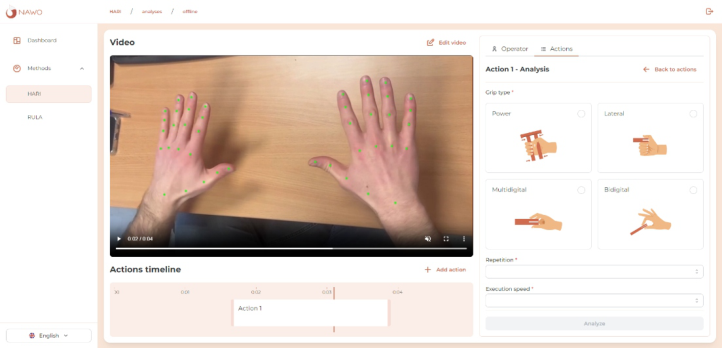
Software Application Developed for the HARI Method The HARI method is developed in the form of software application enabling analysts and ergonomists to carry out a complete, automatic risk analysis of the hand and fingers. The process involves importing a video obtained from a camera into the software, and the algorithms developed as part of this project will enable automatic computation of joint angles and reconstruction of hand points. The first step in the analysis is to select the technical action to be analyzed from the video, then select the duration and the type of grip by the evaluator. The next step is to manually input subjectively-assessed variables such as execution speed, repetition, effort intensity and aggravating factors as shown in Figure 1.
Figure 1: Illustration of the software developed for the HARI method.
106 Haj Mahmoud and Ribot
Once all the variables have been determined, an algorithm is used to cal- culate the result representing the level of risk for the hand and fingers for the technical action studied. The scores level for each risk factor between 1 to 5 based on the HARI risk scoring system are plotted on a radar chart to determine the levels of the risk and their priority. Thanks to the radar sys- tem, it will be possible to better understand which risk factors to prioritize when elaborating the action plan. It is also possible to select several technical actions and calculate the overall risk level for all the actions analyzed.
DISCUSSION AND CONCLUSION This study proposes a new approach to analyzing finger and hand risk fac- tors, introducing a scoring system that considers several MSD risk factors. The HARI Method assessment methodology bases itself on multiplicative interactions among seven risk factor variables. In this regard, it aligns with the concept of the recommended weight limit from the NIOSH guide for manual lifting and the Strain Index score. This method selects several risk factors reported as potential or generic risk factors for hands and fingers. Several studies have demonstrated that the intensity of effort and repetition are considered as the most significant risk factors for hands and fingers. Biomechanical and physiological considerations strongly suggest that pos- ture is a relevant risk variable due to its effect when combined with efforts. This project proposes an automatic movement detection approach, enabling the assessment of MSD risk factors in the hands and fingers over time. Con- sequently, a software program is developed, integrating automatic analysis of the video stream and automatic computation of the HARI score based on the provided data. The intensity of effort and speed of exertion rely on the analyst’s subjective evaluation, which could be enhanced by proposing an approach for the objective quantification of these parameters. Further- more, the HARI score is categorized into three levels: green, orange, and red. The proposed scoring system simplifies the process for decision-makers to determine and identify the level of criticality for fingers and hands. In the future, we recommend conducting experimental studies to further refine the criterion, proposing automatic gesture recognition functions using arti- ficial intelligence, and developing inverse dynamics algorithms to predict hand effort. This data computation will be automatically integrated into the software.
REFERENCES
Ameli. (2020, 12 29). Les TMS : définition et impact. Retrieved 12 15, 2023, from https://www.ameli.fr/entreprise/sante-travail/risques/troubles-musculosque lettiques-tms/tms-definition-impact. Andersson G. (1999). Epidemiological features of chronic low-back pain. Lancet,
9178. Armstrong Thomas J, J. A. (1982). Investigation of cumulative trauma disorders in a poultry processing plant. American Industrial Hygiene Association Journal, 103–116.
HARI: A New Approach to Quantifying MSD Risk Factors for Hands and Fingers 107
Barr AE, B. M. (2004). Work-related musculoskeletal disorders of the hand and wrist: epidemiology, pathophysiology, and sensorimotor changes. J Orthop Sports Phys Ther, 34(10). Borg G. (1998). Borg’s Perceived Exertion And Pain Scales. Human Kinetics. Bruno R. da Costa, E. R. (2010). Risk Factors for Work-Related Musculoskeletal
Disorders: A systematic Review of Recent Longitudinal Studies. American Journal of Industrial Medicine, 285–323. Guélaud F, M.-N. B. (1975). Pour une analyse des conditions du travail ouvrier dans l’entreprise. Haj Mahmoud O, C. P. (2020). Posture Assessment and Subjective Scale Agreement
in Picking Tasks with Low Masses. Advances in Physical, Social & Occupational Ergonomics. AHFE 2020. Hignett S, M. L. (2000). Rapid entire body assessment (REBA). Applied Ergonomics,
31. INRS. (2011). Réglementation des nuisances physiques. INRS. (2022, 12 05). Éclairage : Concilier sobriété énergétique et santé et sécurité au travail. Kroemer, K. (1989). Cumulative trauma disorders: Their recognition and ergonomics
measures to avoid them. Applied Ergonomics, 274–280. Kyung-Sun Lee, M.-C. J. (2015). Ergonomic Evaluation of Biomechanical Hand Function. Safety and Health at Work, 9–17. Li G. (1998). A Practical Method for the Assessment of Work-Related Musculoskele-
tal Risks - Quick Exposure Check (QEC). Proceedings of the Human Factors and Ergonomics Society Annual Meeting, 1351–1355. Lo Victor Ei-Wen, Y.-C. C.-H. (2021). Can We Use Grip Strength to Predict Other Types of Hand Exertions? An Example of Manufacturing Industry Workers. International J Environ Res Public Health. Moore JS, G. A. (1995). The Strain Index: A Proposed Method to Analyze Jobs
For Risk of Distal Upper Extremity Disorders. American Industrial Hygiene Association Journal, 56(5), 443–458. Occhipini, E. (1998). OCRA: A concise index for the assessment of exposure to repetitive movements of the upper limbs. Ergonomics, 1290–1311. Pitarch, E., Yang, J., Abdel-Malek, K., 2005. Santos hand: a 25 degree-of-freedom
model. Proceedings of the Digital Human Modelling for Design and Engineering Symposium. SAE International, Iowa City, IA, USA. Pozzo, T., Papaxanthis, C., Petit, J. L., Schweighofer, N., Stucchi, N., 2006. Shamsan A, A. G. (2020). Development of a Scoring Methodology for Ergonomic Risk Assessment in the Workplace. Conference: International Conference on Industrial Engineering and Operations Management. Waters Thomas R, V. P.–A.(1994). Applications manual for the revised NIOSH lifting
Read this individual research paper free through the original publisher, or explore the full digital proceedings book.
ISBN 978-1-964867-23-6
Explore this ISBN in the AHFE Bookstore ↗Listed in the July 2026 bookstore catalogue; search by ISBN to confirm current availability · Digital book purchase optional