As artificial intelligence becomes integrated into an increasing number of everyday objects, our relationships with these objects will inevitably evolve. The built environment—including architecture, furniture, and even the lighting that shapes much of our lived experience—offers new opportunities to reconsider how we interact with everyday objects. As with other emerging AI-enabled technologies, these objects may shape our attention in fundamental ways. This design research project asks: How might objects that hide in plain sight initiate meaningful interactions with users and appropriately calibrate users’ attention while still fulfilling their conventional role as furniture? To explore this question, we developed a series of lamp prototypes that use light and movement to initiate attention within a given space. We speculate about the development and proliferation of “Attention Fields,” in which objects situate themselves as constellations of AI-embodied artifacts that respond to the presence of users within a space.
As AI-powered interactive technologies continue to proliferate from screens and devices into environments and architecture, designers are offered a ripe opportunity to rethink how architecture can be designed to sense, respond to, and interact with humans. Previous work in Human–Computer Interaction (HCI) and ambient computing has explored systems that respond to users through light, motion, or changes in the environment. Much of this research has focused on efficiency, feedback mechanisms, and how information is displayed to users (Ishii et al., 1998; Haque, 2006; Fox and Kemp, 2009).
However, many HCI and ambient computing design strategies frame the relationship between users and their environments as an instrumental exchange. Within this framing, environments are often understood as reactive systems rather than socially expressive ones. As a result, user interfaces are frequently treated as tools to get the job done, rather than as interpersonal experiences.
Presence and attention are often communicated through subtle cues and gestures. In face-to-face interaction and in many cultural contexts, gestures such as bowing, leaning forward, or softening one’s posture can function as acknowledgments of another person (Hall, 1966; Goffman, 1967; Lakoff and Received May 19, 2026; Revised June 25, 2026; Accepted July 16, 2026; Available online August 25, 2026
Lamp Designs and Attention Fields: Ambient Computing for Agentic AI 171 Johnson, 1980). These gestures convey attentiveness, respect, and openness. Importantly, such movements are not symbolic representations; they are understood through embodied experience rather than explicit interpretation.
Attention Fields draw on these embodied and cultural practices as part of the design language for interactive environments. Instead of merely treating attention as a triggering condition, this investigation considers attention as an expressive trait for both humans and machines. Everyday objects and the built environment can acknowledge human presence in subtle or dramatic ways. In doing so, we might ask how interactive environments can better support socially legible and quietly alive forms of behavior.
Attention Fields When entering a space, human attention is shaped not only by objects and architecture, but also by the presence—or absence—of others. The awareness of being alone in a room, or of sharing it with others, subtly alters how we orient ourselves, where we look, and how we prepare to act. Attention Fields asks a related question: What if objects within a space, and the architectural environment itself, could acknowledge the presence of users in ways similar to how other people do? How might interfaces within the built environment signal readiness, receptivity, or awareness without demanding attention or explicit interaction?
Attention Fields can be characterized by their affordances for attention. Within the field, there is readiness and receptivity to the presence of the user. Within the Attention Field objects offer feedback to the user, establishing and initiating a relationship between the human and the machine.
Attention these days is often measured in likes and clicks. But it can be measured in other ways as well. A wink, a wave, a glance, or a bow all signal presence in interpersonal interactions. These are cultural cues that acknowledge the presence of a person. So we might ask, why can’t objects acknowledge presence in the same way? A simple gesture by an object might acknowledge one’s presence, as if the object was saying to the user, “I am here!” “I am an interface and I am ready to interact with you.” These kinds of ceremonial interfaces act as thresholds into the liminal spaces where the experience is initiated by the users’ presence.
Consider common examples such as the liminal interface of the boot screen on a Mac or the dramatic revelation of the Spirit of Ecstasy, which automatically rises from the hood of a Rolls-Royce when the car is unlocked or started. Even motion-activated cameras embody this principle. We can also imagine more complex systems of interaction: recent advances in voice user interfaces integrated into smart furniture remain inconspicuous in the environment until called upon to perform a task (Gonsher et al., 2026). Work on smart furniture and embodied agentic interfaces likewise suggests that environments can create distributed points of contact for interaction (Gonsher and Kim, 2020; Gonsher et al., 2018; Gonsher et al., 2022; Gonsher et al., 2023; Sirkin et al., 2015; Intuition Robotics, 2025).
The prototypes presented in this paper were developed in order to explore and test the character of that attention and the degree of awareness that objects enhanced with agentic AI might elicit. Early prototypes explored
spectacle, and a more sculptural approach. Later prototypes explored quieter cues for these liminal interfaces; less of a dramatic gesture and more of a gentle greeting (more like a bow). All of these initial prototypes—which were designed into lamps—established Attention Fields through the use of light and movement to lend a conventionally lifeless object a sense of vitality. Attention Fields, in all their potential variety, provide affordances for responsive feedback that acknowledges the user presence, and sets the stage for interactions with agentic AI that is integrated into the built environment.
Recent work in HCI and human–AI interaction has increasingly questioned attention-demanding interfaces that rely on constant notifications, alerts, or commands. Instead, attention is understood as something that can be shaped through timing, context, and perceptual availability. Interfaces are not always “on,” but remain quietly present, becoming noticeable only when conditions are appropriate (Weiser and Brown, 1996; Bakker and Niemantsverdriet, 2016; Heiner et al., 1999). From this perspective, interaction is less about capturing attention and more about aligning with it—meeting the user at the edge of awareness rather than pulling them away from it.
Rather than strictly treating attention as a measurable resource defined by clicks, dwell time, or engagement metrics, Attention Fields treat attention as a relational and embodied condition of awareness. Within an Attention Field, objects do not merely announce themselves as explicit signals. They express a state of readiness through subtle engagements, encounters, and other tacit and implicit behavioral cues. These cues are designed to be easily discoverable and open-ended, allowing users to notice them gradually on the periphery of their perception. The careful calibration of users’ attention within Attention Fields requires that the signal exceed the threshold of awareness within the given setting. This can be calibrated on a case by case basis, based on the requirements and constraints of a given application.
We have designated these discoverable and open-ended design cues within Attention Fields as Smurf features. As one might recall, in the world of the Smurfs - those tiny blue human-like creatures with distinctive Phrygian caps - the word “Smurf” can mean almost anything, depending on ostension and context to derive meaning. A Smurf may use a the word “Smurf “ to communicate in any way that is appropriate within the given context. In linguistics, these kinds of expressions are called placeholder words, whose meaning is recoverable from context (Sailer and Dörner, 2020). The same concept applies to the way light and motion are used to frame attention within the Attention Fields. A Smurf feature is any design feature that signifies a discoverable behavior through an open-ended cue that is neither closed off nor limited to a single semiotic term. A car horn is a common example of a Smurf feature, in so far as a car horn can signify a range of meanings and behaviors with a simple signifier; anything from an angry retort to a friendly greeting, depending on how it is used.
In the final lamp prototype, light and motion were employed as Smurf features within the Attention Field. Brightening lights signify a positive valence, whereas dimming lights signify a negative valence. With regard to motion, these objects perform three primary gestures. The lamp turns from right to left to signal “no.” It gestures up and down to signal “yes.” And it can bow. These simple cues reduce extraneous noise and call the user’s attention to the object within an otherwise quiet environment.
Lamp Designs and Attention Fields: Ambient Computing for Agentic AI 173 Across cultures, attention and acknowledgment are often communicated through small physical gestures rather than verbal statements. A glance, a nod, a bow, or a slight change in posture can signal awareness, openness, or willingness to engage. Such gestures do not function as symbols in the conventional sense; they are understood tacitly through shared embodied experiences and cultural familiarity. Attention Fields draw on this gestural logic and apply it to interactive objects and environments. Through gentle movement, orientation, and light, objects signal that they are “present” and responsive, without asserting dominance over the user’s attention. These gestures function as liminal interfaces—threshold moments that prepare both human and machine for potential interaction. Much like a boot screen that signals readiness without yet performing a task, or a familiar physical gesture like a wave that acknowledges another person before conversation begins, Attention Fields create conditions for interaction rather than forcing it. Objects within the Attention Field quietly indicate their availability, allowing interaction to unfold at the user’s pace.
PRECEDENT WORK The development of Attention Fields in general, and of the lamp prototypes presented in this paper in particular, draw on several important precedents. This prior work explores the use of light and motion to shape attention within a space.
Ambient Computing and Peripheral Interaction HCI research has long explored how interaction can be mediated through subtle, peripheral cues rather than explicit interface elements. Early work on ambient displays, introduced by Ishii and colleagues, proposed that system state or information could be communicated through changes in light, sound, or motion that reside in the periphery of a user’s attention, allowing awareness without disrupting ongoing activity (Ishii et al., 1998). Similarly, Weiser and Brown’s notion of calm technology articulated a vision in which computation recedes into the background of everyday life, supporting human activity without continuously demanding focused attention (Weiser and Brown, 1996).
Building on these ideas, research on ambient intelligence has expanded the scope of interaction beyond individual devices toward environments that sense, interpret, and respond to human presence over time (Aarts and de Ruyter, 2009). Rather than framing interaction as a sequence of explicit inputs and outputs, ambient intelligence emphasizes distributed sensing, context awareness, and adaptive behavior embedded within the built environment itself. Within this paradigm, interaction is often experienced as a quality of space—emerging through proximity, movement, and occupancy—rather than as a discrete action performed on an interface.
Recent work on smart furniture and embedded interactive artifacts exemplifies this shift. These systems integrate computation into everyday objects such as tables, lamps, and seating, allowing them to respond to human presence and activity while remaining visually and functionally unobtrusive (Gonsher and Kim, 2020; Aarts and de Ruyter, 2009; Intuition Robotics, 2025). Rather than force interaction through screens or conventional controls,
such objects often signal readiness or availability through subtle changes in orientation, light, or behavior. Research on conversational and agentic interfaces embedded in furniture further suggests that interaction can remain latent, becoming perceptible only when social or situational conditions invite engagement (Gonsher et al., 2023).
At the same time, research has begun to reframe interaction around attention rather than task execution. Instead of treating attention as a resource to be captured through notifications or alerts, these systems operate just below the threshold of focused awareness, shaping experience through peripheral and ambient cues (Gonsher et al., 2025). Work on implicit and attention-aware interfaces demonstrates how environments can register human presence and orientation without foregrounding interaction, allowing responsiveness to be perceived as part of the space itself rather than as an explicit system response (Gonsher, 2024).
In many ways, Attention Fields already exist. A system of CCTVs that monitor a space for surveillance is an example that may immediately come to mind. The built environment is packed with sensors that collect data on an environment. But what makes Attention Fields different from unilateral surveillance is that the acknowledgment of presence is bilateral in its design, where the attention of the human user and the attention of agentic AI are in conversation with each other. Both the machine and the human see, hear, and even feel, the presence of the other, much like two humans in the same space. This conceptual shift is an important one to consider as intelligent objects increasingly permeate the built environment, and our relationships with these machines shift from instruments to collaborators.
Attention Fields build on this lineage of ambient computing and peripheral interaction, but shifts the focus from information awareness to relational presence. Rather than applying ambient cues to merely communicate system status or support task-based interaction, this project explores how light and motion can establish attentional readiness within a space for both humans and machines. Through subtle, continuous responses to proximity and occupancy, the environment acknowledges human presence in a way that is ambient, embodied, and socially legible—positioning attention not as something to be captured, but as something to be quietly supported by the space itself.
Embodied Attention and Space The design process that produced the prototypes presented here was characterized by extensive empirical research and critical discussions about the social meaning of distance. Some of the most detailed accounts of interpersonal distance and its social significance can be found in Hall’s theory of proxemics (Hall, 1966). Hall argued that interpersonal distance contains emotional, cultural, and relational components that extend beyond physical distance alone.
Another line of inquiry focused on embodied interaction, examining how people perceive and engage with interactive systems through their bodies (Dourish, 2001). As Gaver points out, the benefits of embodiment arise from the material and perceptual qualities of interaction, allowing interaction to be understood through form and behavior rather than symbolic representation (Gaver, 1996).
Lamp Designs and Attention Fields: Ambient Computing for Agentic AI 175 Together, these lines of research suggest that attention can serve as a medium of interaction that does not rely on explicit communication methods such as gestures or commands. Attention Fields build on this understanding by treating attention as a continuous relational context that modulates the actions of objects and environments in relation to one another, rather than as a singular trigger or threshold for interaction.
Responsive and Kinetic Environments Research into spaces that can perceive and react to the activity of individuals has been based on the ways the position of bodies changes in space over time. Haque promotes architecture as a participatory process and emphasizes the importance of motion and light as forms of communication rather than merely decorative elements (Haque, 2006). Fox and Kemp analyze a variety of kinetic and responsive architectural systems, noting how motion contributes to the perception and emotional experience of space (Fox and Kemp, 2009).
Beyond functional responsiveness, movement in space is understood through embodied cognitive processes such as proprioception and kinesthesia—our awareness of the body’s position, orientation, and movement through space. Research in embodied interaction suggests that people interpret spatial change not only through visual perception and symbolic cues, but also through bodily awareness and sensation (Dourish, 2001). Subtle environmental motion can therefore contribute to how people experience space, rather than simply signaling that a system has reacted.
Light and Atmosphere Research has also shown how lighting can significantly influence an individual’s emotional state. McCarthy and Wright suggest that experiences that are explicitly enhanced by technology, such as lighting, are perceived holistically rather than purely cognitively, suggesting that environments are an embodied experience, and not merely understood through conscious thought or symbolic representation (McCarthy and Wright, 2004). Similarly, Ingold argues that environmental dynamics and a sense of “aliveness” emerge through experiences of light and motion, shaping how people feel about and inhabit the spaces around them (Ingold, 2011).
The use of specific lighting qualities, such as warm tones, gradual brightness changes, and periodic temporal rhythms, can create an overall atmosphere that communicates the density and attention of people within a space. This allows for a more experiential, rather than informational, mode of interaction in environments such as Attention Fields.
Within this framing, light does not function as a one-way channel that communicates information from a system to a human observer. Instead, atmospheric lighting sets conditions for participation in a reciprocal process: human presence influences the environment, and the resulting changes in light, in turn, shape how people perceive and behave within the space. In this sense, communication occurs as a continuous coupling between bodily presence and environmental response.
PROTOTYPES AND USER SCENARIOS Attention Fields were developed through a process of iterative prototyping, exploring different strategies for using light and motion to frame attention. Early prototypes expressed a “sculptural” form language in order to dramatically announce its presence to users. Later iterations took a quieter approach, attempting to blend into the environment by drawing on the design language of conventional lighting design.
Prototype: Final Form Language Later prototypes adopted a more conventional form language for the lamp. This allows these interfaces to hide in plain sight, as everyday objects. This prototype not only captures users’ attention through variations in the intensity of light, but also through subtle gestures. Building upon earlier iterations, light and motion became primary design elements in order to achieve these effects.
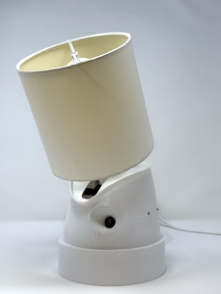
By using computer vision, empowered with OpenCV installed on a Raspberry Pi with an enabled camera, servo motors rotate in both the x and y axes (Figure 1). This allows the lamp to bow to the user, and adjust light levels, which act as a Smurf feature when the user enters the Attention Field. A simple, subtle bow creates a quiet yet effective interaction that carefully calibrates the users’ attention, but does not overstate its importance in the broader constellation of objects and people that may be inhabiting the space as well. The lamp uses motion and light to perform a quiet bow, that is as much a greeting as it is an invitation for further interaction.
Figure 1: Lamp in receptive mode, lamp in attention mode, and a labelled image of the components.
This simple language of form and gesture can be further expanded in future iterations in order to create objects that have real character and personality. These features form a foundation upon which other features of an embodied AI agent can be built. For example, the integration of voice user interfaces, such as those developed in the Tablebot project, can be integrated into lamps as well, thus expanding the Attention Field and creating different points of contact for embodied agentic AI throughout a given space (Gonsher et al., 2026). A quotidian lamp turns out to be the ideal site for AI interfaces that
Lamp Designs and Attention Fields: Ambient Computing for Agentic AI 177 offer a more dynamic user experience beyond what an Alexa, Echo, or other home assistants might offer.
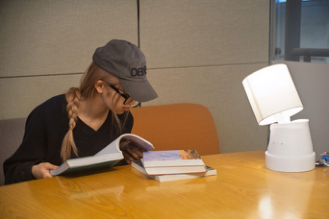
User Scenario Imagine entering a conventional domestic space. Your presence is detected by the lamp sitting on a nearby table or shelf, and the light turns on and gradually becomes brighter as you move towards it. As you get closer, the little object presents itself with a courtesy bow. This simple ritual initiates the user and readies them for further interactions with the object and the space. In future iterations, the lamp will become a voice user interface—it will talk to you and you will talk to it—as you develop a relationship with the object, and it calibrates your attention to that interaction as appropriate. Beyond the bow, the lamp can also signal affirmation through an upward and downward motion, or negation through a side-to-side rotation, reinforcing these gestures with brightening or dimming light to convey positive or negative valence (Figure 2).
Figure 2: The user and the lamp are in the same reading environment. The lamp is tracking the user’s behavior and providing physical feedback.
CONCLUSION
Attention Fields offer the possibility of creating interactions between smart AI-enabled objects and human users in subtle and inconspicuous ways. Light and movement, although a relatively simple lexicon of elements, provides affordances for interactions with users that gives these objects a sense of presence and cues their readiness for interaction.
Variations in light levels can communicate a range of affective responses. Simple movements can communicate an elan vital in these kinds of objects that changes our relationship to them, enhancing the effects they produce, somewhere between a thing and a consciousness.
In future iterations of the project, we intend to expand upon these initial pilot prototypes. We hope to imbue these objects with a sense of life, and in doing so, challenge users to rethink how they relate to the everyday objects around them. This will require further user testing in order to further validate the usefulness of Attention Fields, and provide a greater foundation for the development of AI-enabled objects that hide in plain sight.
REFERENCES
Aarts, E.H.L. and de Ruyter, B.E.R. (2009). New research perspectives on ambient intelligence. Journal of Ambient Intelligence and Smart Environments, 1(1), pp. 5–14. Bakker, S. and Niemantsverdriet, K. (2016). The interaction-attention continuum:
Considering various levels of human attention in interaction design. International Journal of Design, 10(2), pp. 1–14. Dourish, P. (2001). Where the Action Is: The Foundations of Embodied Interaction.
Cambridge, MA: MIT Press. Fox, M. and Kemp, M. (2009). Interactive Architecture. New York: Princeton Architectural Press. Gaver, W.W. (1996). Situating action II: Affordances for interaction. Ecological
Psychology, 8(2), pp. 111–129. Goffman, E. (1967). Interaction Ritual: Essays on Face-to-Face Behavior. New York: Anchor Books. Gonsher, I. (2024). The telepresence of furniture in extended reality. Interactions,
31(2), pp. 44–48. Gonsher, I., Finberg, J., Perez, N., Phelps, J. and Diwan, S. (2026). Acoustic localization and voice user interfaces for robotic furniture. In: K. Arai, ed., Proceedings of the Future Technologies Conference (FTC) 2025, Volume 4, Lecture Notes in Networks and Systems, Vol. 1678. Cham: Springer, pp. 149–164. Gonsher, I., Han, Y., Desingh, K. and Gokaslan, A. (2022). Prototyping mixed
reality large screen mobile telepresence robots. In: 5th International Workshop on Virtual, Augmented, and Mixed Reality for HRI. Gonsher, I., He, M. and others. (2023). Integrating interfaces into furniture: New paradigms for ubiquitous computing, mixed reality, and telepresence within the built environment. In: Proceedings of the Media Architecture Biennale Conference (MAB ’23). New York: ACM, pp. 167–172. Gonsher, I. and Kim, J.Y. (2020). Robots as furniture, integrating human-computer
interfaces into the built environment. In: Companion of the 2020 ACM/IEEE International Conference on Human-Robot Interaction (HRI ’20 Companion). New York: ACM, pp. 215–217. Gonsher, I., Kim, S., Cisler, M., Lister, J., Navetta, B., Haas, P., Mok, E., Han, H., Phillips, B. and de Graaf, M. (2018). Demo hour. Interactions, 25(4), pp. 8–11. Gonsher, I., Phelps, J., Yan, S. and Yang, X. (2025). Bimodal affective computing
interfaces for emerging artificial intelligence paradigms. In: Human Factors and Systems Interaction. AHFE Open Access. Hall, E.T. (1966). The Hidden Dimension. New York: Doubleday. Haque, U. (2006). Architecture, interaction, systems. In: ACM SIGGRAPH 2006 Art Gallery. New York: ACM, pp. 1–5. Heiner, J.M., Hudson, S.E. and Tanaka, K. (1999). The information percolator:
Ambient information display in a decorative object. In: Proceedings of the 12th Annual ACM Symposium on User Interface Software and Technology (UIST ’99). New York: ACM, pp. 141–148. Ingold, T. (2011). Being Alive: Essays on Movement, Knowledge and Description.
London: Routledge. Intuition Robotics. (2025). ElliQ: Companion robot for seniors, older adults, and aging loved ones. Available at: https://elliq.com/ [Accessed 8 May 2026]. Ishii, H., Wisneski, C., Brave, S., Dahley, A., Gorbet, M., Ullmer, B. and Yarin, P.
(1998). Ambient displays. In: CHI ’98 Extended Abstracts on Human Factors in Computing Systems. New York: ACM, pp. 173–174.
Lamp Designs and Attention Fields: Ambient Computing for Agentic AI 179 Lakoff, G. and Johnson, M. (1980). Metaphors We Live By. Chicago: University of
Chicago Press. Lozano-Hemmer, R. (n.d.). Pulse Room; Voice Tunnel; Airborne Series. Available at: https://www.lozano-hemmer.com [Accessed 8 May 2026]. McCarthy, J. and Wright, P. (2004). Technology as Experience. Cambridge, MA:
MIT Press. Norman, D. (2013). The Design of Everyday Things: Revised and Expanded Edition.
New York: Basic Books. Sailer, M. and Dörner, A. (2020). A Smurf-based approach to placeholder expressions.
In: S. Müller and A. Holler, eds., Proceedings of the 27th International Conference on Head-Driven Phrase Structure Grammar. Stanford, CA: CSLI Publications, pp. 136–156. Sirkin, D., Mok, B., Yang, S. and Ju, W. (2015). Mechanical Ottoman: How robotic furniture offers and withdraws support. In: Proceedings of the Tenth Annual ACM/IEEE International Conference on Human-Robot Interaction (HRI ’15). New York: ACM, pp. 11–18. Studio Roosegaarde. (n.d.). Dune. Available at: https://www.studioroosegaarde.net/
project/dune [Accessed 8 May 2026]. Weiser, M. and Brown, J.S. (1996). The coming age of calm technology. Xerox PARC
SEARCH THE AHFE DIGITAL BOOKSTORE BY ISBN
Explore the complete digital volume
Human Interaction and Emerging Technologies (IHIET 2026)
Read this individual research paper free through the original publisher, or explore the full digital proceedings book.