Evani Dalal, Mingyuan Dong, Sofia Vaca Narvaja Cordoba, Yuxin Ni, Ian Gonsher (2025). A Biofeedback-Driven Interaction System for Real-Time Stress Detection and Intervention. In: Human Interaction and Emerging Technologies (IHIET 2025). AHFE Open Access, vol. 197, pp. 326–338. https://doi.org/10.54941/ahfe1006725
This paper presents a novel prototype for a biofeedback system that uses real-time physiological data to detect task-related stress during everyday computer use, with electrodermal activity (EDA) and photoplethysmography (PPG) sensors directly integrated into a computer mouse. By continuously monitoring stress levels with this data, the system enables immediate, adaptive responses to elevated stress levels, aimed at reducing cognitive load. These responses take the form of on-screen, evidence-based mental health exercises designed to enhance user well-being. The interventions, drawn from Cognitive Behavioral Therapy (CBT) and Dialectical Behavioral Therapy (DBT), are delivered through context-aware, discreet pop-up windows that gently prompt users toward stress-reduction behaviors. An exploratory user study found that participants responded positively to the system’s ease of use, its ability to deliver timely support, and its potential to simplify self-directed mental health care through non-intrusive measures. Early findings point to strong user receptivity and validate the concept of embedding stress-responsive interventions into routine computing workflows. While further development is needed to improve personalization, comfort, and model accuracy, this work offers a compelling foundation for future systems that aim to deliver accessible, low-effort mental health support in real time.
Digital devices are central to work and learning environments, and the relationship between users and technology is marked by convenience and efficiency but also growing cognitive and emotional strain. In both professional and academic contexts, stress has emerged as a critical side effect of prolonged computer use. Recent studies suggest that up to 80% of employees experience stress related to digital tasks, negatively affecting focus, productivity, and decision-making capacity (Robinson, 2024).
Stress, particularly in short bursts, also known as acute stress, can arise during challenging digital tasks such as meeting deadlines, handling system
A Biofeedback-Driven Interaction System for Real-Time Stress Detection and Intervention 327
errors, or processing large volumes of information. Physiologically, this form of stress produces measurable changes in heart rate variability (HRV) and skin conductance (Huang et al., 2022). Over time, acute stressors that consistently occur without recovery can lead to chronic stress, with consequences ranging from cognitive fatigue to long-term health risks like cardiovascular strain and cognitive impairment (Chu et al., 2024).
Many existing physiological monitoring systems are reliant on external wearables that users must consciously adopt and maintain. Although these devices can be effective, they introduce friction into daily workflows and limit scalability for continuous stress tracking. This project aims to explore the introduction and effectiveness of The Biomouse System: a biofeedback-driven system that integrates PPG and EDA sensors into an ergonomic computer mouse to detect stress. During natural computer mouse use, physiological data is collected from the embedded sensors to pass into a machine learning (ML) classification model to recognize elevated stress levels. If stress is detected, an on-screen intervention is pushed towards users to reduce stress.
The Biomouse System is an exploratory design research study that aims to mitigate short-term stress through timely interventions to prevent the accumulation of long-term stress over prolonged use. By embedding stress detection and responses into a familiar interface, the system offers a seamless experience that requires no additional effort from users and adapts digital environments to support user well-being.
PRECEDENT WORK Physiological Sensing for Stress Detection
Physiological signals such as EDA, also known as galvanic skin response (GSR), and PPG have become widely used in affective computing to infer multiple emotional states, including stress. These signals offer continuous, passive, and non-invasive insight into users’ internal experiences. Researchers have validated EDA as a proxy for sympathetic nervous system activity, particularly emotional arousal (Picard et al., 2001), while PPG is commonly used to derive HRV, a well-established indicator of stress-related autonomic change (Namvari et al., 2022).
Affective computing studies have demonstrated that machine learning models trained on features derived from EDA and PPG can classify stress in both controlled and real-world settings (Picard et al., 2001; Rahma et al., 2022; Lazarou & Exarchos, 2024). Studies have also explored combining GSR and PPG to build accurate stress classifiers using machine learning frameworks, achieving high precision and recall in dynamic environments (Namvari et al., 2022; Nechyporenko et al., 2024; Nath et al., 2022).
Efforts to embed such sensing into everyday hardware have appeared in a variety of instances. For example, CogniMouse integrates PPG, GSR, and other sensors (e.g. grip force, temperature) into a standard computer mouse to passively monitor users’ stress. The data is processed through probabilistic models to detect cognitive strain in real time (Belk et al., 2016). This device demonstrates the feasibility of integrating biosensors into familiar form factors like the mouse, offering a low-friction pathway for everyday stress
monitoring. However, this system stops at sensing. Even when emotional states are inferred, intervention delivery is treated as future work. This points to a critical gap: real-time sensing has not yet been systematically linked with real-time stress interventions.
Digital Interventions for Stress In parallel, a growing body of clinical and human-computer interaction (HCI) research supports the effectiveness of digital stress interventions grounded in cognitive-behavioral therapy (CBT) principles. Techniques such as cognitive reframing, deep breathing, and grounding exercises have been shown to reduce self-reported stress, especially when delivered in structured, guided formats. Meta-analyses have confirmed that web-based interventions incorporating these techniques are more effective when they include system guidance or therapist support (Heber et al., 2017).
In applied HCI research, CBT-based micro-interventions delivered via a browser plugin during natural breakpoints (such as mouse inactivity) reduced stress by 23% among remote workers (Tong et al., 2023). This highlights the importance not only of content but also of timing in maximizing intervention effectiveness.
Timing, Autonomy, and Calm Interactions Recent research has emphasized that for digital stress interventions to be accepted and effective, they must be delivered at the right time and respect user autonomy as they prefer interventions that give them the choice to engage or defer them (Howe et al., 2022). Stress management mechanism is more effective when paired with user-centered delivery mechanisms. The field of calming technology also informs this space, advocating for systems that support users without disrupting their primary activities. Interventions like the 54321 grounding exercise, commonly used in CBT and DBT, are simple, quick, and engaging as activity choices. These exercises require moderate effort, are empirically supported, and can be delivered unobtrusively through text or visual guidance, making them ideal for contexts of acute stress or anxiety (Howe et al., 2022).
Gaps Despite advances in both physiological sensing and digital intervention design, few systems have meaningfully combined these capabilities. Existing work tends to focus either on passive stress detection without a corresponding action loop, or on self-guided interventions that do not adapt based on individual users’ physiological states. Even previously mentioned sensor- augmented mice have not been deployed in systems that deliver real-time, personalized interventions. Conversely, studies like Home Sweet Office demonstrate that micro-interventions can be both timely and effective, but rely on behavioral context (e.g., mouse inactivity) rather than physiological input (Howe et al., 2022).
Thus, there is a clear opportunity for systems that unify validated stress detection techniques (e.g., EDA and PPG), ML-driven stress inference, and
A Biofeedback-Driven Interaction System for Real-Time Stress Detection and Intervention 329
CBT- and DBT-informed on-screen interventions into a cohesive, feedback loop. Such systems should not only detect when users are stressed but respond adaptively, supporting well-being through evidence-based, user-centered interventions.
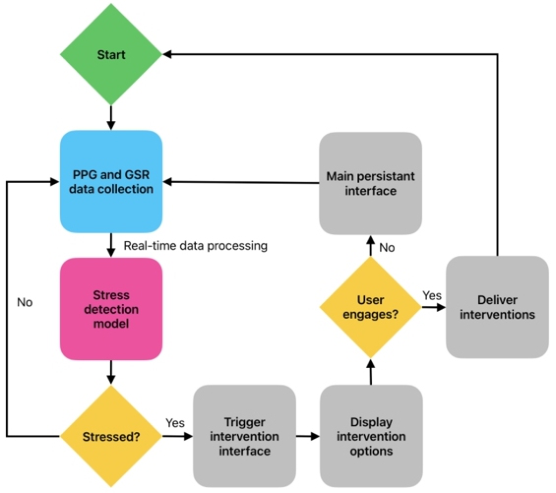
SYSTEM We present an integrated system for real-time stress detection and intervention delivery, as presented in Figure 1. The system includes a biosensing computer mouse embedded with PPG and EDA sensors, which continuously collect physiological data. This data is processed locally by an ML model trained to detect stress states. When elevated stress is identified, the system offers evidence-based digital interventions through a persistent on- screen interface. Users can engage with these interventions at their discretion, supporting timely but non-intrusive stress management.
Figure 1: An overview of the biomouse system.
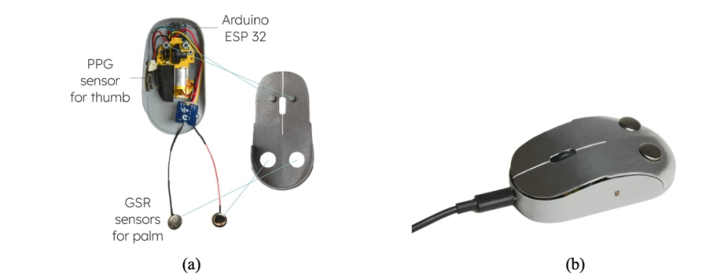
Prototype Description Mouse Design Figure 2 shows the construction of the Biomouse Prototype with a Gravity PPG Heart Rate Monitor Sensor for Arduino and a Fermion MAX30102 PPG and Oximeter Sensor, both connected to an Arduino Nano ESP32. The mouse is ergonomically shaped with a smooth, ridge-free surface: the thumb naturally engages the PPG sensor through grip pressure, and the palm contacts the EDA sensors via resting weight. Its symmetrical form supports
both left- and right-handed users, ensuring inclusive and unobtrusive biofeedback collection. This ergonomic design supports accurate real-time data collection and delivery to the backend ML system for stress-level analysis.
Figure 2: (a) Internal PPG and EDA sensor placement. (b) External view of the biomouse prototype.
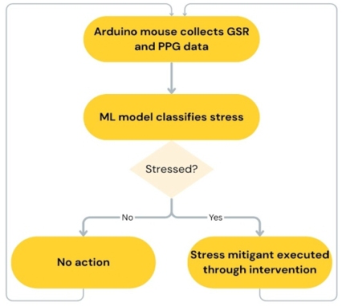
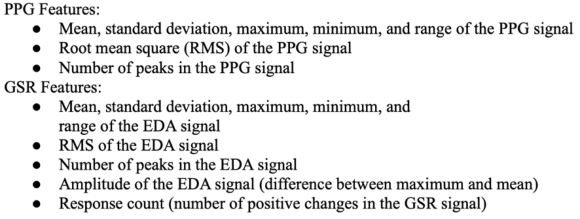
Machine Learning Model The computer mouse collects readings from the EDA and PPG sensors embedded in the computer mouse, with 50 raw values collected each second. To train and develop the ML model, tens of thousands of EDA and PPG measurements over time were collected and segmented into 10-second windows. Approximately 40 minutes worth of self-labelled stress data and 40 minutes worth of self-labelled non-stress data were collected from one individual for training data. With this time series data, from each 10-second window, we extracted a diverse set of statistical and frequency-domain features, presented in Figure 4. These features were used to train a Random Forest classifier to distinguish between stressed and non-stressed states.
Figure 3: The architecture of the ML model.
A Biofeedback-Driven Interaction System for Real-Time Stress Detection and Intervention 331
A Random Forest classifier was selected due to its ability to model complex relationships between features and its robustness in handling imbalanced or noisy physiological data. This classifier requires less data compared to a neural network and captures patterns of data without a linear relationship in a more improved manner, as is the case with EDA and PPG data. Our approach effectively reflects physiological patterns associated with stress, demonstrating the potential of ML for real-time stress classification.
Feature Extraction The preprocessing and feature extraction pipeline transforms raw time-series data into statistical and domain-specific features. A sliding window approach is employed, where fixed length overlapping windows are used to segment the data. For each window, the features are computed to capture both time- domain statistical properties and physiological characteristics relevant to stress detection, as seen in Figure 4.
Figure 4: The listed features of the ML model.
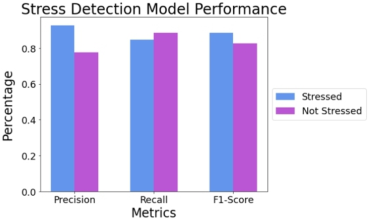
Model Training and Evaluation The dataset is split into training and testing sets using an 80–20 split. The training dataset consists of labeled measurements of these physiological signals collected during resting and stressed conditions. The performance of the classifier is evaluated using k-fold cross-validation where k = 5. Metrics such as accuracy, precision, recall, and F1-score are reported to assess the model’s effectiveness, presented in Figure 5.
Figure 5: The precision, recall, and F1-score of the model on a test dataset of one subject.
Intervention Interface Design The intervention interface was implemented as a persistent pop-up window that remains passively available during computer use and becomes active when the system detects elevated stress. Built using Python’s tkinter library, the window is designed to run continuously in the background without disrupting user workflow.
When triggered by the stress classification model, the interface prompts the user with a calming intervention sequence and presents the option to begin or defer, maintaining a core principle of user agency. This design choice aligns with recent findings in digital mental health tools that emphasize the importance of just-in-time interventions combined with user control (Howe et al., 2022).
The user interface was designed to support relaxation, focus, and sustained engagement during interventions. Color plays a central role in emotional regulation, where soft gradients in cool tones, primarily greens and blue, are shown to reduce stress (Moeller, 2024), and were thus used to initiate the CBT and DBT interventions. As each exercise concludes from a total of 5 exercises, the palette transitions to warmer hues such as orange and yellow, which are associated with motivation and alertness, subtly guiding the user back to their working state (Moeller, 2024).
Layout and interaction design follow user interface (UI) design principles that reduce cognitive load through clear visual hierarchies, minimal text, large touch targets, and low-contrast, but legible typography (Khakal, 2023).
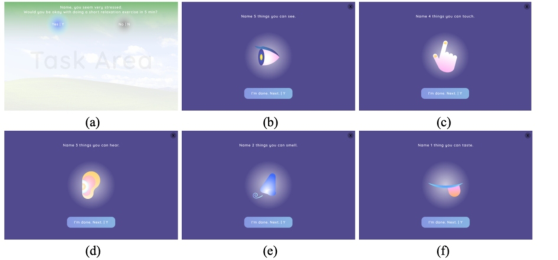
There are two sequences of interventions implemented in the system. Presented in Figure 6, the first intervention is a grounding exercise, introduced through a pop-up window that asks the user whether they would like to begin, giving them the agency to decide whether they want to manage their emotional state. If accepted, the user is guided through a slow, soothing animation with gentle lighting, prompting them to identify: five things they can see, four things they can touch, three things they can hear, two things they can smell, and one thing they can taste, presented in Figure 6. This sensory-based exercise aims to aid the user in reconnecting with physical surroundings, reducing dissociation, and gaining emotional awareness.
Figure 6: (a) Before the intervention, a prompt asks if the user wants to proceed, giving the user agency. (b-f) Grounding exercise guiding the user to reconnect with their physical surroundings, reduce dissociation, and increase emotional awareness.
A Biofeedback-Driven Interaction System for Real-Time Stress Detection and Intervention 333
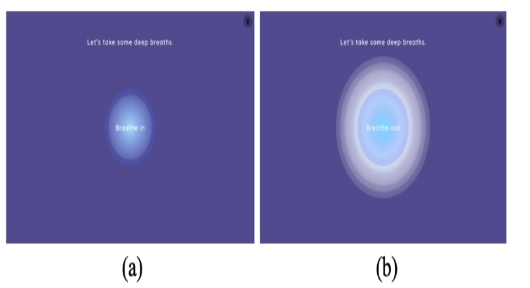
Presented in Figure 7, the second intervention is a breathing exercise with minimal, purposeful animation that can enhance focus and reduce cognitive burden (Johnson, 2024). The user follows a guided inhale-exhale rhythm synchronized with a slow, rippling animation, aiming to increase bodily awareness and reduce physiological and psychological tension. Collectively, these design strategies contribute to an emotionally intelligent, low-friction interface with the goal of encouraging consistent and meaningful engagement with well-being activities.
Figure 7: (a) “Breathe in” animation guiding the user to inhale slowly. (b) “Breathe out” animation with expanding ripple effect to support gradual exhalation. Together, these visuals guide a paced breathing exercise aimed at improving bodily awareness and reducing physiological tension.
EVALUATION OF PROTOTYPE
Methodology
The Biomouse System is designed for everyday computing contexts, including academic, personal, and professional environments where individuals regularly engage in digital tasks. To assess user perceptions and early usability of the system, we conducted an exploratory user study with 8 participants simulating typical computer-based activities.
Participants were recruited through university mailing lists and posters across campus common areas. Eligible participants were required to use computers for at least 3 hours daily. A total of 10 individuals (ages 19–34) participated voluntarily, with the first 2 participants as pilot testers not used for analysis purposes. All users provided informed consent in accordance with the university’s IRB-approved protocol.
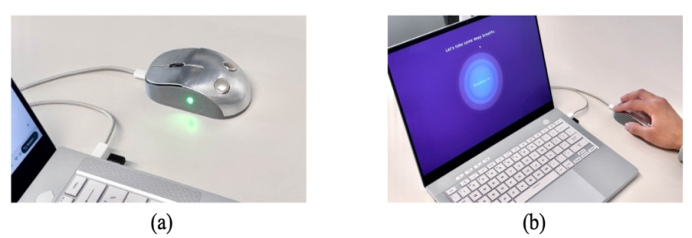
Figure 8 shows the experimental setup, with the Biomouse connected to a laptop. On the laptop, participants completed two tasks that mimic common digital activities: reading a news article on The New York Times for 10 minutes and playing a 10-minute interactive game of Simon Says (https://freesimon.org/). When a participant’s stress level was elevated during the task, the system prompted one of two interventions, which the participant could choose to accept or reject. If no intervention was triggered during
those 10 minutes, participants had the option to explore an intervention after completing the task. At the start of the session and after each intervention, participants were asked to self-report their stress levels in a series of questions in a survey, using the Depression, Anxiety, and Stress Scale – 21 Items (DASS-21), a validated instrument commonly used in psychological and HCI research to assess emotional states over short time periods (Lovibond, 1995). At the end, the last part of the survey evaluated the system on three dimensions: ease of use (1 = very difficult, 5 = very easy), comfort (1 = very uncomfortable, 5 = very comfortable), and improvement of mood (1 = no improvement, 5 = significant improvement). Participants also provided open-ended feedback on their overall experience with the system.
Figure 8: (a) Biomouse with sensors activated and connected to a laptop. (b) Study setup showing a participant interacting with the system during the breathing exercise.
Results
Participants rated the system an average of 3.43 out of 5 in ease of use and comfort, indicating moderate usability of the system. While these scores suggest opportunities for refinement, particularly in ergonomic design and system onboarding, they also indicate that the system is largely accessible and tolerable in its current form. Notably, the average rating for impact on mood was 3 out of 5, suggesting that users perceived a neutral to moderately positive effect on their emotional state after using the system.
Qualitative feedback further supports the promise of the system. Several participants responded positively to the integration of interventions, particularly during the Simon Says task, where real-time interventions were seen as both engaging and supportive. One user remarked, “It was nice to be guided through different mindfulness exercises that could calm you down without having to search these up.” This feedback highlights the potential of automatic, passive interventions, reinforcing the value of a system that is context-aware and requires minimal user effort.
Discussion
Although exploratory in nature and limited by a small sample size, this study offers promising insights into the feasibility of embedding real-time biofeedback and intervention into everyday computing workflows. The
A Biofeedback-Driven Interaction System for Real-Time Stress Detection and Intervention 335
neutral-to-positive mood impact rating and favorable qualitative responses suggest that users are receptive to systems that can detect stress and deliver helpful interventions requiring low effort.
The modest usability and comfort ratings indicate the need for improvements in the system’s physical and interactive design. Potential enhancements include more intuitive onboarding, more responsive feedback mechanisms, and more personalized interventions. However, the fact that participants found the system manageable even in its early prototype stage suggests a strong foundation for future iterations.
While broader testing is necessary to generalize findings, the current feedback validates the idea that low-effort, context-aware interventions can be meaningfully incorporated into digital experiences. As we continue to refine the system, aligning self-reported stress levels via DASS-21 with physiological data will be critical in strengthening the stress classification model and validating the effectiveness of interventions in real-world use.
While this evaluation does not aim to produce definitive claims, it contributes valuable formative insights that will guide future design improvements and expanded testing. These findings support the broader vision of The Biomouse System as a promising tool for real-time stress detection and intervention in everyday computing contexts.
DISCUSSION
Implications The findings reinforce prior research advocating for low-effort, just-in-time interventions delivered through ambient or passive systems (Belk et al., 2016). The ability to remind participants of their psychological needs without relying on self-awareness, and to engage them with mindfulness content without requiring them to search for tools or navigate complex interfaces, highlights a promising pathway for scaling emotional regulation tools in knowledge work settings. Moreover, the prototype’s use of a common interaction device, the mouse, lowers the barrier for deployment and avoids requiring users to adopt unfamiliar hardware.
The positive responses to the intervention sequences, particularly the grounding exercise, suggest that well-timed, sensory-focused content can foster meaningful moments of self-regulation during computer use. This aligns with growing interest in designing emotionally intelligent systems that respond to internal rather than purely behavioral triggers.
Limitations Several limitations shape the scope of our findings. First, the small sample size (n = 8), the limited demographic diversity of participants, primarily drawn from the Providence campus community, and the short study duration limit the generalizability and statistical power of our evaluation. Future work should expand to longitudinal studies with a more diverse population to assess the sustained impact of such systems and refine the adaptive mechanisms of the system over time.
Second, although the machine learning model for stress classification demonstrated relatively high accuracy on the available data, its generalizability is limited due to the small size and lack of diversity in the training dataset. The model was trained on a relatively small corpus of paired physiological and self-reported stress data, which constrained its generalizability across users. Future development should prioritize expanding the training dataset accompanied secondarily by improving feature engineering and refining model architecture to strengthen predictive performance. Regarding feature engineering, exploring features that consider individual physiological baseline values would allow the model to be personalized to each user to better ensure more timely interventions. This can enhance the user experience of the system’s responsiveness and intrusiveness.
Third, although the interface aimed to minimize disruption, a few participants mentioned that even passive pop-up windows can introduce context switching. This highlights a delicate balance: systems must be noticeable enough to prompt emotional regulation but subtle enough not to introduce additional cognitive load. Exploring more seamless forms of intervention delivery such as ambient displays or haptic feedback may address this challenge.
Finally, the interventions themselves were limited in scope, consisting of two predefined sequences. Future work should expand the intervention library, exploring the feasibility and effectiveness of the 160 previously tested on-screen micro-interventions across four therapy domains including meta- cognitive, cognitive-behavioral, somatic, and positive psychology. Other areas for improvement in the intervention include personalizing suggestions based on prior engagement, stress profile, or user preference to support a diverse range of user needs (Tong, 2023).
CONCLUSION AND FUTURE WORK In conclusion, by integrating physiological sensing directly into a familiar computing device, our work presents a novel interdisciplinary approach aimed to evaluate the integration of a mental health support system in a computer mouse utilized in everyday digital tasks. Through the participant testing, The Biomouse System demonstrates the potential to seamlessly embed wellness support into everyday technology, helping users manage short-term stress and maintain balanced long-term stress levels without requiring heavy effort.
Future iterations of this work should be built upon the aforementioned limitations. With further refinement and user-centered iteration, The Biomouse System could evolve into a widely accessible system for promoting emotional well-being in digital environments.
ACKNOWLEDGMENT
This research was supported by a RISD Research SPUR Fund grant. The authors would like to acknowledge the following for their guidance on this project: Jeff Huang, Associate Professor and Associate Chair of Computer
A Biofeedback-Driven Interaction System for Real-Time Stress Detection and Intervention 337
Science, Brown University. Ellie Pavlick, Assistant Professor of Computer Science and Linguistics, Brown University. Soul Brown, Director of Research, Rhode Island School of Design. Tim Maly, Senior Lead of Strategic Design & Communications at RISD’s Center for Complexity.
REFERENCES
Belk, M., Portugal, D., Germanakos, P., & Samaras, G. (2016, July). A computer mouse for stress identification of older adults at work. ResearchGate. https://www.researchgate.net/publication/309763259_A_Comput er_Mouse_for_Stress_Identification_of_Older_Adults_at_Work Chu, B., Marwaha, K., Sanvictores, T., Awosika, A. O., & Ayers, D. (2024, May 7).
Physiology, stress reaction. In StatPearls. StatPearls Publishing. https://www.ncbi .nlm.nih.gov/books/NBK541120/ Gjoreski, M., Gjoreski, H., Luštrek, M., & Gams, M. (2016). Continuous stress detection using a wrist device. Proceedings of the 2016 ACM International Joint Conference on Pervasive and Ubiquitous Computing: Adjunct, 1185–1193. https: //doi.org/10.1145/2968219.2968306 Heber, E., Ebert, D. D., Lehr, D., Cuijpers, P., Berking, M., Nobis, S., & Riper,
H. (2017). The benefit of web- and computer-based interventions for stress: A systematic review and meta-analysis. Journal of Medical Internet Research, 19(2), e32. https://doi.org/10.2196/jmir.5774 Howe, E., Suh, J., Morshed, M. B., McDuff, D., Rowan, K., Hernandez, J., Abdin, M. I., Ramos, G., Tran, T., & Czerwinski, M. P. (2022). Design of digital workplace stress-reduction intervention systems: Effects of intervention type and timing. Proceedings of the 2022 CHI Conference on Human Factors in Computing Systems. https://doi.org/10.1145/3491102.3502027 Huang, W. L., Ko, L. C., & Liao, S. C. (2022). The association between heart rate
variability and skin conductance: A correlation analysis in healthy individuals and patients with somatic symptom disorder comorbid with depression and anxiety. The Journal of International Medical Research, 50(9), 3000605221127104. https://doi.org/10.1177/03000605221127104 Johnson, N. (2024, December 10). How subtle motion design can improve user experience on websites. Triptych. https://www.triptych.co/post/how-subtle-moti on-design-can-improve-user-experience-on-websites Khakal, S. (2023). UI design for mindfulness and mental well-being. International
Research Journal of Modernization in Engineering Technology and Science. https://doi.org/10.56726/irjmets45627 Lazarou, E., & Exarchos, T. P. (2024). Predicting stress levels using physiological data: Real-time stress prediction models utilizing wearable devices. AIMS Neuroscience, 11(2), 76–102. https://doi.org/10.3934/Neuroscience.2024006 Lovibond, P. F., & Lovibond, S. H. (1995). The structure of negative emotional
states: Comparison of the Depression Anxiety Stress Scales (DASS) with the Beck Depression and Anxiety Inventories. Behaviour Research and Therapy, 33(3), 335–343. https://doi.org/10.1016/0005-7967(94)00075-U Moeller, M. (2024, May 24). Understanding color psychology in health care design.
Namvari, M., Lipoth, J., Knight, S., Jamali, A. A., Hedayati, M., Spiteri, R. J., & Syed-Abdul, S. (2022). Photoplethysmography enabled wearable devices and stress detection: A scoping review. Journal of Personalized Medicine, 12(11), 1792. https://doi.org/10.3390/jpm12111792 Nath, R. K., Thapliyal, H., & Caban-Holt, A. (2022). Machine learning based stress
monitoring in older adults using wearable sensors and cortisol as stress biomarker. Journal of Signal Processing Systems, 94, 513–525. Nechyporenko, A., Frohme, M., Strelchuk, Y., & Omelchenko, V. (2024). Galvanic skin response and photoplethysmography for stress recognition using machine learning and wearable sensors. Applied Sciences, 14(24), 11997. https://doi.org/ 10.3390/app142411997 Picard, R. W., Vyzas, E., & Healey, J. (2001). Toward machine emotional
intelligence: Analysis of affective physiological state. IEEE Transactions on Pattern Analysis and Machine Intelligence, 23(10), 1175–1191. https://doi.org/ 10.1109/34.954607 Rahma, O. N., Putra, A. P., Rahmatillah, A., Putri, Y. S. K. A., Fajriaty, N. D., Ain, K., & Chai, R. (2022). Electrodermal activity for measuring cognitive and emotional stress level. Journal of Medical Signals and Sensors, 12(2), 155–162. https://doi. org/10.4103/jmss.~JMSS_78_20 Rani, P., Liu, C., & Sarkar, N. (2006). An empirical study of machine learning
techniques for affect recognition in human–robot interaction. Pattern Analysis and Applications, 9, 58–69. https://doi.org/10.1007/s10044-006-0025-y Robinson, B. (2024, June 15). 80% of employees report “productivity anxiety” and lower well-being in new study. Forbes. https://www.forbes.com/sites/bryanrobins on/2024/06/15/80-of-employees-report-productivity-anxiety-and-lower-well-be ing-in-new-study/ Tong, X., Mauriello, M. L., Mora-Mendoza, M. A., Prabhu, N., Kim, J. P., &
Paredes, P. E. (2023). Just do something: Comparing self-proposed and machine- recommended stress interventions among online workers with home sweet office. Proceedings of the 2023 CHI Conference on Human Factors in Computing Systems, 1–20. https://doi.org/10.1145/3544548.3581319
LISTED IN THE AHFE DIGITAL BOOKSTORE CATALOGUE
Explore the complete digital volume
Human Interaction and Emerging Technologies (IHIET 2025)
Read this individual research paper free through the original publisher, or explore the full digital proceedings book.
ISBN 978-1-964867-73-1
Explore this ISBN in the AHFE Bookstore ↗Listed in the July 2026 bookstore catalogue; search by ISBN to confirm current availability · Digital book purchase optional