Hanlu Zhu (2025). Digital Humanities Design in an Interdisciplinary Context: A Visualized Analysis Based on CiteSpace. In: Human Dynamics, Product Evaluation and Quality. AHFE Open Access, vol. 172, pp. 11–20. https://doi.org/10.54941/ahfe1006265
With the rapid advancement of digital technology, the integration of culture and technology has become an irreversible global trend. While some progress has been made, research on the interdisciplinary fusion of digital humanities and design remains limited. This paper explores the current research status and future trends in digital humanities design. Using CiteSpace software for data visualization, we construct knowledge maps from journals, authors, keywords, and related cases based on literature from the Web of Science. The analysis reveals core research directions, including interdisciplinary knowledge system construction, technological innovation, and educational applications. As an emerging interdisciplinary field, digital humanities design has evolved from focusing on technological applications to building knowledge systems, with increasing emphasis on social impact and user experience. This paper offers new theoretical insights and practical pathways for the digital transformation of cultural innovation design, particularly in the integration of culture, design, and technology.
Over the past few decades, the development of digital technology has significantly transformed the dissemination of cultural heritage, giving rise to several emerging research fields. The rapid growth of new technologies, such as 5G, big data, cloud computing, and artificial intelligence, alongside novel concepts like the metaverse, has gradually captured public attention (Zhang, 2023). In the field of design, an increasing number of local designers draw inspiration from indigenous “cultural artifacts,” creating “cultural products” with distinct national characteristics (Dong et al., 2023). Additionally, some researchers have employed AI models to rapidly generate artistic images, applying them to cultural creative products to explore the feasibility of artificial intelligence in promoting the sustainable development of traditional culture (Zhang et al., 2023). Therefore, how to leverage the concepts and methods of digital design to empower cultural revitalization and innovation (Wang & Hou, 2023) has become a critical and pressing issue for both the digital humanities and design fields. Digital humanities design is rooted in this intersection, emphasizing the integration of digital technology with
disciplines such as the humanities and design. It requires designers to combine humanistic knowledge with technological innovation to enhance the user experience of digital cultural products and create culturally sensitive digital artifacts.
Digital humanities design transcends the mere convergence of technology and the humanities; it also encompasses interdisciplinary innovation within the design field. Originating from the concept of humanistic computing, digital humanities is an emerging field characterized by interdisciplinary integration (Lian et al., 2018). The collaboration between digital humanities and the design discipline underscores the pivotal role of design innovation in addressing challenges in cultural innovation. While these studies have highlighted the progress in technical methods and interdisciplinary integration within digital humanities, a systematic analysis of the intersection of digital humanities and design from an interdisciplinary perspective remains insufficient.
Against this backdrop, this paper employs CiteSpace software for visualization analysis, aiming to address the gap in cross-national perspectives on the interdisciplinary research of digital humanities and design. It systematically examines the current state and development trends of relevant research domestically and internationally, explores the critical role of interdisciplinary collaboration in fostering innovation in digital humanities design, and utilizes visualization methods to uncover international research progress and hotspots. This study provides theoretical insights and practical guidance for the future theoretical development and practical application of digital humanities design.
METHODS
Identifying representative academic content to analyze the current state, hotspots, and future trends of a specific field remains a key challenge in interdisciplinary research (Liu & Zhang, 2024). This study uses scientometric and data visualization methods (Chen & Song, 2019) and CiteSpace software to visually analyze literature on digital humanities design from the Web of Science database, providing insights into the field’s research status and future directions. The search query “TS=Digital Humanities Design OR (Digital Humanities OR Cultural Innovation Design)” was used to retrieve literature, spanning from April 2001—marking the publication of A Companion to Digital Humanities by Blackwell Publishers, which symbolized the shift from “humanistic computing” to “digital humanities” in Western interdisciplinary research (John et al., 2004)—to November 2023. Initially, 2,234 articles were retrieved. After filtering out non-research materials, 1,887 articles were included in the analysis.
RESULTS
Analysis of Core Authors and Research Institutions Core authors and research institutions are key drivers of academic progress in the field of digital humanities design. Their collaborative networks are critical
Digital Humanities Design in an Interdisciplinary Context 13
elements of the research landscape (Lu & Zhou, 2022). CiteSpace-generated networks of authors and institutions provide an intuitive understanding of the distribution and collaborative relationships of researchers domestically and internationally, shedding light on the current state of research collaboration.
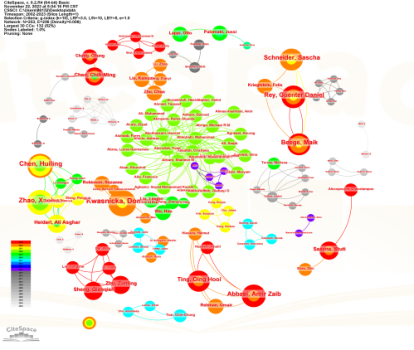
In these visualized networks, each node represents a scholar in the field, with the node size proportional to the scholar’s research output. The lines connecting nodes indicate collaborative relationships between authors or institutions. “N” represents the number of nodes, while “E” represents the number of connections between nodes. A lower ratio of these two values indicates a more distinct network community structure.
As shown in Figure 1, the author collaboration network of major contributors in the field has 253 nodes, 256 edges, and a network density of 0.008. This indicates that international research in this field has reached a certain scale, with relatively close collaboration among scholars and a high frequency of cooperation. However, despite the gradual development and improvement of the collaboration network, the field has not yet formed a clear academic core, and the research topics and directions remain relatively dispersed.
Figure 1: Author collaboration network in the field of digital humanities design (image provided by author).
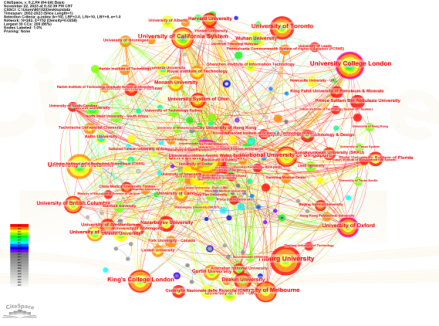
Regarding research institutions, as seen in Figure 2, there are 242 institutions globally engaged in digital humanities design research, with 752 edges and a network density of 0.0259. This highlights the importance of cross-regional and cross-cultural collaboration in this field. Representative institutions, such as the University of London, Tilburg University, and University College London, have publication frequencies of 99, 57, and 44, respectively. These institutions focus more on technological applications and interdisciplinary integration, reflecting the diversity and cutting-edge nature of international research.
14 Zhu
Figure 2: Research institution collaboration network in the field of digital humanities design (image provided by author).
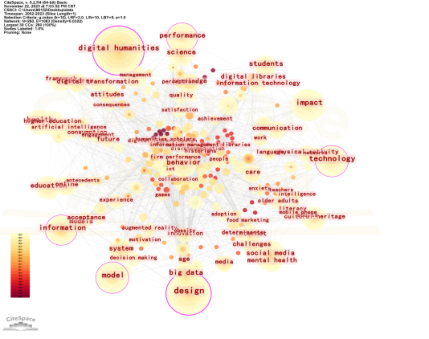
Keyword Co-Occurrence Network Analysis Keyword Co-occurrence analysis can reveal the key topics and directions of a research field. Each node represents a keyword, and the size of the node’s radius reflects the frequency of the keyword’s occurrence—larger radii indicate higher frequencies (Dou, 2023). This paper performs a time- slicing analysis on the literature samples to track the evolutionary trends of keywords, thereby exploring the development directions and research hotspots in the field of digital humanities design. As shown in Figure 3, the keyword network in the field of digital humanities design contains 260 nodes (N = 260), 1,083 edges (E = 1,083), and a network density of 0.0322 (Density = 0.0322). Based on the top 20 keywords’ co-occurrence statistics presented in Table 1, the research hotspots in this field can be categorized into three main directions.
Figure 3: Keyword co-occurrence network in the field of digital humanities design (image provided by author).
Digital Humanities Design in an Interdisciplinary Context 15
First, the construction of an interdisciplinary knowledge system is a key focus. Core keywords like “Digital Humanities” (frequency = 145, centrality = 0.21) and “Design” (frequency = 106, centrality = 0.39) reflect the field’s academic focus. Other keywords, such as “Health” (frequency = 38, centrality = 0.05) and “Management” (frequency = 29, centrality = 0.01), highlight the interdisciplinary applications and societal impact of digital humanities. The keywords “Model” (frequency = 60, centrality = 0.1), “System” (frequency = 34, centrality = 0.05), and “Framework” (frequency = 27, centrality = 0.01) point to the growing emphasis on systematic research and theoretical framework development, including social impact assessment.
Second, research is focusing on technology-driven innovation. Keywords like “Technology” (frequency = 58, centrality = 0.11), “Information” (frequency = 53, centrality = 0.11), and “Big Data” (frequency = 30, centrality = 0.07) indicate a strong focus on technological applications, including AI and big data analysis. Other terms like “Virtual Reality,” “Internet” (frequency = 27, centrality = 0.04), and “Artificial Intelligence” (frequency not listed but present) underscore the frontier of technological innovation in virtual and intelligent technologies.
Lastly, education and learning outcomes are a significant research area. Keywords such as “Impact” (frequency = 61, centrality = 0.07), “Education,” and “Higher Education” emphasize the focus on the effectiveness of educational applications. “Students” are a key research subject, with studies examining how digital humanities technologies influence learning outcomes and experiences, enhancing their application value in education.
Table 1: Top 20 keyword co-occurrence statistics. (No = number, Key = keyword, Fre = frequency, Cen = centrality).
Table available in the original PDF paper.
No. Key Fre Cen No. Key Fre Cen 1 Digital humanities 145 0.21 11 Science 36 0.06 2 Design 106 0.39 12 System 34 0.05 3 Impact 61 0.07 13 Education 33 0.02 4 Model 60 0.1 14 Higher Education 33 0.01 5 Technology 58 0.11 15 Big Data 30 0.07 6 Information 53 0.11 16 Cultural Heritage 30 0.04 7 Social media 52 0.03 17 Management 29 0.01 8 Performance 50 0.12 18 Internet 27 0.04 9 Behavior 38 0.05 19 Framework 27 0.01 10 Health 38 0.05 20 Students 25 0.03
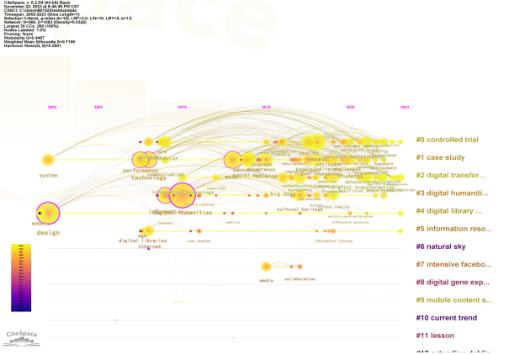
Timeline Diagram and Burst Terms Analysis Timeline diagrams and keyword bursts both introduce a temporal dimension, providing a dynamic analytical perspective for the research field (Long et al., 2024). Timeline diagrams are primarily used to display the research content and trends of a particular topic over time (Wang, 2023). The connections between keywords represent the distribution and span of keywords across time, while circular icons represent key nodes in the clusters. The size of
16 Zhu
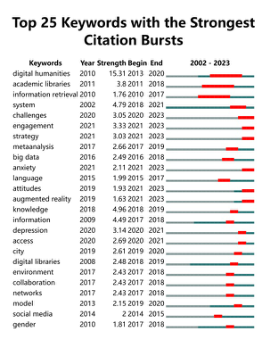
the icons reflects the research popularity and attention of the nodes, and the color is used to distinguish the time periods when the keywords first appeared and when they remained active. This paper utilizes the Timeline View function in CiteSpace to visually analyze the temporal distribution of literature keywords (Figure 4). The modularity clustering value (Q) of the timeline diagram is 0.4467 (> 0.3), and the average silhouette value is 0.7159 (> 0.7), indicating that the clustering results have high structural homogeneity and are reliable and credible. Burst terms distribution reveals the keywords with high citation frequencies in the research field and the years during which they were cited (Chen, 2023). Through burst term analysis, we can intuitively identify the research hotspots in different phases and predict future development trends (Lou & Zheng, 2022). We selected the top 25 keywords with the strongest burst intensity in the field of digital humanities design for quantitative analysis and generated a burst term diagram.
Figure 4: Timeline map in the field of digital humanities design (image provided by author).
As shown in Figure 5, “Digital Humanities”emerged as a research hotspot in the field with a burst intensity of 15.31 and a relatively long duration (2013–2020), indicating that digital humanities occupy a central position in both technological development and academic research. Other technical keywords, such as “Information Retrieval” (2010–2017), “Big Data” (2016– 2018), and “Augmented Reality” (2021–2023), highlight the significant role of technological advancements in driving innovation within the field.
Secondly, the trend of interdisciplinary collaboration is evident. The bursts of keywords such as “Collaboration,” “Networks,” and “Big Data” reflect the ongoing expansion of the theoretical framework and practical methods in the digital humanities design field through multidisciplinary perspectives. This trend has propelled digital humanities research toward more diversified, complex, and systematic directions, further advancing the intersectional research between technology and social sciences.
Digital Humanities Design in an Interdisciplinary Context 17
Figure 5: Burst term map in the field of digital humanities design (image provided by author).
Finally, keyword analysis further reveals a growing focus on social issues and human-centered thinking in current digital humanities design research. For example, the emergence of sociological keywords such as “Gender” and “Attitudes” reflects researchers’ attention to social equity, user attitudes, and behaviors. The concentrated bursts of “Engagement” and “Strategy” (2021–2023) highlight the increasing emphasis on user behavior studies and strategic frameworks. The appearance of psychological keywords such as “Depression” and “Anxiety” shows the heightened focus on users’ psychological experiences and emotional interactions in digital humanities design research.
DISCUSSION
Through knowledge visualization analysis based on nodes such as journals, research authors, keyword clusters, and burst keyword trends, research in digital humanities design can be systematically interpreted from three dimensions: “research status,” “research hotspots,” and “development trends.”
Research Status and Hotspots: Advancing Interdisciplinary Integration and Theoretical Exploration The analysis of author and institutional collaboration networks reveals closely knit research collaborations with high-frequency cross-regional cooperation. Core authors and institutions actively promote knowledge sharing and innovation through intensive academic collaboration. However, despite the well-developed collaboration networks, the research themes and directions in the field remain relatively scattered, and a unified academic core has yet to be established. This indicates that as an emerging field, digital humanities design is still in the process of exploring and refining its theoretical system and research paradigms.
18 Zhu
The keyword Co-occurrence analysis shows that “Digital Humanities” and “Design” are the two core nodes in this field. Keywords like “Health,” “Management,” “Model,” “System,” and “Framework” reflect the academic community’s focus on systematic research and theoretical framework construction. These studies not only emphasize the application of technological tools and information processing methods but also explore societal impact assessments, theoretical deepening, and the construction of interdisciplinary knowledge systems. Consequently, the current research status in digital humanities design can be summarized as a phase where interdisciplinary integration, technological innovation, and theoretical construction are advancing in parallel.
Through the analysis of keyword co-occurrence maps, the research hotspots in the field of digital humanities design are mainly concentrated in three areas: the construction of interdisciplinary knowledge systems, technology-driven innovative research, and education and learning outcomes. These research directions contribute to the promotion and application of digital humanities design in the field of education and provide support for cultivating talents with interdisciplinary literacy and innovative capabilities.
Research Development Trend: From Technological Construction to Social Impact and Human-Centered Orientation Based on the timeline diagram and the distribution of burst terms, the evolution of research directions and future trends in the field of digital humanities design can be clearly observed. Overall, the development of the field has gone through the following three stages:
A) Early Stage (2008–2017): Foundational Technologies and Framework Construction. This stage focused on the construction of digital technology infrastructure and the development of theoretical frameworks. Burst terms such as “Digital Libraries” (2008–2019) and “System” (2018–2021) highlight the emphasis on the development of technological platforms and systematic design, while the emergence of “Information Retrieval” (2010– 2017) indicates the importance of information access and processing in early research. This stage laid the technological and methodological foundation for subsequent research.
B) Mid Stage (2018–2020): Systematization of Knowledge and Technological Deepening. As technologies matured, research hotspots shifted from technological construction to the systematization of knowledge frameworks and the deepening of technology. Burst terms like “Knowledge” (2018–2019) and “Model” (2013–2020) indicate the academic focus on knowledge production and reconstruction, while the frequent appearance of “Big Data” (2016–2018) and “Information” (2017–2018) emphasizes the importance of data-driven technologies. This stage significantly advanced the construction of knowledge systems and technological applications, providing theoretical support for the development of digital humanities design.
C) Recent Stage (2020–2023): Deepening Social Impact and User Experience. In recent years, research has gradually focused on practical applications and social impact. Burst terms such as “Challenges”
Digital Humanities Design in an Interdisciplinary Context 19
(2020–2023), “Engagement” (2021–2023), and “Strategy” (2021–2023) indicate that the academic community is addressing practical issues and enhancing user engagement. At the same time, “Anxiety” (2021–2023) and “Depression” (2020–2021) reflect increasing attention to the psychological impact of technology on users. This stage marks a trend of digital humanities design research expanding towards a more human-centered approach and practical application scenarios. Specifically, with the widespread use of digital technologies in education, work, and entertainment, mental health issues have become a growing focus. For example, researchers have started exploring the potential of augmented reality (AR) and virtual reality (VR) technologies in alleviating psychological stress, treating anxiety, and depression. This not only enriches the application scenarios of digital humanities design but also offers new ideas for the humanistic care provided by technology.
CONCLUSION
This study, through an in-depth analysis of relevant literature in the field of digital humanities design from the Web of Science database, reveals the core authors and institutions driving research, the current state of the field, and its development trends. The analysis demonstrates that the field of digital humanities design is characterized by collaborative development and interdisciplinary cooperation globally. It not only fosters the integration of technology and design but also offers new insights for cultural innovation. The findings of this study will contribute to revealing the dynamic development of digital humanities design, providing valuable insights and inspiration for scholars and practitioners. As technology continues to evolve and societal needs change, the field of digital humanities design will persist in advancing, offering more possibilities for understanding and preserving excellent traditional culture and promoting the digital transformation of cultural heritage.
REFERENCES
Chen, C., & Song, M. (2019). Visualizing a field of research: A methodology of systematic Scientometric reviews. PloS one, 14(10), e0223994. Chen, S., Fan, H, & Jiang, M. (2023). Knowledge mapping analysis of augmented
reality in cultural heritage based on CiteSpace Technology (in Chinese). Packaging Engineering Art Edition, 44(16), 315–329. Dong, Y., Zhu, S., Li, W, & Lin, M. (2023). How does the design guidelines for traditional cultural artefacts inspire design in a culturally inspired design process? A comparative study with novice design students. International Journal of Art & Design Education, 42(1), 49–68. Dou, J., Zhang, B, & Qian, X. (2023). A Review of Research on Artificial Intelligence
Enabling Cultural Heritage - A CiteSpace-Based Visualization Analysis (in Chinese). Packaging Engineering Art Edition, 44(14), 1–20. John W, Sons Ltd. (2004). A Companion to Digital Humanities[M]. Malden: MA Baell Pub, 11.
20 Zhu
Liu, J. X., & Zhang, L. (2024). Bibliometrics-based visualization and analysis of research progress on virtual experience design for cultural heritage in foreign countries (in Chinese). Packaging Engineering (20), 58–80. doi: 10.19554/ j.cnki.1001–3563.2024.20.006. Long, S., Xu, Z. & Chen, H. (2024). A bibliometric study of user experience in
human-computer Interface (in Chinese). Packaging Engineering, 45(4): 288–303. Lian, J., Zhang, X, & Zhao, Y. (2018). Case analysis and empirical insights of public science programs in digital humanities in foreign countries (in Chinese). Intelligence Information Work, 5, 32–40. Lou, S. Y., & Zheng, J. Y. (2022). Hot Topics, Frontiers and Prospects of Community
Renewal in China - A CiteSpace-based Visualization Study (in Chinese). Furniture & Interiors, 29(10), 120–125. Lu, S. J., & Zhou, Z. F. (2022). Progress and Trends of Agricultural Cultural Heritage Tourism Research - Based on CiteSpace Visualization Analysis (in Chinese). Journal of Central China Normal University (Natural Science Edition), 56(6), 1021–1033. Wang, X., & Hou, X. L. (2023). An outline of cultural heritage smart data
construction for adaptive use (in Chinese). Journal of Information Resources Management, 13(5), 5–14. Wang, Y. (2023). Visualization and analysis of Chinese cultural and creative product design research from the perspective of knowledge mapping (in Chinese). Packaging Engineering Art Edition, 44(4), 324–331. Zhang, B., Cheng, P., Deng, L., Romainoor, N. H., Han, J., Luo, G., & Gao, T.
(2023). Can AI-generated art stimulate the sustainability of intangible cultural heritage? A quantitative research on cultural and creative products of New Year Prints generated by AI. Heliyon, 9(10). Zhang, F., Zhang, Z., Cao, T. & Sun, F. (2023). A review of research on digital creative product design (in Chinese). Packaging Engineering Art Edition, 44(12), 1–15.
LISTED IN THE AHFE DIGITAL BOOKSTORE CATALOGUE
Explore the complete digital volume
Human Dynamics, Product Evaluation and Quality
Read this individual research paper free through the original publisher, or explore the full digital proceedings book.
ISBN 978-1-964867-48-9
Explore this ISBN in the AHFE Bookstore ↗Listed in the July 2026 bookstore catalogue; search by ISBN to confirm current availability · Digital book purchase optional