Zhen Zhao, Jiaan Li, Hailiang Wang (2026). Exploring Embodied Design for Technology-Mediated Emotion Intervention in Bipolar Disorder: A Mixed Methods Study. In: Human Systems Engineering and Design (IHSED2026): Future Trends and Applications. AHFE Open Access, vol. 237, pp. 810–820. https://doi.org/10.54941/ahfe1008219
Individuals with bipolar disorder (BD) face embodied challenges in regulating their emotions, which stem from bodily experiences. Current technology-mediated emotion interventions are insufficient to adequately address these challenges. We employed a mixed-methods approach to explore embodied design in BD emotion interventions. First, social media analysis of 281 posts and 3,332 comments from Rednote (Xiaohongshu) was conducted to identify three core embodied challenges: unstable bipolar mood shifts, uncontrollable somatic reactions, and weak emotional awareness. Then, a literature review of technology-mediated emotion interventions screened 510 articles across three databases, identifying 11 relevant embodied design studies. Four embodied design patterns were analyzed through Means-Ends Chain analysis: interoceptive interaction, gestural interaction, somatosensory feedback, and metaphorical mapping. Integrating these findings, we propose embodied design implications that position the body as an active partner in BD emotion regulation, offering actionable guidance for developing technologies bridging bodily experiences and emotional understanding.
Bipolar disorder (BD) is a chronic and recurrent mental health condition characterized by alternating episodes of mania, hypomania, and depression (Grande et al., 2016). The disorder exists on a spectrum from unipolar depression, involving only depressive episodes, to bipolar I and bipolar II, which demonstrate progressively severe manic symptoms (Phillips & Kupfer, 2013). BD affects approximately 2.4% of the global population. In China, an estimated 8.4 million people live with BD (Huang et al., 2019). As a lifelong episodic disorder, BD primarily affects young adults, with a peak age of onset between 15 and 25 years (Grande et al., 2013). Because it predominantly affects people of working age, BD imposes substantial economic and psychosocial burdens on individuals, healthcare systems, and society (Sletved et al., 2023).
Current technology-mediated interventions for BD are centered around cognitive strategies that can be categorized into four types, including Received March 22, 2026 Revised June 15, 2026 Accepted July 5, 2026 Available online September 25, 2026
Exploring Embodied Design for Technology-Mediated Emotion Intervention 811 smartphone-based self-monitoring & management (Bardram et al., 2013; Jonathan et al., 2021), digital phenotyping for mood detection (Guidi et al., 2017; Steel et al., 2023), online community support (Xu et al., 2023), and virtual assessment (Ilioudi et al., 2023).
However, several gaps remain in current interventions. Most apps are generic mental health or wellness apps, with only a small fraction tailored to BD needs (Xu et al., 2023). These apps also showed limits for personalized early sign tracking or individualized intervention plans, which are crucial for BD emotional regulation (Jonathan et al., 2021). Moreover, VR-based systems can be effective for clinical assessment, but they lack portability and are difficult to integrate into patients’ everyday routines. More critically, for individuals with BD, emotions are not solely mental processes but are deeply intertwined with bodily sensations such as racing heartbeats, muscle tension, breathing rhythms, and energy fluctuations (Alf et al., 2025). These cognitive- centered approaches overlook how bodily experiences fundamentally shape people’s emotional states.
The embodied lens offers an alternative perspective that is derived from embodied cognition theory. This theory posits that emotions do not originate solely from thoughts but from the dynamic interaction between the body, brain, and environment. The embodied lens has been applied in technology- mediated emotion interventions to support emotion regulation and mental health. For example, real-time biofeedback systems can make intangible bodily states, such as heart rate or breathing patterns, visible and tangible (Lim, 2021). Tangible devices provide multi-sensory feedback through touch-based interaction, helping users reduce stress and anxiety (Claisse et al., 2022). Due to the complexity of the mood episodes in BD, they have limitations in recognizing subtle changes in mood or mixed states (Xu et al., 2023). Secondly, individuals with BD have unique rhythms, and different mood symptoms trigger different bodily responses. Existing interventions neglect the different embodied regulatory mechanisms. This study addresses this gap by investigating these questions:
1) What specific challenges and needs do individuals with BD face in emotion regulation? 2) What and how embodied design patterns can be incorporated into technology-mediated emotion interventions for BD?
SOCIAL MEDIA ANALYSIS: UNDERSTANDING CHALLENGES AND NEEDS IN BD EMOTION REGULATION Social media analysis aims to understand BD experiences, providing naturalistic, unsolicited data that captures authentic lived experiences without researcher intervention (Xu et al., 2023). This approach addresses the low accessibility and emotional instability of people with BD for recruitment. Rednote (Xiaohongshu) is one of China’s largest experience- sharing platforms, serving more than millions of people. This platform hosts an active BD community where users openly share mood shifts, experiences, and coping strategies.
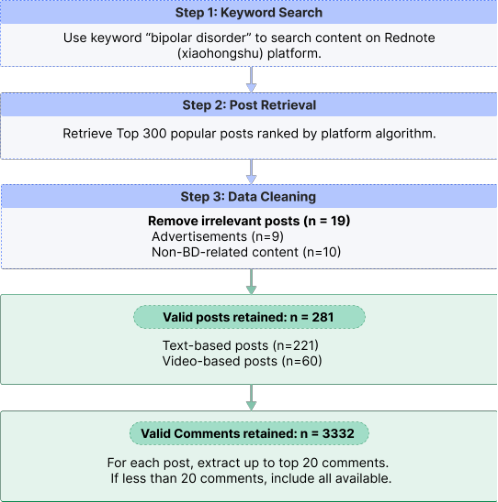
Data Collection and Analysis By using the keyword “bipolar disorder” on Rednote (xiaohongshu), a Python-based web crawler was employed to retrieve the top 300 posts ranked by engagement metrics (e.g., likes, collects, and comments), published between September 2022 and September 2025. For each post, we retrieved up to the first 20 comments according to popularity, resulting in a total of 3,332 comments. After excluding 19 irrelevant or promotional entries, a final dataset of 281 posts was retained for analysis. The data collection and filtering process is shown in Figure 1. We adopted the grounded theory to analyze the collected data. Through independently iterative open coding, axial coding, and selective coding processes, two researchers conducted thematic analysis to identify recurring patterns in emotional regulation challenges.
Figure 1: Data collection and filtering process.
Ethics and Privacy According to previous research (Xu et al., 2023), IRB approval is not required for publicly available online data. We implemented additional privacy protection, including (1) unlinking usernames from the data in the corpus before conducting analysis, (2) refraining from using usernames to search for additional user information, and (3) anonymizing community- specific identifiers to ensure participant de-identification.
FINDINGS Bipolar Mood Shifts Instability
A significant challenge of BD is the unpredictable fluctuations between emotional extremes, often triggered by uncontrollable contexts. For example, sleep disruption is the most common trigger. People report persistent insomnia and abnormally high energy levels during manic episodes. Depressive episodes are characterized by being unable to get out of bed for five or six days. Social stress frequently precipitates mood destabilization by overwhelming emotional regulation capacities. Hormonal changes, particularly menstrual cycle fluctuations, trigger mood swings that many females report beginning one week before menstruation. Traumatic events may cause severe psychological trauma and may trigger mood swings that last for weeks or even months. Substance use, especially alcohol abuse, can further impair self-control and undermine the stability of mood regulation.
Uncontrollable Somatic Reactions Another challenge refers to the somatic reactions during distinct mood episodes. Most people experience multiple somatic reactions but struggle to understand how these symptoms relate to their emotional state. For instance, the transition from stable to manic/hypomanic is accompanied by increased heart rate, sweating, and tremors, as well as a significant reduction in sleep. The transition from stability to depression manifests as heaviness, chronic fatigue, muscle aches, and gastrointestinal discomfort. One person described, “My body felt heavy, like I was carrying a heavy load. Even getting out of bed was difficult” (P89). Furthermore, the manic-to-depression exhibits different patterns. When transitioning from mania to depression, some people experience sudden fatigue and exhaustion. Conversely, the transition from depression to mania is accompanied by decreased sleep and a return of energy. More seriously, mixed episodes produce contradictory symptoms, combining mental excitement with physical fatigue, chest tightness, and neck and shoulder tension.
Weak Emotional Awareness The final key challenge identified in this study is weak emotional awareness, manifested in three interconnected aspects. First, a delayed perception of mood changes is a critical issue. Many people indicated they were completely unaware when entering a manic or depressive episode. This lack of real- time awareness means individuals often miss crucial opportunities for early intervention, allowing the episode to fully develop before it is recognized. Second, difficulty distinguishing emotions extends to everyday interactions. As one respondent stated, “I didn’t realize I was in a manic phase. I thought I had suddenly recovered” (P189). This misunderstanding leads to inappropriate behavioral responses and ineffective regulation support. Third, a lack of bodily awareness appears to underlie the mechanism. Before conscious awareness arises, the body typically signals emotional fluctuations through changes in energy levels, sleep patterns, and bodily tension or anxiety (Khadem et al., 2023; Alfì et al., 2025).
LITERATURE ANALYSIS: EXPLORING EMBODIED DESIGN PATTERNS Building on the embodied challenges identified in our social media analysis, this literature analysis aims to systematically identify embodied design patterns from existing technology-mediated emotion interventions.
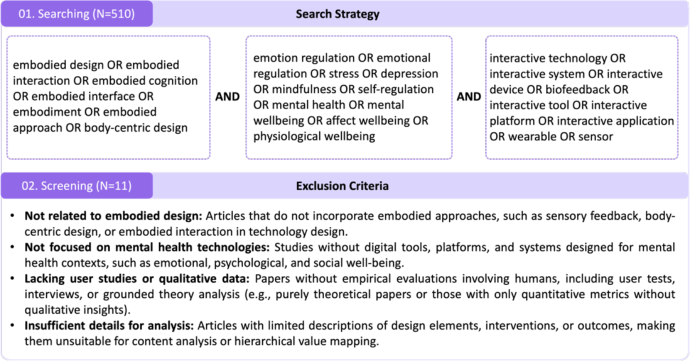
Data Collection To extract key embodied design elements, we conducted a systematic literature search and screening focused on embodied design in technology- mediated emotion interventions. We searched three databases, including PubMed, Web of Science, and Science Direct. Figure 2 illustrates the detailed search strategy and exclusion criteria. The initial search yielded 510 articles: PubMed (N = 228), Web of Science (N = 138), and Science Direct (N = 144), ranging from 2015 to 2025 and covering HCI, mental health, and design domains.
Figure 2: Overview of the literature review strategy.
The screening proceeded in three staged rounds using predefined exclusion criteria, with uncertain cases carried forward. Two researchers independently screened titles and abstracts of 511 records, excluding 363 and retaining 147 for full-text review. The two authors then assessed the 147 full texts and excluded 82 through discussion. Finally, all co-authors jointly reviewed 13 borderline articles, resulting in 11 studies included for analysis.
Data Analysis Means-Ends Chain (MEC) analysis was employed to hierarchically link design attributes to user values, bridging theoretical constructs of embodied cognition to practical design insights (Dong and Dong, 2023). The analysis proceeded through systematic coding of the 11 selected articles. Two researchers first independently conducted content analysis through open and axial coding to generate categories related to attributes, consequences,
Exploring Embodied Design for Technology-Mediated Emotion Intervention 815 and values. In this study, Attributes represent design features of embodied interactions. Consequences denote psychological health benefits or practical effects on emotion regulation resulting from these design features. Values capture the ultimate, deep-seated needs fulfilled by the technology.
Findings Through systematic analysis of 11 studies, we identified key embodied design elements organized across three hierarchical levels (Table 1).
Table 1: Key embodied design elements of technology-mediated emotion interventions.
Table available in the original PDF paper.
Case Name Attributes Consequences Values Affective Sleeve (Papadopoulou, 2024) Haptic action Physiological change mapping Ownership empowerment
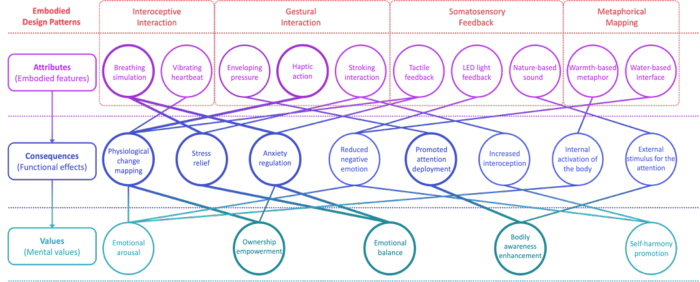
By analyzing linkages between attributes, consequences, and values across the 11 studies. We created a hierarchical value map in Figure 3. This visualization revealed four dominant embodied design patterns that can support individuals’ emotion regulation.
Figure 3: Hierarchical value map of embodied design patterns.
As shown in Figure 3, interoceptive interaction centers on internal bodily sensation simulation through on-body technologies to regulate anxiety and relieve stress. For BD emotion regulation, it helps to reposition out-of-control, automatic emotional physiological processes into a realm of awareness and regulation. Gestural interaction involves direct physical engagement with objects or installations to create immediate sensory feedback. For BD emotion regulation, this pattern can be tailored to the user’s emotional states and may elicit calming physiological responses or positive affect. In addition, somatosensory feedback leverages external sensory inputs to regulate emotional states, offering individuals with BD a body-based bridge for emotion regulation. For BD emotion regulation, this pattern helps link bodily feelings with emotional awareness by making internal states concrete sensory signals. Metaphorical mapping employs symbolic representations to connect bodily sensations with emotional states. For BD emotion regulation, this pattern could help users relate complex mood shifts to concrete bodily experiences.
DISCUSSION
Our mixed-methods study provides critical insights into the embodied design of emotion regulation for individuals with BD. Our social media analysis identified three core embodied challenges that individuals with BD face. These challenges fundamentally differ from typical emotion regulation difficulties and highlight the role of embodiment in promoting body-emotion connection. Furthermore, our literature analysis examined how embodied design patterns have been used in technology-supported emotion interventions. The four embodied design patterns provide concrete pathways to bridge body-emotion disconnection. These findings reveal the actionable ways of incorporating embodied design in emotional regulation
Exploring Embodied Design for Technology-Mediated Emotion Intervention 817 for individuals with BD. In the following sections, we first draw out embodied design implications for BD emotion regulation and then consider the study’s limitations and future research opportunities. Small artifacts that can be stroked, held, or played with can provide a sense of bodily control in triggering situations. They may also help maintain emotional continuity when cognitive regulation is difficult.
DESIGN IMPLICATIONS Design for the Triggering Situations of Different Episodes
Mood swings in BD are often precipitated by triggering situations that feel uncontrollable. These triggers can cause unpredictable shifts between emotional poles and disrupt the continuity between physical and emotional states. First, sleep disruption is the most common trigger in our analysis. We suggest circadian-aligned sensory feedback as an embodied way to address these sleep-related triggers for BD. Second, hormonal changes represent another critical physiological trigger. Metaphor-driven tracking design was suggested to help users identify early hormonal signals through embodied visualization. Third, social stress and traumatic events are also the key triggers we identified (Nierenberg et al., 2023). Building on these works, we propose a tangible interaction that leverages soft materials to treat such objects as emotional anchors.
Calibrate Embodied Feedback to Somatic Profiles We propose somatic-based interventions for different mood episodes. Manic episodes involve a racing heartbeat, tremors, and drastically reduced sleep. The body moves from a baseline state into hyperarousal and builds up strong physiological tension. Depression episodes manifest as increasing body heaviness, chronic fatigue, and muscle aches. Multi-sensory systems combining tactile pressure garments and auditory cues can address these somatic experiences through their material qualities. For the mixed episodes, interactive textiles can provide immediate multi-modal feedback that combines haptic stimulation or gentle compression to create stabilizing anchors during these acute changes.
Support Interpretability and Socially Situated Meaning-Making Emotion regulation is not only an internal cognitive process but also a socially and culturally situated practice shaped by everyday language, stigma, and norms around emotional expression (Khadem et al., 2023). Technology- mediated interventions should prioritize interpretability by helping users understand what bodily and contextual signals might mean in their own terms and situations. We suggest user interface can use metaphorical mapping to translate sensed data into culturally resonant, non-pathologizing descriptions. Because sense-making occurs in social contexts, interventions should also support discretion and selective sharing, enabling private modes in public settings and user-controlled summaries for trusted others (e.g., partners or clinicians) without forced disclosure.
LIMITATIONS AND FUTURE WORKS This study has several limitations. First, our design is primarily based on existing literature analysis, rather than empirical validation in individuals with BD. Future research will involve interviews and questionnaires with individuals with BD for triangulation. Second, we have not yet translated these implications into concrete prototypes. Future research will develop interactive prototypes and conduct user studies to evaluate their usability and effectiveness for emotion regulation in BD.
CONCLUSION
This study advances embodied design research by exploring how body- centered approaches can meaningfully support emotion regulation. We integrated empirical analysis with literature analysis to identify embodied design patterns and develop concrete design implications that position the body as an active partner in BD emotion regulation. These implications provide practical guidance for designing and developing BD-tailored interventions that bridge the critical gap between bodily experiences and emotional awareness.
ACKNOWLEDGEMENT
This work was partly supported by the Hong Kong Polytechnic University grant (number: P0045769).
REFERENCES
Alfì, G., Grenno, G., Caruso, V., Piarulli, A., Palagini, L., Perugi, G., and Gemignani, A.
(2025). Interoceptive sensibility mediates emotional dysregulation: Insights from individuals with Bipolar II Depression. Journal of Affective Disorders, 120236. https://doi.org/10.1016/j.jad.2025.120236 Bardram, J. E., Frost, M., Szántó, K., Faurholt-Jepsen, M., Vinberg, M., and Kessing, L. V. (2013, April). Designing mobile health technology for bipolar disorder: A field trial of the monarca system. In Proceedings of the SIGCHI conference on human factors in computing systems (pp. 2627–2636). https://doi. org/10.1145/2470654.2481364 Claisse, C., Umair, M., Durrant, A. C., Windlin, C., Karpashevich, P., Höök, K., ... and
Sas, C. (2022). Tangible interaction for supporting well-being. In CHI Conference on Human Factors in Computing Systems Extended Abstracts (pp. 1–5). https:// doi.org/10.1145/3491101.3503716 Cochrane, K., Cao, Y., Girouard, A., and Loke, L. (2022). Breathing scarf: Using a first-person research method to design a wearable for emotional regulation. In Proceedings of the Sixteenth International Conference on Tangible, Embedded, and Embodied Interaction (pp. 1–19). https://doi.org/10.1145/3490149.3501330 Costa, J., Adams, A. T., Jung, M. F., Guimbretière, F., and Choudhury, T.
(2016). EmotionCheck: Leveraging bodily signals and false feedback to regulate our emotions. In Proceedings of the 2016 ACM international joint conference on pervasive and ubiquitous computing (pp. 758–769). https://doi. org/10.1145/2971648.2971752
Exploring Embodied Design for Technology-Mediated Emotion Intervention 819 Coulter, J. (2023). Feeling well: using the augmented touch of E-textiles to Embody
emotion and environment as a “Self-health” intervention for female student wellbeing. Journal of Textile Design Research and Practice, 11(1–2), 81–110. https://doi.org/10.1080/20511787.2023.2242165 Daudén Roquet, C., and Sas, C. (2021). Interoceptive interaction: An embodied metaphor inspired approach to designing for meditation. In Proceedings of the 2021 CHI conference on human factors in computing systems (pp. 1–17). https:// doi.org/10.1145/3411764.3445137 Daudén Roquet, C., Theofanopoulou, N., Freeman, J. L., Schleider, J., Gross, J. J.,
Davis, K., ... and Slovak, P. (2022). Exploring situated & embodied support for youth’s mental health: Design opportunities for interactive tangible device. In Proceedings of the 2022 CHI conference on human factors in computing systems (pp. 1–16). https://doi.org/10.1145/3411764.3445137 Dong, Y., and Dong, H. (2023). Design empowering active aging: A resource-based design toolkit. International Journal of Human–Computer Interaction, 39(3), 601–611. https://doi.org/10.1080/10447318.2022.2041908 Goncu-Berk, G., Zhang, R., and Yilmaz, C. (2021). Calmwear: a smart tactile sensory
stimulation clothing. In Proceedings of the 2021 ACM International Symposium on Wearable Computers (pp. 184–188). https://doi.org/10.1145/3460421.3478829 Grande, I., Berk, M., Birmaher, B., and Vieta, E. (2016). Bipolar disorder. The Lancet, 387(10027), 1561–1572. https://doi.org/10.1016/S0140-6736(15)00241-X Grande, I., Goikolea, J. M., De Dios, C., González-Pinto, A., Montes, J. M.,
Saiz-Ruiz, J., ... and PREBIS group. (2013). Occupational disability in bipolar disorder: Analysis of predictors of being on severe disablement benefit (PREBIS study data). Acta Psychiatrica Scandinavica, 127(5), 403–411. https://doi. org/10.1111/acps.12003 Guidi, A., Schoentgen, J., Bertschy, G., Gentili, C., Scilingo, E. P., and Vanello, N.
(2017). Features of vocal frequency contour and speech rhythm in bipolar disorder. Biomedical Signal Processing and Control, 37, 23–31. https://doi.org/10.1016/j. bspc.2017.01.017 Haynes, A. C., Lywood, A., Crowe, E. M., Fielding, J. L., Rossiter, J. M., and Kent, C.
(2022). A calming hug: Design and validation of a tactile aid to ease anxiety. Plos one, 17(3), e0259838. https://doi.org/10.1371/journal.pone.0259838 Huang, Y., Wang, Y. U., Wang, H., Liu, Z., Yu, X., Yan, J., ... and Wu, Y. (2019).
Prevalence of mental disorders in China: a cross-sectional epidemiological study. The Lancet Psychiatry, 6(3), 211–224. https://doi.org/10.1016/S2215- 0366(18)30511-X Ilioudi, M., Lindner, P., Ali, L., Wallström, S., Thunström, A. O., Ioannou, M., … and Steingrimsson, S. (2023). Physical versus virtual reality-based calm rooms for psychiatric inpatients: Quasi-randomized trial. Journal of Medical Internet Research, 25, e42365. https://doi.org/10.2196/42365 Jonathan, G. K., Dopke, C. A., Michaels, T., Bank, A., Martin, C. R., Adhikari, K., ...
and Goulding, E. H. (2021). A smartphone-based self-management intervention for bipolar disorder (LiveWell): User-centered development approach. JMIR Mental Health, 8(4), e20424. https://doi.org/10.2196/20424 Khadem, H., Shahidi, S., Zarani, F., and Panaghi, L. (2023). Embodiment in Patients with Bipolar Disorder: A Dynamic Model. International Journal of Body, Mind & Culture (2345–5802), 10(2). https://doi.org/10.22122/ijbmc.v10i2.379 Lim, C. K. (2021, July). An emotional tactile interaction design process. In International
Conference on Human-Computer Interaction (pp. 384–395). Cham: Springer International Publishing. https://doi.org/10.1007/978-3-030-78462-1_30
Nierenberg, A. A., Agustini, B., Köhler-Forsberg, O., Cusin, C., Katz, D., Sylvia, L.
G., ... and Berk, M. (2023). Diagnosis and treatment of bipolar disorder: A review. Jama, 330(14), 1370–1380. https://doi.org/10.1001/jama.2023.18588 Papadopoulou, A. (2024). Affective Matter: Designing human-material interactions to enhance health and wellbeing. Design Science, 10, e43. https://doi.org/10.1017/ dsj.2024.40 Phillips, M. L., and Kupfer, D. J. (2013). Bipolar disorder diagnosis: Challenges and
future directions. The Lancet, 381(9878): 1663–1671. https://doi.org/10.1016/ S0140-6736(13)60989-7. Sabinson, E., Pradhan, I., and Evan Green, K. (2021). Plant-human embodied biofeedback (pheB): a soft robotic surface for emotion regulation in confined physical space. In Proceedings of the Fifteenth International Conference on Tangible, Embedded, and Embodied Interaction (pp. 1–14). https://doi. org/10.1145/3430524.3446065 Sletved, K. S. O., Ziersen, S. C., and Andersen, P. K. (2023). Socio-economic
functioning in patients with bipolar disorder and their unaffected siblings–results from a nation-wide population-based longitudinal study. Psychological Medicine, 53(3): 706–713. https://doi.org/10.1017/S0033291721002026 Steel, C., Wright, K., Goodwin, G., Simon, J., Morant, N., Taylor, R., Brown, M., Jennings, S., Hales, S., Regan, J., Sibsey, M., Thomas, Z., Meredith, L., and Holmes, E. (2023). The IBER study: a feasibility randomised controlled trial of imagery based emotion regulation for the treatment of anxiety in bipolar disorder. International Journal of Bipolar Disorders, 11. https://doi.org/10.1186/s40345- 023-00305-8 Vianello, A., Chittaro, L., and Matassa, A. (2019). TANGAEON: tangible interaction
to support people in a mindfulness practice. International Journal of Human– Computer Interaction, 35(12), 1086–1101. https://doi.org/10.1080/10447318.2 018.1509540 Xu, T., Yu, J., Doyle, D. T., and Voida, S. (2023). Technology-mediated strategies for coping with mental health challenges: Insights from people with bipolar disorder. Proceedings of the ACM on Human-Computer Interaction, 7(CSCW2), 1–31. https://doi.org/10.1145/3610031
FIND THE COMPLETE VOLUME IN THE AHFE DIGITAL BOOKSTORE
Explore the complete digital volume
Human Systems Engineering and Design (IHSED2026): Future Trends and Applications
Read this individual research paper free through the original publisher, or explore the full digital proceedings book.