Kyoko Kamimura (2026). Designing Multidimensional Digital Purchase Journeys: CASCADE and CASMOT Conceptual Models. In: Intelligent Human Systems Integration (IHSI 2026): Disruptive and Innovative Technologies. AHFE Open Access, vol. 200, pp. 761–770. https://doi.org/10.54941/ahfe1007135
This discussion paper synthesizes insights from three consecutive nationwide online surveys in Japan (2022–2024) to characterize multidimensional, context adaptive digital purchase journeys that require effective human–system integration (HSI) across touchpoints. Grounded in descriptive evidence, we articulate two complementary conceptual models—CASCADE for experience design and CASMOT for behavioral measurement. We aim to clarify how value logics (e.g., assurance, economic/points, convenience/speed, empathy/story) coexist within individuals and switch by context, and to derive conceptual models that make such switching and multi track progression visible to both analysis and design. Design/methodology: From 2022 to 2024, we conducted nationwide online surveys of 2,900–4,350 respondents aged 20–69, covering 29–30 product groups across 11–13 categories. The questionnaire captured digital channels at awareness, comparison, purchase, and post purchase; payment and loyalty point usage; satisfaction and customer support experiences. Modules on webrooming/showrooming and cashless adoption were added in 2023; resale orientation in 2024. Stage specific choices were visualized as Channel Journey diagrams.Insights from the surveys: Online comparison increased from 50.0% (2022) to 55.7% (2024). Journeys bifurcated: daily goods often followed simplified one stop flows, whereas electronics and gifts showed complex cross channel switching. Value logics shifted by situation: 37.3% of marketplace users prioritized points; 12.5% of official site users emphasized security; 24.2% of electronics buyers reported assurance when purchasing on official sites. Loyalty/point activities engaged 96% of respondents—enhancing enjoyment yet adding UX complexity. Resale orientation grew (4.8% consider resale; 8.8% purchased used in 2024), extending value beyond purchase. Support quality—returns/exchanges, delivery notifications, responsive inquiry handling—strongly shaped satisfaction and trust.Conceptual models: From convergent patterns in the data, we inductively articulate two models. CASCADE formalizes a cyclical design process—Context Scan, Activation (parallel value logics), Switch & Select, Channel Diversion, Action, Dynamic Integration, Extension. CASMOT structures measurement—Context Scan, Activation, Switch & Select, Multi Channel (individual), Omni trace (aggregate), Trace. We map model elements to observed indicators (e.g., assurance logic anchored by official sites and support; economic/points on marketplaces; empathy/story on social/video; convenience/speed in rapid fulfillment).Contribution: The insights and models are intended to provide theoretical and practical guidance for service design and experience design, enabling the creation of richer and more diverse purchase experiences and informing future HSI research and practice in digital commerce.
Since the early 2020s, global shifts in social and economic conditions, along side rapid advancements in digital technology, have driven significant diver sification in both consumer purchasing behavior and experience. In Japan, the widespread adoption of e-commerce, cashless payment systems, loyalty point programs, and the evolution of social media and online information platforms have collectively enabled consumers to select from a broader range of channels and services, customizing their purchasing processes to suit indi vidual needs and contexts.
Amid these sweeping changes, consumer experiences are evolving beyond traditional linear and stage-based models. While grounded in these estab lished frameworks, purchasing behaviors in Japan have adapted and grown into more complex, multi-layered, and flexible forms. Actions and value sys tems are now dynamically reconfigured based on surrounding situations and contexts, reflecting a progression from single-path models to adaptive, con text-responsive journeys.
The primary aim of this study is to clarify how Japanese consumer jour neys have diversified and grown more complex, drawing on survey data col lected from nationwide panel surveys conducted between 2022 and 2024.
762 Kamimura The survey comprehensively captures a wide range of aspects across each phase of the purchase process, such as the use of different sources of infor mation and channels for awareness, comparison, and purchase, the influence of economic ecosystems including point programs and payment methods, post-purchase value or resale orientation, and expectations for customer support.
In this paper, we examine, based on the data, how multi-dimensional pur chase logics and value systems coexist and are flexibly switched depend ing on the context in contemporary Japanese consumer behavior, as well as how experience design processes such as branching, parallel progression, and reintegration are manifested.
Literature Review & Context Stage-based process models such as AIDMA, proposed by Samuel Roland Hall, and AISAS (Dentsu, 2005) have been widely used to make the flow of consumer behavior visible, from initial awareness through to purchase and even post-purchase information sharing. With the rise of the digital era, further frameworks such as AISCEAS (Kazuyoshi Mochino, 2005), SIPS (SATONAO Open Lab, 2011), and DECAX (Dentsu, 2015) have emerged.
These models expand upon previous theories by incorporating elements such as information searching and experiential features unique to the age of social media, reflecting the increasingly diverse and complex nature of con sumer experience.
At the same time, with advances in service design and user experience (UX), there has been a growing emphasis on holistic experience design that goes beyond the act of purchasing alone. Approaches such as customer jour ney mapping and service blueprints now highlight the importance of encom passing not only multiple channels and daily life situations, but also the sup port and interactions that follow after purchase. As a result, the optimization of the consumer experience has expanded from a focus on individual prod ucts or services to an approach that takes into account personal situations, contextual factors, value systems, and broader social backgrounds.
In recent years, it has become increasingly clear that one-dimensional or unidirectional process models are not sufficient to fully explain consumer behavior, leading to the development of new models. For instance, SEAMS (Masashi Miyamae et al., 2024) was proposed as a framework for under standing contemporary, serendipitous purchasing behavior in today’s infor mation-rich environment, emphasizing the flexibility and dynamism in how values and decision-making criteria shift depending on situation, purpose, product attributes, social environment, and individual psychology.
As Hori Mayumi (2013) noted, consumer behavior is constantly trans forming, reflecting the continual changes in modern society. Designers are now expected to adapt to these ongoing shifts by selecting and applying frameworks that best fit the evolving trends and demands of the times. In
Designing Multidimensional Digital Purchase Journeys 763 this light, the development of new models that can visualize various forms of branching and multi-layered consumer experiences is anticipated to become increasingly important in the future.
Methodology
This study is based on quantitative data collected through nationwide panel surveys of Japanese consumers conducted between 2022 and 2024. Each year, data were gathered via online surveys from a sample of 2,900 to 4,350 male and female respondents aged 20 to 69 years, representing a broad cross-section of the Japanese population. The scope of the survey included 11 to 13 categories of consumer goods—such as food, daily necessities, fashion, consumer electronics, home interiors, gifts, and pharmaceuticals—compris ing a total of 29 to 30 product groups. This breadth enabled comprehensive analysis of consumer behavior across various product attributes and pur chase contexts.
The questionnaire was structured around major stages of the purchase journey: “awareness,” “comparison and consideration,” “purchase,” and “post-purchase.” At each phase, questions addressed the use of different chan nels (including brick-and-mortar stores, online marketplace, official com pany website, social media, video platforms, and emerging technologies such as AR/VR), utilization of payment and points programs, satisfaction with the purchase process, and customer support experiences. Since 2023, additional questions have been included to reflect changing consumption patterns; these address the distinction between in-store and online shopping, adoption of cashless payments, engagement with point-based economic ecosystems, and reasons for continued or discontinued engagement after purchase.
Analysis was carried out by visualizing trends and changes in consumer behavior by product category, age group, channel, and purchase phase for each survey year. The analysis focused on extracting multidimensional and context-adaptive behavioral patterns, such as the conditions under which spe cific purchase logics (trust, empathy, economic rationality, etc.) emerge, and the bifurcation between simplification and increased complexity. Data from 2023 and 2024 further highlighted emerging factors including webrooming, resale consciousness (in 2024), and sustainability-driven motivations, which are redefining the value of the purchasing experience.
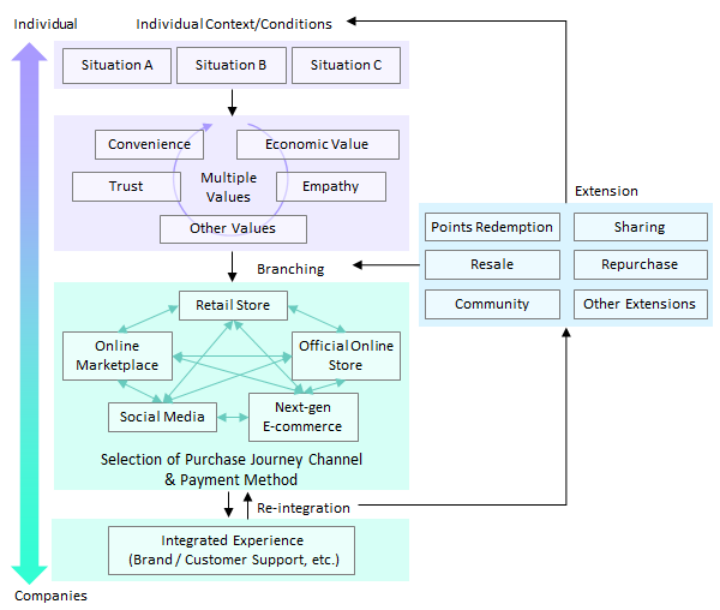
Findings In the following sections, we describe the processes of consumer purchase behavior and the accompanying diversity of actions and values observed. These findings are presented in reference to Figure 1, which offers an over view diagram of the consumer purchase behavior patterns identified in this study.
Figure 1: Overview of multidimensional purchase journey model.
Simplification and Complexity of the Purchase Process According to the survey, the percentage of consumers using online channels for product comparison increased steadily, from 50.0% in 2022, to 52.2% in 2023, and 55.7% in 2024. This trend was especially seen in categories such as consumer electronics and gifts, where an online preference emerged. These results indicate that Japanese purchasing behavior has gone beyond a simple linear process, showing flexible and diverse changes depending on the product, the situation of the consumer, and the broader social environment.
From 2022 to 2024, a shift was observed. In 2023, a simple, one-stop purchasing style—from awareness, through comparison, to purchasing— became stronger, particularly for daily necessities and low-risk items. On the other hand, in 2024, a more complex process of switching between online and offline channels became apparent for high-priced items such as electron ics and gifts, and situation-dependent changes in purchasing behavior were observed.
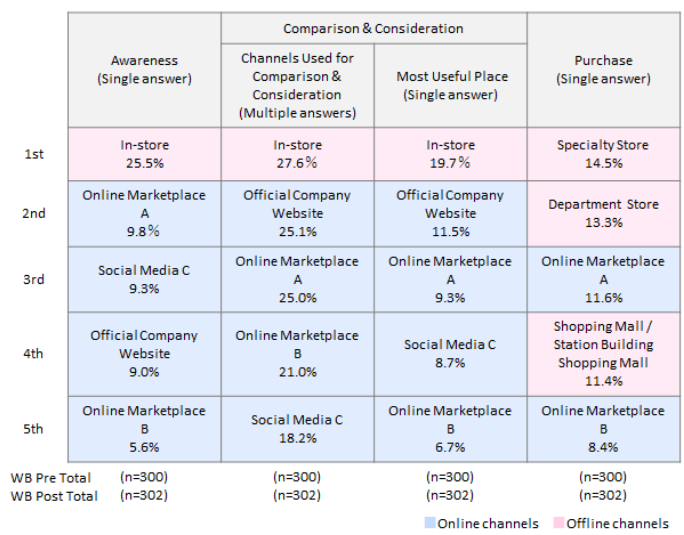
The main channels used for each stage (awareness, comparison, and pur chase) in major product categories were summarized as Channel Journeys in order to visualize branching points and the phenomenon of value switching. Figure 2 is the Channel Journey for the fashion category in 2024.
Figure 2: Channel journey for the fashion category in 2024.
Switching of Values by Category and Situation The values emphasized at the time of purchase have become more diverse. For example, in the 2024 survey, 37.3% of online marketplace users chose their purchase channel because they wanted to earn points, while 12.5% of those using official company website prioritized a sense of security. For con sumer electronics and other high-priced products, respondents highly valued “accuracy of information” and “the support provided by official websites”; 24.2% of electronics purchasers reported that they felt assured because they were buying from the official site. In contrast, for daily necessities, factors such as same-day pickup, price, and point rewards were the main consider ations, highlighting the importance of convenience and economic benefit.
Among younger consumers, empathy and the sharing of experiences through social media and video also played a role in product selection, espe cially for gifts and fashion items.
The emphasis on these values constantly shifts according to individual circumstances, life stage, and social psychology. For example, in times of heightened risk or anxiety, security and trust are prioritized, while in busy periods, quick decision-making and convenience take precedence. Although there were differences by age group, it was observed that flexible switching of purchasing logic according to situation and product has become estab lished across all segments.
In addition, the majority of consumers use multiple point programs and cash less payment methods. Point programs in Japan have developed in a unique way, allowing people to earn and use points flexibly in various situations, beyond the boundaries of specific product types. The practice of collecting and using points is called POIKATSU, and 96% of respondents reported participating in some form of point collection. Japanese-style POIKATSU is not limited to economic advantages; it also supports the enjoyment and customization of the shopping experience. On the other hand, the increase in different types of points and payment methods has led to greater complexity, which has surfaced as a user experience challenge (Cross Marketing Inc., 2021; G-plan Inc., 2024).
Expansion of Risk-Hedging Purchases and Resale Orientation For high-priced products and items intended for long-term ownership, greater emphasis is now placed on risk diversification in purchasing, resale value, and asset value after acquisition. There is a growing trend of consum ers seeking to “extend value after purchase” and make purchases they will not regret.
In the 2024 survey, 4.8% of respondents reported that they now consider potential resale (future selling) when choosing products, an increase from the previous year, and 8.8% had experience purchasing used items.
These trends are also linked to increased sustainability awareness and changes in lifestyle, contributing to the rise in resale-oriented consumers. The structure of the consumer experience is thus shifting toward a cycle that includes pre-purchase, post-purchase, ownership period, and eventual redistribution.
Expectations and Challenges in Customer Support Finally, the survey reconfirmed that the quality of customer support and overall customer satisfaction plays a crucial role in sustaining purchasing behavior and building brand trust. According to a 2024 survey, consumers in Japan consider not only products and pricing, but also additional ser vices—such as the availability of returns and exchanges (20.3%), delivery and arrival notifications via email or message (18.4%), and responsive cus tomer inquiry support (13.9%)—to be especially desirable. This suggests that Japanese consumers increasingly expect easy access to assistance when issues arise, consistent and reliable support, and a satisfying, seamless purchasing experience, rather than being limited to the core attributes of products or price alone.
Looking ahead, the design of customer support experiences—particu larly through predictive and integrated approaches—is expected to become a key differentiator among service providers. These findings underscore the growing importance of support systems that not only respond reactively to
Designing Multidimensional Digital Purchase Journeys 767 customer needs, but also anticipate them proactively and deliver a unified, end-to-end service experience throughout the purchasing journey.
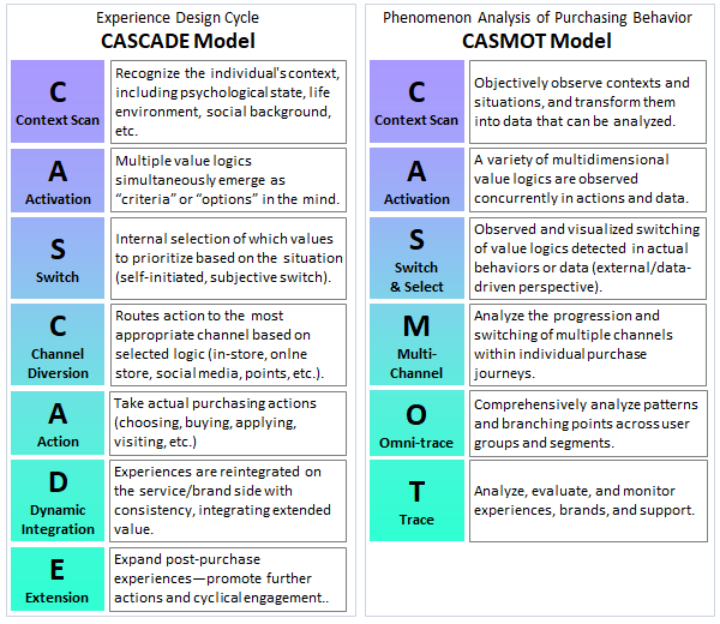
New Frameworks for Contemporary Purchase Journeys: CASCADE and CASMOT Traditional stage-based consumer models, such as AIDMA and AISAS, have long been used to clearly organize the sequence of consumer aware ness and behavioral flow, and are still widely referenced today. This study proposes two new frameworks that leverage the strengths of these existing models while responding to the increasingly complex and multi-faceted nature of modern consumer behavior, including the coexistence of multi ple personal values within individuals, context-specific branching, frequent value switching, cross-channel movement, and post-purchase experience expansion.
The first, the CASCADE model, is particularly useful for structuring ser vice design and UX processes in contexts where individual consumers flex ibly switch between multiple internalized values and channels according to their situations.
CASCADE organizes the customer journey as a circular process, starting with context scanning (Context Scan), moving through simultaneous activa tion of multiple values (Activation), switching and selecting between value logics (Switch & Select), utilizing multiple channels in parallel (Channel Diversion), taking action (Action), dynamic reintegration of experiences (Dynamic Integration), and extension of experiences beyond the original purchase (Extension).
On the other hand, the CASMOT model is particularly effective for visu alizing and analyzing purchase journeys that unfold along diverse pathways, and is especially suitable for tracking and analyzing, within actual data, how value switching and cross-channel behaviors occur. CASMOT is well suited to empirical observation and data analysis. It organizes purchase behavior into stages such as context scanning (Context Scan), concurrent identifica tion of multiple logics (Activation), switching and selecting of logic (Switch & Select), multi-channel progression at the individual level (Multi-Channel), omni-channel tracking at the aggregate level (Omni-trace), and reintegration (Trace), providing a practical framework for the visualization and analysis of complex phenomena.
Both models supplement conventional frameworks, and are meaningful in their ability to clearly describe trends often seen in modern consumer behav ior, such as frequent value switching based on context or mood, branching and multi-track experiences, and the continued expansion and circulation of value after purchase. By applying and combining these models, it becomes possible to support both the design and analytical aspects of a wide range of consumer experience innovations.
Figure 3: The CASCADE and CASMOT models: two frameworks for modern multidimensional purchase journeys.
Discussion
This study has shown that consumer purchasing behaviors in Japan do not progress according to a single pattern. Rather, they flexibly adapt to situa tions, product categories, individual psychologies, and social environments. Multiple values—such as trust, economic rationality, empathy, and conve nience—coexist and are dynamically switched, reflecting an advanced and contemporary purchasing process.
The purchasing process oscillates between “simplification” and “complexi fication” depending on the situation. High-priced products are characterized by multi-stage and cautious purchasing experiences, involving information gathering, in-store confirmation, risk hedging, and attention to resale value. In contrast, for daily necessities and low-risk goods, the simple, one-stop style is more prevalent.
The diversification and utilization of point programs and cashless pay ments have broadened the enjoyment and freedom of the purchasing experi ence, but have also led to the emergence of management complexity and user experience (UX) issues.
Designing Multidimensional Digital Purchase Journeys 769 Furthermore, the desirability of accessible customer support and over all customer satisfaction has once again emerged as an important issue. Consumers value not only products and prices but also services that allow for easy consultation, consistent support, and a pleasant purchasing experience. In this context, the need for integrated, predictive, and consistent customer support has become a major focus for future service and experience design.
Overall, these findings indicate that Japanese purchasing behavior is cur rently at a stage where values and processes can flexibly change according to situation and category, with multidimensionality and circulation as defin ing characteristics. Experience design now requires a balance between con text-adaptive UX and the consistency and proactivity of customer support.
CONCLUSION
In conclusion, Japanese purchasing experiences have evolved into a cyclical structure characterized by context adaptation, multiple values, branching, multi-track progression, and reintegration. It has become clear that, for effec tive service and UX design, it is essential to enable context-based switching, the simultaneous inclusion of diverse values, consistently designed channels and processes, and the extension of user experience beyond the point of pur chase. Furthermore, by utilizing models such as CASCADE and CASMOT, together with multifaceted approaches, it is expected that more flexible and sustainable experience design will be possible, promoting further develop ment of service-oriented society.
ACKNOWLEDGMENT
The author would like to express sincere appreciation to Mr. Satoru Nagayama, Executive Director of Dentsu Digital, for his support and helpful advice. The author is also grateful to all members of the Commerce Fixed- point Survey Team for their assistance in providing data and support in report preparation every year. In addition, the author would like to thank Mr. Kazuhiko Yamazaki, former Professor of Musashino Art University, for reviewing the manuscript.
REFERENCES
Cross Marketing Inc. (2021, April 14). Trends in point programs in Japan. Website: https://www.cross-m.co.jp/report/trend-eye/20210414point Dentsu Digital Inc. (2022, December 21). Survey on consumers’ purchasing behaviors
across digital and offline channels. Website: https://www.dentsudigital.co.jp/news/ release/services/2022-1221-000065 Dentsu Digital Inc. (2023, October 4). Research on commerce behavior across digital and offline channels. Website: https://www.dentsudigital.co.jp/news/release/ services/2023-1004-000113 Dentsu Digital Inc. (2024, October 7). Visualization of cross-channel purchasing
behaviors: Commerce research 2024. Website: https://www.dentsudigital.co.jp/ news/release/services/2024-1007-000175 Dentsu Inc. (2005). AISAS process model. Dentsu Inc.
770 Kamimura Dentsu Inc. (2015). DECAX consumer behavior model. Dentsu Inc. Dentsu Satonao Open Lab. (2011). SIPS model of consumer behavior. Dentsu Inc. G-plan Inc. (2024, June 25). Blog post on consumer behavior models. Website:
https://www.g-plan.net/service/blog/c209 Hori, M. (2013). Transition of consumption society and consumer behavior. Annual Report of the Institute for the Study of Culture and Society, Chuo University, 17, 137–153. Miyamae, M., Matsuoka, Y., & Seki, T. (2024). Design for impulse purchases.
Sendenkaigi Co., Ltd. Mochino, K. (2005). AISCEAS consumer behavior model. Amviy Communications Inc.
LISTED IN THE AHFE DIGITAL BOOKSTORE CATALOGUE
Explore the complete digital volume
Intelligent Human Systems Integration (IHSI 2026): Disruptive and Innovative Technologies
Read this individual research paper free through the original publisher, or explore the full digital proceedings book.
ISBN 978-1-964867-76-2
Explore this ISBN in the AHFE Bookstore ↗Listed in the July 2026 bookstore catalogue; search by ISBN to confirm current availability · Digital book purchase optional