Tam Cao, Yi Qing Khoo, Shivani Birajdar, Zhiyun Gong, Chia-fang Chung, Yassi Moghaddam, Anbang Xu, Hridhay Mehta, Aaditya Shukla, Zhilin Wang, Rama Akkiraju (2024). Designing towards productivity: A centralized AI assistant concept for work. In: The Human Side of Service Engineering. AHFE Open Access, vol. 143, pp. 118–128. https://doi.org/10.54941/ahfe1005090
Recent research has shown that Artificial Intelligence (AI) assistance can significantly improve workers’ productivity. Software such as Zoom and GitHub have also recently introduced AI into the system, marketed to enhance users’ productivity. While each software has its platform, users tend to feel overwhelmed by the numerous workplace tools available. In this paper, we introduce the concept of a centralized platform based around an AI chatbot that can answer user queries from the company's knowledge base and act as a personal assistant to help the user with daily workplace tasks. Exploratory interviews confirmed the need for such a system and gathered users’ expectations, guiding the direction of the preliminary sketches. The concept is evaluated by productivity support's design and interaction aspects without implementing a functional AI chatbot. This research uses qualitative data from multiple rounds of moderated usability testing to identify factors impacting perceived usability. Results showed that participants recognized the system's potential benefits and the overall usability of the design. Participants also highlighted the positive user experience resulting from the capability to access third-party workplace tools for personalized productivity, the conversational and transparent task support interaction, the streamlined workflow with smart suggestions, and the usefulness of a tutorial for learning about the new concept. The research explores a potential shift in the role of workplace support chatbots from question responders to task collaborators. Further research can also look into the actual implementation of such systems, measure their impacts on users' productivity, and explore potential challenges and ethical considerations in deploying these AI assistants in real-world business settings.
Popular AI applications like ChatGPT can potentially enhance workplace productivity. Recognizing the need for a unified solution in the current work- place tool, we present a design concept for a next-gen workplace AI assistant. In order to address the exploratory research findings, our design concept emphasizes individual productivity through a centralized experience. This
Designing Towards Productivity: A Centralized AI Assistant Concept for Work 119
involves connecting employees’ work accounts and ensuring a seamless con- versational experience by leveraging AI. It is worth noting that our research’s scope includes designing and evaluating a concept without integrating AI into the prototype, allowing for a proof of concept before committing resources to software implementation. The research questions to guide our evaluation are:
1. Are users open to a centralized AI assistant for productivity? 2. What interaction and interfaces are most effective for AI task support? 3. Does the proposed concept require minimal learning effort for users?
RELATED WORK
Previous Research AI’s rapid advancement presents significant potential for individuals and businesses. In business applications, AI offers benefits such as error reduc- tion, task automation, and availability for tasks like data retrieval and recommendations (Google, n.d.). This potential is demonstrated by 97% of business owners anticipating ChatGPT’s positive impact on their enterprises (Haan, 2023). Previous research has established a connection between AI and increased productivity (Kapur, 2022). AI’s roles in enhancing produc- tivity can come across various sectors, from manufacturing firms optimizing routine tasks (Gao et al., 2023; Javaid et al., 2022) to improving project man- agement (Dam et al., 2019), customer support (Brynjolfsson et al., 2023), and HR functions (Workday, 2023). Enthusiasm for AI is not confined to busi- ness owners; employees also express excitement (Workday, 2023), with 50% seeking a unified solution for diverse tasks and 90% open to AI assistance for at least 1 task (Robinson, 2023). AI positively influences employee job satisfaction (Kapur, 2022), highlighting the need for a centralized AI work assistant within the company context. The exploratory research (Gong et al., 2024) identified trust challenges, the need for conversational experience, and productivity assistance in human-AI interaction.
Market Research AI is commonly used in business tools but often serves specific purposes, creating a disjointed experience. For instance, GitHub Copilot and Zoom AI address coding and meeting needs separately. However, there is a trend towards centralization, where tools like Slack integrated AI into their com- munication platform to connect various platforms for automation, data retrieval, and project management. AmazonQ is another example, using AI to streamline AWS setup, troubleshoot, manage business intelligence, and improve customer experience.
INITIAL DESIGN In our early research (Gong et al., 2024), users wanted an AI chatbot that provided a conversational experience and assisted with daily work tasks. The tasks include coding support, meeting summaries, scheduling, draft- ing emails, and helpdesk ticket submissions. Based on these insights, our
preliminary design focuses on a chatbot that delivers reliable answers and task support. While the complete design includes various features, this paper explores explicitly and evaluates its productivity aspects.
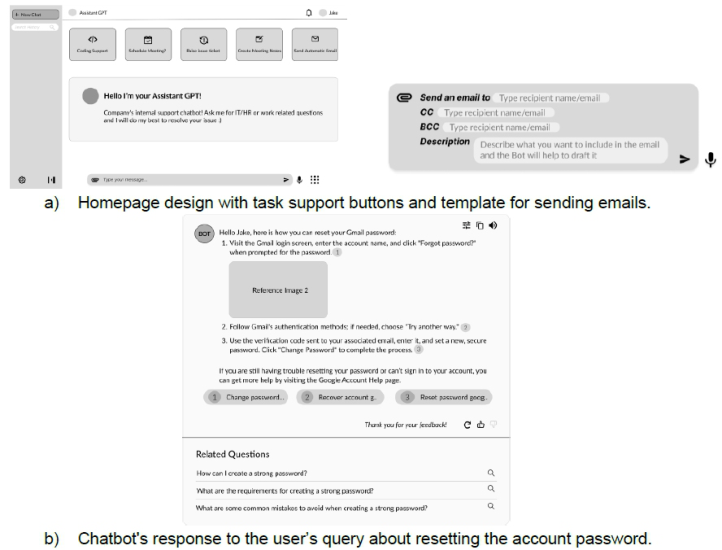
The initial concept introduces a centralized AI assistant designed to enhance user productivity by assisting with tasks upon request. This is achieved by integrating with users’ employee email and work platforms. To showcase the chatbot’s capacities, we have implemented task assistant but- tons that provide request templates, allowing users to edit input information (Figure 1a).
To prioritize interactive chatting and minimize the learning curve for users, we adopted a ChatGPT-style interface for the chatbot’s homepage. The response design emphasizes a conversational and transparent experience, fea- turing source links, customizable verbosity, a transparent chain of thoughts or bullet points for explanations, and multimedia formats in both input and output (Figure 1b).
Figure 1: The initial designs based on the findings of exploratory research.
EVALUATION PROCESS We used a qualitative method to understand user preferences for a new pro- ductivity AI concept, as qualitative research is vital for exploring new topics and solutions (Islam, 2022) and is recommended in the iterative design pro- cess (Van Velsen et al., 2008). Our evaluation process is comprised of three stages. In the first stage, we tested user reactions to the AI assistant con- cept, navigation, and chatbot responses. In the second stage, we focused
Designing Towards Productivity: A Centralized AI Assistant Concept for Work 121
on refining the interaction and interface for smart task support. The third stage validated previous insights and finalized the chatbot design with pro- ductivity features. We iterated the Figma (a design tool) prototype throughout each stage based on feedback from at least three users for the next testing stages. Usability testing was conducted in each evaluation stage. Preference testing was included in the first two stages to expedite the iteration-testing process.
Participants We recruited participants from diverse sources, including professionals, aca- demics, and high-tech company employees. A screening survey helped us identify those with professional experience, while we also welcomed partic- ipants with limited chatbot experience for diverse perspectives. We aimed to recruit participants of diverse backgrounds, including industries, gen- ders, and ages, to acknowledge the varied roles of chatbot users in a company. The participants, ranging in age from 20 to 50+, were split 60% female and 40% male, representing professions such as designers, engineers, project managers, marketing specialists, and legal consultants. In addition to general users, we included three AI/ML experts from a leading technology company to capture insights into the domain’s visions and concerns. With the total of 15 participants, the first testing stage had 7, including 2 from the pilot testing, and the 2 later stages involved 8 participants.
User Testing For moderated usability testing, we employed semi-structured interviews, think-aloud protocols, and observation to collect feature insights. This facilitated aligning user actions and impressions with detailed expla- nations, enabling a qualitative assessment of feature intuitiveness and usability.
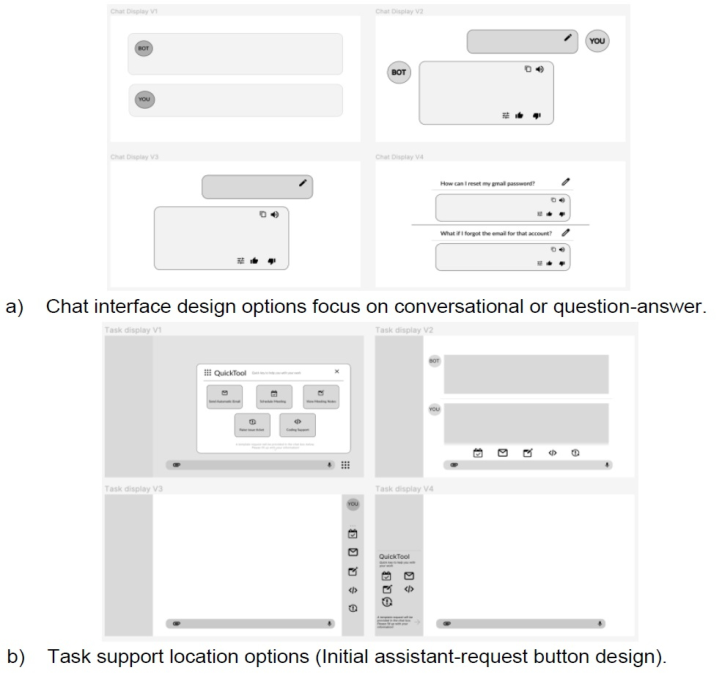
For preference testing, users were presented with design variations for different features, allowing us to explore their preferences and the under- lying reasons. This method was instrumental in guiding early-stage design decisions. The preference testing examples were referred to in Figures 2a and b.
Data Analysis Qualitative data, comprising user feedback and observation notes, was gath- ered during usability and preference testing. Notetaking and data synthesis on Google Sheets facilitated the collection process, with documented key insights and common themes from participants.
Figure 2: Examples of preference testing with design variation of the same features.
FINDING THEMES We identified key productivity themes with the supporting user quotes:
Users Expressed Interest in a Centralized AI Productivity Platform Concept Participant 12 stated, “From the perspective of (a stand-alone) webpage, I think this (AI task support platform connects with third parties) is very useful.” Participant 4 shared, “Usually, all of these things (the task support request buttons) are on different platforms. I would definitely feel that it would be helpful to have everything more centralized and maybe interplaying with each other.”
Initial Support Interaction With Templates From Buttons Proved Less Efficient Users preferred direct chat interactions over button menus and editing templates. Participant 11 said, “I probably would have just typed into it directly… it is almost slower to click through a menu of buttons”.
Designing Towards Productivity: A Centralized AI Assistant Concept for Work 123
Users expect the chatbot to access employee data for information auto- filling and quick verification with minimal manual edits. Participant 10 expressed, “It should be able to figure all these things from what I typed.” Participant 15 said, “We should avoid getting too much information from the users we already have.”
The Need for Real-Time Updates and Familiar Interfaces in Task Collaboration Users feel more confident in task support when receiving immediate feedback on the draft generated by the bot. Participant 10 suggested, “I would like to see the window of the form that will be on the right side, and the left side will be for conversation with the bot, which automatically fills up that form.” Participant 15 appreciated the interface, “I like how it shows the draft and lets me check before I hit submit.”
Users tend to trust interfaces they are familiar with, especially in the context of daily work tasks. Participant 12 stated, “If it is plug-in with Ser- viceNow, impact the transparency, perfect, just as ServiceNow would have shown… If I had that ticket flow that we follow in ServiceNow, I think I would have trusted the bot more.”
The Need for Conversational Experience and Workflow Streamlining Users needed continuous conversation and task support when chatting with the bot. Participant 3 from the exploratory research (Gong et al., 2024) men- tioned, “I will go to Google to research more about the topic based on the answer. But if there is a question at the end asking if I want more informa- tion about the topic, I would continue chatting with the bot”. Participant 13 shared about their complete workflow and expressed the need for expedite transitioning to the next task, stating, “We used to give code to the tool, make it review that, and we also add another round of peer review on the same sug- gestion that the tool has provided… With that button (Smart suggestion to Request team review), you can also export those (bot suggestions) directly”.
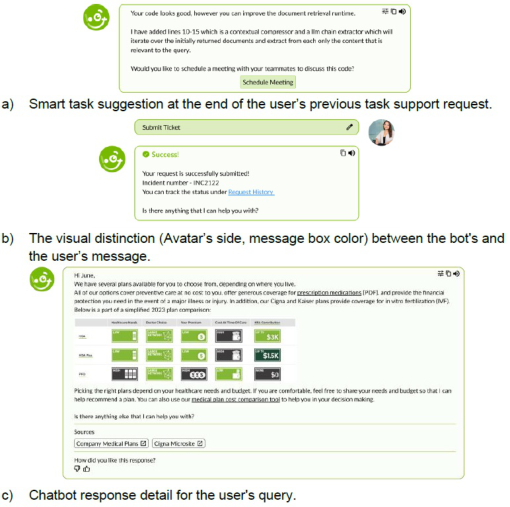
In preference testing, users favored a more conversational chatting expe- rience. Participant 5 expressed, “I like this one the most because it seems like a conversation… One of my issues when I am using ChatGPT, for exam- ple, is when I am scrolling, I cannot tell which messages are mine and which are theirs”. Participant 2 mentioned, “This (Q&A-focused display) is more formal; this one (messaging display) is more interactive.”
Participants confirmed the insights from our initial research on the bot’s responses. Participant 5 mentioned, “I like how the steps are really simple. I like that there are going to be images. And I like the sources; I think this is nice just in case I need to do something a little more specific. And the related questions, I like it too.”
Users Experienced Confusion With the New Assistant Concept and Navigation Users mistakenly saw the productivity-focused interface as primarily for chatting, influenced by past experiences with conversational chatbots like
ChatGPT or Slack bots. Participant 8 mentioned, “This part is pretty weird (the productivity features)… What is the goal of the chatbot?”
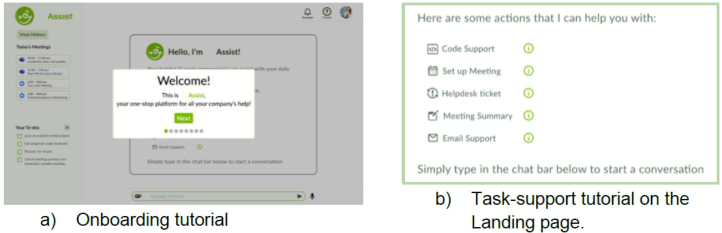
Users suggested a tutorial as a solution for a new product concept. Partic- ipant 6 said, “... sometimes before I use a product I am not familiar with… they have a short tutorial…”
DESIGN RECOMMENDATION Based on our findings, we propose recommendations with demonstrations.
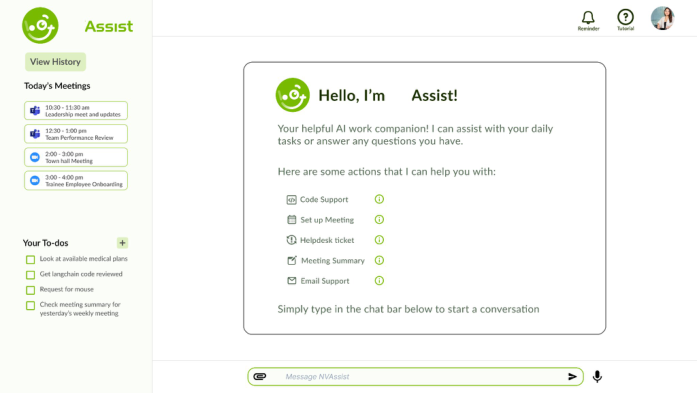
Centralized AI Platform For a centralized assistance experience, the bot should integrate with the employee’s account and work platforms. This enables the AI assistant to access and retrieve data for answering queries and task execution. The home- page should highlight personalized productivity, displaying today’s meetings, to-do lists, and smart reminders to keep users on track with their tasks (Figure 4).
Figure 3: AI assistant landing page.
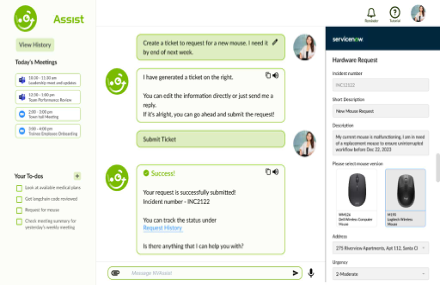
Support Interaction and Interface To enhance the task support experience, we propose chatting interaction for support requests and auto-filling user information in generated task drafts. A split-screen interface, adopted from third-party platforms, can seamlessly integrate real-time updates from user request chats to the gener- ated task drafts, fostering trust and familiarity within the task support flow (Figure 5).
Designing Towards Productivity: A Centralized AI Assistant Concept for Work 125
Figure 4: Real-time updates with split screen and 3rd-party interface for task support.
Conversational Experience and Workflow Streamlining In optimizing workflow efficiency, our recommendation involves utilizing AI to suggest the next tasks following each task-related interaction, enabling users to confirm and proceed quickly (Figure 6a). To enhance prolonged and regular interaction in the daily workplace setting, we advocate for a distinct visual separation between user and chatbot messages (Figure 6b).
In order to foster transparency and convenience, the bot’s responses should include source links, customizable verbosity, chain-of-thoughts or bullet- point information display, and multimedia formats in input and output (Figure 6c).
Figure 5: The conversation with the AI assistant.
Improved Navigation Enhanced user navigation can be achieved by adding an onboarding tuto- rial to guide users on feature locations and usage (Figure 7a). Additionally, task assistant features should be prominent on the landing screen as a fixed educational tutorial highlighting the bot’s capabilities (Figure 7b).
Figure 6: The platform’s tutorials.
DISCUSSION
Our project shares a vision with Amazon Q and Slack AI to create a central- ized AI productivity solution for businesses. While similarities include chat interaction and access to company databases, our approach differs. Unlike existing solutions that build upon their current products (communication channels and AWS services), our design is a stand-alone platform for per- sonalized employee productivity. Our exploration introduces a split-screen interface for transparency of task support and next-task smart suggestions, which existing solutions during the literature review lacked.
This paper is constrained by its focus on productivity features rather than the entire application and the lack of AI implementation. Also, the valida- tion lacks quantitative data and an in-depth feature comparison with similar concepts. Additionally, our concept is influenced by ChatGPT, limiting the exploration of different interactions and interfaces.
Future efforts should prioritize user testing on a functional AI prototype, integrating quantitative methods for a comprehensive evaluation. Exploring the AI assistant concept in the context of enhanced user collaboration and communication is valuable for expanding this concept. To ensure the appli- cability of this concept, collaboration with AI/ML, legal, and IT experts is crucial for verifying technical feasibility and addressing privacy concerns in real business settings. The design, influenced by user biases towards Chat- GPT and challenges arising from the novelty of the productivity AI assistant concept, requires ongoing market research and iterative development for rel- evance. Additionally, ethical considerations should explore the impact on employment, including potential role replacements and new opportunities.
Designing Towards Productivity: A Centralized AI Assistant Concept for Work 127
CONCLUSION
This research introduces an innovative AI-driven approach to boost indi- vidual productivity through a centralized platform. Motivated by challenges posed by diverse workplace tools, we designed and evaluated the initial con- cept, refining it based on the evaluation results. Conclusions drawn from our research questions include 1) users’ interest in a centralized AI productivity platform, 2) a preference for conversational AI to personalize and streamline workflow, and 3) a need for a tutorial for the new productivity concept. Our study envisions AI as a task collaborator, fostering its integration in business for enhanced efficiency and productivity.
REFERENCES
[AmazonQ preview]. (n.d). AWS. https://aws.amazon.com/q/ [Figma homepage]. (n.d). Figma. https://www.figma.com/ [Github copilot homepage]. (n.d.). Github Copi- lot. https://github.com/features/copilot Brynjolfsson, E., Li, D., & Raymond, L. R. (2023). Generative AI at work (No. w31161). National Bureau of Economic Research. Dam, H. K., Tran, T., Grundy, J., Ghose, A., & Kamei, Y. (2019, May). Towards effec-
tive AI-powered agile project management. In 2019 IEEE/ACM 41st international conference on software engineering: new ideas and emerging results (ICSE-NIER) (pp. 41–44). IEEE. Gao, X., & Feng, H. (2023). AI-Driven Productivity Gains: Artificial Intelligence and Firm Productivity. Sustainability (Basel, Switzerland), 15(11), 8934. https: //doi.org/10.3390/su15118934 Gong, Z., Birajdar, S., Cao, T., Khoo, Y., Chung, C., Moghaddam, Y., Xu, A.,
Mehta, H., Shukla, A., Wang, Z., & Akkiraju, R. (2024). Enhancing Trust in LLM Chatbots for Workplace Support through User Experience Design and Prompt Engineering Advances in the Human Side of Service Engineering, Vol. 135. Proceedings of the International Conference on Applied Human Factors and Ergonomics AHFE (2024) July 24–27, 2024, Université Côte d’Azur, Nice, France. Google. (n.d.). What is Artificial Intelligence (AI)?. https://cloud.google.com/learn/w hat-is-artificial-intelligence Haan, K. (2023, April 24). How Businesses Are Using Artificial Intelligence In 2024.
Forbes Advisor. https://www.forbes.com/advisor/business/software/ai-in-business/ Islam, M. A., & Aldaihani, F. M. F. (2022). Justification for adopting qualitative research method, research approaches, sampling strategy, sample size, interview method, saturation, and data analysis. Journal of International Business and Management, 5(1), 01–11. Javaid, M., Haleem, A., Singh, R. P., & Suman, R. (2022). Artificial intelligence appli-
cations for industry 4.0: A literature-based study. Journal of Industrial Integration and Management, 7(01), 83–111. Kapur, D. (2022). Application of Artificial Intelligence: Productivity and Job Satisfaction Analysis (Literature Review Study). Dinasti International Journal of Education Management And Social Science, 4(1), 148–157. https://doi.org/10. 31933/dijemss.v4i1.1554 Meet Zoom AI Companion, your new AI assistant! Unlock the benefits with a paid
Robinson, B. (2023, March 10). Employees Are Overloaded—96% Say Workplace Tools Aren’t Helping Them Keep Up. Forbes. https://www.forbes.com/sites/bryan robinson/2023/03/10/employees-are-overloaded-96-say-workplace-tools-arent- helping-them-keep-up/?sh=6263d26f4d88 Slack AI. (2023). The future of intelligent productivity, powered by Slack AI [Brochure]. https://d34u8crftukxnk.cloudfront.net/slackpress/prod/sites/6/Slac kAI_productivity.pdf Van Velsen, L., Van Der Geest, T., Klaassen, R., & Steehouder, M. (2008). User-
centered evaluation of adaptive and adaptable systems: A literature review. The knowledge engineering review, 23(3), 261–281. Workday. (2023, November). A Human-Centered Approach To AI In The Workplace. https://forms.workday.com/en-us/reports/a-human-centered-approach-to- ai-in-the-workplace/form.html?step=step2_hr
LISTED IN THE AHFE DIGITAL BOOKSTORE CATALOGUE
Explore the complete digital volume
The Human Side of Service Engineering
Read this individual research paper free through the original publisher, or explore the full digital proceedings book.
ISBN 978-1-964867-19-9
Explore this ISBN in the AHFE Bookstore ↗Listed in the July 2026 bookstore catalogue; search by ISBN to confirm current availability · Digital book purchase optional