Jin-long Lin, Chen-rao Zhong, Meng-Cong Zheng (2025). Goodbye to Parking Anxiety: An Empirical Study on the Usability of Automatic Parking Assist Systems. In: Human Factors in Design, Engineering, and Computing. AHFE Open Access, vol. 199, pp. 2044–2054. https://doi.org/10.54941/ahfe1007016
Parking continues to pose a considerable challenge for novice drivers, particularly within complex urban settings. As vehicle automation technologies advance rapidly, Automatic Parking Assist (APA) systems have become increasingly prominent and valuable features in contemporary vehicles. Despite their growing prevalence, empirical research on the user experience of APA systems remains scarce, and a systematic evaluation framework has not yet been fully established. To address this gap, the present study conducted a comprehensive evaluation of the usability and performance of APA systems in three mainstream sport utility vehicle (SUV) models available in the Chinese market: the Avatr 11, AITO M5, and Trumpchi Emkoo. A mixed-methods approach was employed, integrating heuristic evaluation with objective performance testing. Specifically, two performance metrics were collected, including parking time and the number of steering corrections, in order to assess the systems across three common parking scenarios. The usability issues identified through heuristic evaluation were categorized into four dimensions: functionality, interactivity, sensory experience, and emotional response. These dimensions served as the basis for analyzing the frequency and characteristics of usability problems and for informing future design improvements. Additionally, a user journey map was constructed to represent the operational flow of APA usage. Finally, targeted design recommendations are proposed to enhance system satisfaction. These insights contribute to the refinement of APA systems and offer a practical framework for future research on intelligent vehicle-human interaction.
Parking is one of the most common tasks in daily urban driving, especially in densely populated areas and space-constrained environments, where it places high demands on drivers’ operational skills and spatial awareness (Mashko et al., 2021). A study of reversing accidents across 25 U.S. states found that 64% of such collisions occurred in parking lots (Cicchino, 2019), with over 60,000 parking lot accidents reported annually (Gurbuz et al., 2022). Parking
Goodbye to Parking Anxiety: An Empirical Study on the Usability 2045
difficulties have become a common source of stress for novice drivers and can lead to traffic congestion, property damage, or even serious traffic accidents (Oetiker et al., 2009). Even when driving vehicles equipped with rear-view cameras and radar sensors, collisions remain difficult to avoid (Hurwitz et al., 2010), primarily due to limitations in drivers’ visibility, attention, and experience.
With the rapid advancement of autonomous driving technologies, Automatic Parking Assist (APA) systems have emerged as a critical component of intelligent driving. They are now widely integrated into many mid-end to high-end vehicle models. APA systems typically consist of an environment recognition module, a path planning module, a path tracking controller subsystem, and improved actuators (Song & Liao, 2016). These components work together to identify parking spaces, generate parking trajectories, and automatically control steering, acceleration, and braking to assist drivers in completing parking maneuvers in various types of spaces. In recent years, APA systems have continued to improve technologically, with advancements in perception accuracy, trajectory planning algorithms, and control execution stability (LR et al., 2024). However, real-world user interactions with APA systems still encounter usability challenges and operational errors (Barré & Yousfi, 2025). Issues such as the intuitiveness of the system’s activation process, the clarity of feedback during parking, and the precision of the final parked position significantly affect overall user satisfaction. Existing research has largely focused on algorithmic performance and sensor configurations (Ma et al., 2021; Wang et al., 2023; Yang et al., 2024), while systematic evaluation of APA systems from the perspectives of human factors and user experience remains scarce. Moreover, there is currently no standardized framework for evaluating APA usability, which limits cross-model comparisons and reduces the transferability of improvement recommendations across different vehicle systems.
To address the aforementioned research gaps, this study takes vehicles equipped with APA systems as the primary subject and conducts a comprehensive evaluation of both usability and objective indicators through heuristic evaluation and performance testing. The research focuses on the real-world use of APA across three typical parking scenarios: perpendicular spaces, parallel spaces, and angled spaces. It also integrates qualitative feedback from in-vehicle human factors experts with quantitative performance metrics to analyze user experience and system behavior from multiple perspectives. The main research objectives of this study are fourfold:
1. To develop a systematic usability evaluation framework tailored for APA systems, encompassing four core dimensions: functionality, interactivity, sensory experience, and emotional response. 2. To identify key user touchpoints and usability issues throughout the APA usage process using user journey mapping, thereby providing theoretical support for optimizing human-machine interaction design. 3. To analyze the performance of APA in three mainstream vehicle models across different parking scenarios, and to explore differences in path planning and vehicle control strategies.
4. To synthesize findings from both usability testing and performance evaluation and propose actionable recommendations that offer empirical support for future APA design and implementation.
MATERIALS AND METHODS
APA Vehicle Sample This study selected three vehicle models equipped with APA systems as the evaluation subjects, namely the Avatr 11, AITO M5, and Trumpchi Emkoo. To control for differences in parking-related conditions across APA systems, all three vehicles are Sport Utility Vehicles (SUVs) with similar body dimensions (see Table 1). Additionally, the study recorded each vehicle’s hardware configurations relevant to intelligent driving systems. Detailed information is presented in Table 2.
Table 1: Body dimensions of the three vehicle models. (Unit: mm).
Table 2: Intelligent driving hardware configurations of the three vehicle models.
Table available in the original PDF paper.
Vehicle Model
LiDAR Millimeter-Wave Radar
Ultrasonic Sensors
Exterior Cameras
6 units 12 units 13 units
Avatr 11 3 units (semi-solid-state LiDAR) None 3 units 12 units 6 units AITO M5 None 3 units 12 units 6 units Trumpchi Emkoo
Heuristic Evaluation (Usability Test) For the evaluation methodology, this study invited nine experts in the field of in-vehicle systems to conduct a usability assessment of APA systems using the heuristic evaluation method. The expert panel consisted of three interface designers, three human factors engineers, and three APA system developers. Before the evaluation, each expert was provided with a usability assessment guideline covering four dimensions: functionality, interactivity, sensory experience, and emotional response (see Table 3). The guideline was adapted from a previously established evaluation framework developed for in-vehicle AR-HUD usability (Lin et al., 2024). It also incorporated principles from the ISO 9241–10 usability standard (Prümper, 1993). We also provide each expert with a detailed description of each criterion. For example, Completeness refers to “Whether the APA system includes all necessary functions for completing parking tasks and meets the requirements of common usage scenarios.” Experts examined each APA system based on
Goodbye to Parking Anxiety: An Empirical Study on the Usability 2047
16 assessment criteria across the four dimensions and identified usability issues using the “thinking aloud” method (Van Someren et al., 1994). During the evaluation, experts sat in the driver’s seat, interacted with the APA system, and simultaneously provided their observations, while the researchers recorded the usability problems raised in real time.
Table 3: Evaluation guidelines for usability testing.
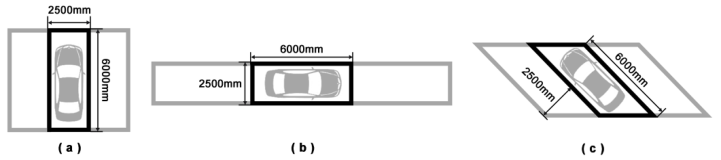
Test Environment The usability testing was conducted at a closed vehicle testing ground over the course of three days, with all sessions scheduled during daylight hours with sufficient sunlight. The basic parking scenarios were categorized into three types: perpendicular, parallel, and angled parking spaces (Wang et al., 2023), as illustrated in Figure 1. During the evaluation, each domain expert was required to use the APA system to complete parking tasks for all three space types. In addition, each expert conducted a heuristic evaluation for all three vehicle models. To control for order effects, a Latin Square design was employed to balance the testing sequence across experts.
Figure 1: Three basic types of parking spaces. (a) Perpendicular parking (b) Parallel parking (c) Angle parking.
Benchmarks Test (Performance Test) Following the usability testing, the research team conducted a benchmark test to evaluate the performance of the APA systems in the three selected vehicle models across the three types of parking spaces. Specifically, a researcher familiar with the APA functionality operated each test vehicle and used the APA system to complete parking tasks in perpendicular, parallel, and angled spaces. Another researcher was responsible for recording the parking duration and the number of steering corrections. Each parking scenario was tested three times per vehicle model, and the average values were used for analysis. Parking duration was used as an indicator of the system’s vehicle control performance, while the number of steering corrections reflected the path planning capability of the APA system. The number of steering corrections refers to the total number of directional adjustments made through gear shifting during the APA operation.
EVALUATION RESULTS Usability Test Results
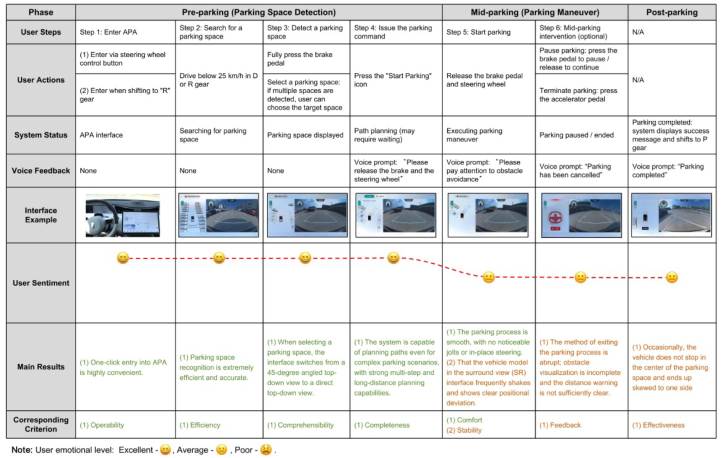
During the heuristic evaluation of the Avatr 11, a total of 16 usability issues related to the APA system were identified. These included 6 issues related to functionality, 3 related to interaction, 3 concerning sensory experience, and 4 related to emotional response. To evaluate the APA system’s parking process, we constructed a user journey map based on three stages: Pre- parking (parking space detection), Mid-parking (parking maneuver), and post-parking. Key usability issues identified during the evaluation are marked within the journey map (see Figure 2).
Figure 2: User journey map of the Avatr 11 APA system during parking.
Goodbye to Parking Anxiety: An Empirical Study on the Usability 2049
The user journey map for parking with the Avatr 11 indicates that during the parking space detection stage, the user experience is generally positive. This is mainly reflected in the convenient activation of the APA function, high efficiency in parking space detection, and well-visualized interface presentation. However, during the parking maneuver and post- parking stages, the user experience is relatively average. The main issues arise from the Surrounding Reality (SR) interface, where the vehicle model exhibits noticeable shaking and shows significant deviation from the actual vehicle’s relative position in the environment. Additionally, in the post-parking stage, a key usability problem is that the vehicle’s final parked position is not centered within the parking space, showing a clear bias toward one side. Despite these positional deviations, the Avatr 11 successfully completed parking maneuvers in all three basic parking scenarios.
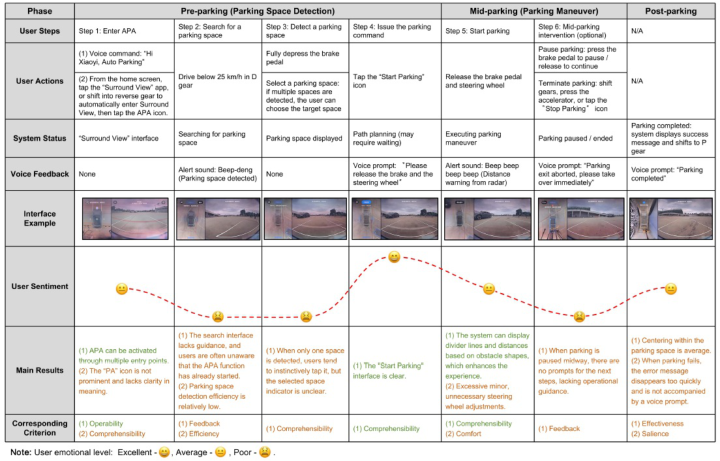
Figure 3: User journey map of the AITO M5 APA system during parking.
In the heuristic evaluation of the AITO M5, a total of 33 usability issues related to the APA system were identified, including 12 functional issues, 5 interaction issues, 10 sensory experience issues, and 6 emotional response issues. As shown in Figure 3, the overall user experience during the APA- assisted parking process in the AITO M5 exhibits considerable variability. During the pre-parking stage, the APA function icon has low recognizability, which may cause difficulty for first-time users to identify its functionality. Additionally, the vehicle’s parking space detection efficiency is relatively low during the search phase; the system often only recognizes a parking space when the vehicle has already passed or is very close to it. During the parking maneuver stage, major issues include noticeable jerking during braking and gear shifting, as well as excessive steering corrections that do not contribute
to actual maneuvering. However, the AITO M5 performs well in its Around View Monitor (AVM) system, demonstrating high accuracy in obstacle detection and well-designed alert messages. Finally, in the interruption or post-parking stage, the system exhibits unclear indicators, and the vehicle’s final parked position often deviates from the center of the parking space.
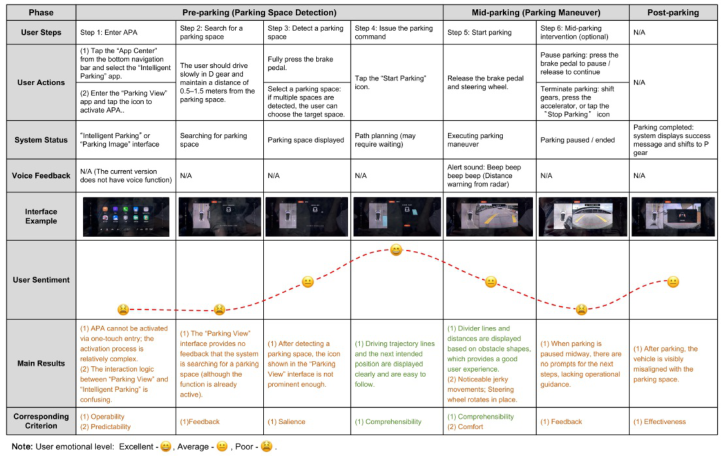
Figure 4: User journey map of the Trumpchi Emkoo APA system during parking.
In the heuristic evaluation of the Trumpchi Emkoo, a total of 38 usability issues related to the APA system were identified, including 13 functional issues, 5 interaction issues, 12 sensory experience issues, and 8 emotional response issues. As shown in Figure 4, the overall user experience during APA-assisted parking with the Trumpchi Emkoo was unsatisfactory. Firstly, the APA function in this model does not support one-touch activation or voice wake-up, which may reduce user willingness to use the system. When accessing the APA function through the “Parking View” application, the system interface feedback is insufficiently clear. Moreover, after detecting a parking space, the user must manually click an icon to switch to the “Intelligent Parking” page, resulting in a lack of operational fluidity. Additionally, the parking space detection efficiency is relatively low. The system only completes detection when the vehicle is fully in front of or has passed behind the parking space. The detection rate is also low, especially when two or more parking spaces are present; the system often recognizes only a single space. During the parking maneuver stage, the vehicle exhibits significant jerking and frequent on-the-spot steering adjustments, negatively impacting ride comfort. Despite these issues, the interface experience during parking is relatively acceptable, with clear visual indicators of obstacle distance and timely, clear feedback on parking steps. Finally, in the post- parking stage, the vehicle’s final parked position frequently shows noticeable
Goodbye to Parking Anxiety: An Empirical Study on the Usability 2051
deviation, and the vehicle body is not aligned parallel to the parking space lines.
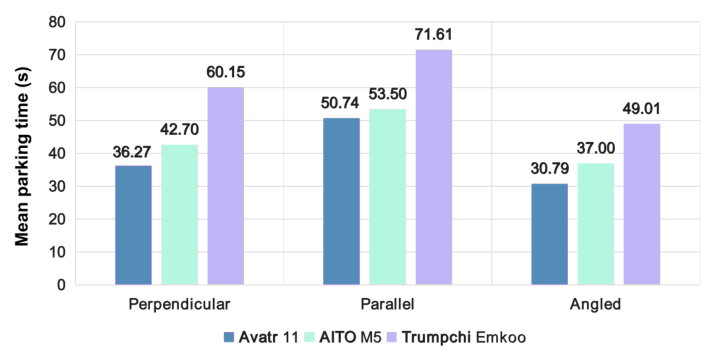
Performance Test Results As shown in Figure 5, the ranking of parking duration across the three vehicle models remained consistent for perpendicular, parallel, and angled parking scenarios: Avatr 11 recorded the shortest parking time, followed by AITO M5, while Trumpchi Emkoo had the longest parking time. In terms of parking space type, angled spaces resulted in the shortest parking duration for all models, followed by perpendicular spaces, with parallel parking taking the longest time.
Figure 5: Mean parking time of the APA systems across three vehicle models under different parking space types. (Note: The recorded time excludes the parking space detection phase and starts from the moment the “Start Parking” function is initiated.).
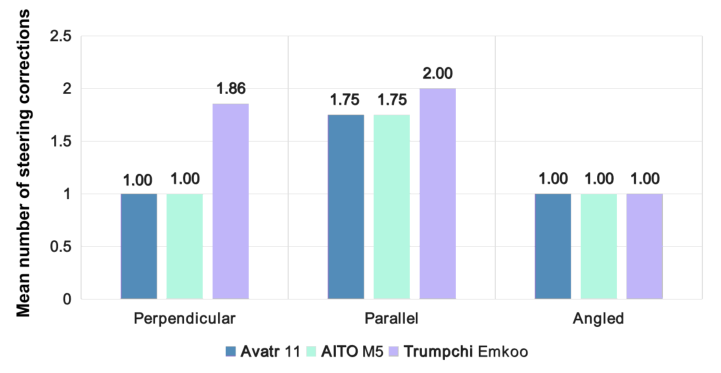
Further analysis of the number of steering corrections across different parking space types revealed that Avatr 11 and AITO M5 demonstrated identical performance (see Figure 6). In contrast, Trumpchi Emkoo exhibited a noticeably higher number of steering corrections in perpendicular and parallel parking scenarios, while its performance in angled parking was comparable to that of the other two models.
Overall, although Avatr 11 and AITO M5 exhibited identical performance in terms of the number of steering corrections, there was a notable difference in parking time, with Avatr 11 completing parking maneuvers more quickly. Combined with the findings from the usability test, Avatr 11 demonstrated superior smoothness during parking. This was particularly evident in the seamless coordination between gear shifting and steering operations. In contrast, both AITO M5 and Trumpchi Emkoo exhibited in-place steering and frequent pauses during parking, with Trumpchi Emkoo showing more pronounced issues, thereby negatively affecting the overall user experience.
Figure 6: Mean Number of steering corrections of the APA systems across three vehicle models under different parking space types.
DISCUSSION
According to the user journey maps of the three vehicles equipped with APA systems, emotional feedback during the post-parking phase generally fell short of expectations. A key reason is that after parking is completed, the vehicle sometimes fails to stop in a centered position within the parking space. Based on the Peak-End Rule, the most intense (peak) and final (end) moments of an experience influence overall evaluations more than the average experience (Fredrickson & Kahneman, 1993). Therefore, future improvements to APA systems should focus on enhancing performance at the final stage of parking. Specifically, the vehicle should stop centered and aligned with the parking lines, and the system should provide clear and explicit feedback to confirm the completion of the parking task. These measures help reinforce the user’s sense of accomplishment and satisfaction. In addition, stages where users rated their emotional experience as “Poor” should not be overlooked. For instance, in Step 2 (search for a parking space) with AITO M5, the APA interface lacked guidance and the parking space detection efficiency was low, both of which negatively impacted user experience.
Among the three evaluated models, Avatr 11 performed better overall than the other two. It is worth noting that even though Avatr 11 has a larger body size in all dimensions except height compared to the other SUVs, its parking performance was not adversely affected. In fact, it demonstrated higher efficiency and stability. During the parking space detection phase, Avatr 11 also showed faster response time and better recognition accuracy. These advantages are likely related to its more advanced intelligent driving hardware, such as the integration of high-performance LiDAR sensors (LR et al., 2024; Yang et al., 2024). The benchmark test results further indicate that although Avatr 11 and AITO M5 performed similarly in path
Goodbye to Parking Anxiety: An Empirical Study on the Usability 2053
planning ability, Avatr 11 clearly outperformed AITO M5 in the smoothness and precision of vehicle control. In contrast, Trumpchi Emkoo showed significant limitations in both planning and control aspects. Its APA system still has substantial potential for future improvement.
CONCLUSION
This study conducted a systematic usability and performance evaluation of mainstream APA-enabled vehicle models in the Chinese market, identifying common issues present in the real-world use of APA systems and proposing targeted improvement suggestions. First, in the parking space detection stage, the system should offer an intuitive and accessible method for activating APA and improve the efficiency of parking space recognition, particularly for medium to long-distance spaces. Second, during the parking maneuver stage, efforts should focus on optimizing the visual feedback design of the predicted driving trajectory and enhancing the smoothness and continuity of vehicle movements throughout the parking process, thereby reducing user uncertainty and operational disruption. Finally, in the post-parking stage, whether the vehicle can be accurately centered within the parking space is a critical factor influencing overall user satisfaction and perception of the APA system. Moreover, this study proposed a methodological framework that combines heuristic evaluation with performance testing, offering empirical support and methodological reference for future APA system design optimization and user experience research.
REFERENCES
Barré, J., & Yousfi, E. (2025). Training older drivers to use automatic parking assistance: Error analysis and mental model evolution. Journal of Transport & Health, 44, 102098. Cicchino, J. B. (2019). Real-world effects of rear cross-traffic alert on police-reported
backing crashes. Accident Analysis & Prevention, 123, 350–355. Fredrickson, B. L., & Kahneman, D. (1993). Duration neglect in retrospective evaluations of affective episodes. Journal of personality and social psychology, 65(1), 45. Gurbuz, O., Aldrete, R. M., Salgado, D., Ostos, M. V., & Madrid, D. (2022). The
future of parking: Safety benefits and challenges. Hurwitz, D. S., Pradhan, A., Fisher, D. L., Knodler, M. A., Muttart, J. W., Menon, R., & Meissner, U. (2010). Backing collisions: a study of drivers’ eye and backing behaviour using combined rear-view camera and sensor systems. Injury Prevention, 16(2), 79–84. Lin, J.-L., Zheng, M.-C., & Zhong, C.-R. (2024). Empirical study on usability and
user experience of vehicle-mounted AR-HUD. 2024 International Conference on Consumer Electronics-Taiwan (ICCE-Taiwan),. LR, R., Bhat, S. J., & KV, S. (2024). Prospective study on challenges faced in a perception system. Cogent Engineering, 11(1), 2353498. Ma, Y., Liu, Y., Zhang, L., Cao, Y., Guo, S., & Li, H. (2021). Research review on
parking space detection method. Symmetry, 13(1), 128.
Mashko, A., Toman, P., Mik, J., Bouchner, P., & Tichy, T. (2021). Autonomous parking system user interface-assessment of visual behavior. 2021 Smart City Symposium Prague, SCSP 2021,. Oetiker, M. B., Baker, G. P., & Guzzella, L. (2009). A Navigation- Field-Based Semi-Autonomous Nonholonomic Vehicle-Parking Assistant. IEEE Transactions on Vehicular Technology, 58(3), 1106–1118. https://doi.org/ 10.1109/TVT.2008.928643. Prümper, J. (1993). Software-evaluation based upon ISO 9241 part 10. Vienna
Conference on Human Computer Interaction,. Song, Y., & Liao, C. (2016). Analysis and review of state-of-the-art automatic parking assist system. Proceedings - 2016 IEEE International Conference on Vehicular Electronics and Safety, ICVES 2016,. Van Someren, M. W., Barnard, Y. F., & Sandberg, J. A. (1994). The think
aloud method: a practical approach to modelling cognitive processes. London: AcademicPress, 11(6). Wang, X., We, W., Zhang, Y., Jiao, W., & Yang, W. (2023). Research on automatic parking assistant system based on path planning. 2023 7th International Conference on Transportation Information and Safety (ICTIS),. Yang, W., Li, D., Xu, W., & Zhang, Z. (2024). A lidar-based parking slots detection
system. International Journal of Automotive Technology, 25(2), 331–338.
LISTED IN THE AHFE DIGITAL BOOKSTORE CATALOGUE
Explore the complete digital volume
Human Factors in Design, Engineering, and Computing
Read this individual research paper free through the original publisher, or explore the full digital proceedings book.
ISBN 978-1-964867-75-5
Explore this ISBN in the AHFE Bookstore ↗Listed in the July 2026 bookstore catalogue; search by ISBN to confirm current availability · Digital book purchase optional