Markus Warg, Eric Schott, Markus Frosch (2024). From Generative AI to Generative Organizations: A Service Lens on Organizational Learning and Development. In: The Human Side of Service Engineering. AHFE Open Access, vol. 143, pp. 12–22. https://doi.org/10.54941/ahfe1005079
GenAI has conquered the world in flight. Balancing benefits and risks of introducing GenAI the question organizations are asking themselves is not whether to use GenAI, but how: integrate into the "run" of existing processes, "transform" the processes or "innovate" the organization at all (Spohrer, 2021, March, 1991)? On the other hand generative learning in the organizational context is in theory hardly characterized beyond rudimentary properties (Chiva et al., 2010, Senge, 1997). Our research focuses on building theoretical knowledge and practical implications of "how GenAI can be used to transform organizations to generative organizations for improving organizational learning and development". To address the research question we take a service lens and ground our research design on a broad knowledge base of theories, concepts, company practices, and instantiations that address individual parts of our research. The purpose of the paper is to explore how the introduction of GenAI can be used in a "land and expand" strategy to develop also other generative capabilities (GenXX). In this way, the study contributes to building knowledge about how organizations can continuously scale up their capacity to (co-) create value to learn, to adapt, and thus to develop.Methodology and Approach Our research design is seen as overall strategy in order to integrate in a logical way the different components of our research for ensuring that the research question will be thoroughly analyzed and investigated (Khanday S., 2019). A conceptual paper as approach and within this a “model” as type of paper is selected for building a conceptual framework that predicts relationships between the properties and the processes in the context of introducing GenAI. For explaining the properties of the phenomenon, we draw on the domain theories Service-Dominant Logic and Service Science. To demonstrate and study the relationships of the properties Service Dominant Architecture is chosen as method theory (MacInnis, 2011, Jaakkola, 2020, Gilson and Goldberg, 2015).Findings The study contributes to theory building referring to the terms and mechanisms of building generative capabilities and generative learning of organizations. More precisely, this means: The extension of the definition of "generative". The narrative and process of learning and building generative capabilities (GenXX) via service for service exchange provided by S-D Logic. The structural perspective on generative learning judged by Service Science as improvement of a service system or the structure of interconnected service (eco) systems. And architecture perspectives as (construction-) plan as medium and output for the intentional building of generative capabilities and fostering learning to improve change by Service Dominant Architecture. In this way, this work also contributes knowledge for practical decisions to foster organizational learning in the sense of "land and expand" with the introduction of GenAI.
Generative artificial intelligence (GenAI) has conquered the world in flight. As a distinct class of AI the powerful technology has been popularized by ChatGPT. Developed by OpenAI, ChatGPT reached 100 million users two months after it was made public (Hu, 2023; Lim et al., 2023).
GenAI can be defined as a technology that leverages deep learning models to generate content (e.g., images, words) by learning patterns from existing data and in response to complex and varied prompts (e.g., languages, instruc- tions, questions). In contrast to related concepts (e.g. conversational AI) GenAI has the unique ability to not only provide a response but also to gener- ate new content in that response (Brynjolfsson et al., 2023; Lim et al., 2023). Taking a closer look at the terminology, the word “generative” is defined as
“(being) able to produce or create something” (García-Peñalvo & Vázquez- Ingelmo, 2023). Generative” is considered as creation or unfoldment of new content; unfolding the implicate order; making it explicit, applicable, knowledgeable (Chiva et al., 2010; Crossan et al., 1999).
Applied in organizational context GenAI as initially autonomous resource becomes part of Human-Technology-Interaction with significant impact on productivity, working practices, processes and structures. An example: dur- ing an insurance agent’s consultation with a customer, the question arises as to whether the drone (or the mowing robot) is also insured. So far, this ques- tion has led to queries in the head offices, the involvement of other employees and a much-delayed response. With GenAI, the agent can clarify the question without involving other employees and in a matter of seconds without signifi- cantly delaying the conversation with the customer. As a matter of fact, within this typical insurance process GenAI retrieves, analyses and ranks multiple company specific as well as customer specific documents.
Adapting and creating organizational knowledge is not a matter of choice, it is rather a necessity in the “business of organizational survival”. As e.g. Alphabet, Amazon, Apple, Meta, and Microsoft demonstrate by creating value by learning faster than their competition and by easily adapting to new business models. Amazon began as an online bookseller and now has reached into media, logistics, retail, grocery, and more. Every product Ama- zon offer is a vehicle to learn more about its customer; every interaction is transformed into a learning moment, is input for new value creation and adaptation. In this process the rationale of the firm shifts from scalable effi- ciency to “scalable learning”. To reach “scalable learning”, basic “adaptive learning” must be combined with “generative learning”, i.e. learning that enhances the organizational capacities and capabilities (GenXX) to create (Amit & Schoemaker, 1993; Andreu & Ciborra, 1996; Hagel III et al., 2012; McGowan & Shipley, 2020; Senge, 1997, 2006).
Given these huge implications, companies looking to implement GenAI face a decision area between the implementation of a single GenAI solu- tion in the existing processes or using GenAI for improving the enterprise architecture as organizing logic for new value creation paths (Behara, 2023). However, the processes of the types of adaptive and generative learning, par- ticularly the latter, have not been widely analyzed and incorporated into the organizational learning process (Chiva et al., 2010). Organizations therefore currently cannot rely on a mindset, proven framework or organizational logic that allows them to quickly start with GenAI use cases and at the same time to develop the organizational logic and enterprise architecture.
This is where our work begins. Our research focuses on building concep- tual knowledge and derive from this practical implications of “how GenAI can be used to transform organizations into generative organizations for improving organizational learning and development”. The purpose of this paper is to model the phenomenon and to use the model for more appropriate (business) decisions. These decisions are typically in a wide range of exploit- ing existing resources or exploring new opportunities with GenAI (March, 1991). More business related these decisions can be grouped into: (1) “Run” - what to invest in doing routine activities, (2) “Transform” - what to invest
in copying best practices from others (social learning), and (3) “Innovate” - what to invest in exploring and creating new knowledge and activities more adapted to future business opportunities (Spohrer, 2021). Thereby, we focus on the general properties and modes of action of capabilities in the con- text of transforming organizations with GenAI and therefore exclude specific dimensions of capabilities like human skills.
METHODOLOGY AND APPROACH Our research design is seen as overall strategy in order to integrate in a logical way the different components of our research for ensuring that the research question will be thoroughly analyzed and investigated (Khanday S., 2019). A conceptual paper as approach and within this a “model” as type of paper is selected for building a conceptual framework as set of design pattern that predicts relationships between the properties and the processes of generative organizational learning here applied in the context of introducing GenAI.
For explaining the properties of the phenomenon, and why a sequence of events leads to a certain outcome, we draw on the domain theories Service-Dominant Logic and Service Science. To demonstrate and study the relationships of the properties Service Dominant Architecture is chosen as method theory (Gilson & Goldberg, 2015; Jaakkola, 2020; MacInnis, 2011).
A SERVICE LENS ON GENERATIVE LEARNING “What is service? Service is the application of resources (e.g., knowledge, data) for the benefit of another and oneself (Spohrer et al., 2022).
S-D Logic and Service Science Service-Dominant Logic maintains that exchange is better understood in terms of service-for-service than in terms of goods-for-goods. Actors (e.g., organizations) applying resources, such as knowledge, for the benefit of oth- ers in exchange for others providing service for them (Vargo & Lusch, 2004). In this process actors as carrier of operant and/or operand resources engage by acting on resources (Löbler, 2013). Service-Dominant Logic establishes the primacy of operant resources - those that act upon other resources to cre- ate benefit -, such as competences, over operand resources - those resources which must be acted on to be beneficial -, such as natural resources, goods and money (Constantin & Lusch, 1994). Knowledge as an intangible oper- ant resource is seen as the primal source of wealth and the only sustainable source of competitive advantage (Vargo & Lusch, 2004).
In the process of value cocreation resource-integrating actors are connected by shared institutional arrangements. That way they are forming institution- ally coordinated service ecosystems (Vargo & Lusch, 2016, 2018). In this ecosystem structures actors are aligned by value propositions and need to interact in order for a focal value proposition to materialize (Adner, 2017; Lusch et al., 2008).
Dynamic interaction and open communication among actor provide a mechanism for constantly adapting and learning via the exchange process
From Generative AI to Generative Organizations 15
(Lusch & Nambisan, 2015; Vargo et al., 2010). Social and economic actors exchange with other actors in order to improve their existing conditions, generally by improving the conditions of others. The interactive relationship during the process of value co-creation results in added value that improves one’s wellbeing as own state or condition (Vargo & Lusch, 2016).
Key constructs in Service Science include the service system and Service- Dominant Logic. Service systems as responsible actors are defined as dynamic value co-creation configurations of resources, all connected internally and externally to other service systems by value propositions. Service systems include at least one operant resource. Service systems as open systems are (1) capable of improving the state of another system through sharing or apply- ing resources and (2) capable of improving their own states by acquiring external resources. Service exchange depends on reciprocal value creation between service systems. Organizations represent instances of service systems (Kieliszewski et al., 2018; Spohrer et al., 2007).
In this process of mutual value creation networked responsible actors alternately liquefy and solidify access to resources in new higher density con- stellations that create more value. Learning from the perspective of Service Science can be judged as the improvement of a service system or a structure or network of service systems, as assessed by the abilities and capacities of the system or systems to adapt to an environment (Spohrer & Maglio, 2010).
Regardless of whether from the perspective of an actor in the process of value cocreation (Service-Dominant Logic) or the perspective of a structure of service systems entities (Service Science) resource integration and resource density have a direct impact on learning and service innovation as new com- binations of resources that are beneficial (Arthur, 2009; Lusch & Nambisan, 2015).
Properties of the Phenomenon (Process & Structure)
Table1groups the theoretical foundations and concepts from the service perspective according to the core elements of the phenomenon.
Table 1. A service lens on the properties of generative organizational learning.
generative capabilities (GenXX) - (being) able to produce or create something; creation or unfoldment of new content.
- service as the application of resources (e.g., knowledge, data) for the benefit of another and oneself - operant resources: resources capable of acting on other (potential) resources to (co)create value.
(Continued)
Table 1. Continued generative learning - learning that enhances the organizational capacities and capabilities (GenXX) to create
- learning via. exchange; dynamic interaction among actors provide a mechanism for constantly adapting and learning via the process of value cocreation. - learning can be judged as the improvement of a service system or a structure or network of service systems, as assessed by the abilities and capacities of the system or systems to adapt to an environment (Vargo & Lusch, 2016) (Arthur, 2009) (Penrose, 1959) (Lusch & Nambisan, 2015)
generative organization - shifts the rationale of the organization from scalable efficiency to scalable learning - learning and adaptation advantage
- resource density - emergence / structuralism - (re-)bundling of resources - service innovation - new combinations - leveraging existing capabilities - service platform - service ecosystem
SDA as Conceptual Framework As architecture Service Dominant Architecture (SDA) is about better cultural and structural models of e.g. organizations to improve change. SDA facil- itates and evolves like a construction plan (e.g. for building a house) both the process as plan and organizing logic of service exchange and the struc- ture (e.g., a service platform) as output of application and implementation (Alexander, 1977; Gamma, 1995).
Service Dominant Architecture (SDA) was derived from the knowledge base of the concepts of Service-Dominant Logic, Service Science, and insti- tutional economics. The architecture enables responsible actors such as organizations to evolve roles and systems that by their implementation and mutual value creation become dynamic value cocreation configurations and by this service systems (Spohrer et al., 2022; Warg & Engel, 2016).
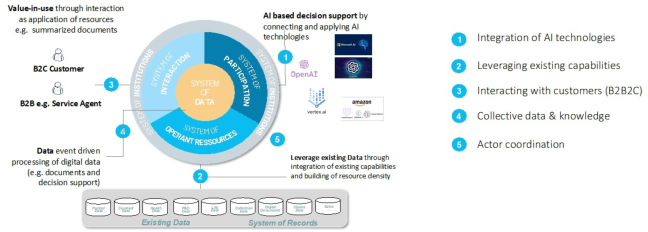
SDA provides a transcending perspective and organizing logic on enter- prise architecture by reimagining the organization in the terms of Service- Dominant Logic and Service Science. As a framework of five design pattern SDA facilitates processual and structural properties for value cocreation in the process of service exchange. Technically implemented as systems the SDA design pattern support five specific roles: (1) sense-and-respond cocreation interactions with actors, e.g., customers (System of Interaction); (2) fric- tionless onboarding and participation of human or technological actors e.g. GenAI solutions (System of Participation); (3) rapid integration of the com- panies operant resources, including data (System of Operant Resources); (4) improved insights from data for all stakeholders (System of Data); and (5) actor coordination by institutions as rules and norms (System of Institutions).
From Generative AI to Generative Organizations 17
Table 2. SDA as set of design pattern.
Table available in the original PDF paper.
Service Lens Ref.
SDA Design Pattern System of Participation
(Warg & Engel, 2016)
- actor engagement - connecting (human and non-human) actors - resource integration (co-production) - liquefy resources System of Interaction (Vargo & Lusch, 2004); (Weiß, 2019) -(inter-) acting as application of resources - resource integration (value cocreation) - value in use - value in context
System of Data - unlocking and leveraging knowledge from existing data
(Warg et al., 2019); (Glushko, 2013)
(Spohrer et al., 2022) System of Operant Resources
- operant Resources - resource density - intentionally imposing order and structure - emergence - service innovation - value proposition (Vargo & Lusch, 2016)
- actor and resource coordination - institutions - unfolding working practices
System of Institutions (Service Catalog)
From a practical perspective the conceptual framework of the SDA has already been implemented in a large number of cross-domain examples (e.g. health, mobility) and longitudinal case studies (Warg Markus et al., 2016; Weiß, 2019).
SOLUTION DESIGN FOR GENERATIVE ORGANIZATIONAL LEARNING The solution design demonstrated in Figure 1 shows the properties and mech- anism based on a GenAI use case, e.g. a query regarding whether drones are covered by the insurance. Number one displays that the GenAI solution is connected via the System of Participation. AI resources, e.g. AI algorithms are integrated. Number two reveals how the existing data are leveraged, and new knowledge is generated as a result of (operant) AI resources act- ing on the existing organizational data. In the case of insurance, for example, this involves contract data, claims data or correspondence. The latter are integrated via the System of Operant Resources. The new knowledge, for example about whether a drone is also insured, is provided to the customer via the System of Interaction as pointed with number three. During the interaction, the internal customer (sales or service agent) and the external cus- tomer (insurance customer) receive value in use. Number four highlights the System of Data where each event and each interaction is processed and stored and databased understanding about e.g. customers and their preferences is build. The coordination of the actors and the allocation or limitation of
rights, e.g. about queries, takes place in the System of Institutions. The latter play a central role in harmonizing working practices within actor networks and in tapping into additional data and capabilities.
Figure 1: Service dominant architecture as organizing logic, e.g. use case GenAI.
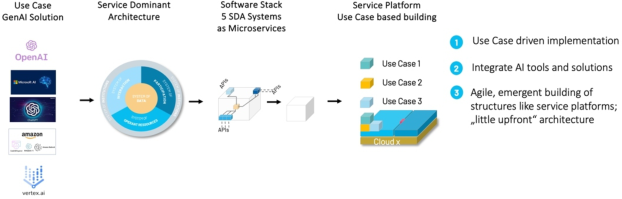
For the technical implementation of the demonstrated process, each SDA stack (a bundle of microservices) is provided with the necessary architecture (the five systems) so that the stack interacts and systematically and mutually creates value with other SDA stacks e.g. on a service platform. In this way, the platform as structure and output is built up step by step with each use case (e.g. the GenAI use case). SDA as conceptual framework enables an agile, use case-based approach that is nevertheless planned and evolves the enter- prise architecture with each capability. Accordingly, lengthy “big upfront” conception phases prior to application development, in which the customer’s requirements change, are avoided. This approach is also referred to as agile emergent - or “little upfront” architecture (Ambler, 2023; Bradley, 2018).
Figure 2: Service dominant architecture as output, e.g. agile, emergent service platform.
OBSERVATIONS Based on the conceptual framework of Service Dominant Architecture a solution design for the use case-based implementation of GenAI solutions is modelled. Learning is shown from a process and a structure perspective. Along the process of service exchange as dynamic interaction among actor the properties and mechanism of generative learning are demonstrated. From the
From Generative AI to Generative Organizations 19
perspective of continuously evolving structures generative learning is shown on the mechanism of service systems and learning is judged as improve- ment of the system or the systems to adapt to an environment. According to the service lens both perspectives interpret generative learning as constantly improving capacities, capabilities and value propositions for better sense and respond and adapting to the environment.
The model demonstrates that key concepts of service help to explain how generative organizational capabilities evolve in the process of resource inte- gration, building resource density and bundling and re-bundling of diverse resources. Operant resources (e.g. GenAI, institutions, teams) are capable to act on these resources and leverage knowledge and existing resources. In this transformational process operant resources act within organizational context and build, generate and produce new generative capabilities (GenXX) which change organizational routines and become source of competitive advantage. In this way “scalable learning”and “organizational development”as improv- ing the ability to adjust, integrate, and apply resources are fostered (Warg, 2018). Based on the model also novel connections between the constructs are identified. E.g. institutions as generative capabilities facilitating actor and resource coordination and in this way the access, “pull” and use of network resources in the process of social and working practices.
PRACTICAL IMPLICATIONS There is no predictional clue in addressing the revolutional character of AI and GenAI. It will be a game changer for sure, most likely leading to an even bigger impact than the one coming from its older sister, the digital transformation.
But our paper targets, in a way, the more evolutional character of AI. Stakeholders and (IT) decision makers must choose in which way they will implement GenAI technologies in their organizations. We propose a wider look by applying the SDA right from the start, although this “little upfront” architecture comes at the beginning with some extra cost. But if initial GenAI based pilot projects, even if they are rather decentralized, are part of and con- tribute to an overall architecture as sketched above it will lead to accelerated reuse and learning within the organisations and companies. The set of capa- bilities and capacities will be fast growing. So, the existing and proven SDA framework is a very appropriate strategy to let new and innovative GenAI projects evolve. The framework thus turns the AI revolution into a manage- able evolution. The continent of GenAI applications is immense, it requires a land and expand approach. In contrary, if (IT) decision makers mainly orga- nize GenAI initiatives as isolated pilot projects, they might capture an island, but not a continent.
OUTLOOK FOR FURTHER RESEARCH This paper is to be considered as a starting point. We have set out of scope highly relevant dimensions like the needs for human resources strategies
to foster “generative organizations”. This should be included in upcoming studies.
Especially since research has shown that for successful digital transforma- tions new personal skills were a main contribution as well as new organi- zational elements, e.g. new digital units, uniting a quite diverse background of employees coming from different departments, with different skills and educations and different careers. Finally, AI is about data - and data is what we need here, for a future empirical assessment of the concepts and SDA framework presented in this paper.
CONCLUSION
The study contributes to theory building and practical implications in the context of generative capabilities, generative learning and generative organi- zations. For the process of transforming the rationale of the organization to “scalable learning” and “generative capabilities” a Service-Dominant mindset, Service Dominant Architecture (SDA) as organizing logic and the relevance of institutions are emphasized.
It is demonstrated that the key concepts of service exchange, value cocre- ation and service systems are suitable to explain how the implementation of GenAI use cases can be used in a “land and expand” approach to systematically
build up generative organizational capabilities (GenXX),
leveraging the services from existing organizational resources and
developing organizational routines as learned and institutionalized work- ing practices to better sense and respond to environmental changes, e.g. new customer needs or new business (model) opportunities as well as upcoming external constraints, e.g. supply chain changes or new regulatory requirements.
In this way, Service Dominant Architecture (SDA) as organizing logic facilitates the systematic building of “generative organizational capabilities” in the process of service exchange and thus contributes to organizational development, understood as improving the ability to apply resources.
REFERENCES
Adner, R. (2017). Ecosystem as Structure: An Actionable Construct for Strategy. Journal of Management, 43(1), 39–58. https://doi.org/10.1177/0149206316678451 Alexander, C. (1977). A pattern language: towns, buildings, construction. Oxford
university press. Ambler, S. (2023). Big Modeling Up Front (BMUF) Anti-Pattern. https://agilemodel ing.com/essays/bmuf.htm Amit, R., & Schoemaker, P. J. (1993). Strategic assets and organizational rent.
Strategic Management Journal, 14(1), 33–46. Andreu, R., & Ciborra, C. (1996). Organisational learning and core capabilities development: the role of IT. The Journal of Strategic Information Systems, 5(2), 111–127.
From Generative AI to Generative Organizations 21
Arthur, W. B. (2009). The nature of technology: What it is and how it evolves. Simon and Schuster. Behara, G. K. (2023, 20230308). Enterprise Architecture vs. Solution Architecture.
Architecture & Governance Magazine. Bradley, C. (2018, 2018, September, 28th.). An Introduction to Agile Emergent Architecture - Always Intentional. The Scrum Crazy Blog. Brynjolfsson, E., Li, D., & Raymond, L. R. (2023). Generative AI at work. Chiva, R., Grandío, A., & Alegre, J. (2010). Adaptive and generative learning: Impli-
cations from complexity theories. International Journal of Management Reviews, 12(2), 114–129. Constantin, J. A., & Lusch, R. F. (1994). Understanding Resource Management: How to Deploy Your People, Products, and Processes for Maximum Productivity. Oxford, OH: The Planning Forum. Crossan, M. M., Lane, H. W., & White, R. E. (1999). An organizational learning
framework: From intuition to institution. Academy of management Review, 24(3), 522–537. Gamma, E. (1995). Design patterns: elements of reusable object-oriented software.
Pearson Education India. García-Peñalvo, F., & Vázquez-Ingelmo, A. (2023). What do we mean by GenAI?
A systematic mapping of the evolution, trends, and techniques involved in Generative AI. Gilson, L. L., & Goldberg, C. B. (2015). Editors’ comment: So, what is a conceptual paper? In: SAGE Publications Sage CA: Los Angeles, CA. Glushko, R. J. (2013). The discipline of organizing. Bulletin of the American Society
for Information Science and Technology, 40(1), 21–27. Hagel III, J., Brown, J. S., & Davison, L. (2012). The power of pull: How small moves, smartly made, can set big things in motion. Basic Books. Hu, K. (2023). ChatGPT sets record for fastest-growing user base-analyst note.
Reuters, 12, 2023. Jaakkola, E. (2020). Designing conceptual articles: four approaches. AMS Review, 1–9. Khanday S., K. D. (2019). The Research Design. Jourbnal of Critical Reviews, Vol.
06, Issue 03, 2019(03). Kieliszewski, C. A., Spohrer, J. C., Lyons, K., Patrício, L., & Sawatani, Y. (2018).
Handbook of Service Science (Vol. 2). Springer. Lim, W. M., Gunasekara, A., Pallant, J. L., Pallant, J. I., & Pechenkina, E. (2023).
Generative AI and the future of education: Ragnarök or reformation? A para- doxical perspective from management educators. The International Journal of Management Education, 21(2), 100790. Löbler, H. (2013). Service-dominant networks. Journal of Service Management. Lusch, R. F., & Nambisan, S. (2015). Service Innovation: A Service-Dominant Logic Perspective. MIS Quarterly, 39(1), 155–175. Lusch, R. F., Vargo, S. L., & Tanniru, M. (2010). Service, value networks and learn-
ing [10.1007/s11747-008-0131-z]. Journal of the Academy of Marketing Science, 38(1), 19–31. https://www.springerlink.com/content/j40277m4u826mu51/ Lusch, R. F., Vargo, S. L., & Wessels, G. (2008). Toward a conceptual foundation for service science: Contributions from service-dominant logic. IBM Systems Journal, 47(1), 5–14. MacInnis, D. J. (2011). A framework for conceptual contributions in marketing.
Journal of Marketing, 75(4), 136–154.
March, J. G. (1991). Exploration and exploitation in organizational learning.
Organization Science, 2(1), 71–87. McGowan, H. E., & Shipley, C. (2020). The adaptation advantage: Let go, learn fast, and thrive in the future of work. John Wiley & Sons. Penrose, E. T. (1959). The theory of the growth ofthe firm. New York: Sharpe. Senge, P. M. (1997). The fifth discipline. Measuring Business Excellence. Senge, P. M. (2006). The fifth discipline: The art and practice of the learning
organization. Broadway Business. Spohrer, J. (2021). Service innovation roadmaps and responsible entities learning ITM Web of Conferences, Spohrer, J., Maglio, P., Bailey, J., & Gruhl, D. (2007). Steps toward a science of service
systems. Computer, 40(1), 71–77. Spohrer, J., Maglio, P. P., Vargo, S. L., & Warg, M. (2022). Service in the AI era: Science, logic, and architecture perspectives. Business Expert Press. Spohrer, J. C., & Maglio, P. P. (Eds.). (2010). Toward a Science of Service Systems. Vargo, S. L., & Lusch, R. F. (2004). Evolving to a New Dominant Logic for
Marketing. Journal of Marketing, 68(January), 1–17. Vargo, S. L., & Lusch, R. F. (2016). Institutions and axioms: an extension and update of service-dominant logic. Journal of the Academy of Marketing Science, 44(1), 5–23. Vargo, S. L., & Lusch, R. F. (2018). The SAGE handbook of service-dominant logic.
SAGE Publications Limited. Vargo, S. L., Lusch, R. F., & Akaka, M. A. (2010). Advancing service science with service-dominant logic. InHandbook of Service Science (pp. 133–156). Springer. Warg, M., & Engel, R. (2016). Service-Dominierte Architektur (SDA): Kernkom-
ponente digitaler Transformation. Zeitschrift für Versicherungswesen, 2016(12), 391–395. Warg, M., Frosch, M., Weiß, P., Zolnowski, A. (2018). Becoming a Platform Organization: how incumbent companies stay competetive. Cutter Business Technology Journal, Vol. 31, No. 11/12, 8. Warg, M., Zolnowski, A., Frosch, M., & Weiß, P. (2019). From Product Orga-
nization to Platform Organization - Observations of Organizational Develop- ment in the Insurance Industry [Conference paper]. Naples Forum on Service, Ischia/Naples. https://www.ifsd.hamburg/OPEN-SCIENCE/ Warg Markus, Weiß Peter, Engel Ronald, & Zolnowski, A. (2016). Service Dominant Architecture based on SD logic for Mastering Digital Transformation: The Case of an Insurance Company. Tiziana Russo-Spenaand Cristina Mele, 807. Weiß, P. W., Markus; Zolnowski, Andreas. (2019). Building Systems of Engagement
to overcome the challenges of digital transformation Naples Forum on Service, Ischia.
LISTED IN THE AHFE DIGITAL BOOKSTORE CATALOGUE
Explore the complete digital volume
The Human Side of Service Engineering
Read this individual research paper free through the original publisher, or explore the full digital proceedings book.
ISBN 978-1-964867-19-9
Explore this ISBN in the AHFE Bookstore ↗Listed in the July 2026 bookstore catalogue; search by ISBN to confirm current availability · Digital book purchase optional