Markus Warg, Markus Frosch (2023). Human-Technology Interaction and Future of Work: Science, Logic and Architecture Perspectives on Designing Service Platforms for Future Work. In: Application of Emerging Technologies. AHFE Open Access, vol. 115, pp. 175–184. https://doi.org/10.54941/ahfe1004314
Motivation and PurposeThe research of this paper is about the phenomenon of “pull” or more concise about "how companies can design service platforms as opportune strategy to connect with other actors and to pull from that network the capabilities required to address unexpected needs" (Hagel, Brown et al. 2010, McGowan and Shipley 2020). To contribute to the knowledge creation in this context, the paper takes a service lens and draws on science, logic and architecture perspectives for studying and building models. The purpose of this conceptual paper is to derive implications for the design of service platforms as structural models of organizations to improve human-technology interaction, change and the future of work (Jaakkola 2020, Spohrer, Maglio et al. 2022).Methodology and ApproachReferring to the research a conceptual paper as methodology and within this methodology the research design “model” is selected (MacInnis 2011, Gilson and Goldberg 2015, Jaakkola 2020). A conceptual paper as methodology is picked to bridge existing theoretical perspectives and concepts in interesting ways, link work across disciplines, and broaden the scope of our thinking. The research design “model” facilitates to build a theoretical framework that explains and predicts relationships between the key elements and processes (Jaakkola 2020).To address the key elements of the phenomenon “human-technology interaction and the future of work” a service lens with Service Science and Service-Dominant Logic as domain theories is chosen. Service Dominant Architecture as method theory is used to explain the relationships between the elaborated key elements and to derive the relevant building blocks for the design (pattern) of service platforms for human-technology interaction and the future of work. Findings The paper demonstrates that a service lens, a service-dominant mindset and the perspectives of science, logic and architecture are appropriate to model and describe the phenomenon of “pull” and to derive implications for the design of service platforms. The key elements and building blocks of the “pull” process – understood as the ability to draw people and capabilities out of actor-to-actor networks – are elaborated and design (pattern) for service platforms are evolved. By describing the interplay of the key elements using the example of a service platform for future work based on the elaborated (design pattern) the paper demonstrates how “pull effects” are exploited and human-technology interaction can be improved via a service platform.
“The edge is becoming the core”, with this statement Hagel and Brown (Hagel & Brown, 2005) summarized their point of view. The edge of compa- nies is where they are interconnected to their environment, to other human or technology actors, where they “sense and respond” regarding to societal needs, culture, growth, innovation and value creation. The edge is where the adaptation to new approaches and value creation emerges (Haeckel, 1999; Hagel et al., 2010; McGowan & Shipley, 2020).
Over the past centuries the focus of organizations was on perfecting efficiency in the process of goods-production. The approaches of the organi- zations may vary in their details, but they share a common mindset. They are all designed to “push”resources in advance to areas of need. The term “push” describes an approach of organizing activities and actions. This approach operates on the central assumption that it is possible for organizations to fore- cast demand. Based on this assumption organizations act to “push”resources and to ensure that the right resources are available at the right place and the right time; the associated leadership style is referred to as “adminis- trative” (Selznick, 1957), or “leading with control” (Hagel III et al., 2012;
Hastings & Meyer, 2020). In education, standard curricula to expose stu- dents to codified information in a pre-determined sequence of experiences are designed. In human resources, standard systems are used in recruitment to procure and deploy employees in the same pre-determined way as other non-human resources. In operations, highly automated plants supported by standardized processes seeking to deliver resources to the right place at pre-determined times. In technology, enterprise applications specifying activ- ities that must be performed and resources that must be deployed to meet anticipated pre-determined demand (Hagel & Brown, 2005).
Hagel (Hagel et al., 2010) denotes the phenomenon needed to approach the challenges of uncertainty in regard to demand and environmental change as “pull”; understood as the ability to draw out people and resources as needed to address opportunities and challenges. Where “push” describes a method of organizing activities and actions operating on the key assumption that it is possible to forecast or anticipate demand. “Pull”as open, connected, and participative approach facilitates the ability to “pull” from the network the human and technical resources required to address unexpected needs. Using “pull” can create the conditions by which individuals, teams and orga- nizations can achieve their potential in less time and with more impact (Hagel et al., 2010).
This research is about the phenomenon of “pull” or more concise about how companies can design service platforms as opportune strategy to connect with other actors and to “pull” from that network the human and techno- logical capabilities required to address unexpected needs (Hagel et al., 2010; McGowan & Shipley, 2020). Using the example of recruitment within the domain of human resources, the existing “push” structures are sketched and approaches for platform-based developments of “pull”models for New Work are introduced.
The purpose of this conceptual paper is to derive implications for the design of service platforms as structural models of organizations to improve “pull” and human-technology interaction, change and the future of work of companies. To contribute to the knowledge creation in this context, the paper takes a service lens and draws on logic, science and architecture perspectives for studying and building models (Jaakkola, 2020; J. C. Spohrer et al., 2022).
METHODOLOGY AND APPROACH To contribute to the knowledge creation in the context of designing ser- vice platforms as structural models of organizations to improve human- technology interaction, a conceptual paper as methodology and within this methodology the research design “model” is selected (Gilson & Goldberg, 2015; Jaakkola, 2020; MacInnis, 2011). The methodology is picked to bridge existing theoretical perspectives and concepts in interesting ways and broaden the scope of our thinking. The research design “model”facilitates to elaborate and build a theoretical framework that explains key elements and predicts their relationships (Jaakkola, 2020).
To address the key elements of the phenomenon “human-technology inter- action and the future of work” a service lens with Service-Dominant Logic
Human-Technology Interaction and Future of Work 177
and Service Science as domain theories is chosen. Service Dominant Archi- tecture as method theory is used to explain the relationships between the elaborated key elements and to derive the relevant building blocks for the design (pattern) of service platforms for human-technology interaction and the future of work.
MODELLING DESIGN PATTERN OF SERVICE PLATFORMS FOR FUTURE WORK A service lens with Service-Dominant Logic and Service Science is chosen to elaborate the key elements of the phenomenon “pull” within actor-to-actor networks. After that Service Dominant Architecture is applied as method the- ory to demonstrate, analyze, and explain the mechanism of the key elements and their interplay.
A Service Lens on Human-Technology Interaction According to Vargo et al. (Spohrer et al., 2022) “a logic is a conceptual lens for observing the world and understanding how it works. It is also some- times referred to as a mental model or a paradigm”. Logic is about better mental models in people to improve interaction; it exists within the minds of people and become dominant when they improve people’s capabilities and practices for interactions and outcomes. Over the past centuries the dominant logic of economic exchange was based on the exchange of goods as manu- factured output. This Goods-Dominant Logic focuses on tangible resources and transactions.
Service-Dominant Logic is an alternative to Goods-Dominant Logic, because it maintains that exchange is better understood in terms of service- for-service than in terms of goods-for-goods. Service-Dominant Logic is about the process and outcome of actors (e.g., people and organizations) applying resources, such as knowledge, for the benefit of others in exchange for others providing service for them” (Spohrer et al., 2022; Vargo & Lusch, 2004). The process of value co-creation according to Service-Dominant Logic is focused on the participation and interaction of networked human and non- human actors (Lusch & Vargo, 2008). The interactive relationship during the process of value co-creation results in added value that improves one’s wellbeing as own state or condition (Vargo & Lusch, 2016). In this pro- cess actors e.g., companies as carrier of operant and/or operand resources engage by acting on resources (Löbler, 2013). Operant resources, such as competences, are those that act upon other resources to create benefit; while operand resources are resources which must be acted on to be beneficial, such as natural resources, goods and money (Constantin & Lusch, 1994; Vargo et al., 2010).
Service-Dominant Logic is a meta-theoretical framework for explain- ing the process of value co-creation through actor engagement and service exchange. In this process resource-integrating actors (human and non- human) are connected by shared institutional arrangements and mutual value creation through service exchange. That way they are forming institutionally
178 Warg and Frosch
coordinated service ecosystems (Vargo & Lusch, 2016, 2018). In this ecosys- tem structures actors are aligned by value propositions and need to interact in order for a focal value proposition to materialize (Adner, 2017).
Referring to Spohrer et al. (Spohrer et al., 2022) Science can be viewed as a knowledge creation service. Science is about better models of the world both complex natural and social systems. Service Science grounds the nature, sci- entific understanding and management principles needed to understand and improve service and service innovation. Service Science models service and its essential interrelationships and abstracts responsible actors e.g., companies as service systems (service system entities) interconnected by value propositions (Spohrer & Maglio, 2008; Spohrer et al., 2022; Spohrer et al., 2008).
Service systems are defined as dynamic value co-creation configurations of resources, including people, organizations, shared information and tech- nology, all connected internally and externally to other service systems by value propositions (Spohrer et al., 2008). Service systems are characterized as open systems (1) capable of improving the state of another system through sharing or applying resources and (2) capable of improving their own states by acquiring external resources. In this context, economic exchange depends on reciprocal value creation between service systems This recursive service system definition highlights the fact that service systems have internal struc- tures (intra-entity services) and external structures (inter-entity services) in which responsible actors (entities) coproduce value directly or indirectly with other service systems. Individuals, families, organizations, teams, nations, and economies all represent instances of service systems (Kieliszewski et al., 2018; Spohrer et al., 2007). Any service system can be observed as a structure of interconnected ele- ments, to understand how it behaves it is necessary to see its systemic functioning. “Each instance of resource integration, service provision, and value creation, changes the nature of the system to some degree and thus the context for the next iteration and determination of value creation” (Spohrer & Maglio, 2008; Vargo & Lusch, 2011).
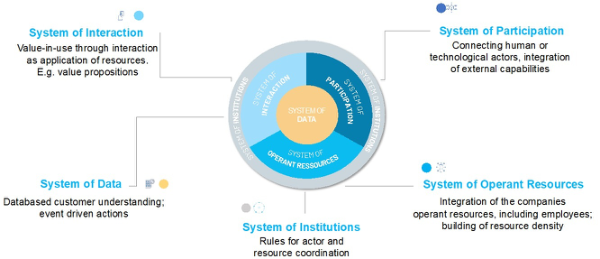
SDA as Design Pattern for Human-Technology Interaction Referring to Warg et al. (Spohrer et al., 2022) architecture is about better cul- tural and structural models of e.g., organizations to improve change. Archi- tecture is understood as both the process and the product (output) of plan- ning, designing, and constructing buildings or other structures (Alexander, 1977; Gamma et al., 1995; Safin et al., 2010; Warg & Deetjen, 2021). Service Dominant Architecture provides a transcending perspective on enterprise architecture by reimagining the company in the terms of Service- Dominant Logic and Service Science. As a framework of design pattern SDA facilitates to describe and analyze structures larger than modules, procedures or objects” (Coplien, 1997). Implemented as systems the design pattern sup- port five specific roles: (1) sense-and-respond cocreation interactions with actors, e.g., customers (System of Interaction); (2) frictionless onboarding and participation of human or technological actors (System of Participation);
Human-Technology Interaction and Future of Work 179
(3) rapid integration of the companies operant resources, including employ- ees (System of operant Resources); (4) improved insights from data for all stakeholders (System of Data); and (5) actor coordination by institutions as rules and norms (System of Institutions).
Figure 1: Systems and design pattern of service dominant architecture.
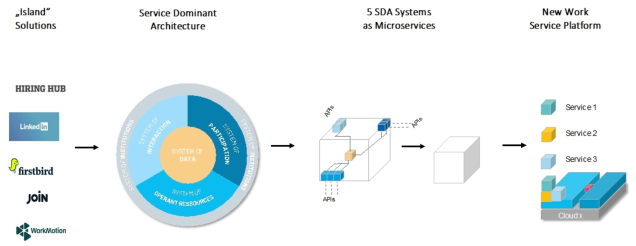
SDA as framework of design pattern represents both plan and output of designing, planning and implementing structures, e.g., service platforms. As shown in Fig. 2 the design pattern is applied as construction plan for develop- ing software stacks as bundles of microservices, preconfigured with the five SDA systems. After use-case driven realization the software stacks are part of the service platform (output). This approach of building structures is also named “agile emergent - or little up-front architecture” (Bradley, 2018).
Figure 2: Agile emergent service dominant architecture.
By making only the minimum architecture decisions up-front, such as selecting the SDA design pattern and the technology stack, the architecture emerges with each use case (Waterman et al., 2015).
Need for New Work The associated management style of the organizing logics of “push” and “Goods-Dominant Logic”was described already in the middle of last century by Selznick as “administrative” approach (Selznick, 1957).
Efficiency as the operating ideal of the “administrative” Human Resource Management (HRM) presumes that goals are settled, the demand is pre- determined and that the main capabilities for achieving them are available. The problem is then one of joining available means and capabilities e.g., employee, to known outputs and ends. The decisions to be made and the
180 Warg and Frosch
decision-making process itself are characterized by routines. As a conse- quence extensive delegation of responsibility may be worked out and the role of HRM and Leadership is to maintain, administrate and control this state (Selznick, 1957).
The enterprise architectures, as organizing logic for business processes and infrastructure, follow and implement these “push”, “Goods-Dominant” or “administrative” strategies and their structures mirror this mindset (Behara, 2023). “Administrative” companies are positioned e.g., in the HR units like in goods manufacturing units, they “treat and process” the human resource like the other non-human input factors. The software solutions define the possible processes and value propositions for internal and external customers are pre- defined from the inside out (Frosch et al., 2021).
As a result, HR managers encounter in their day-to-day business a variety of rigidly predefined working methods, stand-alone solutions embedded and time-consuming restrictions, e.g., for data protection reasons. This leads to a lack of end-to-end processes, missing comprehensive data-based views of employees and candidates, applicants and prevents the ability to react quickly to changing and innovative market developments. As a result, the processes, e.g., recruiting, are excessively slow, closed, isolated, limited to the existing systems, and only with great effort able to take up new solutions. In summary, there is a lack in relationship, interaction and understanding internal and external customers, missing transparency regarding new solutions, absence of multi-sourcing readiness, no or hardly any data-based support. Therefore, neither the expectations of internal nor of external customers are met.
New Work in a broader understanding does not limit workforce to the human actors but stands for all actor combinations (e.g., human- technological) that contribute to organizational development (Frosch & Warg, 2020). New Work needs new approaches in the area of HR, e.g., recruiting and staffing. Approaches like “pull” in a sense of a quick sourcing, deployment and integration of new competencies, augmenting technologies and other required resources from the edge (actor-to-actor networks) are fun- damental to react on new developments and to create new value creation paths. Selznick and Hastings denote the compatible management styles that “Pull” and integrate out of the social and economic context as “institutional integrity” approach (Selznick, 1957) or “leading with context” (Hastings & Meyer, 2020).
In the next section, relying on the SDA pattern a platform-based solution for enabling “pull” approaches in the context of HRM and New Work is designed.
Solution Design for New Work Service Platforms Value creation occurs at the edge of the company and in interaction with other actors. To facilitate the process of value cocreation and interaction is the main reason for implementing service platforms (Warg, 2022). From a more theoretical point of view, Lusch and Nambisan (Lusch & Nambisan, 2015) define a service platform as “[…] a modular structure that comprises
Human-Technology Interaction and Future of Work 181
tangible and intangible components (resources) and facilitates the interaction of actors and resources (or resource bundles). In practice, firms implement service platforms to enable rapid development and facilitate innovations and new value propositions (Ross et al., 2016).
Thus independent of industries service platforms allow companies to con- nect to multilateral sets of partners that need to interact in order for a focal value proposition to materialize (Adner, 2017). By connecting actors and sharing institutional arrangements service platforms facilitate the integration of resources and enhance resource density. Resource density describes the amount of resources that are made available on service platforms to create and deliver innovative services whose application by interaction generates benefits like value in use (Lusch & Nambisan, 2015; Shapiro & Varian, 1998; Vargo & Lusch, 2016).
The architectural approach of SDA is a so called emergent - or little up- front architecture. Every step of implementation is aligned to the design pattern and intentional. By implementing the platform use case for use case the architecture as structure of the service platform emerges. This way a service-platform evolves in which the team makes only the minimum archi- tecture decisions up-front, such as selecting the SDA design pattern and the technology stack.
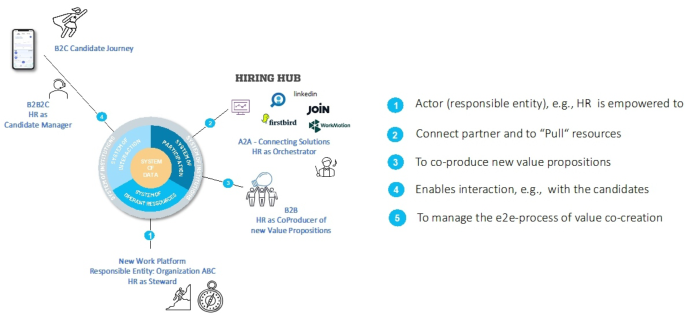
Regarding New Work and the example of recruiting this approach aims for the integration of many human or technological recruiting resources and solutions. E.g., Figure 3. shows tools like Hiring Hub for central coordination and management of recruiting agencies, and external researchers; firstbird or other employee recommendation applications; JOIN for multi-posting of job ads on job sites or Workmotion for accessing and integrating international talents.
In this way, the platform empowers the HRM team to be transparent about the solutions. As demonstrated in Fig. 3. the pattern as construction plan facilitate to design the service platform. The interplay of the patterns enables value co-creation between the internal HRM team, external partners and candidates.
Figure 3: Architecture (SDA) as construction plan for service platforms.
182 Warg and Frosch
Implemented as New Work platform the SDA pattern (the five systems) facilitate both the “pull” of external solutions (System of Participation) and the process of value co-creation as interplay of the systems. This way the New Work platform reshapes and mobilizes the role of the internal HRM team and the “the edge becomes the core”.
Fig. 4 shows how architecture as tangible output New Work service plat- form emerges. The service platform is the output of implementing resources step by step or use case by use case related to the solutions. The resources are assigned to the respective system of the SDA. In this way, the platform as output or tangible structure is created following the construction plan of the five design pattern or systems.
Figure 4: Architecture (SDA) as output “New Work service platform”.
OBSERVATIONS As demonstrated in Fig. 3, the (human and technological) solutions that make sense for the target candidates are integrated (System of Participa- tion) and combined with the existing resources of the company (System of Operant Resources). The platform enables HRM to “pull”external resources and to manage the processes from the candidate’s perspective, to build corresponding value propositions and to facilitate interaction with the can- didates (System of Interaction) as application of the value proposition. Every interaction, every resource integration improves insights from data for all stakeholders (System of Data). This way the platform with Service Domi- nant Architecture facilitates to “pull” external resources and to mobilize the HRM teams for shaping new forms of cooperation. HR becomes steward and orchestrator of the recruiting process, co-producer of value propositions and candidate manager.
FINDINGS The main findings of this paper can be summarized as following:
1. The paper demonstrates that a service lens, is appropriate to model, ana- lyze and describe the key elements of the phenomenon of “pull”and their interplay.
Human-Technology Interaction and Future of Work 183
2. Changing mindsets and leadership styles are necessary to transform from “push”, “Goods-Dominant” and “administrative” approaches to “pull”, “Service-Dominant” and “integrative” approaches. 3. The mindset must be reflected in the enterprise architecture (e.g., Service Dominant Architecture) and the solution design, so that the imple- mented structures, e.g., service platforms, facilitate human-technology interaction and value co-creation within actor-to-actor networks. 4. As observed on behalf of the domain of New Work “pull” approaches enable new combinations of human-technological interactions, mobilize existing resources and shape new roles. Or as stated by Hagel (Hagel & Brown, 2005) bring the edge to the core of the company.
REFERENCES
Adner, R. (2017). Ecosystem as Structure: An Actionable Construct for Strategy. Journal of Management, 43(1), 39–58. https://doi.org/10.1177/0149206316678451 Alexander, C. (1977). A pattern language: towns, buildings, construction. Oxford
university press. Behara, G. K. (2023, 20230308). Enterprise Architecture vs. Solution Architecture.
Architecture & Governance Magazine. Bradley, C. (2018). An Introduction to Agile Emergent Architecture - Always Intentional. Retrieved 2018, September, 28th. from https://scrumcrazy.wordpress.com /2018/09/28/an-introduction-to-agile-emergent-architecture-always-intentional/ Constantin, J. A., & Lusch, R. F. (1994). Understanding Resource Management:
How to Deploy Your People, Products, and Processes for Maximum Productivity. Oxford, OH: The Planning Forum. Coplien, J. O. (1997). Idioms and patterns as architectural literature. IEEE Software, 14(1), 36–42. Frosch, M., & Warg, M. (2020). A Conceptual Framework for Workforce Manage-
ment: Impacts from Service Science and SD Logic. International Conference on Applied Human Factors and Ergonomics. Frosch, M., Warg, M., & Lange, M. (2021). HR-Management: Impacts from Service (Eco) Systems. International Conference on Applied Human Factors and Ergonomics. Gamma, E., Helm, R., Johnson, R., & Vlissides, J. (1995). Design Patterns - Elements
of reusable object-oriented software. Reading: Addison-Wesley. Gilson, L. L., & Goldberg, C. B. (2015). Editors’ comment: So, what is a conceptual paper? In: SAGE Publications Sage CA: Los Angeles, CA. Haeckel, S. H. (1999). Adaptive enterprise: Creating and leading sense-and-respond
organizations. Harvard business press. Hagel III, J., Brown, J. S., & Davison, L. (2012). The power of pull: How small moves, smartly made, can set big things in motion. Basic Books. Hagel, J., & Brown, J. S. (2005). From push to pull. Sign. Hagel, J., Brown, J. S., & Davison, L. (2010). The power of pull: How small moves,
smartly made, can set big things in motion. New York: Basic Books. Hastings, R., & Meyer, E. (2020). No Rules Rules: Netflix and the Culture of Reinvention. In: Penguin, New York, NY. Jaakkola, E. (2020). Designing conceptual articles: four approaches. AMS Review,
1–9. Kieliszewski, C. A., Spohrer, J. C., Lyons, K., Patrício, L., & Sawatani, Y. (2018).
Handbook of Service Science (Vol. 2). Springer.
184 Warg and Frosch
Löbler, H. (2013). Service-dominant networks. Journal of Service Management. Lusch, R. F., & Nambisan, S. (2015). Service Innovation: A Service-Dominant Logic Perspective. MIS Quarterly, 39(1), 155–175. Lusch, R. F., & Vargo, S. L. (2008). The service-dominant mindset. InService science,
management and engineering education for the 21st century (pp.89–96). Springer. MacInnis, D. J. (2011). A framework for conceptual contributions in marketing.
Journal of Marketing, 75(4), 136–154. McGowan, H. E., & Shipley, C. (2020). The adaptation advantage: Let go, learn fast, and thrive in the future of work. John Wiley & Sons. Ross, J. W., Sebastian, I., Beath, C., Mocker, M., Moloney, K., & Fonstad, N.
(2016). Designing and Executing Digital Strategies Thirty Seventh International Conference on Information Systems, Dublin. Safin, S., Delfosse, V., & Leclercq, P. (2010). Mixed-reality prototypes to support early creative design. The Engineering of Mixed Reality Systems, 419–445. Selznick, P. (1957). Leadership in administration. Berkeley. In: CA: University of
California Press. Shapiro, C., & Varian, H. R. (1998). Information rules: a strategic guide to the network economy. Harvard Business Press. Spohrer, J., Maglio, P., Bailey, J., & Gruhl, D. (2007). Steps toward a science of service
systems. Computer, 40(1), 71–77. Spohrer, J., & Maglio, P. P. (2008). The emergence of service science: Toward systematic service innovations to accelerate co-creation of value. Production and Operations Management, 17(3), 238–246. Spohrer, J., Maglio, P. P., Vargo, S. L., & Warg, M. (2022). Service in the AI era:
Science, logic, and architecture perspectives. Business Expert Press. Spohrer, J., Vargo, S. L., Caswell, N., & Maglio, P. P. (2008, 2008). The service system is the basic abstraction of service science. Proceedings of the 41st Annual Hawaii International Conference on System Sciences (HICSS 2008). Spohrer, J. C., Maglio, P. P., Vargo, S. L., & Warg, M. (2022). Service in the AI Era.
Business Expert Press. Spohrer, J. C., Vargo, S. L., & Maglio, P. P. (2008). The Service System is the Basic Abstraction of Service Science Proc. 41st Hawaii Int. Conf. on System Science, Big Island. Vargo, S. L., & Lusch, R. F. (2004). Evolving to a New Dominant Logic for
Marketing. Journal of Marketing, 68(January), 1–17. Vargo, S. L., & Lusch, R. F. (2011). It’s all B2B... and beyond: Toward a systems perspective of the market. Industrial Marketing Management, 40(2), 181–187. Vargo, S. L., & Lusch, R. F. (2016). Institutions and axioms: an extension and update
of service-dominant logic. Journal of the Academy of Marketing Science, 44(1), 5–23. Vargo, S. L., & Lusch, R. F. (2018). The SAGE handbook of service-dominant logic.
SAGE Publications Limited. Vargo, S. L., Lusch, R. F., & Akaka, M. A. (2010). Advancing service science with service-dominant logic. InHandbook of Service Science (pp. 133–156). Springer. Warg, M. (2022). Erfolg in Ökosystemen: Empfehlungen für deutsche Versicherer
[Interview]. Allgemeiner Fachverlag. Warg, M., & Deetjen, U. (2021). Human Centered Service Design (HCSD): Why HCSD Needs a Multi-level Architectural View. InInternational Conference on Applied Human Factors and Ergonomics (pp. 249–256). Springer. Waterman, M., Noble, J., & Allan, G. (2015). How much up-front? A grounded
theory of agile architecture. 2015 IEEE/ACM 37th IEEE International Conference on Software Engineering.
LISTED IN THE AHFE DIGITAL BOOKSTORE CATALOGUE
Explore the complete digital volume
Application of Emerging Technologies
Read this individual research paper free through the original publisher, or explore the full digital proceedings book.
ISBN 978-1-958651-91-9
Explore this ISBN in the AHFE Bookstore ↗Listed in the July 2026 bookstore catalogue; search by ISBN to confirm current availability · Digital book purchase optional