Yi Ming Li, Jia Xin Xiao, Ming Jun Luo (2022). Design intervention and behaviour change: Implications for inclusive public design to promote sustainable behaviour. In: Design for Inclusion. AHFE Open Access, vol. 45, pp. 126–134. https://doi.org/10.54941/ahfe1001877
Sustainable behaviour is the basis of social and environmental sustainability. In everyday practice, public facilities can play an important role in promoting such behaviour. Determining how city users understand and use public facilities is crucial to design for sustainability. Drawing on the literature on behavioural change, this study investigates the relationship between design interventions and user behaviour through an analysis of everyday life scenarios in open spaces. Taking public design in Guangzhou, China as a case study, the study examines how intervention strategies affect behaviour through public facilities. We explore how these effects vary with intervention intensity and how city users respond accordingly. The study develops a framework to illustrate the relationship between behaviour change and design intervention, which reveals that changes to user behaviour can be realised through several approaches, depending on the level of intensity of the intervention. The study also analyses each type of intervention based on the dimensions of effectiveness and user acceptance. Finally, from the perspective of inclusiveness, design interventions should be multidimensional and integrated to help achieve long-term sustainability.
People’s behaviour can be affected by both internal and external factors. The study on behaviour change originates in the behavioural and social sci- ences, which provide a wealth of insights and frameworks through research and practice (Niedderer et al., 2017). Based on Clack’s (2010) classifica- tion, Niedderer, Clune and Ludden (2017) divide behavioural approaches in design into two schools of thought: cognition-based individualistic rational choice theories and context-related social structuralist theories. The authors take usefulness as the basis for classification. Another taxonomy of behavi- our change techniques used in interventions illustrates how meta-analyses of intervention content and effectiveness can be used to test behavioural change theories by mapping defined behaviour change techniques onto theo- retical frameworks (Abraham & Michie, 2008). However, when applying this
Design Intervention and Behaviour Change: Implication for Inclusive Public Design 127
strategy to public spaces, the specific environments and situations should be considered. Hargreaves (2011) conceptualises behavioural change initiatives as attempts to intervene in the organisation of social practices, highlighting the need to consider the connections between seemingly unrelated practices, surrounding physical infrastructure, laws, society, and power relations. Thus, local visits and other research should be conducted to ensure that intervention strategies are well suited to the public spaces involved and the responses of citizens from different backgrounds are observed as thoroughly as possible.
Facilitating positive behavioural changes in open spaces is challenging. Unreasonable or inappropriate interventions are likely to raise unfavorable problems (Xiao et al., 2021). City administrators aim to maintain the orderly and stable functioning of society by setting rules and structures that restrict and regulate people’s actions. Some such strategies prove effective, but others are met with a less than enthusiastic response and may even lead to protest. Thus, a gap may emerge between the desired effect and the response of the populace. Tang and Bhamra (2008) note that user-centred approaches expose the gap between environmental awareness and real action. Siu (2001: p. 418) considers user-oriented design based on field investigations and user partici- pation to be approaches worthy of consideration by the government, as they can help to ‘obtain’ and ‘maintain’ an inhabitable living environment with variety and vitality. Designers, who represent the operational layer of public design strategies, in addition to those at the executive layer, face challenges that they need to develop solutions through a continuous two-way commu- nication with those who will use their work (Siu, 2003). A design that truly benefits the public must be adapted to local life and it must also follow the principle of inclusive design thinking, i.e., combining diverse perspectives and needs into user friendly solutions for all.
Our study focuses on public facilities, such as transportation and waste recycling, which have become an indispensable aspect of everyday life. The actions of citizens are closely related to public facilities, particularly in modern cities.
This study aims to determine how behaviour is influenced and how users respond in practice by examining design interventions focusing on public faci- lities. We seek not to identify shortcomings of existing approaches but to better understand the relationships between them and thus provide a frame- work for the study of behaviour in open spaces. This can lead to further intervention strategies that are both effective and well accepted and that encourage sustainable behaviour.
METHODOLOGY
Case Study of Public Intervention Strategies in Guangzhou Any discussion of inclusion and usefulness in terms of public facilities requi- res a solid urban foundation. We thus take the public facilities of Guangzhou as our case study. Guangzhou is a major Chinese city with many modern features that achieves a balance between economic, social, cultural and tech- nological development. Thus, a close connection between public facilities and citizens has emerged in Guangzhou.
Disability Equality Scotland (2006) defines inclusive design as follows: ‘an environment that is designed inclusively is not just relevant to buildings; it also applies to surrounding open spaces, wherever people go about everyday activities’. Our research was conducted in several typical residential areas, with public spaces such as streets and public transportation facilities selected as the observation points. This enabled us to explore how these facilities can lead to behaviour changes in various contexts.
RESULTS
The level of intensity of an intervention can determine its effects on behavi- our in practice. In this section, we categorise design interventions into three levels of intensity according to the approach to behavioural change: advo- cating, steering or domination of behaviour. We find from our case study that these approaches affect behaviour along different dimensions. In addi- tion, the results concerning user practice reveal differences in the level of user acceptance of each type of intervention.
Morality-Based Behavioural Change Through ‘Soft’ Interventions This type of intervention is usually presented as a ‘reminder’, typically displa- yed in public spaces or on public facilities in the form of signs, notices, symbols, etc. Such reminders indicate that certain behavioural guidelines or aspects are being promoted, and therefore that the behaviour advocated is in line with the moral standards and expectations of society.
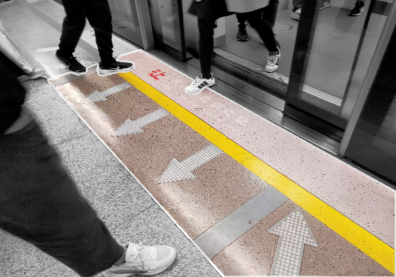
The figure below (Figure 1) provides a typical example of a soft interven- tion aimed at promoting socially considerate behaviour. When the subway arrives at the station, people on the platform should stand either side of the doors and, as prompted by the ground instructions, make way to allow the passengers on the train to alight from the train. This can be viewed as a type of sociological approach of behaviour change and is thus considered an intangible intervention. The behaviour advocated is thus conducted on the initiative of the individual. The validity of this approach builds on the accumulation of collective actions or certain objects (signs, symbols, etc), suggesting that individuals need to be constrained by other social relations or practices. Heath and Heath (2010) point out that change is more likely to occur when the ‘path’, or situation (including the surrounding environment), is shaped accordingly. Such ‘reminder’ facilities inform people through social practice and are generally well accepted by the public.
Clearly, this type of strategy has a weak binding effect on user behaviour and is somewhat dependent on social and individual awareness. However, it does have the benefits of low cost, space saving and the ability to generate a subtle but positive impact on behaviour.
Cognition-Based Behavioural Change Through ‘Medium’ Interventions Medium interventions are more intense than soft interventions; they can be considered ‘guides’ that steer behaviour from disorder to order. Medium
Design Intervention and Behaviour Change: Implication for Inclusive Public Design 129
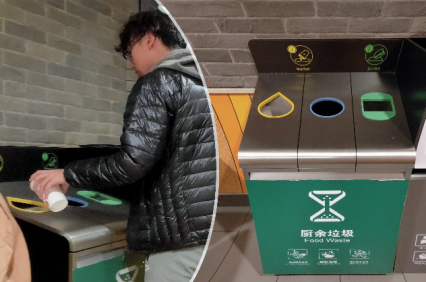
Figure 1: Example of a soft intervention: signs on the ground on a subway platform.Figure 2: Example of a medium intervention: public bins that guide the user through different shaped input ports.
interventions are applied through tangible objects, such as rubbish drop- off facilities (Figure 2, 3). These public facilities change user behaviour mainly through psychological mechanisms proposed in cognition-based the- ories (Niedderer et al., 2017). If rules for using public facilities are complex (such as those concerning waste separation and recycling), users’ resistance behaviour is often due to a lack of understanding (Heath & Heath, 2010). Clear direction should therefore be provided. Figure 2 illustrates how food waste drop-off inlets are designed using different shapes and colours, clearly informing users of the placement procedure and the operation of each step, thus reducing their cognitive and practical burden.
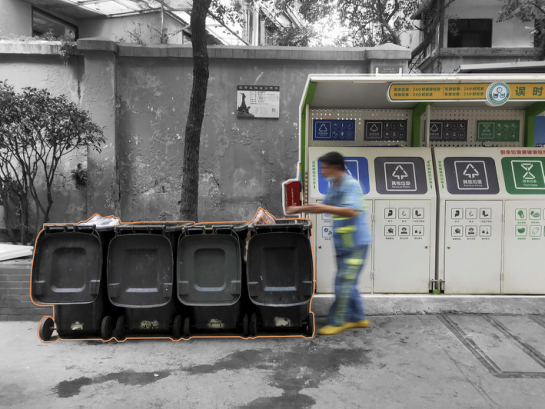
However, a medium level of intervention is not always effective for public facilities. It can fail to work effectively when new options are presented to users (such as black rubbish bins that do not need to be sorted, as in Figure 3). Such facilities require higher levels of user operation and thus more intense than soft interventions, as they tend to be more susceptible to obstructions.
Action-Based Behavioural Change Through ‘Forceful’ Interventions If none of the abovementioned flexible interventions work, forceful interven- tions may be applied. This level of intensity mainly includes strategies that
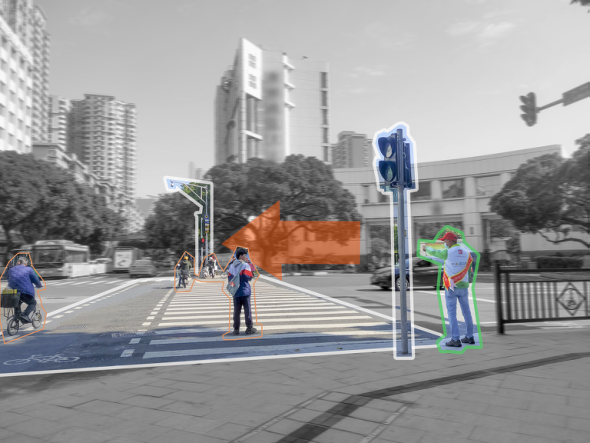
Figure 3: Example of a failed medium intervention: waste sorting rules are broken as a separate drop-off facility free of rules is set up next to a dedicated one.Figure 4: A complex scenario in which triple interventions coexist. Forceful intervention strategy (green frame) is more effective than those of soft and medium intervention (white frame) in changing undesirable behaviour (orange frame) when it comes to serious issues such as safety.
involve intercepting, interrupting, removing or other methods of restricting people’s activities, which can be considered ‘obstacles’. These interventions exert rigorous control over their targets’ behaviour.
In the situation shown in Figure 4, pedestrians and cyclists are ignoring traffic rules and the red light and crossing the road without waiting. Neither a
Design Intervention and Behaviour Change: Implication for Inclusive Public Design 131
Figure 5: Example of a failed forceful intervention: timed drop-off site was still full of waste even after the bins have been removed.
soft intervention (the pedestrian crossing on the ground painted in white) nor a medium intervention (traffic signals framed in white) is sufficient. Tougher tactics are required, which here amounts to a forceful intervention. A volun- teer assumes the role of traffic marshal and stops pedestrians and cyclists from running the red light by shouting at them, thus restoring order. Tangi- ble interventions can induce a passive state in people and thus make them follow the rules and behave. Such measures can ensure that regulations are followed and that public behaviour matches expectations.
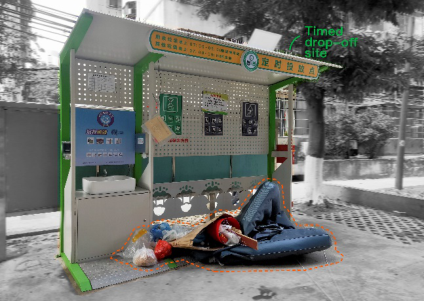
However, an intervention that is too forceful will inevitably attract objecti- ons and even protest. Figure 5 shows a household rubbish drop-off point in a residential community in Guangzhou that includes a time limit regulation, and the actions taken by the neighbouring residents who were not satisfied with it.
By comparing the two cases cited above (Figure 4 and Figure 5), one can clearly conclude that using forceful means to manipulate users’ actions is effective but risky. Such interventions provide users with direct guidelines for their actions, promoting individual actions that contribute to collective order. However, if this goes beyond the boundaries of user acceptance, the intervention will be perceived as aggressive and will be counterproductive.
DISCUSSION
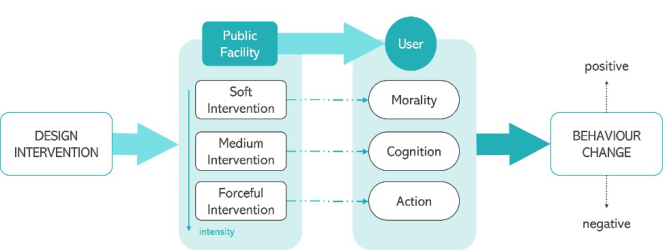
In our case study of Guangzhou, the purposes of the design interventi- ons applied in open spaces vary from advocacy to the forceful direction of behaviour, depending on the level of intensity. The various purposes of the interventions mean that the paths that trigger changes in user behaviour are varied. In our framework (Figure 6), we divide the intensity of interventi- ons into three levels, soft, medium and forceful, according to their intended purpose.
At the soft intervention level, moral reminders alone can encourage peo- ple to make concessions. Medium interventions lead to behavioural change
Figure 6: Framework of the three paths for design interventions aimed at behaviour change.Figure 7: Effectiveness and acceptance of three intervention intensity levels. On the horizontal axis, ‘−1’ and ‘1’ represent the extremes of the worst and best effects, and ‘0’ means invalid.
mainly through the cognitive dimension. However, interventions at the high- est level of intensity, forceful interventions, directly and physically influence people’s actions.
In addition, people’s behaviour in public spaces can be influenced by combinations of interventions with different levels of intensity. Appropri- ate intervention strategies correspond to different scenarios, and none are perfectly matched or gain the approval of all users. Each intensity type has advantages and disadvantages.
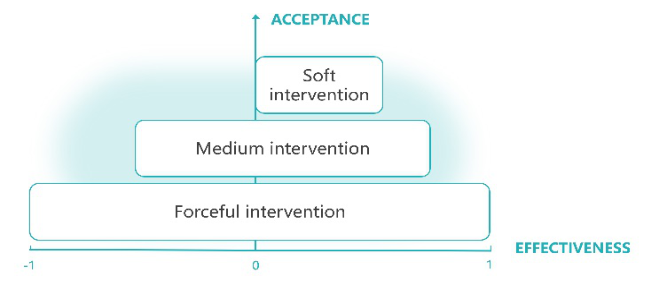
In the following chart (Figure 7), the three types of design intervention, divided by intensity, are visualised along the dimensions of acceptance and effectiveness. Soft interventions involve user-initiated actions and thus have a high acceptance level. They are unlikely to lead to negative outcomes, but as their intensity is low, there is no guarantee that they will be effective. Medium interventions provide guidance for action and are generally also well acce- pted. However, their effectiveness is influenced by other factors, such as the design of the facility or users’ levels of competence. Medium interventions may not be as effective as forceful interventions, which can produce either the
Design Intervention and Behaviour Change: Implication for Inclusive Public Design 133
best or the worst outcomes. While forceful interventions are generally effe- ctive in changing behaviour, they are the most extreme of the three strategies and have the lowest acceptance rate.
Despite the satisfactory results in terms of user response, we should note that the practical outcomes, from positive to negative, can be triggered regardless of the type of intervention (Figure 7). This suggests that inte- rventions should be carefully discussed and developed in the initial planning stage and the proportion of each type of intervention should be reasonably controlled to avoid or minimise possible ineffective or negative outcomes. User participation is also an important component of public design, which allows users to engage in the design decision-making process (Siu, 2003). In addition to pre-service inspections, regular visits are indispensable once the facility is in service. The participation of and feedback from all sectors of the community represent a huge incentive for government and designers to ensure that public spaces in cities are inclusive of all. Highly informative and directional recommendations for subsequent improvements can then be obtained.
CONCLUSION
We examine public facilities and user responses in this study and explore the relationship between design interventions and city user behavioural change. Based on a practical case study, we observe and analyse public facilities in open spaces in relation to the corresponding user practices. Three main level- s/types of design intervention are found to significantly influence and change user behaviour in relation to public facilities. We also analysed the different levels of acceptance and effectiveness for the three types of intervention.
Our results suggest that to promote sustainable behaviour in the long term, city administrators such as government departments should consider the uti- lity of design interventions. Design intervention strategies in open spaces and public facilities have been shown to significantly influence behavioural decisions, indicating that these strategies can lead to significant sustainable outcomes with proper consideration. However, openness and inclusiveness should be maintained. Interventions should remain human-centred and the use of high-intensity intervention strategies should be minimised. This will ensure that interventions are carried out in a way that is acceptable to the majority, making the outcomes beneficial to as many people as pos- sible. Finally, sustainable behaviour will result from multidimensional and integrated intervention. The ideal approach may therefore be a combination of strategies with multiple dimensions to leverage all strengths.
ACKNOWLEDGMENT
The authors would like to acknowledge the Humanity and Social Science Youth foundation of Ministry of Education (20YJC760111), the Plan for Philosophy and Social Sciences in Guangdong Province (GD19YYS06), and Major projects of Special Funds for Scientific and Technological Innovation Strategy in Guangdong Province (pdjh2021a0152) for the data collection and the preparation of the paper.
REFERENCES
Abraham, C. and Michie, S. (2008). A taxonomy of behavior change techniques used in interventions. Health psychology, 27(3), pp. 379-387. Hargreaves, T. (2011). Practice-ing behaviour change: Applying social practice the-
ory to pro-environmental behaviour change. Journal of Consumer Culture, 11(1), pp. 79–99. Heath, C. and Heath, D. (2010). Switch. New York: Broadway Books, pp. 17–18. Inclusive Design Hub. (2016). What is Inclusive Design. [online] Available at: https://inclusivedesign.scot/what-is-inclusive-design/ [Accessed 2 February 2022]. Niedderer, K., Clune, S. and Ludden, G. (2017) “Introducing models, methods
and tools for design for behaviour change.”, in: Design for Behaviour Change, Niedderer, K., Clune, S., & Ludden, G. (Eds.). pp. 19–25. Norman, D. (1998) The Design of Everyday Things. Cambridge, MA: The MIT Press Siu, K. (2001). The practice of everyday space: The reception of planned open space in Hong Kong. Hong Kong: Hong Kong Polytechnic University. Siu, K. (2003). Users’ creative responses and designers’ roles. Design Issues, 19(2),
pp. 64–73. Tang, T. and Bhamra, T. (2008) “Changing energy consumption behaviour through sustainable product design.”, DS 48: Proceedings DESIGN 2008, the 10th International Design Conference, Dubrovnik, Croatia. Xiao, J., Luo, M. and Li, W. (2021). Evaluation of models for household recycling
behaviour in high-rise buildings: A Chinese case study in urban Guangzhou. Waste Management, 131, pp. 126–135.
LISTED IN THE AHFE DIGITAL BOOKSTORE CATALOGUE
Explore the complete digital volume
Design for Inclusion
Read this individual research paper free through the original publisher, or explore the full digital proceedings book.
ISBN 978-1-958651-21-6
Explore this ISBN in the AHFE Bookstore ↗Listed in the July 2026 bookstore catalogue; search by ISBN to confirm current availability · Digital book purchase optional