Youle Liu, Zhuang Mou, Hanling Zhang (2026). Designing a Social Exergame for Community-Dwelling Older Adults: The Impact of Collaboration Conditions on Psychological Needs and Gaming Well-being. In: Human Factors in Aging and Special Needs. AHFE Open Access, vol. 214, pp. 21–31. https://doi.org/10.54941/ahfe1007570
Against the backdrop of the "active aging" concept driving innovation in community-based elderly care services, enhancing the quality of social participation among older adults through technological means has become a critical research focus. Employing a design thinking framework, this study developed a prototype for a two-player gesture-based exergame through five stages: empathy, definition, ideation, prototyping, and testing. A within-subjects controlled experiment was conducted to compare the effects of symmetric and asymmetric collaboration conditions on the basic psychological needs and gaming well-being of 22 community-dwelling older adults. Findings indicate that the asymmetric condition fostered greater mutual attention and positive communication, thereby strengthening the sense of relatedness. In contrast, the symmetric condition provided a psychologically safer environment that facilitated recognition of individual contributions, leading to a stronger sense of competence. Both conditions yielded similar levels of autonomy and gaming well-being. Future designs of social games for older adults should explore more diverse and flexible collaborative forms and cultivate a shared culture conducive to exploration and growth. This study offers practical implications and insights for designing social exergames for older adults in community-based active aging initiatives.
In China, community-based elderly care is a comprehensive model grounded in “aging in place,” allowing older adults to stay in familiar settings while integrating professional care into community networks (Yang Zhang & Xintong Yin, 2025). As “active aging” gains global recognition, the focus of community care has expanded beyond basic needs such as food, housing, transportation, and medical safety towards fostering supportive ecosystems that help older adults maintain or develop abilities and combat social isolation. Against this backdrop, exergame design for older adults has attracted growing attention. Scholars note that such games naturally create
shared activity contexts, allowing older adults to chat and interact during exercise and turning physical activity into social engagement, making them suitable for integration into social interaction settings (Skjæret et al., 2016). While existing research confirms the positive role of exergames in promoting social interaction and reducing loneliness among older adults (Borrego et al., 2021), little is known about how specific social interaction mechanisms affect their engagement (Som et al., 2024).
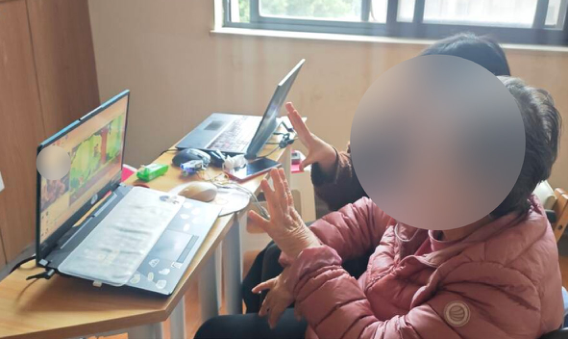
This study introduces social interaction mechanisms into exergame design for older adults. Using a five-stage design thinking approach including empathy, definition, ideation, prototyping, and testing, a two-player exergame prototype was developed. A within-subjects controlled experiment examined the effects of symmetric and asymmetric collaboration on the basic psychological needs and gaming well-being of 22 community-dwelling older adults. The study aims to offer practical insights for designing and researching socially focused exergames for older adults.
LITERATURE REVIEW
Exergames for Older Adults Exergames are motivating interactive video games in which users follow visual cues to control body movements, interact with the game environment, and receive real-time feedback to complete in-game operations or tasks (Chen et al., 2022). Compared to traditional physical exercise, exergames integrate physical activity with cognitively challenging tasks through a video-game interface, allowing multi-component training in a single session (Stanmore et al., 2017). Research indicates that the benefits of exergames for older adults arise mainly through embodied, task-oriented interaction mechanisms, which embed physical exercise within rule-based virtual environments offering feedback. This design shifts the user’s focus toward game goals rather than the movements themselves (Molina et al., 2014). However, the general lack of social elements in such designs may limit how well research findings reflect the practical value of exergames in real community or home settings (Skjæret et al., 2016). Although preliminary studies have shown that exergames can promote social interaction and reduce loneliness among older adults (Borrego et al., 2021), research remains largely focused on individual experiences. Relative to the sizable user population, relevant studies are still limited, and no systematic investigation has examined how specific social interaction mechanisms influence participants’ psychosocial well-being (Som et al., 2024).
Social Gaming Social gaming refers to digital gaming experiences involving active participation from multiple individuals. Rooted in the fundamental human need for stable and meaningful social bonds (Ryan & Deci, 2000), it serves as a common way to build and strengthen relationships through shared activities (Lenhart et al., 2008). Its design emphasizes “sociability”, focusing on how gameplay and context foster interaction among participants (Metaxas et al., 2005). This is realized through cooperative or competitive
Designing a Social Exergame for Community-Dwelling Older Adults 23 mechanics, as well as features such as chat and content sharing, which offer players varied channels for interaction. Extensive research shows that social gaming, especially cooperative play, can significantly enhance users’ hedonic and eudaimonic well-being (Bowman et al., 2022). Among older adults, cooperative games tend to promote prosocial behaviors and contribute to positive emotional experiences—even when players face challenges or exert effort during gameplay (Cès et al., 2025).
Symmetric and asymmetric gameplay represent two distinct interaction paradigms, each uniquely fostering engagement, shaping social relationships, and influencing the overall experience. Symmetric gameplay provides equal abilities, rules, and objectives for all participants, creating fair competition or collaboration. In contrast, asymmetric gameplay establishes complementary interactions by assigning players different roles, information, capabilities, or goals. While studies confirm that asymmetric cooperative games can enhance perceptions of social involvement and immersion, these findings may not generalize to other game types or contexts (Harris & Hancock, 2019). To date, the experiential differences and effects of symmetric versus asymmetric collaboration among older adults have not been thoroughly investigated. Further empirical research is needed to understand how design can effectively promote social interaction.
Self-Determination Theory Self-Determination Theory (SDT) is a macro theory of human motivation, development, and well-being. It posits that humans are inherently active organisms, driven by intrinsic motivation to pursue activities of interest and enjoyment, and endowed with a natural capacity to assimilate and integrate external stimuli for self-development. The fulfillment of this motivation, integration, and well-being relies on satisfying three basic psychological needs (Tyack & Mekler, 2024). Among these, the need for competence refers to experiencing effectiveness and mastery in environmental interactions, fulfilled through successfully confronting challenges, acquiring new skills, and achieving meaningful goals. The need for autonomy reflects one’s sense that their actions are self-initiated, volitional, and aligned with personal values and interests, entailing ownership and endorsement of one’s behavior. The need for relatedness stems from humans’ social nature. Its satisfaction involves feeling understood, valued, and cared for in relationships, as well as experiencing the capacity to offer care and connection to others.
RESEARCH METHODOLOGY Overall Research Process
This study employed a user-centered design thinking framework, following its five-stage process including empathize, define, ideate, prototype, test to design, develop, and evaluate a motion-sensing game aimed at promoting social interaction and physical activity among older adults. The first four stages focused on gathering user insights, defining design goals, generating concepts, and iteratively prototyping the game solution. The final testing stage involved an experimental evaluation of two design variants of the game prototype, conducted in the Futian Community, Nanchang.
Participants During the initial empathy phase, fieldwork was conducted across eight community senior care or activity centers in Changsha (Hunan Province) and Nanchang (Jiangxi Province) to establish a broad understanding of user needs and contexts. For prototype testing, 22 older adults were recruited from Futian Community, Nanchang City, Jiangxi Province (6 males, 16 females). The inclusion criteria were as follows: absence of severe psychiatric, neurological, or cognitive disorders; no history of traumatic brain injury or stroke; and normal or corrected vision, hearing, and physical mobility. Participants had a mean age of 67 years (SD = 4.06), ranging from 60 to 73 years.
Experimental Design and Procedure A within-subjects design was used, with each participant experiencing both symmetric and asymmetric collaboration conditions. To counterbalance potential order and fatigue effects, the 22 participants were randomly divided into two groups: Group 1 completed the asymmetric condition first, followed by the symmetric condition, while Group 2 underwent the two conditions in reverse order.
Immediately after each gameplay condition, participants completed standardized questionnaires. The Chinese version of the Psychological Need Satisfaction in Exercise Scale for Older Adults was used to measure the satisfaction of three basic psychological needs including competence, relatedness, and autonomy during gameplay. Minor wording adaptations were made to fit the gaming context (e.g., replacing “activity” with “game level”). All items used a 7-point Likert scale (1 = Completely Disagree, 7 = Completely Agree). The Gaming Well-Being Scale, consisting of 5 items rated on a 6-point scale (0 = Never, 5 = Always), was also administered to assess the frequency of positive emotions during play. Data were analyzed using the SPSSAU platform.
After all gameplay sessions, a semi-structured interview was conducted with each participant, covering topics such as condition preference, suggestions for game improvement, and perceptions of the interactive experience.
DESIGN PROCESS AND FINDINGS Empathize
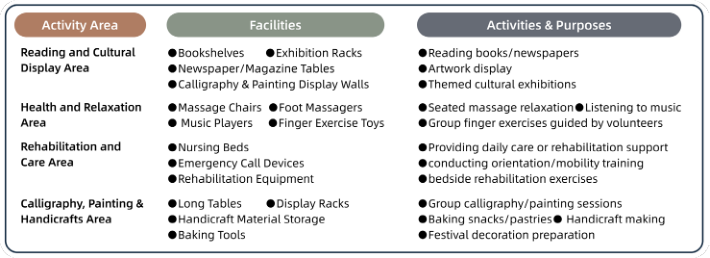
Based on field visits to eight communities in Changsha and Nanchang, this study summarized the common spatial configurations and daily activity arrangements of community-based elderly care service facilities. The results are presented in Figure 1.
Figure 1: Community elderly care service center: functional zoning and activities.
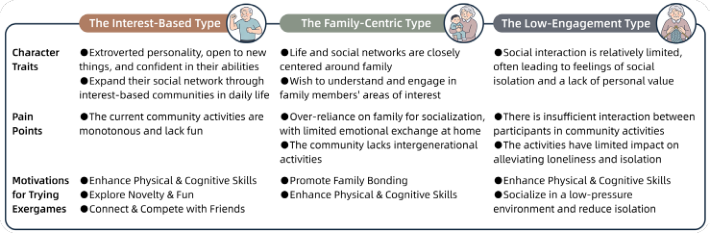
Based on interviews and observations, user personas for community- based elderly care services were synthesized (see Figure 2). According to social engagement patterns, older adults were classified into three user types: InterestBased Community Socializers, FamilyCentric Socializers, and the Low-Engagement type. All three groups showed interest in exergames, but with differing motivations: the first sought social interaction and enjoyable challenge; the second aimed to enhance intergenerational communication and family bonding; the third hoped to expand social networks and engage in lowpressure cognitive exercise. Participants generally viewed existing community activities as monotonous, low in interactivity, and lacking familysuitable facilities. Exergames were thus considered a potential way to address their needs for enjoyment, social engagement, and physical activity.
Figure 2: User persona.
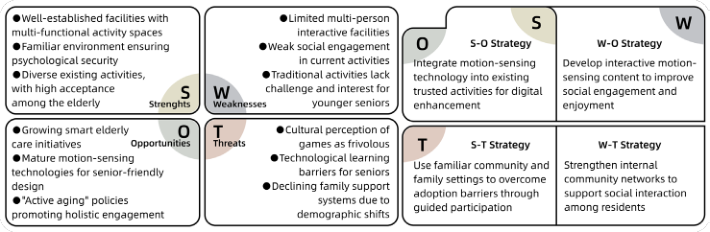
Define Building upon the findings from the empathize phase, this study conducted a SWOT analysis to examine the internal and external environment of community elderly care service activities and, through combined strategy analysis, derived four strategic types, as summarized in Figure 3.
Figure 3: SWOT and strategic analysis of current community elderly care service.
Focusing on the core weaknesses of current community elderly care activities—weak social elements and insufficient interaction—the W-O strategy could leverage mature technology and policy support to enhance the social and fun aspects of activities by developing collaborative exergames. Simultaneously, the S-O strategy builds upon existing facilities, activity foundations, and the trust of older adults to ensure the smooth integration of design innovations into familiar settings. This combination focuses on “reshaping the experience from within” rather than dispersing resources to address external threats like public perception, making it more targeted and executable at the current stage.
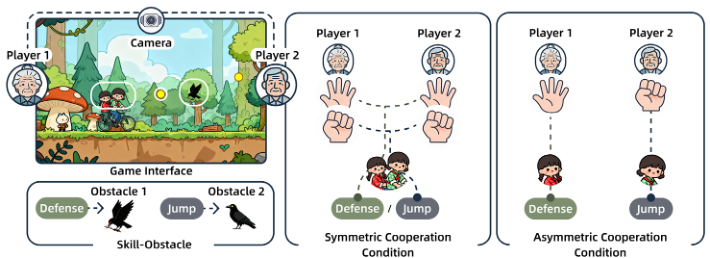
Ideation and Prototyping Centered on the core requirements, the research team conducted brainstorming sessions and finalized the design solution: a twoplayer exergame requiring tacit cooperation, in which participants jointly control a game character through natural gestures. The game implements two collaboration conditions, as shown in Figure 4. In the symmetric condition, both players perform synchronized gestures to activate defensive or jumping actions to avoid obstacles. In the asymmetric condition, each player controls a distinct character type with different skills, requiring complementary operations to succeed. The influence of these two conditions on players’ basic psychological needs and gaming wellbeing is examined in subsequent sections.
Figure 4: Game interface and cooperative condition.
Designing a Social Exergame for Community-Dwelling Older Adults 27 Technically, the game prototype (see Figure 5) was developed using Python and Figma. It utilizes a main loop to process events and update the game state at 60 frames per second, allowing two players to jointly guide a character in collecting coins and avoiding obstacles. Player gestures are captured via OpenCV at 30 frames per second from a webcam, horizontally flipped, and mapped to commands using MediaPipe hand landmark detection. The game state module monitors the character and activates a temporary “invincible state” with increased speed and collision immunity upon successful cooperation, while also recording collisions to assess coordination. Collision handling collects coins and increments the score upon bounding box overlap, and processes obstacle impacts in conjunction with the state module to determine outcomes.
Figure 5: Game prototype.
PROTOTYPE EVALUATION RESULTS Normality Test of Difference Scores
The Shapiro–Wilk test was used to assess the normality of the difference scores (Condition 1 – Condition 2, where Condition 1 = Asymmetric collaboration, Condition 2 = Symmetric collaboration) for each variable. The results showed that the distribution of difference scores for autonomy significantly deviated from normality (p < .05). By contrast, the difference scores for competence (p = .126), relatedness (p = .291), and gaming wellbeing (p = .262) all satisfied the normality assumption (see Table 1). Therefore, paired t-tests were performed for competence, relatedness, and gaming wellbeing, while the Wilcoxon signedrank test was used for autonomy.
Table 1: Normality test of difference scores.
Table available in the original PDF paper.
Measure N M SD Skew. Kurt. W p Competence 22 -0.682 1.211 0.381 −0.008 0.931 0.126
Paired t-Tests Paired-samples t-tests (see Table 2) indicated significant differences between conditions for competence and relatedness, but not for gaming wellbeing. Competence scores were significantly higher in Condition 2 than in Condition 1, t(21) = −2.642, p = .015. Relatedness scores were significantly higher in Condition 1 than in Condition 2, t(21) = 2.270, p = .034. The difference in gaming wellbeing between conditions was nonsignificant, t(21) = −0.658, p = .518.
Wilcoxon Signed-Rank Test for Paired Samples The results of the paired-sample Wilcoxon signed-rank test, as presented in Table 3, showed that the difference in autonomy between the two conditions was not significant (z = −0.153, p = .878), with similar median scores (Condition 1 Mdn = 26.50; Condition 2 Mdn = 26.00).
Table 3: Wilcoxon signed-rank test for paired samples.
This study found that the asymmetric collaboration condition strengthened participants’ sense of relatedness, consistent with prior research on team coordination and interdependence. Well-coordinated teams engage in “heedful interrelating,” where responsive and proactive communication fosters unity and enhances peer connection (Stephens & Lyddy, 2016). In the asymmetric condition, participants were assigned complementary, non-substitutable roles that prevented independent task completion. This designed interdependence required them to articulate their own capabilities while actively attending to, interpreting, and integrating their partner’s actions, thereby facilitating mutual information exchange and shared meaning-making. Creating opportunities for mutual attention and responsive interaction has been shown to promote the experience of “acting as a whole” among older adults in games.
Participants reported a stronger sense of competence in the symmetric collaboration condition. This contrasts with a study of younger players, where asymmetric roles led to higher perceived adaptation to game controls— an indicator of operational comfort and confidence (Harris & Hancock, 2019). The difference highlights how player characteristics moderate the effectiveness of social game design. For older adults, symmetric collaboration, with identical capabilities, allowed cooperation to improve efficiency or share risks. One participant noted, “When I was still learning the rules, having a more skilled partner let me follow along, which built my confidence. Even when my own reaction was slow, my partner could step in and complete the action—that felt very secure.” Those perceived as more capable reported a clearer sense of “leading and helping their partner” and stronger feelings of “being recognized” in the symmetric condition. When team members can contribute without tight coordination, individual contributions become more visible (Thomas et al., 2020). However, heightened “perception of individual contribution” may also trigger peer competition or excessive social comparison (Harris & Hancock, 2019). Notably, several participants expressed a desire to “gain ability recognition through level progression” and to “compare themselves with younger people,” such as by receiving feedback like “Your reaction speed matches that of a 20-year-old” upon completing a level. Aging often involves real-world challenges like diminished social roles or perceived declines in ability, reducing sources of “personal contribution.” Games provide a safe, rule-bound environment where clear feedback directly links action to outcome, allowing older players to observe how effort improves ability—reinforcing the belief that “they are still capable of learning and growing”.
Levels of autonomy were similar across conditions. Participants reported “paying attention to their partner’s actions when making decisions” without feeling “hindered or controlled.” Satisfying the need for autonomy depends on experiencing volition and endorsement of one’s actions. However, high performance arises when team members focus on improving personal capability rather than solely on outperforming others (Nederveen Pieterse et al., 2019). As one interviewee remarked, “I care more about what I learn from the game and from others than about getting a higher score.” This
suggests that collaborative games should not only provide meaningful choice, decisional authority, and a clear shared purpose, but also cultivate a shared culture that encourages exploration and growth. Without such a culture, excessive autonomy can fragment objectives and undermine collaboration.
No significant difference in gaming well-being was observed between conditions. Whether in asymmetric or symmetric collaboration, participants reported similar levels of enjoyment, calmness, vitality, relaxation, and interest. This implies that players’ emotional responses are shaped by multiple factors. Future social game designs for older adults should therefore explore more diverse and flexible collaborative forms, constructing interaction frameworks that dynamically incorporate different relational characteristics.
CONCLUSION
Following a design-thinking process informed by multi-community preliminary research, this study developed a two-player gesture-based motion-sensing game prototype. Using a within-subjects design, it examined the effects of symmetric and asymmetric collaboration conditions on basic psychological needs and gaming well-being among 22 community-dwelling older adults. Results showed that the symmetric condition better supported competence, whereas the asymmetric condition more effectively satisfied relatedness. Autonomy and gaming well-being did not differ significantly between conditions.
The conclusions of this study are derived from a specific community sample and thus require further validation with larger, geographically diverse populations to enhance their generalizability. Additionally, the investigation was limited to a single session, leaving the long-term effects of the different collaboration conditions unexamined. Future work should employ longitudinal methods to trace how sustained engagement with such exergames shapes older adults’ social participation over time. Further research could also explore a wider spectrum of collaborative formats and investigate the potential role of AI agents as asymmetric partners to guide and scaffold cooperative interactions.
REFERENCES
Borrego, G., Morán, A. L., Meza, V., Orihuela-Espina, F., & Sucar, L. E. (2021). Key factors that influence the UX of a dual-player game for the cognitive stimulation and motor rehabilitation of older adults. Univ Access Inf Soc, 20(4), 767–783. https://doi.org/10.1007/s10209-020-00746-3 Bowman, N. D., Rieger, D., & Tammy Lin, J.-H. (2022). Social video gaming
and well-being. Curr Opin Psychol, 45, 101316. https://doi.org/10.1016/j. copsyc.2022.101316 Cès, P., Doyen, A. L., Duflos, M., & Giraudeau, C. (2025). Intergenerational Board Games Among Older Adults and School-Aged Children, Through the Lens of Shared Pro-Social Behaviors and Positive Affect. Scand J Psychol, 66(4), 611–623. https://doi.org/10.1111/sjop.13108 Chen, P.-J., Chen, K.-M., Hsu, H.-F., & Belcastro, F. (2022). Types of exercise and
training duration on depressive symptoms among older adults in long-term care facilities. Ageing Res Rev, 77, 101613. https://doi.org/10.1016/j.arr.2022.101613
Designing a Social Exergame for Community-Dwelling Older Adults 31 Harris, J., & Hancock, M. (2019). To Asymmetry and Beyond: Improving Social
Connectedness by Increasing Designed Interdependence in Cooperative Play. 1-12. https://doi.org/10.1145/3290605.3300239 Lenhart, A., Kahne, J., Middaugh, E., Macgill, A., Evans, C., & Vitak, J. (2008).
Teens, Video Games, and Civics: Teens’ Gaming Experiences Are Diverse and Include Significant Social Interaction and Civic Engagement. Pew Internet & American Life Project. Metaxas, G., Metin, B., Schneider, J., Shapiro, G., Zhou, W., & Markopoulos, P.
(2005). SCORPIODROME: an exploration in mixed reality social gaming for children. 229-232. https://doi.org/10.1145/1178477.1178514 Molina, K. I., Ricci, N. A., de Moraes, S. A., & Perracini, M. R. (2014). Virtual reality using games for improving physical functioning in older adults: a systematic review. J NeuroEngineering Rehabil, 11(1), 156–156. https://doi. org/10.1186/1743-0003-11-156 Nederveen Pieterse, A., Hollenbeck, J. R., van Knippenberg, D., Spitzmüller, M.,
Dimotakis, N., Karam, E. P., & Sleesman, D. J. (2019). Hierarchical leadership versus self-management in teams: Goal orientation diversity as moderator of their relative effectiveness. The Leadership quarterly, 30(6), 101343. https://doi. org/10.1016/j.leaqua.2019.101343 Ryan, R. M., & Deci, E. L. (2000). Self-Determination Theory and the Facilitation of Intrinsic Motivation, Social Development, and Well-Being. Am Psychol, 55(1), 68–78. https://doi.org/10.1037/0003-066X.55.1.68 Skjæret, N., Nawaz, A., Morat, T., Schoene, D., Helbostad, J. L., & Vereijken, B.
(2016). Exercise and rehabilitation delivered through exergames in older adults: An integrative review of technologies, safety and efficacy. Int J Med Inform, 85(1), 1–16. https://doi.org/10.1016/j.ijmedinf.2015.10.008 Som, H. M., Hanafi, H. F., & Savita, K. S. (2024). A Comprehensive Review of User Experience Research on Somatosensory Games for Older Adults. ICCUBEA, 1–7. https://doi.org/10.1109/ICCUBEA61740.2024.10775083 Stanmore, E., Stubbs, B., Vancampfort, D., de Bruin, E. D., & Firth, J. (2017). The
effect of active video games on cognitive functioning in clinical and non-clinical populations: A meta-analysis of randomized controlled trials. Neurosci Biobehav Rev, 78, 34–43. https://doi.org/10.1016/j.neubiorev.2017.04.011 Stephens, J. P., & Lyddy, C. J. (2016). Operationalizing Heedful Interrelating: How Attending, Responding, and Feeling Comprise Coordinating and Predict Performance in Self-Managing Teams. Front Psychol, 7, 362–362. https://doi. org/10.3389/fpsyg.2016.00362 Thomas, J. S., Loignon, A. C., Woehr, D. J., Loughry, M. L., & Ohland, M. W. (2020).
Dyadic Viability in Project Teams: the Impact of Liking, Competence, and Task Interdependence. J Bus Psychol, 35(5), 573–591. https://doi.org/10.1007/s10869- 019-09647-6 Tyack, A., & Mekler, E. D. (2024). Self-Determination Theory and HCI Games Research: Unfulfilled Promises and Unquestioned Paradigms. ACM TOCHI, 31(3), 1–74. https://doi.org/10.1145/3673230 Yang Zhang & Xintong Yin. (2025). Lhasa’s Vibrant Practice and Strategies for
Enhancing Community Elderly Care Services. Xizang Studies(03), 141–154. (in Chinese) http://dx.chinadoi.cn/10.3969/j.issn.1000-0003.2025.03.013.
LISTED IN THE AHFE DIGITAL BOOKSTORE CATALOGUE
Explore the complete digital volume
Human Factors in Aging and Special Needs
Read this individual research paper free through the original publisher, or explore the full digital proceedings book.
ISBN 978-1-964867-90-8
Explore this ISBN in the AHFE Bookstore ↗Listed in the July 2026 bookstore catalogue; search by ISBN to confirm current availability · Digital book purchase optional