Di Fang, Jin Li, Hanling Zhang (2024). An experiential study of digital interactive feedback for anxiety attention bias modification. In: Usability and User Experience. AHFE Open Access, vol. 156, pp. 118–128. https://doi.org/10.54941/ahfe1005421
Attentional Bias Modification Training (ABMT) shows promise in digital therapy for anxiety. However, there's limited research on interactive feedback in ABMT for anxiety populations. This study examines ABMT's application in anxiety interventions, focusing on different interactive feedback effects on user experience, willingness to participate, and intervention outcomes. Using an emotional visual search task, the experiment comprised two parts: participants completed 100 trials with varied feedback, and their anxiety changes and eye-movement tendencies were recorded. In the second part, participants experienced each task 10 times, completed a user experience questionnaire, and underwent interviews. Results revealed ABMT's positive impact on anxiety. Combining avatar customization and points enhanced intervention effects, while points feedback alone was ineffective. Avatar customization or a combination of feedback methods led to a better participant experience. The study suggests points may increase stress, while customized images guide emotions positively, emphasizing interactive feedback's importance in digital interventions and offering insights for future development.
Anxiety, a prevalent mental disorder (Charlson, 2019), can lead to severe mental and physical issues. Early prevention and intervention are crucial to prevent escalation. However, limited mental health resources result in underdiagnosis and undertreatment of anxiety (Mangolini, 2019). Effective methods are needed to enhance early identification and intervention rates to address society’s mental health needs.
In the era of rapid technological advancement, Internet-based mobile psychological interventions have become an emerging psychotherapeutic approach. Digital therapy, as a therapy based on the Internet and smart devices, provides users with digitized therapeutic services with the help of smart media (Saramago, 2021). It bridges the gap of traditional psychother- apy, reduces the cost of interventions, improves accessibility, and enables users to receive psychotherapy in a more multifaceted way (McDonald, 2020).
An Experiential Study of Digital Interactive Feedback 119
Despite progress in digital therapy for anxiety, design flaws persist in user experience. Translating treatment theories into digital apps requires attention to interaction and user experience, impacting intervention effec- tiveness (Biagianti, 2023). Digital interventions struggle to ensure active user engagement and telemedicine utilization (Miu, 2021). User motivation and personalized treatment plans directly affect intervention experience and effec- tiveness, influencing future participation. To enhance psychotherapy appeal, thorough investigation into computerized psychological intervention user experience is essential in addressing psychological disorder traits.
In this study, we assessed different feedback types’ impacts on intervention effects, task motivation, and user experience in an anxiety intervention task. We focused on points and avatar customization as feedback modalities, creat- ing four versions of the Emotional Visual Search Task (EVST). We used both physiological and subjective data to measure intervention effects and task experience. Attentional Bias Modification Training (ABMT) had a positive effect on anxiety symptoms. We found that avatar customization maintained intervention significance, while points diminished it. Combining both feed- back types positively influenced motivation, eye-movement attention, and intervention effects.
RELATED WORK
Anxiety and Attention Bias Modification Training The information processing bias in anxiety is crucial to its development and maintenance (Bar-Haim, 2010). Anxious individuals typically exhibit atten- tional bias towards threatening faces and struggle with attention shifting (Hudays, 2022). This bias not only worsens anxiety but also leads to more severe cases (Nelson, 2015). Allowing attention to shift away from threat- ening stimuli effectively reduces anxiety responses and mitigates various anxiety disorders. (Bar-Haim, 2010). ABMT modifies abnormal attentional tendencies in anxiety patients (Bø, 2021), offering therapist-less interven- tions suitable for digital transformation. However, digital research on ABMT remains limited, requiring more focus on usability for further develop- ment. User experience is crucial in mental health interventions, significantly impacting treatment outcomes (Mohr, 2017).
User Experience and Self-Determination Theory User experience refers to how users feel psychologically when using a product (Ma, 2012). Clever interactive design in digital psychotherapy will enhance user experience, leading to more effective interventions. Self-determination theory (SDT) highlights three psychological needs: autonomy, competence, and relatedness (Ryan and Deci, 2017). Autonomy is the main motivational principle (Bandura, 1977), and granting users more autonomy improves task performance and process experience (Peters, 2018). High willingness to participate encourages users to engage consciously in cognitive training, improving psychological intervention outcomes (Ryan and Deci, 2017). SDT
distinguishes between extrinsic and intrinsic motivation, emphasizing intrin- sic motivation’s importance and recognizing the potential for internalization of extrinsic motivation under appropriate conditions and environments.
Interactive Feedback Based on User Experience Interaction feedback cues users about their actions’ outcomes (De Sales, 2022), like answering a question correctly. Motivational feedback improves user experience and encourages active participation (Tang, 2021). However, inappropriate feedback decreases motivation sensitivity and impedes eliciting specific emotional experiences (Ming, 2021). Given that different user groups prefer various feedback methods, designing feedback based on user character- istics improves task outcomes. Thus, understanding system nature and user characteristics is crucial in crafting appropriate feedback for user-centered design.
Points, commonly utilized as extrinsic rewards, cater to users’ extrinsic motivation (Yang, 2021). They prove motivating for tasks lacking inherent appeal (Legault, 2016) and can incentivize both extrinsic and intrinsic moti- vation under appropriate circumstances. For instance, points may symbolize a user’s competence and be easily recognized by others (Yang, 2021). A well- crafted points system can address users’ emotional needs, thereby enhancing task engagement.
In systems and tasks, avatar customization offered flexibility in present- ing a user’s identity, allowing adjustments based on personality needs (Kang, 2020). It enhanced autonomy satisfaction and strengthened identity, fostering intrinsic motivation (Birk, 2019; Kang, 2020). Avatars served as process aids in cognitive training, boosting effectiveness, reducing anxiety (Birk, 2019), and improving health education through increased intrinsic motivation and task engagement (Kang, 2020). Despite its benefits, current cognitive tasks primarily used avatars during setup or as selected affective pictures. No studies explored using images as part of interactive feedback.
Therefore, in this ABMT task, we investigated feedback design using two key elements: points and avatar customization, targeting intrinsic and extrinsic motivation promotion, respectively. Our goal was to explore how different feedbacks impact intervention effectiveness, task motivation, and user experience in an anxiety intervention task.
RESEARCH METHODOLOGY Experimental Task
Free-viewing Task: Participants freely viewed three sets of emotional images, each with 16 face images, including 8 non-threatening and 8 threatening images. The images were randomized distributed on the screen. Each set appeared for 15 seconds, with a 1.5-second red “+” gaze point between switches to cue participants to refocus their attention ABMT: During the intervention session, participants underwent training using the EVST, a method of ABMT known for effectively correcting cogni- tive biases (Li, 2023). In the EVST, participants actively searched for positive
An Experiential Study of Digital Interactive Feedback 121
stimuli among 4 pictures, 3 of which were threatening and 1 non-threatening. They used a mouse to select the non-threatening picture within 10 seconds. If no response occurred within 10 seconds, “timeout” appeared, and the next set of pictures displayed. A 1.5-second red “+” and 1.5-second white screen between picture sets directed participants’ attention.
Avatar Customization: To enable avatar customization, we utilize the iOS system’s simulated expression function. Users can select various hairstyles, hair colors, eye colors, mouth shapes, and more to customize avatar. After creating the characters, users can also choose from a variety of facial expres- sions and actions, such as smiling, frowning, and winking. During character creation, users can observe the dynamic effects of their characters in real- time. In this experiment, participants in the image group and the integrated group customized their images at the start. They were instructed to cre- ate images based on their preferences and select expressions and actions reflecting positive emotions.
Stimulus In all tasks, stimuli comprised facial images displaying various emotions, including non-threatening (neutral or happy) and threatening (angry or sad) expressions. Images were sourced from the Geneva Affective Picture Database (Dan-Glauser, 2011) and the Open Affective Standardized Image Set (Kurdi, 2017), known for effectively stimulating emotions. From these databases, 112 images were chosen and uniformly resized to 473x378px and 72dpi to match the task program. The selection included characters of differ- ent genders and age groups to prevent specific demographics from influencing the task.
Measures State Trait Anxiety Inventory (STAI): We used the STAI to measure subject anxiety. Participants completed the scale both before and after the task. The STAI includes 20 trait anxiety (T-AI) assessment items and 20 state anxiety (S-AI) assessment items, covering a range of descriptions like “I feel calm.” Responses were rated on a 4-point scale from “not at all”to “very noticeable” (Spielberger, 1971).
Motivation Scale: We employed the scale adapted from Tang et al. to evalu- ate participants’ task motivation (Tang, 2021). The modified scale consisted of nine questions assessing extrinsic motivation, intrinsic motivation, and willingness to participate, utilizing a five-point Likert scale for all questions.
User Experience Questionnaire (UEQ): We utilized the UEQ to eval- uate the user experience of the ABMT. The UEQ is a standardized tool for assessing software user experiences. It measures six experiential fac- tors: attractiveness, clarity, efficiency, reliability, stimulation, and novelty to synthesize overall user experience quality (Laugwitz, 2008). Participants rated their feelings on a 7-point Likert scale, ranging from “unpleasant” to “pleasant,” in relation to the problem.
Eye Movement: We focused on subjects’ attentional behavior as an objec- tive measure. Anxious populations tend to pay pronounced attention to
threatening stimuli, with their eye-movement behavior differing significantly from healthy groups (Bar-Haim, 2010). Moreover, individuals paying more attention to positive stimuli contribute to maintaining a favorable mental state (Blanco, 2019). As attentional behavior is a key target of anxiety interventions, we assessed whether subjects’ eye-movement behavior was modified during a free-viewing emotional picture task. We adapted the pro- cedure used by Zhang et al. (Zhang, 2022), where participants freely viewed emotional images. Gaze duration and gaze counts for emotional stimuli were recorded using a Tobii Pro Glasses 3 eye-tracker, and eye-movement data were analyzed in detail using Tobii Pro Lab.
User Interview: We conducted user interviews to understand subjects’ experiences in different tasks. Our questions included, but were not limited to, “Which feedback do you prefer?” and “Why do you feel good/not good about this feedback?” We collected subjective statements from participants and asked follow-up questions to gain deeper insights into their feelings and perspectives.
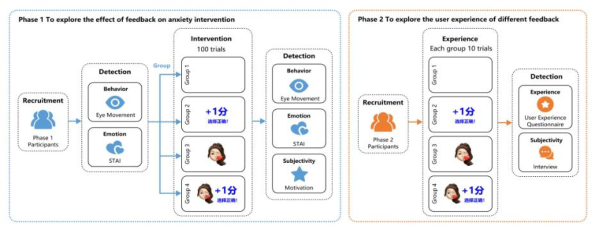
Figure 1: Framework of this study.
Participants To better explore feedback’s impact, we recruited participants in two stages.
Phase 1: To explore the impact of feedback on anxiety intervention effec- tiveness, we recruited 43 participants (25 males, 22 females) from Hunan University using an online questionnaire. Participants had a mean age of 23.40 years (SD = 2.14), ranging from 21 to 30 years. Anxiety condi- tions are prevalent among individuals aged 21 to 30 (Zhang, 2020), who are also more accustomed to electronics and likely to adapt to digital interventions.
Phase 2: To delve deeper into users’ feedback experiences, participants were recruited again via a questionnaire. None of the re-recruited partici- pants had previously taken part in the anxiety intervention task used in the experiment. A total of 33 subjects were recruited, including 21 males and 12 females, with a mean age of 23.67 years (SD = 2.259) and an age range of 21 to 30 years.
An Experiential Study of Digital Interactive Feedback 123
Both stages of the study received approval from the Ethics Committee of the School of Design at Hunan University. All participants provided informed consent at the beginning of the experiments.
Procedure The entire experimental procedure and framework are illustrated in Figure 1.
In Phase 1, participants were briefed on the study’s duration (60 min) and compensation (60 RMB) and informed about the inclusion of images depicting threatening emotions. They completed a demographic survey and the STAI. Participants with high anxiety scores were selected and randomly assigned to one of four groups: no-feedback (Group 1), points (Group 2), avatar customization (Group 3), and points & avatar customization (Group 4). Each participant underwent a free-viewing task with Tobii Pro Glasses 3 and completed a 100-trial image selection task, receiving feedback based on their group assignment. After ABMT, they repeated the free-viewing task and completed the STAI and motivation scales.
In Phase 2, participants completed a questionnaire, provided demographic information, and customized avatars after learning about the experiment’s duration (30 min) and compensation (30 RMB). Unlike Phase 1, participants individually experienced each of the four tasks. They completed 4 tutorial exercises before starting the task and were randomly assigned to one task group. After 10 image selections, participants filled out the UEQ and were interviewed upon completion.
Analysis Throughout the study, we maintained a significance level of p < 0.05. Data analysis was conducted using SPSS version 26. We assessed normal- ity using the Shapiro-Wilk Test, confirming that samples were normally distributed. Paired-samples t-tests were conducted within each group to examine the intervention effect of ABMT on anxiety. One-way ANOVA analyses were performed to explore differences in anxiety changes between groups. We also investigated the impact of different feedback and motiva- tion scale components on task motivation using one-way ANOVA analyses. Spearman correlation coefficients were calculated to assess the relation- ship between willingness to participate and intervention effects. In the third analysis, eye movement data were processed using Tobii Pro Lab. Gaze duration in threatening versus non-threatening areas of interest was ana- lyzed with paired-sample t-tests to evaluate changes before and after ABMT. Additionally, Spearman’s correlation coefficient was utilized to examine the correlation between eye-movement behavior and anxiety scores, validating the eye movement data.
In phase 2, normal distribution was again confirmed using the Shapiro- Wilk Test. A one-way ANOVA analysis with task group as the factor and each UEQ question as the dependent variable was conducted. Post hoc multiple tests using the LSD method were performed to assess significant differences between task groups and integrate results with interview content.
RESULTS
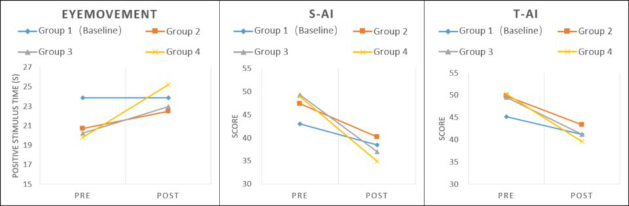
The results of the statistical tests are shown in Figure 2 and Table 1.
STAI: We found significant differences in S-AI scores before and after train- ing in Groups 1, 3, and 4 (p < 0.05), while no significant differences were observed in Group 2 (p = 0.077). Interestingly, only Groups 3 and 4, which included avatars, showed a significant effect on T-AI (p3 < 0.05, p4 < 0.01). Group 4 had a significantly better S-AI intervention than Group 1 (p < 0.05), whereas the group that only included points (Group 2) and the group that only included avatars (Group 3) failed to present a significant difference from the control group.
Motivation: The groups did not significantly differ in terms of extrinsic motivation and willingness to participate. However, extrinsic motivation was notably higher in Group 4 compared to Group 2 (p < 0.05). Correlation anal- ysis showed no significant correlation between task participation motivation and intervention effectiveness.
Eye Movement: Before and after ABMT, Group 1 and Group 2’s positive picture attention tendencies remained unchanged (p1=0.997, p2=0.284). However, Groups 3 and 4, which included avatars, experienced signifi- cant alterations in attentional behavior (p < 0.05). Particularly, Group 4 showed superior corrective effects compared to the control group (p < 0.05). Additionally, we found a significant positive correlation (p < 0.01) between changes in active attentional behavior and changes in anxiety scores, rein- forcing the reliability of the eye movement data.
Figure 2: (Left) change in active gaze time across groups before and after the task; (middle & right) change in S-AI and T-AI scores across groups before and after the task.
UEQ: Table 1 presents the mean and standard deviation of the UEQ scores. Between-group comparisons revealed significant differences in attractiveness, excitement, and novelty. Groups incorporating avatar customization (Group 3 and Group 4) performed better in terms of attractiveness (p < 0.01), excite- ment (p < 0.01), and meeting user expectations (p < 0.05). Adding points to avatars significantly enhanced expectations (p < 0.01). Regarding stim- ulation, adding only avatar (Group 3) was more enjoyable (p < 0.05) and favorable to the task (p < 0.01) compared to adding only points (Group 2). Combining avatar customization with points offset the negative impact of points on task favorability (p < 0.05). Tasks with avatar customization
An Experiential Study of Digital Interactive Feedback 125
(Groups 3 and 4) were perceived as more innovative (p < 0.05), creative (p < 0.01), novel (p < 0.01), and original (p < 0.01). While tasks with added points (Group 2) lacked user approval in terms of innovativeness, adding avatars to points (Group 4) significantly improved perceptions (p < 0.01).
Table 1. Results of statistical tests of motivation scale and UEQ
Table available in the original PDF paper.
DISCUSSION
The study found that ABMT effectively improved S-AI, in line with prior research (Li, 2023). Avatar customization significantly boosted the inter- vention’s impact on S-AI, while points did not yield significant effects. Despite points typically enhancing task enjoyment, they seemed to hinder intervention effectiveness in ABMT tasks. However, reintroducing avatar customization alongside points significantly outperformed the control group, suggesting a mixed feedback approach might be more beneficial. Participants perceived points as stressful, akin to exam pressure, and were ineffective in motivating anxiety intervention participants, especially students facing aca- demic stress (Zhang, 2020). Therefore, caution is needed when using points in anxiety interventions in the future.
Combining avatars with points mitigates the negative effects of points on anxiety intervention, and the interaction between the two enhances the user’s experience. Interview results suggest some changes in their functioning when both types of feedback are present. The avatar still had a motivational effect, while the points acted more as behavioral cues. The avatar was more appeal- ing to users as positive feedback, with most participants stating that the avatar customization was their ideal look or favorite character, and that this identification helped to reduce defensiveness and receive health information more effectively (Kang, 2020). Users paid more attention to textual prompts than scores, which may be disturbing at first contact, and the addition of tex- tual prompts is necessary to make the feedback mechanism more complete; scores are not essential, and future intervention tasks may consider removing points and using only textual prompts.
ABMT had limited effectiveness in improving T-AI compared to its pri- mary association with S-AI. Our task aimed to reduce attentional bias by encouraging users to focus on positive stimuli, resulting in a reduction of
T-AI relative to S-AI, which aligns with prior findings. The avatar notably reduced T-AI levels by enhancing feedback recognition and increasing user attention. T-AI relates to difficulties in attentional distraction, and recogniz- able positive stimuli improved these problems. The positive expressions or actions provided through avatar served as additional intervention strategies. Eye movement revealed a strong correlation between changes in attentional tendencies and anxiety scores, indicating the efficacy of attentional modi- fication in alleviating anxiety, consistent with previous research. External interventions can disrupt the cycle of anxiety and threatening attentional tendencies, preventing anxiety from persisting (Nelson, 2015).
Our results diverged from prior research as the introduction of points did not increase users’ extrinsic motivation to engage in the task. Con- versely, incorporating avatar customization along with points notably ele- vated extrinsic motivation levels. While points seemed ineffective in providing rewards or facilitation, avatars played a motivational role. Through UEQ and user interviews, we discovered that avatars significantly enhanced the attrac- tiveness, excitement, and novelty of the tasks. Adding avatar customization to baseline or point tasks made them more appealing, interesting, engag- ing, and innovative. Our initial experiment results suggest that avatar boosts extrinsic motivation due to its inherently entertaining nature. Users actively participate in creating images, fulfilling psychological needs and enhancing user experience, consistent with other task findings (Peters, 2018). Previous studies indicate that points are typically used as extrinsic rewards to meet users’ external needs (Yang, 2021). However, for anxious groups, points lose their rewarding aspect and may even induce stress.
Compared to the baseline task, the introduction of feedback did not sig- nificantly alter extrinsic motivation, intrinsic motivation, or willingness to participate. This could be attributed to the ABMT’s lack of inherent interest and the feedback’s limited ability to fulfill autonomy needs. The level of per- sonalization may not be sufficient to enhance appeal. Simple feedback designs may not fundamentally change the task’s nature, hindering the internalization of extrinsic motivation and lacking complete feedback closure, thus failing to stimulate strong participation willingness. Hence, future research should focus on enhancing task feedback design and exploring additional methods to boost participation willingness.
CONCLUSION
Addressing global mental health issues is an urgent task, and the promo- tion of digital psychotherapy is crucial in this context. In this backdrop, user experience design plays a critical role in digital therapy. Our study aimed to assess the impact of different feedback on intervention effect, motivation, and user experience in anxiety intervention tasks, while elucidating the rea- sons behind these effects. The results indicate that caution is warranted in using points in anxiety intervention tasks, as they may add extra pressure to anxious individuals. In contrast, avatar customization emerges as a highly promising feedback, enhancing task emotional, innovative experiences and attractiveness, and serves as a secondary intervention. Combining both feed- back resulted in better task performance. Future research should focus on
An Experiential Study of Digital Interactive Feedback 127
refining task interaction design to stimulate long-term user engagement and achieve more significant therapeutic effects.
REFERENCES
Bandura, A. 1977. Self-efficacy: Toward a unifying theory of behavioral change.
Psychological Review, 84: 191–215. Bar-Haim, Y., 2010. Research Review: attention bias modification (ABM): A novel treatment for anxiety disorders: Research Review: Attention bias modification (ABM). Journal of Child Psychology and Psychiatry 51, 859–870. Biagianti, B., Foti, G., Di Liberto, A., Bressi, C., Brambilla, P., 2023. CBT-informed
psychological interventions for adult patients with anxiety and depression symp- toms: A narrative review of digital treatment options. Journal of Affective Disorders 325, 682–694. Birk, M. V., Mandryk, R. L., 2019. Improving the Efficacy of Cognitive Training for Digital Mental Health Interventions Through Avatar Customization: Crowdsourced Quasi-Experimental Study. J Med Internet Res 21, e10133. Blanco, I., Poyato, N., Nieto, I., Boemo, T., Pascual, T., Roca, P., Vazquez, C., 2019.
Attentional biases in dysphoria when happy and sad faces are simultaneously presented. Journal of Behavior Therapy and Experimental Psychiatry 65, 101499. Bø, R., Kraft, B., Jonassen, R., Harmer, C. J., Hilland, E., Stiles, T. C., Haaland, V.Ø., Aspesletten, M. E. B., Sletvold, H., Landrø, N. I., 2021. Symptom severity mod- erates the outcome of attention bias modification for depression: An exploratory study. Journal of Psychiatric Research 138, 528–534. Charlson, F., Van Ommeren, M., Flaxman, A., Cornett, J., Whiteford, H., Saxena, S.,
2019. New WHO prevalence estimates of mental disorders in conflict settings: A systematic review and meta-analysis. The Lancet 394, 240–248. Dan-Glauser, E. S., Scherer, K. R., 2011. The Geneva affective picture database (GAPED): A new 730-picture database focusing on valence and normative sig- nificance. Behav Res 43, 468–477. De Sales, A. B., Santos, B. A., Palmeira, E. G. Q., 2022. Feedback Mechanisms
in Human-Computer Interaction Serious Games, in: 2022 17th Iberian Confer- ence on Information Systems and Technologies (CISTI). Presented at the 2022 17th Iberian Conference on Information Systems and Technologies (CISTI), IEEE, Madrid, Spain, pp. 1–6. Hudays, A., Gallagher, R., Hazazi, A., Arishi, A., Bahari, G., 2022. Eye Movement Desensitization and Reprocessing versus Cognitive Behavior Therapy for Treating Post-Traumatic Stress Disorder: A Systematic Review and Meta-Analysis. IJERPH 19, 16836. Kang, H., Kim, H. K., 2020. My avatar and the affirmed self: Psychological and
persuasive implications of avatar customization. Computers in Human Behavior 112, 106446. Kurdi, B., Lozano, S., Banaji, M. R., 2017. Introducing the Open Affective Standardized Image Set (OASIS). Behav Res 49, 457–470. Laugwitz, B., Held, T., Schrepp, M., 2008. Construction and Evaluation of a User
Experience Questionnaire, in: Holzinger, A. (Ed.), HCI and Usability for Educa- tion and Work, Lecture Notes in Computer Science. Springer Berlin Heidelberg, Berlin, Heidelberg, pp. 63–76. Legault, L., 2016. Intrinsic and Extrinsic Motivation, in: Zeigler-Hill, V., Shackelford, T. K. (Eds.), Encyclopedia of Personality and Individual Differences. Springer International Publishing, Cham, pp. 1–4.
Li, G., Cai, X., Yang, Q., Cui, Q., Huang, L., Jing, X., Wang, Y., 2023. A review of attentional bias modification trainings for depression. CNS Neurosci Ther 29, 789–803. Mangolini, V. I., Andrade, L. H., Lotufo-Neto, F., Wang, Y.-P., 2019. Treatment
of anxiety disorders in clinical practice: A critical overview of recent systematic evidence. Clinics 74, e1316. McDonald, A., Eccles, J. A., Fallahkhair, S., Critchley, H. D., 2020. Online psychotherapy: Trailblazing digital healthcare. BJPsych Bull 44, 60–66. Ming, X., Lou, Y., Zou, L., Lei, Y., Li, H., Li, Y., 2021. The cumulative effect of
positive and negative feedback on emotional experience. Psychophysiology 58, e13935. Miu, A. S., Vo, H. T., Palka, J. M., Glowacki, C. R., Robinson, R. J., 2021.
Teletherapy with serious mental illness populations during COVID-19: Telehealth conversion and engagement. Counselling Psychology Quarterly 34, 704–721. Mohr, D. C., Weingardt, K. R., Reddy, M., Schueller, S. M., 2017. Three Problems With Current Digital Mental Health Research... and Three Things We Can Do About Them. PS 68, 427–429. Nelson, A. L., Purdon, C., Quigley, L., Carriere, J., Smilek, D., 2015. Distinguishing
the roles of trait and state anxiety on the nature of anxiety-related attentional biases to threat using a free viewing eye movement paradigm. Cognition and Emotion 29, 504–526. Peters, D., Calvo, R. A., Ryan, R. M., 2018. Designing for Motivation, Engagement and Wellbeing in Digital Experience. Front. Psychol. 9, 797. Ryan, R. M., and Deci, E. L. (2017). Self-Determination Theory: Basic Psychological
Needs in Motivation, Development, and Wellness. New York, NY: Guilford Press. Saramago, P., Gega, L., Marshall, D., Nikolaidis, G. F., Jankovic, D., Melton, H., Dawson, S., Churchill, R., Bojke, L., 2021. Digital Interventions for Generalized Anxiety Disorder (GAD): Systematic Review and Network Meta-Analysis. Front. Psychiatry 12, 726222. Spielberger, C. D., Gonzalez-Reigosa, F., Martinez-Urrutia, A., Natalicio, L. F., &
Natalicio, D. S. (1971). The state-trait anxiety inventory. Revista Interamericana de Psicologia/Interamerican journal of psychology, 5(3 & 4). Tang, J., Zhao, Y. (Chris), Wang, T., Zeng, Z., 2021. Examining the Effects of Feedback-giving as a Gamification Mechanic in Crowd Rating Systems. Interna- tional Journal of Human–Computer Interaction 37, 1916–1930. Yang, C., Ye, H. J., Feng, Y., 2021. Using gamification elements for competitive
crowdsourcing: Exploring the underlying mechanism. Behaviour & Information Technology 40, 837–854. Zhang, D., Liu, X., Xu, L., Li, Y., Xu, Y., Xia, M., Qian, Z., Tang, Y., Liu, Z., Chen, T., Liu, H., Zhang, T., Wang, J., 2022. Effective differentiation between depressed patients and controls using discriminative eye movement features. Journal of Affective Disorders 307, 237–243. Zhang, J., Huen, J. M. Y., Lew, B., Chistopolskaya, K., Talib, M. A., Siau, C. S.,
Leung, A. N. M., 2020. Depression, Anxiety, and Stress as a Function of Psychological Strains: Towards an Etiological Theory of Mood Disorders and Psychopathologies. Journal of Affective Disorders 271, 279–285.
LISTED IN THE AHFE DIGITAL BOOKSTORE CATALOGUE
Explore the complete digital volume
Usability and User Experience
Read this individual research paper free through the original publisher, or explore the full digital proceedings book.
ISBN 978-1-964867-32-8
Explore this ISBN in the AHFE Bookstore ↗Listed in the July 2026 bookstore catalogue; search by ISBN to confirm current availability · Digital book purchase optional