Yuhan Hou, Fenghui Deng (2024). Optimizing Human-machine Interface Design through Information Transparency in Autonomous Driving Systems. In: Usability and User Experience. AHFE Open Access, vol. 156, pp. 170–180. https://doi.org/10.54941/ahfe1005427
With the development of autonomous driving technology, emerging functions and various services in vehicles are proliferating, and the information that drivers need to operate and master is also gradually increasing. The complexity of vehicle interaction information leads to the problem of difficult to understand and lack of trust in the in-vehicle human-machine interface (HMI). Transparency of the in-vehicle HMI refers to the extent to which users can access and understand the information and data in the vehicle operation and decision-making process. It not only enhances the mechanism of effective interaction between the driver and the in-vehicle HMI, but also serves as an important indicator for establishing the driver's trust in the self-driving vehicle. Therefore, this study firstly collated theoretical models related to information transparency. Afterwards, the information transparency levels were further analysed and sorted out through behavioural analysis experiments and interview evaluations. Finally, an information transparency hierarchy model for in-vehicle human-machine interface (HMI) is constructed, aiming to form an information transparency design standard for in-vehicle HMI. The model is used as a basis for design practice. The information transparency hierarchy model proposed in this study can effectively guide the design of information type and hierarchy of in-vehicle human-machine interface, significantly improve the driver's understanding of the vehicle system and the degree of trust, and provide a reliable solution to enhance the user's ability to grasp the vehicle's driving system, as well as provide a new methodology and ideas for the research of information transparency in the field of self-driving cars.
Optimizing Human-Machine Interface Design Through Information Transparency 171
stage where both the driver and the intelligent vehicle control system can con- trol the self-driving car under non-full driving conditions, implying that the machine and the driver share the decision-making and control of the car. In this stage, only the driver and the vehicle system can work together to pro- vide a safe and comfortable driving experience. However, the development of various assisted driving systems and entertainment systems has led to a proliferation of functions in intelligent vehicles, and the number of functions that drivers need to understand and use has increased as well. The complexity of in-vehicle interaction information has led to difficulties in understanding and a lack of trust in the in-vehicle system.
In-vehicle information transparency refers to the extent to which passen- gers, other road users and regulators can access and understand information and data about vehicle operations and decision-making processes. Infor- mation transparency helps drivers and other road users to build trust in self-driving vehicles. The driver’s evaluation of the transparency of the in- vehicle human-machine system depends not only on system attributes, but is also influenced by subjective factors of the driving subject. As a result, there are also differences in in-vehicle human-machine system transparency from one driver to another. Therefore, focusing on the actual needs of drivers, we can conduct a hierarchical study on the transparency of in-vehicle human- computer systems and construct differentiated in-vehicle human-computer interaction interfaces, which can be applied to different drivers to create a safe and good driving experience, in order to effectively carry out human-machine cooperative co-driving and improve driving safety and experience.
Status of Research on Information Transparency In the case of semi-autonomous driving, the driver needs to sense, under- stand, and provide feedback on the driving state and traffic conditions of the self-driving car.Beggiato and his team suggest that users would like to be provided with an overview of the surrounding traffic when changing lanes, an explanation of the current target speed in the case of free driving and the speed limit, as well as information about route choice, delays, and the cause of the congestion when congested (Beggiato and Franziska, 2015). Diels and his teams shou that users want to have access to two types of information: sit- uational awareness (what the vehicle sees) and behavioural awareness (what the vehicle is going to do) (Diels and Thompson, 2015). In this context, it is important to ensure that there is interaction between the driver and the self- driving car, and the driver’s understanding of the self-driving car is referred to as ‘transparency’.
When experiencing Level 3+ autonomous driving vehicles (Jeamin Koo and Jungsuk Kwac, 2015), drivers are able to free themselves from oper- ational and tactical levels of control. The two most fundamental tasks for the driver are (1) maintaining situational awareness to ensure it performs as expected and (2) gaining back control (i.e., taking over) when the auto- mated driving deviates from their expectations How to better understand how the automation interacts with the driver. Determining how to commu- nicate these actions to the operator has come within the realm of realisation for numerous researchers.Chen et al. have proposed a scenario-based System Transparency Theory (SAT), which provides a framework for what informa- tion should be communicated and how it should be communicated to increase
172 Hou and Deng
the operator’s situational awareness (SA) in order to create a more ‘transpar- ent’ system (Chen and Lakhmani, 2018). The Situational Awareness Based System Transparency (SAT) model was developed to provide a framework for what information should be communicated to the driver and how the infor- mation should be structured to support situational awareness (Wright and Chen, 2020). The SAT model consists of three levels of information (Chen and Lakhmani, 2018). Combining these three levels enables the operator to understand the reasoning process behind their behaviour and helps the oper- ator to make decisions.The SAT model provides a clear categorisation of the types of information.
In order to adequately address the complexity of transparency, it is impor- tant to consider the information that the system needs to convey to the human, as well as the information that the system needs to convey about the human’s awareness and understanding.Lyons proposes a model of infor- mation types for transparency in human-robot interaction based on the theory of human-computer interaction (HCI), with the intention of using the HCI theory to better understand the model of transparency.Lyons sep- arates human-robot interaction into two levels, i.e., two types of information conveyance that include robot-to-human and robot-human factors (Lyons, 2015). The former is categorised as robot-to-human factors that convey information about the system’s display of the state of the environment, i.e., information about the state of the system, including the intent model, the task model, the analysis model and the environment model. The latter, on the other hand, is defined as human characteristics perceived by the robot and consists of a team model and a human state model (Lehman, 2019). HRI models are biased towards displaying types of information and do not have explicit hierarchical properties.
Aiming at the above research deficiencies, this paper proposes an informa- tion transparency hierarchy model for in-vehicle human-computer interac- tion interface. Firstly, the information processing stage model is introduced and a preliminary information transparency hierarchy model is constructed by combining the human-computer interaction transparency model. Sub- sequently, a further analysis of the trust hierarchy is conducted through behavioural analysis experiments and interview evaluations. Finally, the information transparency hierarchy model for in-vehicle human-machine interface is constructed by combing the information transparency hierarchy through behavioural analysis experiments and interview evaluation.
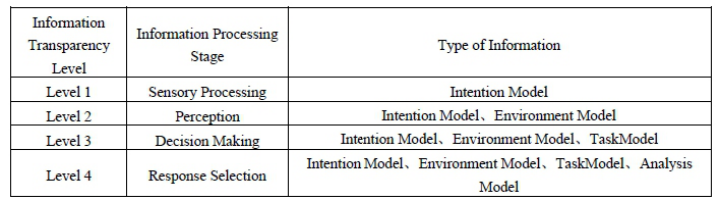
Build a Preliminary Information Transparency Level Model First of all, it is necessary to clarify the correspondence between information processing stages and information types. In the four stages of information processing, the information acquisition stage is mainly the collection of information, and the intention type information provides the most basic information to help the collection of information; the information anal- ysis is to analyse, perceive, and judge the current information, and the environment type information suggests the current phenomenon and assists the analysis process; the decision-making stage outputs the solutions to the current situation, and the task type information gives the tasks and decision- making suggestions to assist the driver in decision-making; the execution stage implements the action instructions consistent with the decision-making,
Optimizing Human-Machine Interface Design Through Information Transparency 173
and the analysis type information gives each step of the operation and decision-making suggestions. The task type information gives what the driver needs to do, decision-making suggestions, and assists the driver in decision- making; the execution phase implements action instructions consistent with the decision-making, and the analysis type information gives each step of the operation Since the HRI system transparency model does not have a hierarchical relationship, but the information processing model has a continuous relation- ship, and the transparency level of the system is controlled by the amount of information, the information type in the HRI system transparency model is combined with the information processing process, and the information types corresponding to each step of the information processing process can be com- bined sequentially to construct a preliminary information transparency level model with a hierarchical relationship. The information transparency hier- archy model with hierarchical relationship can be constructed initially (see Figure 1).
Figure 1: A preliminary information transparency level model (adapted from Lyons, 2013).
EXPERIMENTAL RESEARCH BASED ON INFORMATION TRANSPARENCY LEVEL MODEL Experimental Material Design
Based on the preliminary information transparency hierarchy model, this study further carries out experimental research on information transparency grading assessment. Firstly, based on the preliminary model, three representa- tive scenarios are selected for experimental evaluation, and then based on the transparency theory, the evaluation method and specific evaluation indexes are selected to evaluate the four aspects of security, usability, workload and trust, and the conclusion of the evaluation will provide the experimental basis for the final construction of the information transparency hierarchy model of the in-vehicle human-machine interface.
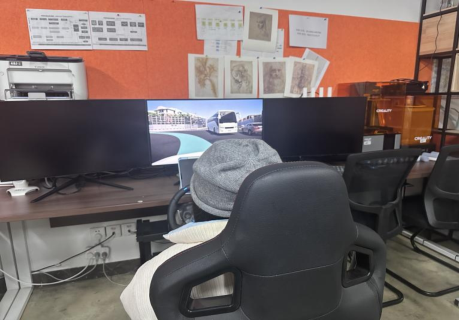
The experimental environment is based on a car simulation system, devel- oped using Unity software to simulate a real driving environment. The experimental scenario is a two-way three-lane road with a large number of oncoming vehicles in the opposite lane, and driving at a speed of about 35km/h ∼45km/h. During the driving process, the subjects need to complete the driving task according to the information displayed by the in-vehicle HMI
174 Hou and Deng
simulation device. The in-vehicle HMI is simulated using a flat panel, which is placed in the same position as the real vehicle and can be operated in a simple interactive way, and the subjects can operate it during the driving process.
Participants A total of 16 subjects were recruited for this experiment by quota sampling, 12 males and 4 females (22–45 years old, with the age range mainly between 22 and 35 years old), with an average driving experience of 6 years. All sub- jects held a valid driver’s licence and all had experience in using in-vehicle information systems. The subjects had normal vision or corrected vision in both naked eyes, and had no special conditions such as colour blind- ness, colour weakness, or hearing impairment. The subjects were required to understand the entire experimental procedure before the experiment and then sign a written informed consent form.
Design of Experiment This experiment was based on a preliminary information transparency hier- archy model with three tasks, each of which was designed with experimental groups with different levels of information transparency (see Table 1).
Table 1. Experimental scenario design.
Table available in the original PDF paper.
Experimental Scene
Scene Description Task The level of urgency High Scene 1 Potential hazards on the road ahead Emergency braking to avoid danger
Middle
Scene 2 Road ahead requires a right turn
Change lanes and turn right Low Rear vehicle overtakes smoothly
Scene 3 Approaching from behind and overtaking
Experimental scenario 1 is a high emergency scenario in which the road ahead is potentially dangerous and the events in the scenario pose a threat to the driver’s personal safety. The driver needs to complete the emergency brak- ing according to the information prompted by the in-vehicle human-machine interface, so as to eliminate the danger ahead. According to the preliminary information transparency model, experimental group 1 will only display driv- ing information, experimental group 2 will display risk tips on the basis of experimental group 1, experimental group 3 will obtain emergency braking advice on the basis of this information, and experimental group 4 will obtain driving information, risk tips, braking advice, and emergency braking pro- cedures. 32 subjects were divided into 4 groups of 4 persons each, with the same number of men and women and different driving ages in each group. The number of participants in each group was the same and their driving experience was different. After completing the driving task and completing the usability, workload, trust and SAM affectivity scales, Experiment 2 was conducted.
Optimizing Human-Machine Interface Design Through Information Transparency 175
Experimental scenario 2 was that the vehicle was driving in the leftmost lane and the in-vehicle navigation prompted the need to change lanes to make a right turn. The event in the scenario posed a low threat to the driver’s personal safety, but needed to be completed at the appropriate time, which belonged to a medium-high degree of urgency scenario. The driver needs to change lanes and turn right successfully according to the information prompted by the in-vehicle HMI. According to the preliminary information transparency level model, Experimental Group I will display only driving- related information during driving, Experimental Group II will add lane change turn prompts to Experimental Group I, and the experimental group will obtain lane change related suggestions based on the first two groups, while Experimental Group IV will have access to driving information, lane change turn prompts, lane change turn suggestions, and lane change turn- specific steps .32 subjects were divided equally into 4. The 32 subjects were evenly divided into 4 groups of 4, each with the same number of males and females and with different driving ages. After completing the driving task and completing the availability, workload, trust, and SAM affectivity scales, Experiment 3 was conducted.
Experimental scenario 3 was a scenario in which a rear vehicle needed to overtake the driver, and the incident event in the scenario posed less of a phys- ical threat to the driver, but required the driver to operate at the appropriate time, which was a medium-low emergency situation. The driver needs to follow the information provided by the in-vehicle human-machine interface to allow the vehicle behind to overtake successfully. According to the pre- liminary information transparency level model, Experimental Group 1 only displays driving-related information during the driving process, Experimental Group 2 adds the hints of the oncoming vehicle on the basis of Experimen- tal Group 1, Experimental Group 3 obtains the suggestions of allowing the vehicle behind to overtake on the basis of the previous two groups, and Exper- imental Group 4 obtains the information of driving, the hints of the oncoming vehicle, the suggestions of the vehicle operation as well as the specific oper- ation steps. 32 subjects were divided into 4 groups, and each group of 4 was divided into 4 groups, and each group of 4 was divided into 4 groups, and each group of 4 was divided into 4 groups. The 32 subjects were evenly divided into 4 groups of 4, each with the same number of men and women and with different driving ages. After completing the driving task, they completed the availability, workload, trust and SAM affectivity scales.
Procedures The experiment was conducted in the Human-Computer Interaction and Intelligent Design Laboratory, where the room was softly lit and at a suitable temperature. First, the experimental subjects read the brief information about the experiment and signed an informed consent form, and they were also required to fill out a basic information questionnaire (which included ques- tions about age, gender, driving age, average annual driving mileage, etc.). The experimenter then checked the subject’s driver’s licence, after which the subject was invited to familiarize himself with the experimental environment
176 Hou and Deng
and was introduced to the experimental process and tasks (in order to ensure the authenticity of the data, the experimenter did not introduce the sub- ject to the experimental details such as emergency situations that might be encountered during the experiment). Next, the experimenter introduced the experimental equipment and its operation method to the subjects and con- ducted a preexperiment for about 10 minutes. During the experiment, the experimenter introduced the subjects to the interface display of the four lev- els of information transparency, with the aim of familiarising the subjects with the overall setup of the experiment and the hierarchy of information display levels that occurred during the experiment. After completing the pre- experiment, the subjects took a break of about 5 minutes and then formally started the experiment.
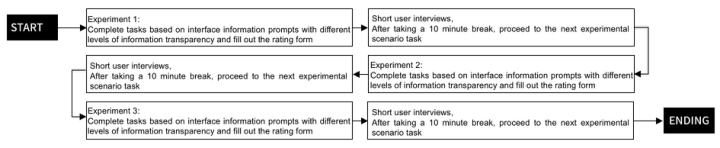
The formal experiment began with a soothing piece of music. When the subjects relaxed to a quiet state, the subjects were grouped into experimen- tal groups, and the subjects started to drive the vehicle and performed the corresponding driving tasks according to the information prompts of differ- ent information transparency levels. When an information type cue appeared and the subject completed the corresponding braking task, the subject ended the driving, and the subject completed the entire rating scale before being required to undergo a short user interview and take a short 10-minute break. After the break, the next task scenario was carried out as shown in Fig. 2. The total duration of the experiment was about 50 minutes, and the experimental scenario is shown in Fig. 3.
Optimizing Human-Machine Interface Design Through Information Transparency 177
Measurements and Analysis In this experimental study, the in-vehicle human-machine interfaces of four information transparency levels in three different scenarios were evalu- ated from five evaluation levels: usability (Lewis, 1991), safety, driving load (Pauzié, 2008), trust, and user experience (Bradley, 1994), and the experimental data are shown in Table 2.
Table 2. Summary table of experimental data.
Table available in the original PDF paper.
Task Task 1: Emergency Braking Task 2: Lane Changing Turn Task 3: Overtaking from Behind Grou Grou
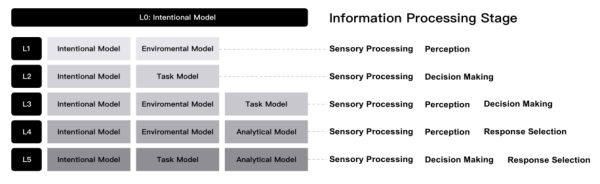
BUILD AN INFORMATION TRANSPARENCY LEVEL MODEL FOR VEHICLE MOUNTED HUMAN MACHINE INTERFACE The above experimental study found that (1) too much information transparency (four information types) as well as too little information transparency (displaying only the basic information types) performs poorly in terms of usability, driving load, trust, user experience, and safety, and can
178 Hou and Deng
have an impact on driving. (2) Different types of users have different needs for information transparency. Some users need sufficient information to ensure normal driving, while others only need basic driving information. (3) Driving scenarios have an impact on the need for transparency. High-emergency sce- narios require the user to be able to operate as quickly as possible, whereas medium- and low-emergency scenarios provide enough transparency to allow the driver to operate safely.
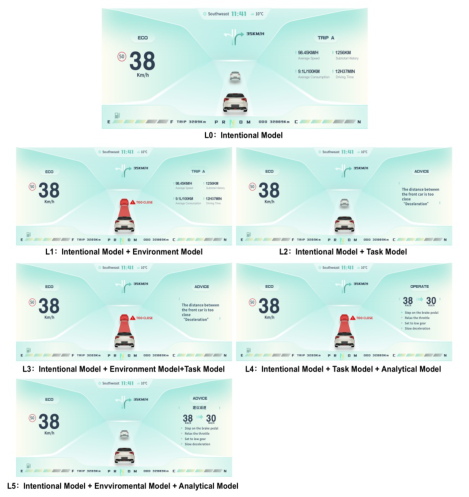
System transparency is controlled by adjusting the number of messages, but due to limited attention resources, the increase in the number of messages can lead to driver information confusion, and in Level 4 the number of messages is too large which can lead to information overload, so it is considered that the number of message types should be adjusted to the best of two or three. The information transparency level model for in-vehicle HMI is shown in Fig. 4.
Figure 4: Information transparency level modelling for in-vehicle human machine interfaces.Figure 5: Information transparency level modelling for in-vehicle human machine interfaces.
Optimizing Human-Machine Interface Design Through Information Transparency 179
CONDUCT HUMAN-MACHINE INTERFACE DESIGN As a very large and complex industrial system product, automobile is com- posed of many sub-systems and components, and each part closely cooperates with each other to maintain the smooth operation of each function of the vehicle. The main interface of automobile dashboard is the functional core of the dashboard, which carries the most important information of the vehi- cle, and feeds back the vehicle information to the driver in time during the vehicle operation process, and the driver can perceive the vehicle condition and interact with the vehicle. Therefore, this study selects the intelligent vehicle dashboard for optimisation design, combing the information in the dashboard and presenting it in a reasonable way. As shown in Figure 5.
CONCLUSION
This study aims to provide drivers’ trust in vehicle systems by adjusting the information transparency of in-vehicle human-machine interfaces to meet the driving needs of different drivers. In order to scientifically design information transparency that meets different users’ needs, an informa- tion transparency hierarchy model for in-vehicle human-machine interface is proposed. By further analysing and sorting out the trust level classifica- tion through behavioural analysis experiments and interview evaluation, the information transparency hierarchy model for in-vehicle human-computer interface is constructed and used to guide the design practice. In the future, it is necessary to further improve the information transparency hierarchy model and design practice to make up for the shortcomings of the existing research.
FUNDING This research was supported by the Key Research and Development Project of Hubei Province (2022BAA071).
REFERENCES
Beggiato, M.; Schleinitz, K.; Krems, J. (2015). “What would drivers like to know during automated driving? Information needs at different level of automation”, In Proceedings of the 7th Conference on Driver Assistance, Munich, Germany, 25–26. Bradley, Margaret M. and Peter J. Lang. (1994). Measuring emotion: The Self-
Assessment Manikin and the Semantic Differential. Journal of behavior therapy and experimental psychiatry, 1994, 25(1): 49–59. Chen, J. Y., Lakhmani, S. G., Stowers, K., Selkowitz, A. R., Wright, J. L., & Barnes, M. J. (2018) “Situation awareness-based agent transparency and human- autonomy teaming effectiveness”, Theoretical Issues in Ergonomics Science, 19, 259–282. Diels, C.; Thompson, S. (2017) “Information expectations in highly and fully
automated vehicles”, In Advances in Human Aspects of Transportation, Proceed- ings of the International Conferenceon Applied Human Factors and Ergonomics, LosAngeles, CA, USA, 742–748.
180 Hou and Deng
Koo, J.; Kwac, J.; Ju, W.; Steinert, M.; Leifer, L.; Nass, C. (2015) “Why did my car just do that? Explaining semi-autonomous driving actions to improve driver understanding, trust, and performance”, Int. J. Interact. Des. Manuf., 269–275. Lehman, W. E. (2019). “The Effects of Automation Transparency and Reliability on
Task Shedding and Operator Trust”, Norfolk Virginia: Old Dominion University Libraries, 1–14. Lewis, James R. (1991). Psychometric evaluation of an after-scenario questionnaire for computer usability studies: The ASQ. ACM SIGCHI Bull, 1991, 23(1): 78–81. Lyons JB. (2015) Being Transparent about Transparency: A Model for Human-Robot
Interaction. AAAI Spring Symposium, 2013, 13(7): 48–53. Pauzié, Annie. A method to assess the driver mental workload: The driving activity load index (DALI). Iet Intelligent Transport Systems, 2008, 2(4): 315–322. Wright, J. L., Chen, J. Y., & Lakhmani, S. G. (2020) “Agent Transparency and
Reliability in Human–Robot Interaction: The Influence on User Confidence and Perceived Reliability”, IEEE Transactions on Human-Machine Systems, 50, 254–263.
LISTED IN THE AHFE DIGITAL BOOKSTORE CATALOGUE
Explore the complete digital volume
Usability and User Experience
Read this individual research paper free through the original publisher, or explore the full digital proceedings book.
ISBN 978-1-964867-32-8
Explore this ISBN in the AHFE Bookstore ↗Listed in the July 2026 bookstore catalogue; search by ISBN to confirm current availability · Digital book purchase optional