Pengcheng Guo, Meichen Lin, Peiyuan Du (2026). Memory Path: An Inclusive Multimodal Interaction System Design for Home-Based Alzheimer's Care. In: Human Factors in Aging and Special Needs. AHFE Open Access, vol. 214, pp. 122–132. https://doi.org/10.54941/ahfe1007579
Alzheimer's disease is a progressive cognitive disorder characterized by memory decline, spatial disorientation, impaired executive function, and emotional-behavioral changes. Its caregiving challenges manifest continuously within the domestic living environment. In China, where home-based care remains the predominant model for elder support, patients frequently experience task forgetting, spatial disorientation, difficulty locating objects, operational errors, and emotional distress within familiar surroundings due to the hidden nature of early symptoms, insufficient daily support, and the limited professional competence of family caregivers. Caregivers, in turn, must sustain long-term responsibilities including reminding, companionship, monitoring, emergency response, and emotional regulation, facing considerable coordination burden. Existing digital health products predominantly focus on singular functions such as medication reminders, health record management, or remote monitoring. Conventional mobile applications continue to rely on text-based reading, hierarchical menus, and active user input, while traditional reminder tools fail to integrate with real domestic spaces and specific task contexts. These limitations make it difficult to simultaneously address the compound needs of low cognitive load for patients, remote coordination for caregivers, and continuous spatial support within the home environment.In response to these challenges, this paper proposes the Memory Path multimodal home support system, taking the triadic interaction relationship among patient, caregiver, and domestic space as its design entry point. The system is grounded in inclusive design theory, operationalizing the principles of recognizing exclusion, designing for one and extending to many, and treating diversity as a resource into concrete design methods. By identifying exclusion contexts in patients' task comprehension, spatial navigation, interface operation, and emotional stability, the system develops low-load interaction strategies. With Alzheimer's patients as the primary user group, simplified interfaces, voice prompts, spatial guidance, and remote collaboration mechanisms are extended to individuals with mild cognitive impairment, elderly users, and diverse family caregiving scenarios. Patient ability differences, caregiver experience variations, and home spatial configurations are simultaneously reframed as configurable resources. The design responds to diverse ability levels and environments through information hierarchy simplification, enhanced multi-channel perception, reduced operational steps, fault-tolerant feedback, and configurable spatial anchors.In terms of system architecture, Memory Path is not a single application but an integrated system comprising a minimalist patient-side application, a caregiver monitoring dashboard, AR spatial anchor navigation, smart bone-conduction earphones, and home environment optimization components. Caregivers can configure daily tasks, edit spatial anchors within the home, and upload family messages, photographs, and familiar music. Patients receive synchronized visual, auditory, and spatial cues through task cards, AR guidance paths, object highlighting, and bone-conduction voice prompts, triggered by specific times, locations, or task states. The system thereby establishes a closed-loop mechanism of configure, trigger, recognize, guide, feedback, and accompany, transforming medication reminders, indoor wayfinding, remote assistance, status feedback, emotional support, and memory prompts into visualizable, audible, and configurable multimodal interaction processes.For subsequent prototype evaluation, the study plans to invite early-stage Alzheimer's patients, family caregivers, and interaction design experts to participate in scenario-based usability testing, System Usability Scale (SUS) assessment, and semi-structured interviews, subject to ethical approval and informed consent. Core interaction flows including medication reminders, AR-based indoor navigation, remote caregiver assistance, and emotional content triggering will be validated. The evaluation will focus on task comprehension difficulty, operational burden, spatial guidance clarity, caregiving coordination experience, and emotional support effectiveness, providing evidence for iterative refinement of interface hierarchy, anchor configuration, and multimodal prompt strategies. This study provides a low-burden, coordinated support pathway for home-based Alzheimer's care contexts and offers practical references for the application of inclusive design principles in cognitive assistance systems.
Global population aging has made Alzheimer’s disease a complex social issue beyond the medical domain. People with Alzheimer’s disease often experience declines in memory, spatial orientation, and executive function, which may lead to disorientation, forgetting, and anxiety even in familiar home environments. Previous studies indicate that the number of people living with dementia continues to increase worldwide, and family care remains an important form of long-term daily support for many patients (Ren et al., 2021). In China, where home-based care remains the dominant aging-care model, cognitive decline is directly reflected in domestic risks such as getting lost, forgetting medication, misusing household devices, and experiencing frustration when daily tasks cannot be completed. Meanwhile, family caregivers often undertake long-term responsibilities, including reminders, companionship, monitoring, emotional support, and responses to Received June 4, 2026; Revised June 18, 2026; Accepted June 24, 2026; Available online July 20, 2026
Memory Path: An Inclusive Multimodal Interaction System 123 unexpected situations, while also facing information asymmetry, insufficient professional knowledge, and caregiving fatigue (Yang and Wang, 2024). Therefore, Alzheimer’s disease home-based care is not merely a matter of compensating for individual patient abilities, but a systemic issue shaped by patient cognition, caregiver collaboration needs, and insufficient support from the home environment. Constructing a low-burden home-care support system through digital media interaction, smart wearable devices, and spatial enhancement technologies has thus become an important issue in smart health product design.
However, existing digital health products still present multiple limitations in cognitive impairment scenarios. Many products implicitly assume intact cognitive abilities, while text-based information and hierarchical interaction structures create barriers to use. Many tools are also functionally limited, detached from daily-life contexts, or insufficiently integrated, making it difficult to provide continuous support for everyday care. In addition, emotional support and remote collaboration mechanisms are often overlooked, limiting their ability to address patients’ action and emotional needs as well as caregivers’ management and support needs.
Inclusive design provides a useful theoretical perspective for addressing these issues. Its core concern is to identify design exclusion arising from differences in human abilities and to transform diversity into a resource for innovation (Dongye, 2023). In Alzheimer’s disease home care, inclusive design is not limited to simplifying or visually refining interfaces. Instead, it requires the reorganization of information presentation, interaction methods, and spatial cueing mechanisms based on the relationships among patients, caregivers, and the home environment. Such a system should reduce patients’ cognitive load and operational effort, provide caregivers with configurable and feedback-oriented management functions, and support visual, auditory, spatial, and emotional forms of assistance.
Based on the above background, this study addresses the following three research questions: (1) How can inclusive design theory be used to translate the cognitive
differences, mobility-related difficulties, and collaboration needs of people with Alzheimer’s disease and their family caregivers into low- cognitive-load interaction design strategies in home-care contexts? (2) How can AR spatial anchor-based navigation and a smart bone-conduction headset integrate spatial routes, task reminders, and emotional support into a visual–auditory coordinated multimodal interaction mechanism? (3) How can a collaborative system framework between the patient side
and the caregiver side be constructed so that home care can shift from single reminders or passive monitoring toward a configurable, feedback- oriented, and collaborative support process?
This study does not aim to evaluate clinical effects. Instead, from the perspective of digital media interaction and smart health product design, it explores a system prototype and design method for Alzheimer’s disease home-care contexts. To respond to the above questions, this study proposes Memory Path, a multimodal home-care support system that integrates a
simplified patient-side application, a caregiver-side monitoring interface, AR spatial anchor-based navigation, a smart bone-conduction headset, and optimization of the home support environment. The system forms a support loop combining visual guidance, auditory prompts, spatial anchoring, remote collaboration, and emotional support. Its main contribution lies in proposing a needs-translation approach based on the relationship among patients, caregivers, and home environments, while exploring a multimodal interaction mechanism that provides an application-oriented reference for digital media interaction design and smart health product development for people with cognitive impairment.
RELATED WORK
Home-Based Care for Cognitive Impairment and Ambient Assisted Living Technologies Research on home-based care for older adults with cognitive impairment is grounded in identifying patients’ daily health management needs and family caregivers’ support needs. Existing studies show that people with Alzheimer’s disease have considerable needs in disease awareness, daily life management, safety risk prevention, psychological care, and rehabilitation training, indicating that home care involves daily support, safety maintenance, and caregiving collaboration rather than medical management alone (Li et al., 2024). From a technological perspective, ambient assisted living technologies have been applied to daily living assistance, in-home care, and health status monitoring for older adults with mild cognitive impairment. Smart home systems, sensors, wearable devices, fall-prevention tools, and cognitive training tools provide a technical basis for intelligent home- care support (Wang and Li, 2021). However, existing studies often focus on health records, risk monitoring, or single-point assistance, with limited attention to the continuous relationship among patient task performance, spatial mobility, and remote caregiver collaboration. A systematic support framework involving patients, caregivers, and home environments remains underdeveloped.
AR-Based Spatial Enhancement and Indoor Navigation Assistance With the development of spatial computing and immersive interaction technologies, VR and AR have been increasingly explored in relation to quality of life, cognitive stimulation, psychological well-being, and social interaction among older adults. Studies suggest that virtual and augmented reality can provide reminiscence stimulation, enjoyable experiences, and psychological support for people with dementia and mild cognitive impairment, although current research is still limited by small samples, fragmented scenarios, and insufficient long-term validation (D’Cunha et al., 2019). A systematic mapping review further shows that VR and AR have been used to support older adults’ physical, cognitive, psychological, and social well-being, while their systematic integration into healthcare and home-care contexts remains at an early stage (Baragash, Aldowah and Ghazal, 2022). In spatial navigation research, NavMarkAR uses landmark-based AR cues to support
Memory Path: An Inclusive Multimodal Interaction System 125 wayfinding and spatial learning in complex indoor environments (Qiu et al., 2024). Another AR indoor navigation prototype based on Unity and Vuforia suggests the potential of this technology for supporting indoor mobility among people with mild cognitive impairment and Alzheimer’s disease, while reducing the need for continuous caregiver accompaniment (Bibbò et al., 2024). However, most AR studies still focus on standalone navigation tasks. Less attention has been given to linking AR spatial anchors with real home- care tasks, caregiver-side configuration, task reminders, auditory prompting devices, and emotional-content triggering.
Cognition-Friendly Interfaces, Audio-Enhanced Interaction, and Smart Home Environments At the interaction design level, usability barriers in smart interfaces for older adults with cognitive decline are central to age-friendly and inclusive design research. Existing studies indicate that complex menus, abstract icons, deep navigation structures, and insufficient feedback may increase learning burden and usage risks. Therefore, interface design should emphasize clarity, task predictability, explicit feedback, and error-tolerant interaction (Zhang and Ju, 2025). Beyond visual interfaces, audio-enhanced interaction has also been used to reduce cognitive load among older users. Based on cognitive load theory, sound can supplement visual information through operational cues, information representation, status feedback, and warning reminders, providing design insights for using a smart bone-conduction headset as an auditory interaction entry point (Yu and Ding, 2024). Research on intelligent home-care environments has also begun to emphasize the integration of “needs–scenarios–technologies,” highlighting interface inclusiveness, service accessibility, and spatial adaptability as references for moving from single- terminal optimization toward spatial system design (Shan, 2025). Overall, however, existing research still tends to address interface optimization, audio prompts, and smart home environments as separate dimensions, with limited attention to an integrated mechanism connecting visual, auditory, spatial, and caregiving collaboration.
Research Gaps and Positioning of This Study In summary, existing studies provide foundations for home-based support for older adults with cognitive impairment from the perspectives of home health management, ambient assisted living technologies, AR indoor navigation, cognition-friendly interfaces, audio-enhanced interaction, and intelligent home environments. However, current research still largely focuses on single mobile applications, individual smart devices, isolated audio reminders, standalone AR navigation tasks, or general home-care systems. A multimodal collaborative mechanism specifically oriented toward Alzheimer’s disease home-care scenarios remains insufficiently developed. Further exploration is needed in patient–caregiver information linkage, the alignment between AR spatial anchors and real home environments, the coordination between bone-conduction auditory assistance and application systems, and emotional
support with dignity preservation. Based on these gaps, this study regards Alzheimer’s disease home care as a composite interaction context involving patients, caregivers, and home environments. It develops Memory Path as a multimodal home-care support system based on inclusive design, integrating a simplified patient-side application, a caregiver-side monitoring interface, AR spatial anchor-based navigation, a smart bone-conduction headset, and optimization of the physical support environment. The system explores a design pathway combining visual guidance, auditory prompts, spatial anchoring, remote collaboration, and emotional support.
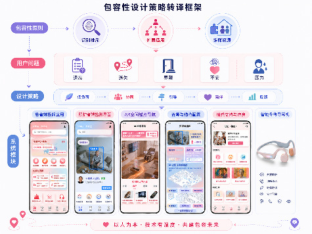
Design Strategies for a Multimodal Support System Based on Inclusive Design Theory Based on inclusive design theory, the Memory Path system regards people with Alzheimer’s disease, family caregivers, and home environments as a composite interaction system. Rather than focusing on a single application or smart device, the system addresses changes in patients’ cognitive abilities, caregivers’ collaboration needs, and insufficient support from the home environment. It translates the three core principles of inclusive design into multimodal design strategies that integrate visual guidance, auditory prompts, spatial anchoring, remote collaboration, and emotional support.
Figure 1: Framework for translating inclusive design strategies.
Identifying Exclusion: Low-Cognitive-Load Support Strategy “Identifying exclusion” emphasizes recognizing the specific ways in which users may be overlooked or constrained by products, services, and environments. In Alzheimer’s disease home-care scenarios, patients often experience difficulties in cognitive understanding, spatial orientation, task recall, and emotional stability. These barriers may increase interaction pressure when patients encounter complex interfaces, abstract prompts, or unstructured home environments. Accordingly, the system transforms these exclusion points into low-cognitive-load support strategies. For information understanding, the simplified patient-side application and large task cards are used to reduce reading and memory demands. For spatial mobility, AR spatial anchor-based navigation transforms rooms, objects, and routes into
visual cues. For task execution, the smart bone-conduction headset provides voice reminders and route prompts. For emotional support, familiar music, family messages, and optimization of the home support environment are used to strengthen familiarity and a sense of security.
Solving for One and Extending to Many: Patient–Caregiver Collaboration Strategy “Solving for one and extending to many” emphasizes using the needs of high- demand user groups as an entry point to develop design strategies that can be extended to broader populations. People with Alzheimer’s disease often require substantial support in cognitive understanding, spatial judgment, and task execution, and these needs are representative to some extent. Therefore, low-hierarchy interface structures, graphical prompts, auditory assistance, and spatial guidance strategies developed for this group may also be applicable to older adults with mild cognitive impairment, memory decline, or general age-related difficulties. At the same time, the system connects the simplified patient-side application with the caregiver-side monitoring interface, expanding the design focus from an individual patient to a family- care context jointly involving patients and caregivers. This collaborative structure is intended to support the continuity and manageability of home care.
Seeing Diversity as a Resource: Personalized Adaptation Strategy “Seeing diversity as a resource” emphasizes transforming user differences into design inputs rather than treating them as obstacles to system adaptation. People with Alzheimer’s disease may differ in disease stage, daily habits, emotional preferences, and memory-related cues. Home layouts and caregiving practices also vary across families. Therefore, the system transforms differences in patient abilities, caregiver experience, and home environments into configurable resources. The caregiver-side monitoring interface not only supports status viewing, but also serves as an entry point for incorporating family knowledge. It supports AR spatial anchor editing, task configuration, family messages, and familiar music management, enabling rooms, objects, routes, and memory-related content in real homes to be transformed into personalized support cues.
In summary, Memory Path translates the three core principles of inclusive design into low-cognitive-load support, patient–caregiver collaboration, and personalized adaptation strategies. These strategies provide the theoretical basis for the subsequent collaborative operation mechanism of the system.
MULTIMODAL INTERACTION AND COLLABORATIVE OPERATION MECHANISM OF THE MEMORY PATH SYSTEM System Architecture and Overview of the Experience Flow
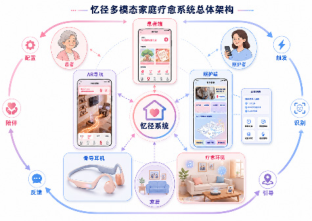
The Memory Path system consists of five coordinated modules: a simplified patient-side application, a caregiver-side monitoring interface, AR spatial anchor-based navigation, a smart bone-conduction headset, and a home support environment. Together, these modules form a support chain involving patients, caregivers, and the home environment.
From the perspective of user experience, the system follows the process of “configuration–triggering–recognition–guidance–feedback– companionship.” Caregivers first configure tasks and spatial anchors based on the patient’s daily habits and home layout. Patients then receive reminders triggered by time, location, or task status, and complete tasks with visual, auditory, and spatial cues. Task completion or abnormal status is synchronized to the caregiver-side interface, enabling remote assistance or content adjustment. Meanwhile, family messages, familiar music, and photos are embedded into the process to provide low-stimulation emotional companionship.
Figure 2: Overall architecture of the memory path multimodal home-care support system.
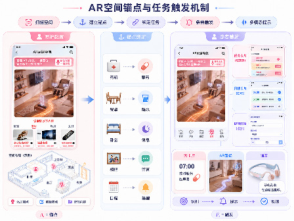
Configuration Stage: Caregiver-Side Task Setting and AR Spatial Anchor Creation The configuration stage transforms patients’ daily care needs and home environments into support resources that can be recognized and invoked by the system. Caregivers enter basic patient information through the caregiver- side monitoring interface, including daily routines, medication habits, emotional preferences, and risk scenarios. They can then set tasks such as medication, drinking water, resting, rehabilitation exercises, and preparation for going out, transforming care content that previously relied on verbal reminders into manageable task sequences.
At the spatial configuration level, caregivers use the AR spatial anchor editing function to scan the home environment and mark meaningful objects or locations, such as medicine boxes, dining tables, bedrooms, photo frames, resting areas, and bathrooms, as spatial anchors. Each anchor represents a physical location and can be linked to tasks, voice prompts, photos, music,
Memory Path: An Inclusive Multimodal Interaction System 129 or family messages. In this way, the home environment is transformed from a passive living background into a supportive environment with prompting and emotional meaning.
The value of this stage lies in enabling caregivers to configure support according to real home conditions and patient habits. Through task setting, anchor marking, and content binding, the system converts caregivers’ family knowledge into spatial cues that patients can perceive, providing the basis for task triggering, route guidance, and status feedback.
Figure 3: AR spatial anchors and task triggering mechanism.
Triggering and Guidance Stage: Low-Cognitive-Load Task Execution on the Patient Side The triggering and guidance stage focuses on patients’ daily task execution. In home settings, people with Alzheimer’s disease may find it difficult to actively search for functions, remember operation steps, or judge spatial directions. Therefore, the system does not require patients to enter complex menus. Instead, it automatically triggers prompts based on time, location, and task status. When it is time to take medication, when the patient approaches a relevant AR spatial anchor, or when a task remains incomplete, the simplified patient-side application presents a large task card, while the smart bone- conduction headset plays a short voice prompt.
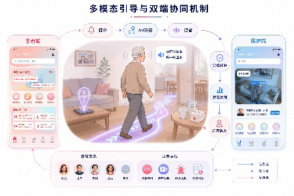
When a task involves spatial movement, AR spatial anchor-based navigation presents route cues, directional arrows, or target-object highlighting in the physical home environment. Patients do not need to memorize complete routes, but can follow visualized paths and auditory prompts step by step. If the patient does not respond or deviates from the preset direction, the system can provide more noticeable visual prompts or repeat the voice prompt gently, reducing the possibility of task interruption.
The focus of this stage is not complex technical display, but reducing patients’ task-understanding and spatial-action burdens through multimodal prompts. The large task card clarifies what needs to be done, the AR spatial anchor indicates where to go, and the bone-conduction headset supplements how to complete the current action. Together, these components form a visible, understandable, and followable task execution experience.
Figure 4: Multimodal guidance and patient–caregiver collaboration mechanism.
Feedback and Companionship Stage: Caregiver Collaboration, Status Reporting, and Emotional Support The feedback and companionship stage forms a closed support loop. After a task is completed, the system synchronizes the status to the caregiver-side interface, allowing caregivers to check whether tasks such as medication, drinking water, resting, and rehabilitation exercises have been completed on time. If the patient does not respond for an extended period, deviates from the route, encounters device connection issues, or repeatedly fails to complete tasks, the system can send a prompt to the caregiver side. Caregivers can then provide remote voice-based assistance, adjust tasks, or modify spatial anchors.
The system also incorporates emotional content into the companionship process. Family members can upload messages, photos, familiar music, and family stories, and bind them to specific spatial anchors or task nodes. When the patient approaches a related anchor or completes a task, the system can trigger a family voice message, familiar music, or photo to provide emotional support, memory cues, and companionship.
This mechanism is not intended to provide clinical intervention. Instead, it transforms family relationships, personal memories, and daily spaces into everyday support resources. The feedback mechanism helps caregivers understand patient status, while the companionship mechanism supports familiarity and a sense of security for patients. Together, they connect task support, remote collaboration, and emotional companionship within a home-care support process.
In summary, the Memory Path system follows the experience flow of “configuration–triggering–recognition–guidance–feedback– companionship,” organizing home environments, daily tasks, remote collaboration, and emotional companionship into a continuous multimodal home-care support loop. Unlike Section 3, which focuses on translating inclusive design principles into design strategies, this section explains how the system operates in real home-care contexts as a configurable, feedback- oriented, and adjustable interaction mechanism.
DISCUSSION AND LIMITATIONS A prototype evaluation is planned under ethical approval and informed consent. The study will invite 12 participants, including five people with early- stage Alzheimer’s disease, five family caregivers, and two experts in interaction design and smart health. It will examine four core processes: medication reminders, AR-based home navigation, remote assistance, and emotional- content triggering. Feedback will be collected through task scenario testing, task observation, the System Usability Scale (SUS), and semi-structured interviews. Patient-side evaluation will focus on understanding of large task cards, AR path guidance, and bone-conduction voice reminders, while caregiver- and expert-side evaluation will focus on status feedback, remote assistance, and emotional-content configuration. This design is intended to address the three research questions by examining the low-cognitive-load interaction strategy, the visual–auditory multimodal mechanism, and the patient–caregiver collaborative framework.
This study has several limitations. The current work remains at the stage of system prototype design and evaluation planning, and long-term user testing in real home environments has not yet been completed. Therefore, no claims are made regarding clinical outcomes, long-term use outcomes, or changes in patients’ cognitive abilities. The planned evaluation also has a relatively small sample size, so its findings will mainly support assessment of understandability, usability, and interaction suitability. In addition, AR spatial anchors may be affected by indoor lighting, occlusion, positioning accuracy, device performance, and network stability, while the smart bone- conduction headset involves wearing comfort, battery life, connection stability, and acceptance among older users. Differences in home layouts, object placement, and caregiving habits may also create initial configuration costs. Future work should expand the sample size, conduct usability testing in real home environments, and further improve privacy protection, spatial anchor configuration logic, and multimodal prompting methods.
CONCLUSION AND FUTURE WORK This study proposed Memory Path, a multimodal home-care support system for Alzheimer’s disease home-care contexts. It conceptualizes home care as a composite interaction scenario involving patients, family caregivers, and home environments, and forms a support loop of “configuration– triggering–recognition–guidance–feedback–companionship.” By translating inclusive design principles into low-cognitive-load support, patient–caregiver collaboration, and personalized adaptation strategies, the system explores a shift from single reminders or passive monitoring toward a configurable, feedback-oriented, and collaborative support process. Through the integration of AR spatial anchors, a smart bone-conduction headset, and patient–caregiver interaction components, this study provides an application- oriented design reference for digital media interaction design and smart health product development for people with cognitive impairment.
Future work will focus on technical optimization, prototype evaluation, and scenario adaptation. Further efforts are needed to improve AR spatial anchor stability, the wearing comfort of the smart bone-conduction headset, multimodal prompt adjustment, caregiver-side configuration, and privacy protection for sensitive home-care data. Future studies will expand participant samples and conduct usability testing in real home environments, focusing on task understanding, operational burden, spatial guidance clarity, caregiver collaboration, and emotional support experience. The system may also be further adapted to different disease stages, home layouts, and caregiving habits, with potential connections to community-based care services.
REFERENCES
Baragash, R. S., Aldowah, H., & Ghazal, S. (2022). Virtual and augmented reality applications to improve older adults’ quality of life: A systematic mapping review and future directions. Digital Health, 8, 20552076221132099. Bibbò, L., Bramanti, A., Sharma, J., & Cotroneo, F. (2024). AR platform for indoor
navigation: new potential approach extensible to older people with cognitive impairment. BioMedInformatics, 4(3), 1589–1619. Dongye, Guanghao. (2023). Research Shift and Strategic Approaches to Design Exclusion in Inclusive Design(Master’s Thesis, Jiangnan University). Master. D’Cunha, N. M., Nguyen, D., Naumovski, N., McKune, A. J., Kellett, J.,
Georgousopoulou, E. N., ... & Isbel, S. (2019). A mini-review of virtual reality- based interventions to promote well-being for people living with dementia and mild cognitive impairment. Gerontology, 65(4), 430–440. Li, Li, Liu, Haiyan, Hao, Bin, et al. (2024). Investigation on knowledge needs of home health management for patients with Alzheimer’s disease. Chinese Nursing Research, 38(23), 4255–4259. Qiu, Z., Ashour, M., Zhou, X., & Kalantari, S. (2024). NavMarkAR: A landmark-
based augmented reality (AR) wayfinding system for enhancing older Adults’ spatial learning. Advanced Engineering Informatics, 62, 102635. Ren, Rujing, Peng, Yin, Zhihui, Wang, Jinlei, Qi, Ran, Tang, Jintao, Wang, ... & Gang, Wang. (2021). China Alzheimer’s Disease Report 2021. Journal of Diagnostics and Concepts & Practice, 20(4), 317–337. Shan, Lei. (2025). Research on the design of intelligent systems for home-based
elderly care spaces from the perspective of inclusive design. Jushe, (30), 3-5, 8. Wang, Yidan, & Li, Zheng. (2021). Research progress on the application of ambient assisted living technologies in elderly adults with mild cognitive impairment. Chinese Nursing Management, 21(4), 632–636. Yang, Jingjing, & Wang, Shuhong. (2024). Research progress on caregiver support
programs for families of patients with Alzheimer’s disease. Journal of Clinical Research in Medicine, 41(11), 1633–1636. Yu, Na, & Ding, Hongyu. (2024). Voice enhancement design strategies for agingappropriate smart home terminals based on cognitive load theory. Furniture, 45(6), 25–30. Zhang, Guojun, & Ju, Lei. (2025). Research on inclusive design strategies for
intelligent interfaces targeting cognitive decline in older adults. Journal of Art and Design, (10), 37–39.
LISTED IN THE AHFE DIGITAL BOOKSTORE CATALOGUE
Explore the complete digital volume
Human Factors in Aging and Special Needs
Read this individual research paper free through the original publisher, or explore the full digital proceedings book.
ISBN 978-1-964867-90-8
Explore this ISBN in the AHFE Bookstore ↗Listed in the July 2026 bookstore catalogue; search by ISBN to confirm current availability · Digital book purchase optional