Yuling Wang, Jintian Shi (2026). Generative AI-Driven Multimodal Interaction Design for Age-Friendly Health Consultation. In: Usability and User Experience. AHFE Open Access, vol. 232, pp. 219–231. https://doi.org/10.54941/ahfe1008050
With an increasingly aging global population and rising demand for digital health solutions, elderly health service management faces numerous critical challenges—including delayed health data monitoring, insufficient personalization of health recommendations, and persistent digital divides in technology adoption. This study focuses on the fundamental self-health assessment and consultation needs of older adults, employing an AIGC-based multimodal model as its core technical enabler. It systematically investigates interaction design principles for an AI-powered chatbot specifically tailored to support elderly users’ health-related inquiries. Through analysis of key using scenarios and functional requirements associated with elderly self-health assessments and consultations, this research proposes a Multimodal AIGC Interaction Design Framework for Older Adults. Grounded in AIGC-driven multimodal interaction, empathetic emotional communication, and age-inclusive design principles, the framework supports personalized interpretation of individual physical examination reports, image-based daily dietary analysis, and holistic, individualized planning of healthy lifestyles. This research aims to enhance both the operational efficiency,user experience and service quality of AI-enabled health screening and consultation chatbots for older adults. Furthermore, it contributes actionable methodologies and practical design tools to advance the development of age-friendly AI health services.
With the global demographic shift toward an aging society, the population aged 60 years and older is projected to double—reaching 2.1 billion by 2050. The prevalence and burden of chronic diseases rise markedly with advancing age. Globally, nine of the ten leading causes of death among individuals aged 60 and older are non-communicable diseases (NCDs). This epidemiological trend has intensified demand for continuous health monitoring and longitudinal chronic disease management. (UN, 2025, Section II.D).
However, older adults frequently face a “usability divide” when engaging with conventional digital health services. Physiological changes—including declines in visual acuity and hearing—and psychosocial factors—such as lower digital literacy and heightened cognitive load—render standard mobile applications and web-based interfaces challenging to navigate. Moreover, traditional platforms often employ complex information architectures and Received February 6, 2026; Revised April 1, 2026; Accepted April 18, 2026; Available online July 20, 2026
220 Wang and Shi dense clinical terminology, rendering them inaccessible or unintelligible to many older users. Artificial intelligence–generated content (AIGC) powered by large language models (LLMs) presents a transformative opportunity to mitigate these barriers. Multimodal LLM-based systems, in particular, hold strong potential to lower the threshold for adoption and effective use among older adults. Yet, most existing AI-driven health applications lack rigorous, fine-grained user experience and interaction design research tailored specifically to the cognitive, sensory, behavioural, and contextual characteristics of older adult users—despite the substantial functional advantages offered by modern LLMs.
ANALYSIS OF ELDERLY USERS IN CORE USING SCENARIOS OF HEALTH SCREENING AND COUNSELING To comprehensively investigate the core health screening and consultation needs of older adults, this study employed a mixed-methods research design integrating quantitative surveys and qualitative interviews. The overarching objective was to examine three key domains: (1) participants’ physical health status, (2) patterns of digital device usage, and (3) attitudes toward and acceptance of AI-enabled health technologies.
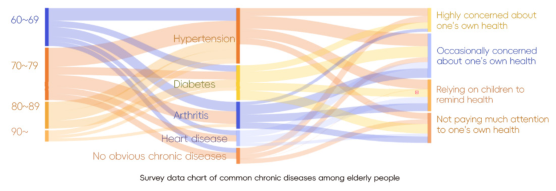
A total of 37 valid questionnaire responses were collected—comprising 16 male and 21 female participants aged 60–79 years—with representation across diverse occupational backgrounds, educational levels, and self-reported health conditions. The structured questionnaire consisted of 23 items covering demographic characteristics, subjective and objective health assessments, and perceptions of smart health devices. Survey findings confirmed a high prevalence of multimorbidity among older adults. As illustrated in Figure 2—the trend chart of common chronic conditions—hypertension, diabetes, arthritis, and cardiovascular disease emerged as the most frequently reported comorbidities. Moreover, a pronounced cumulative effect in chronic disease burden was observed with advancing age: the number and diversity of diagnosed conditions increased markedly when comparing the 60–69 age group to those aged 80 years and above.
Figure 1: Survey data chart of common chronic diseases among older adults.
Regarding digital literacy, although smartphone ownership was widespread, usage remained largely confined to social communication and entertainment applications. Engagement with specialized medical or health-related software was notably limited, primarily due to visual impairments and perceived interface
Generative AI-Driven Multimodal Interaction Design for Age-Friendly Health Consultation 221 complexity. Specifically, 62% of respondents identified persistent usability barriers—including excessively small font sizes, unintuitive navigation, and information overload—as key deterrents to adoption.
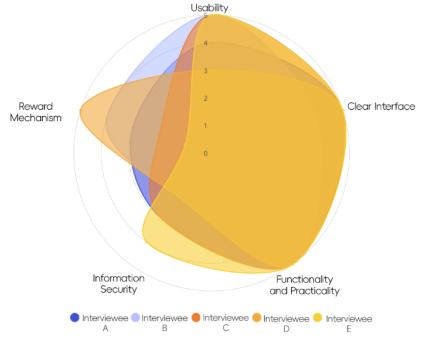
To complement the survey data, semi-structured in-depth interviews were conducted with five representative older adult participants. Each participant was guided through a hands-on trial of an AI-powered health inquiry tool; their real-time interaction behaviours, verbal feedback, and contextual reflections were systematically documented. A multi-dimensional evaluation framework was applied to assess five critical dimensions: operational convenience, interface clarity, functional relevance, data security assurance, and receptivity to incentive-based engagement mechanisms. Results are visualized using a radar chart in Figure.
Figure 2: Radar chart of the survey results on the needs of elderly users.
The interviews revealed that older adults’ primary pain points when using existing AI health products centre on three key issues: (1) difficulty locating functional entry points, (2) susceptibility to accidental touches, and (3) unclear or unintelligible content. Notably, participants also expressed an unexpectedly strong interest in features related to “emotional care” and “interactive rewards”.
Drawing upon preliminary user research data, this study applies the Kano model (Kano, 1984) and the Better–Worse coefficient framework (Berger et al., 1993) to systematically classify and evaluate the functional attributes of an age-inclusive health survey system for older adults. This dual-method approach supports evidence-based prioritization of feature development.
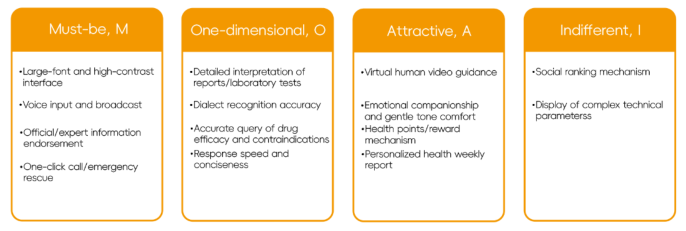
The Kano model, originally proposed by Japanese scholar Noriaki Kano, is a well-established analytical framework for categorizing and prioritizing user requirements according to their impact on perceived satisfaction. It classifies functional attributes into five distinct categories based on users’ responses to two questions: (a) “How would you feel if the function were present?” and (b) “How would you feel if the function were absent?” The resulting categories are: Must-be (M), One-dimensional (O), Attractive (A), Indifferent (I), and Reverse (R).
Figure 3: Users’ demand classification based on KANO Model of the survey.
To quantify the relative priority of each functional attribute, this study employs the Better–Worse coefficients. The Better coefficient (i.e., satisfaction impact) reflects the degree to which the presence of a function enhances user satisfaction; the Worse coefficient (i.e., dissatisfaction impact) quantifies the extent to which its absence diminishes satisfaction. Formally: Better = (A+O)/(A+O+M+I); Worse = −(O+M)/(A+O+M+I)
Table 1: Better-worse coefficient summary of the survey data.
Table available in the original PDF paper.
Functional Modules Demand Attributes Better Worse Development Priority
Health Weekly Report/Points Reward Attractive(A) 0.65 −0.1 P2 (Highlight Features) Analysis results indicate that the foundational objective of age-friendly design is to robustly fulfil Must-be (M) requirements—ensuring the system is physically operable by older adults without barriers (e.g., through adequate contrast, responsive touch targets, and unambiguous navigation). However, for AI-generated content (AIGC)-based systems, competitive differentiation arises primarily from One-dimensional (O) and Attractive (A) attributes. In particular, AIGC’s advanced multimodal understanding capability— combined with flexible multimodal output (e.g., synchronized speech, text, and visual cues)—significantly enhances comprehension and usability among older adults.
A MULTIMODAL AICG INTERACTION DESIGN FRAMEWORK FOR OLDER ADULTS Establishing a Multimodal Interaction Design Framework Based on the Performance Advantages of Large-Scale Language Models (MLLM)
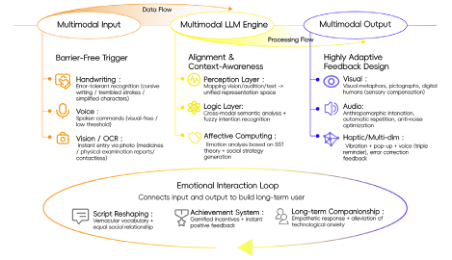
The core advantage of MLLMs extends beyond their large parameter count and strong generative capacity to encompass two critical capabilities: cross- modal semantic alignment and context-aware reasoning. These models project heterogeneous inputs—such as visual, auditory, textual, and sensor data— into a shared representational space, enabling robust interpretation of users’ complex, ambiguous, and often implicit intentions (Tang et al., 2024). This study proposes a multimodal AI-generated content (AIGC)-driven interaction design framework tailored for age-friendly human–computer interaction. The proposed Multimodal AIGC Interaction Design Mechanism for Older Adults comprises three hierarchical layers. At the bottom (perception) layer, barrier- free multimodal input modalities—including handwriting, speech, and vision- based recognition (e.g., OCR)—are integrated to reduce interaction friction for older adults. At the middle (processing) layer, a dedicated multimodal LLM engine unifies information from diverse sources through perception fusion, cognitive analysis, and affective computing, thereby supporting deep intention understanding. At the top (presentation) layer, highly adaptive, multi-dimensional output modalities—encompassing visual, auditory, and haptic feedback—are employed to ensure reliable, accessible, and cognitively appropriate information delivery. Crucially, an end-to-end emotional interaction loop is embedded across all layers to systematically address older adults’ sensory, cognitive, and affective barriers.
Figure 4: The multimodal AIGC interaction framework for older adults proposed in this paper.
Multimodal Input: Barrier-Free Trigger Design The input interface constitutes the initial access point, and thus a critical usability threshold, for older adults engaging with digital systems. Achieving “barrier-free triggering” requires the system to accommodate older adults’ habitual, low-precision, and heterogeneous modes of expression.
Handwriting Input: While keyboard-based input dominates among younger users, age-related declines in fine motor control and diminished recall of Pinyin phonetic spellings render handwriting input the most familiar and cognitively accessible text-entry method for older adults (Liu et al., 2025). To ensure robust recognition across common variation, including cursive script, stroke simplification, and distortions induced by hand tremors, handwriting recognition algorithms must be specifically optimized for geriatric use. Within the Multimodal AIGC Interaction Framework proposed in this study (Figure 5), we implement an on-screen, finger-based handwritten Chinese character input modality tailored for older adults. This functionality employs error-tolerant recognition— designed explicitly to accommodate cursive forms, simplified strokes, and tremor-induced deviations—thereby enabling accurate text entry without demanding precise penmanship. As a result, operational complexity and cognitive load are significantly reduced for older users.
Voice Input: Compared with text input, voice input is generally perceived by older adults as more convenient and efficient for retrieving simple information. Text-based input places substantial demands on users’ visual acuity and sustained visual attention: individuals must accurately locate and distinguish keyboard keys or on-screen input fields—a task that poses significant challenges for older adults experiencing age-related visual impairments. In contrast, voice input substantially reduces reliance on visual processing, enabling users to issue commands solely through spoken language. As illustrated in Figure 5, the proposed Framework incorporates a voice-enabled interactive input modality. This functionality supports natural- language spoken commands and dynamically adapts to elderly users’ non- standard, colloquial speech patterns, thereby minimizing visual dependency and lowering operational complexity.
Image/Video Upload: For complex, paper-based health information (e.g., medication instructions or physical examination reports), a “non-entry-based” acquisition method can significantly alleviate cognitive load among older adults. Leveraging state-of-the-art Optical Character Recognition (OCR) and Computer Vision techniques (T, P. et al., 2025), the system automatically extracts critical information, including drug names, prescribed dosages, and key clinical indicators, from uploaded images. Given the widespread availability of high-resolution smartphone cameras, this image-centric interaction paradigm has emerged as a vital enabler of effective medication management for older users. As depicted in Figure 5, the Framework integrates a photo-upload–enabled interactive input modality. This feature
Generative AI-Driven Multimodal Interaction Design for Age-Friendly Health Consultation 225 facilitates information entry via image capture, supporting “zero-input” interaction, eliminating manual text entry entirely and markedly reducing operational burden for elderly users.
Multimodal Output: Highly Adaptive Feedback Design The output channel is designed to ensure that older adults can accurately and effortlessly comprehend system feedback. This design responds directly to older adults’ strong preference for simplicity, clarity, and intuitive accessibility.
Visual Display: In visual feedback, verbose or dense textual instructions frequently induce cognitive overload. When interpreting complex health- related trends, older adults demonstrate significantly higher comprehension efficiency with “visual analogies” and “pictographs” than with text-only descriptions. Accordingly, the design leverages perceptual support, such as illustrative images, dynamic video demonstrations, and virtual digital human avatars, to facilitate “sensory compensation” and thereby reduce cognitive demand. As illustrated in Figure 5, the Framework establishes a visually enhanced output modality. This functionality employs data visualizations (e.g., charts), animated demonstrations by virtual digital humans, and other intuitive visual elements to replace intricate textual explanations, thereby lowering cognitive load for older users and enhancing the speed and accuracy of information assimilation.
Voice Enhancement: Synthetic speech often exacerbates auditory strain among older adults due to its artificial prosody and limited robustness in noisy environments (Wolters, Maria et al., 2015). To mitigate this, the system employs a gentle, steady, and anthropomorphically natural intonation, designed not only to improve intelligibility but also to deliver empathetic emotional support and alleviate anxiety associated with novel technologies. For critical health instructions, the system automatically repeats each instruction twice to reinforce retention and recall. As shown in Figure 5, the Framework incorporates an interactive voice-enhanced output modality. This functionality utilizes naturalistic synthetic speech with calibrated prosody, delivers dual repetition of core health instructions, and supports on-demand pausing and real-time volume adjustment, collectively reducing auditory burden and improving accessibility for older users.
Feedback Reminders: The feedback stage should transcend mere informational notification and instead foster users’ operational confidence through multidimensional, timely, and interactive feedback (Azeez et al., 2024). By incorporating explicit interactive confirmation feedback and delivering constructive error-correction feedback, this approach effectively alleviates older adults’ anxiety regarding whether their actions have been successfully executed. The framework developed in this study (Figure 5) establishes an output modality that supports multimodal feedback reminders. Specifically, this functionality implements a tripartite feedback mechanism, comprising voice broadcast, on-screen pop-up prompts, and device vibration, to deliver unambiguous interactive confirmation and actionable error-correction guidance, thereby strengthening users’ confidence in system interaction.
Grounded in Socioemotional Selectivity Theory (SST) (Hofer, 2020), older adult users demonstrate a heightened preference for positive emotional experiences and meaningful interpersonal connections. To address this, an emotional companionship mechanism is proposed: the AI assistant must adopt an empathetic, long-term interactive model—achieved through deliberate speech script redesign. Specifically, technical jargon should be eliminated in favour of high-frequency, everyday vocabulary, thereby facilitating rapid establishment of an egalitarian, socially grounded relationship (Zheng et al., 2025).
In daily health management—such as blood pressure monitoring and moderate physical activity—older adults frequently struggle with sustained adherence due to insufficient intrinsic motivation. SST further suggests that this demographic is particularly responsive to immediate, positive reinforcement. Accordingly, an emotional reinforcement mechanism anchored in an “achievement system” is recommended¹. Integrating gamified elements into elderly health applications has been empirically shown to significantly enhance enjoyment, engagement, and sustained participation among older users (Bravo-Aparicio et al., 2025).
Within the Multimodal AIGC Interaction Framework for older adults, this Emotional Interaction Loop synthesizes three interdependent core mechanisms: (1) speech script reshaping using life-oriented, accessible language to foster equitable interaction; (2) an achievement-based, gamified incentive system to support long-term health behaviour adherence; and (3) sustained empathetic companionship to alleviate technology-related anxiety—collectively cultivating enduring user engagement and loyalty.
VISUAL DESIGN FOR AGE-FRIENDLY VISUAL PRESENTATION Age-Friendly Design of Basic Visual Elements
Findings from preliminary research indicate that a substantial proportion of older adults exhibit a preference for bright, warm-colour palettes. Contrast constitutes the most critical determinant of text readability for this demographic. In accordance with established age-friendly design specifications for mobile Internet applications, textual presentation must satisfy the following criteria: (a) the minimum font size for text associated with core functionalities must be no less than 30 dp (or 18 pt); (b) the minimum font size for general body text must be no less than 18 pt; (c) sans- serif typefaces are recommended to minimize visual recognition interference; (d) the contrast ratio between text and its background must be at least 4.5:1; and (e) line spacing must be no less than 1.3 times the font size, while paragraph spacing must exceed 1.3 times the line spacing—both measures intended to mitigate reading fatigue arising from overly dense typographic layouts (Accessibility Standards, 2022).
Layout and Navigation Design Complex, multi-layered information architectures represent a primary usability barrier for older adults when interacting with chatbot interfaces.
Generative AI-Driven Multimodal Interaction Design for Age-Friendly Health Consultation 227 To enhance accessibility, interface design should adhere to the principles of flatness and linearization. Specifically, the navigational depth required to complete core tasks in the prototype must not exceed three hierarchical levels. At each step of the interaction flow, a clear and persistent progress indicator should be provided to orient users within the task sequence. Furthermore, a globally accessible navigation bar, fixed either at the bottom or along the side of the screen, must be implemented. Crucially, a highly visible “Back” button shall be positioned consistently in the top-left corner of all pages beyond the first level of navigation (Gómez-Hernández et al., 2023).
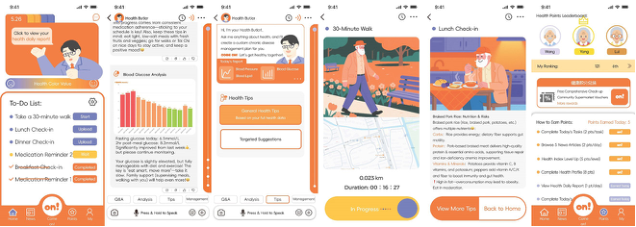
DESIGN IMPLEMENTATION – COME ON! (GENERATIVE AI-ENABLED HEALTH MANAGEMENT SERVICE DESIGN FOR OLDER ADULTS) COME ON! is an elderly-centered health management service designed to fulfil its core mission: accompanying older adults in healthy living. Grounded in generative AI capabilities (AIGC) and age-inclusive interaction design principles, the service establishes an integrated, user-centered health management ecosystem. Its information architecture adheres to a coherent, user-oriented logical flow: Daily User Operations → Core Health Services → Incentive System → Personal Center.
The Core Function System Informed by Socioemotional Selectivity Theory (SST), the Smart Health Butler is conceptualized as an “identity- and memory-aware companion”, explicitly addressing older adults’ socioemotional needs, including continuity of relationship, recognition of personal history, and affective support. The homepage enables one-click generation of personalized health reports, visualized through intuitive, accessible charts. Technical terminology is systematically replaced with plain, everyday language to reduce cognitive load; all reports are further supplemented with optional voice-based summaries. To enhance usability and continuity, the system preserves conversational context across sessions, thereby eliminating redundant re-entry of critical personal or health-related information, and generates contextually grounded, scenario-aware health recommendations based on longitudinal health data and real-world behavioural patterns.
The daily health check-in interface, located on the homepage, is deliberately streamlined and modularized to minimize operational complexity and cognitive demand. It integrates multimodal accessibility features, including voice-based reminders and oversized, high-contrast interactive buttons, thereby mitigating memory-related challenges associated with multi-step navigation. The incentive system is co-designed with older adults to emphasize two empirically validated motivators: “tangible, practical benefits” (e.g., wellness resources, community access) and “authentic emotional recognition” (e.g., affirming feedback, milestone acknowledgments). Progress visualization for key health indicators delivers timely, positive reinforcement aligned with users’ intrinsic motivation to sustain self-worth and autonomy. Furthermore, a family- and friend-linked
228 Wang and Shi health points leader board transforms health engagement into a shared, intergenerational practice—fostering meaningful emotional connection and reinforcing social support networks.
Visual Design of the Use Case COME ON!
The visual design is grounded in evidence-based principles of gerontechnology and aligns precisely with the sensory capabilities and affective needs of older adults. Specifically, it employs a warm chromatic palette dominated by orange–yellow hues, complemented by subtle blue–purple accents to enhance visual contrast and cognitive salience. Text layout adheres strictly to the Mobile Internet Age-Friendly Interface Guidelines (Accessibility Standards, 2022), ensuring optimal legibility, sufficient colour contrast, and appropriate font sizing. The interface architecture is intentionally minimalist and hierarchically structured: primary interactive elements and step-by-step operational prompts are visually prioritized through size, placement, and contrast; these are further reinforced by semantically transparent, high-fidelity icons and illustrative imagery designed for immediate comprehension.
Figure 5: Intof Come On! design prototype.
EFFECTIVENESS VERIFICATION Based on the prototype design, five representative older adult participants, selected from the preliminary user research interviews, were invited to conduct a usability evaluation, and complete the User Experience Evaluation Questionnaire. Following data collection, the responses were integrated and analyzed quantitatively, yielding the final User Experience Evaluation Scale Report below:
Table 2: User experience evaluation scale.
Table available in the original PDF paper.
Dimension Detailed Indicators A B C D E Avg Availability Meet user needs 10 8 7 10 9 8.8
Average score per user _ 9.29 7.35 6 9.71 8.07 9.29 Users consistently affirmed the product’s core health management functionalities and its age-inclusive foundational design. Specifically, they unanimously agreed that features such as medication reminders and diet/ exercise check-ins effectively address the daily health management needs of older adults. Furthermore, the integration of health analytics with a point-based reward system successfully balances functional utility with user engagement. The interface design—featuring enlarged typography, high- contrast colour schemes, clear and concise textual content, and intuitive, low-complexity interactions—appropriately accommodates the visual and cognitive characteristics common among older users.
Users’ optimization suggestions primarily centered on enhancing operational accessibility and refining functional granularity, with particular attention to supporting older adults with sensory impairments, including hearing loss and age-related vision decline. Key recommendations included: (1) simplifying navigation logic to reduce cognitive load; (2) strengthening contextual help systems and error recovery guidance, improving the discoverability of assistance entry points, and incorporating unambiguous textual and icon-based prompts; (3) clarifying icon semantics through standardized visual design and supplementing icons with descriptive text labels; and (4) introducing explicit privacy reminders for sensitive health data, reinforcing security feedback mechanisms (e.g., confirmation cues for data sharing or deletion), and thereby heightening users’ subjective sense of data confidentiality and control.
In summary, evaluation data collected from the five representative older adult participants in this study indicate that the proposed design successfully fulfils core requirements for daily health self-management among older adults, significantly enhances overall usability and user experience, and empirically validates the feasibility of the underlying research approach. Moreover, the qualitative feedback gathered during the usability testing
230 Wang and Shi phase provides actionable insights to inform subsequent design iterations and targeted refinements.
CONCLUSION
With the intensification of global population aging and the growing demand for digital health solutions, the digital divide and challenges in adapting health services to older adults have become increasingly salient. Consequently, the development of age-friendly health management products holds significant practical importance. This study proposes a Multimodal AIGC Interaction Framework tailored specifically for older adults, grounded in principles of multimodal interaction design. Guided by this framework, we developed a design prototype—Come On!, and conducted an empirical evaluation of it. Results demonstrate that the prototype achieves high usability and user satisfaction, effectively supporting elderly users’ daily health management needs. This research contributes actionable insights for age-inclusive AIGC design and offers concrete design strategies and methodological guidance for the innovative application of AIGC technologies in intelligent elderly health services.
ACKNOWLEDGMENT
This research is supported by the 2024 Special Research Project on People- to-People Exchange (Grant No. CCIPERGZN202432), “Research on User Experience Design Strategies for Chinese New Energy Vehicles in the Context of International People-to-People Exchange”, Institute for International People-to-People Exchange in Artificial Intelligence and Advanced Manufacturing, Ministry of Education; and the 2025 Shanghai University Interdisciplinary Joint Project (LH2025028), “Innovative Research on User Experience Design of Health Screening and Consultation Interaction System Based on AIGC Multimodal Models”; and the 2025 Shanghai University Innovation Training Program (Grant No. X202510280578), “User Experience Design and Innovation Research of AIGC Multimodal Large Model Based on Health Detection”.
REFERENCES
Accessibility Standards. (2022). Font and color sensitivity in older adults: Enhancing contrast and sizing. SIAA News. Azeez, Adeyinka & Adesina, Ganiyu & Timothy, Iyiola & Bamidele, Paul. (2024).
Design and Iplementation of Medicine Time Reminder System Using Sound and Vibration Indicators. Iarcce. Berger, C., et al. (1993). Kano’s methods for understanding customer-defined quality.
Center for Quality Management Journal, 2(4), 3–36. Bravo-Aparicio J, Trillo-Charlín I, Avendaño-Coy J, Beltran-Alacreu H. (2025) Effectiveness of Gamification on Enjoyment and Satisfaction in Older Adults: Systematic Review and Meta-AnalysisJMIR Aging;8:e72559 Gomez-Hernandez M, Ferre X, Moral C, Villalba-Mora E. (2023) Design Guidelines
of Mobile Apps for Older Adults: Systematic Review and Thematic Analysis. JMIR Mhealth Uhealth. Sep 21;11:e43186.
Generative AI-Driven Multimodal Interaction Design for Age-Friendly Health Consultation 231 Hofer, M. (2020). Socioemotional Selectivity Theory: Aging and Media Preferences.
In The International Encyclopedia of Media Psychology, J. Bulck (Ed.). Jakob, D.; Wilhelm, S.; Gerl, A.; Ahrens, D.; Wahl, F.(2025, 5, 4). Adapting Voice Assistant Technology for Older Adults: A Comprehensive Study on Usability, Learning Patterns, and Acceptance. Digital Kano, N., Seraku, N., Takahashi, F. and Tsuji, S. (1984) Attractive Quality and
Must-Be Quality. Journal of the Japanese Society for Quality Control, 41, 39–48. Liu, Y., Wu, J., Wang, X., Pan, C., Chen, Z., & Xue, C. (2025). The Influence of Input Method and Chinese Character Complexity on older adults Using Smartphones to Input Information – A Study from China. International Journal of Human– Computer Interaction, 41(1), 471–489. Tang, Z. et al. (2024) “CoDi-2: In-Context, Interleaved, and Interactive Any-to-Any
Generation”, proceedings of the IEEE/CVF Conference on Computer Vision and Pattern Recognition (CVPR). Thetbanthad, P.; Sathanarugsawait, B.; Praneetpolgrang, P. (2025, 11, 11).
Application of Generative Artificial Intelligence Models for Accurate Prescription Label Identification and Information Retrieval for older adults in Northern East of Thailand. J. Imaging. United Nations. (2025). Ensuring healthy lives and promoting well-being for all at all ages. Economic and Social Council, Commission on Population and Development. Zheng, Xi, et al. (2025) “Customizing Emotional Support: How Do Individuals
Construct and Interact With LLM-Powered Chatbots”, proceedings of the Conference, Washington, DC, USA, July.
LISTED IN THE AHFE DIGITAL BOOKSTORE CATALOGUE
Explore the complete digital volume
Usability and User Experience
Read this individual research paper free through the original publisher, or explore the full digital proceedings book.
ISBN 979-8-950676-08-6
Explore this ISBN in the AHFE Bookstore ↗Listed in the July 2026 bookstore catalogue; search by ISBN to confirm current availability · Digital book purchase optional