Lei Zhong, Hao Ren (2026). Generative AI-Enabled Innovative Design for Cultural Heritage: A Research Framework for Cultural Creative Products Based on Yingxian Wooden Pagoda. In: Affective and Pleasurable Design. AHFE Open Access, vol. 204, pp. 132–142. https://doi.org/10.54941/ahfe1007339
The rapid development of generative AI technology offers new opportunities for the traditional cultural and creative industry to break through homogenization. The Wooden Pagoda in Ying County, Shanxi Province, is the tallest and oldest existing wooden-structured pagoda in China, boasting extremely high cultural value. However, the corresponding cultural and creative designs for it are plagued by such problems as superficial cultural transformation, insufficient personalization and weak interactive experience. Taking the design of cultural and creative products for the Ying County Wooden Pagoda as a case study, this research constructs an AI-driven design framework for cultural and creative products, provides effective application paths, and improves the collaborative efficiency between designers and AI. Combining the AI design logic with the theories of cultural and creative design, and integrating AI generation into the general design process of cultural and creative products, this research builds a four-stage framework of "intelligent extraction of cultural elements - dynamic mapping of user demands - generation of emotional design schemes - human-machine collaborative optimization". Under the guidance of this framework, the cultural and creative products of the Ying County Wooden Pagoda designed in this research have won high praise from experts and users, which verifies the effectiveness of the framework.
Research Background Against the backdrop of global digital transformation, the integration of emerging technologies with traditional culture has become the core driving force for the upgrading of the cultural and creativ e industry. Empowered by its robust capabilities in intelligent generation, data analysis and multimodal fusion, Generative AI has broken the traditional design paradigm and brought revolutionary changes to cultural and creative design (Jing Liang, 2024). Unlike conventional computer-aided design tools, Generative AI can rapidly explore the potential correlations between cultural elements and
Generative AI-Enabled Innovative Design for Cultural Heritage: A Research 133 user demands and generate a vast array of design schemes, thus providing a brand-new approach to addressing the homogenization dilemma of cultural and creative products.
The Sakyamuni Pagoda of Ying County in Shanxi Province is the tallest and oldest existing wooden-structured pagoda in China, boasting significant historical and cultural value. Its core elements such as the mortise and tenon craftsmanship, bracket set system and architectural aesthetics serve as high- quality materials for cultural and creative design. However, the current cultural and creative products related to it are plagued by problems including superficial cultural transformation, insufficient personalized supply and weak interactive experience. Taking the cultural and creative design of the Sakyamuni Pagoda of Ying County as a case study, this paper explores the implementation paths for humanization and personalization in cultural and creative product design enabled by AI.
Research Significance This study enriches the research findings in the interdisciplinary field of Generative AI and cultural and creative design. By constructing a four-stage design framework that integrates AI technology with traditional cultural and creative design, it clarifies the application paths and mechanism of action of Generative AI in the entire process of cultural and creative design, and fills the theoretical gap in the methodology of AI-driven cultural and creative design of traditional culture (Ji Li & Xiaohan Cao, 2025).
Aiming at the existing problems of cultural and creative products for the Sakyamuni Pagoda of Ying County, this study proposes a feasible design framework, which can effectively guide designers to apply Generative AI technology to carry out innovative design, realize the in-depth extraction and emotional expression of cultural elements, and enhance the personalization and interactivity of products.
Current Research Status at Home and Abroad Research on the Application of Generative AI in the Field of Design
Research on the application of Generative AI in the design field was first proposed overseas as early as 2020. In 2022, multimodal Generative AI was adopted in architectural design research to realize the style transfer and intelligent reconstruction of traditional architectural elements, which verified the application potential of AI in the inheritance of architectural culture. Domestic research has focused on the integration of Generative AI and cultural and creative design, and an AI-assisted cultural and creative design model was constructed in 2023, which can generate personalized cultural and creative schemes according to user demands. However, there is a lack of a systematic framework for integrating Generative AI into the entire process of cultural and creative design.
Overseas research emphasizes the balance between cultural authenticity and modern design, advocating that cultural and creative products should retain the core cultural symbols of architectural heritage while meeting the needs of modern users. Domestic research focuses on the extraction and transformation of architectural elements, and proposes a design method of “element deconstruction - modern adaptation - emotional expression”. However, the existing design methods are mostly dependent on designers’ experience, which are inefficient and highly subjective, making it difficult to achieve rapid and large-scale personalized design (Jing Liang, 2024).
Contents and Methods of the Study Contents:
(1) Analyze the cultural value and extractable elements of the Sakyamuni Pagoda of Ying County, and construct a multimodal database of cultural elements; (2) Based on the general design process of cultural and creative products,
integrate Generative AI technology to build a four-stage design framework; (3) Explore the key technologies and implementation paths for AI application in each stage of the framework; (4) Verify the effectiveness of the framework through the design and
evaluation of physical cultural and creative products.
Methods: (1) Literature Research Method: Systematically sort out the relevant
literatures on Generative AI, cultural and creative design, and traditional architectural heritage, lay a theoretical foundation for the research, and clarify the research gaps; (2) Case Study Method: Take the Sakyamuni Pagoda of Ying County as a typical case, conduct an in-depth analysis of its cultural elements and existing design problems, and construct and verify the design framework in combination with practical cases; (3) Experimental Research Method: Apply technologies such as multimodal
deep learning and affective computing to carry out experiments on key links of the framework including cultural element extraction and emotional scheme generation, so as to verify the feasibility of the technical path; (4) Questionnaire Survey and Expert Evaluation Method: After the design of cultural and creative products is completed, verify the effectiveness and practical value of the framework through user questionnaires and expert reviews.
THEORETICAL FOUNDATION Core Principles of Generative AI
Emotional Design Theory: Proposed by Donald Norman, the Emotional Design Theory divides design into three dimensions: the visceral level, the behavioral level, and the reflective level. In cultural and creative design, emotional design not only needs to meet users’ basic functional needs (the behavioral level) but also trigger their emotional resonance through the expression of cultural elements (the reflective level), thereby establishing an emotional connection between users and products (Jorge Alcaide Marzal & Jose Antonio Diego Mas, 2025).
Emotional Design Theory Proposed by Donald Norman, the Emotional Design Theory divides design into three dimensions: the visceral level, the behavioral level, and the reflective level. In cultural and creative design, emotional design not only needs to meet users’ basic functional needs (the behavioral level) but also trigger their emotional resonance through the expression of cultural elements (the reflective level), thereby establishing an emotional connection between users and products (Qianlong Xia; Jiajun Wang; Pengwei Jiao; Mohan Xu; Dingpeng Ma; Haotian Liang; Sili Xu; Yanni Fan; Pengpeng Hu, 2025).
Analysis of the Value and Design Elements of the Sakyamuni Pagoda of Ying County Value of Sakyamuni Pagoda of Ying County
The Sakyamuni Pagoda of Ying County adopts a five-storey and six-eave structure, which consists of three parts: the base, the body and the spire, featuring a rational layout and exquisite craftsmanship. The pagoda is equipped with more than 240 sets of dougong brackets of different types, and its exquisite mortise and tenon craftsmanship embodies the superb skills of ancient Chinese wooden structure architecture.
With a history of nearly a thousand years, the Sakyamuni Pagoda of Ying County is a witness to the integration of ethnic cultures. A large number of cultural relics are preserved in the pagoda, which holds great value for the research of culture, art and history.
Extraction of Design Elements for Sakyamuni Pagoda of Ying County Figurative elements: the octagonal planar shape of the pagoda body, the layered eave structure, and the tapering form from top to bottom. Structural elements: the dougong bracket system, mortise and tenon joints, and the wooden beam-column structure of the pagoda body. Decorative elements: carved patterns on the dougong brackets, door and window motifs, and wind chimes at the eave corners. A new cultural phenomenon has also emerged around the pagoda—the tower-guarding cats and tower-protecting swallows (the cats and house martins living in the pagoda courtyard help eliminate rats and harmful insects).
136 Zhong and Ren Abstract elements: the cultural, craft and aesthetic concepts of the Sakyamuni Pagoda of Ying County.Cultural concepts: the integration of Buddhist culture and architectural art, and the philosophical thought of harmony between man and nature.Craft concepts: the precision and rigor of mortise and tenon craftsmanship, and the stability and durability of structural design.Aesthetic concepts: the pursuit of symmetry and harmony in ancient architecture, and an artistic style of simplicity and elegance.
Problems in Current Cultural and Creative Design of Sakyamuni Pagoda of Ying County Through field research and market analysis, the main problems of the existing cultural and creative products of the Sakyamuni Pagoda of Ying County are summarized as follows:
(1) Superficial cultural expression, failing to abstractly extract and integrate its overall stylistic impression, which leads to the loss of cultural value of the products; (2) Single product form and severe stylistic homogeneity, unable to keep
pace with the times and bring a sense of freshness to consumers; (3) Insufficient personalization and interactive experience, with no effective interactive experience design, making it difficult to arouse users’ emotional resonance; (4) Low design efficiency, as traditional design methods rely on designers’
experience, resulting in long design cycles and slow iteration speeds, and failing to respond quickly to market changes and user demands.
Construction of AI-Driven Cultural and Creative Design Framework Stage 1: Intelligent Extraction of Cultural Elements
(1) Data Collection and Preprocessing: Collect multimodal data of the Sakyamuni Pagoda of Ying County and conduct preprocessing such as image denoising, unified dimension adjustment, text word segmentation and semantic annotation. (2) Semantic Analysis of Cultural Elements: Based on the multimodal
deep learning model, establish a semantic mapping between the text descriptions and image features of cultural elements to realize the semantic understanding of cultural elements. (3) Style Transfer of Cultural Elements: Apply the style transfer technology of Generative AI to transfer the stylistic features of the cultural elements of the Sakyamuni Pagoda of Ying County to modern design styles, achieving the modern adaptation of traditional cultural elements. (4) Construction of a Cultural Element Database: Conduct classified
annotation of the extracted figurative and abstract elements, and
Generative AI-Enabled Innovative Design for Cultural Heritage: A Research 137 establish a structured cultural element database to provide data support for subsequent scheme generation.
Stage 2: Dynamic Mapping of User Demands (1) User Data Collection: Collect user data through multiple channels,
including e-commerce platform transaction data, social media comment data, questionnaire survey data, and designer interview data, covering information such as user demographic characteristics (age, gender, occupation), consumption preferences (design style, product type, price range), and cultural demands (cognitive level of the Sakyamuni Pagoda of Ying County culture). (2) Construction of Dynamic User Portraits: Mine and analyze user data based on big data analysis technology to build multi-dimensional dynamic user portraits. Different from static portraits, dynamic portraits can update user demands and preferences in real time according to newly added data to adapt to demand changes. (3) Mapping of User Demands and Cultural Elements: Establish a mapping
relationship between user demands and the cultural elements of the Sakyamuni Pagoda of Ying County based on user portraits. For example, map the “fashion and personalization” demands of young users to the dougong and mortise and tenon elements after style transfer; map the “cultural authenticity” demands of cultural enthusiasts to the original dougong structure and pagoda form elements (Xin Zhang, 2026).
Stage 3: Generation of Emotional Design Schemes (1) Establish an “Element-Emotion” Mapping Table: Based on the theory
of affective computing, combine the cultural elements of the Sakyamuni Pagoda of Ying County with users’ emotional demands to construct the mapping table. For example, the original dougong bracket elements are mapped to emotions such as “awe” and “inheritance”; the dougong bracket elements after style transfer are mapped to emotions such as “fashion” and “individuality”; and the mortise and tenon elements are mapped to emotions such as “precision” and “stability” (Wei Wu, 2024). (2) Design Prompt Engineering: According to user portraits and the “Element-Emotion” Mapping Table, design precise text prompts for the Generative AI, covering information such as user demands, cultural elements, emotional positioning, and design style. For example, a prompt for young users: “Design a minimalist keychain integrated with the style- transferred dougong bracket elements of the Sakyamuni Pagoda of Ying County, with the emotional positioning of fashion and individuality, small and portable in size, and silver and black as the main color tones.” (3) AI Generation of Initial Schemes: Input the prompts into the Generative
AI model, which will generate 20 to 50 sets of initial schemes, providing sufficient options for subsequent optimization.
(1) Designer Evaluation and Screening: Designers evaluate the initial schemes from multiple dimensions including cultural authenticity, emotional expression, aesthetic effect and functional rationality, eliminate the non-compliant ones, and screen out 5 to 10 schemes with optimization potential. (2) Reinforcement Learning Optimization: Take the schemes screened
by designers as positive samples and the eliminated ones as negative samples, input them into the reinforcement learning model to optimize the generation parameters of the Generative AI, and generate revised schemes based on the screened ones. Repeat the above process until the optimal scheme is obtained. During this period, designers can adjust the text prompts according to the evaluation results to guide the AI to generate schemes that are more in line with expectations. (3) Scheme Finalization and Output: Confirm the final design scheme and output materials such as design drawings and renderings for subsequent product development and production.
Framework Application and Effect Verification Application of the Framework in the Cultural and Creative Design of the Wooden Pagoda of Ying County
First, Intelligent Extraction of Cultural Elements: Collect multi-modal data including architectural drawings, high-definition images and 3D models of the Wooden Pagoda of Ying County. Extract concrete elements such as brackets, mortise and tenon joints, and octagonal shapes, as well as abstract elements like “precision” and “inheritance” through multi-modal deep learning technology; conduct style transfer on bracket elements to generate minimalist and ink-wash style bracket patterns (Dan Xiao, 2025), and build a cultural element database.
Second, Dynamic Mapping of User Demands: Collect user data via online questionnaires and e-commerce platforms, and construct portraits of three core user groups: the young fashion group (18–30 years old), the cultural enthusiast group (31–50 years old), and the family parent-child group (25–45 years old with children aged 6–12 in the family). For the young fashion group, focus on the demands for fashion, personalization and portability; for the cultural enthusiast group, emphasize cultural authenticity and collection value; for the family parent-child group, highlight interactivity and educational significance. Establish a mapping relationship between demands and elements: the young group corresponds to bracket and mortise-tenon elements after style transfer; the cultural enthusiast group corresponds to original bracket structures and tower shape elements; the parent-child group corresponds to simplified mortise-tenon elements and interactive elements.
Third, Emotionalized Scheme Generation: Based on the “Element- Emotion” mapping table, design targeted prompt words for the three groups: the prompt for the young group is “Style transfer of the Wooden Pagoda of Ying County, fashionable and personalized style, mainly silver and black,
Generative AI-Enabled Innovative Design for Cultural Heritage: A Research 139 compact and portable”; the prompt for cultural enthusiasts is “Cultural and creative night light featuring the architectural characteristics and bracket styles of the Wooden Pagoda of Ying County, fashionable and personalized style, minimalist style, integrating the images of the tower-guarding cat and tower-protecting swallow, size 15cm×10cm, emotional positioning of cultural inheritance and collection”; the prompt for the parent-child group is “Simplified mortise and tenon jigsaw puzzle toy of the Wooden Pagoda of Ying County, suitable for children aged 6-12, bright colors, with both interactivity and educational value”. Input the above prompt words into AI software to generate 30 sets of initial schemes.
Fourth, Human-Machine Collaborative Optimization: Designers evaluate the initial schemes from the dimensions of cultural expression, emotional transmission and functional rationality, and screen out 8 sets of potential schemes; input the potential schemes into the reinforcement learning model for optimization to generate 8 sets of optimized schemes; after two rounds of iterative optimization, finally determine 3 sets of schemes corresponding to the three user groups respectively.
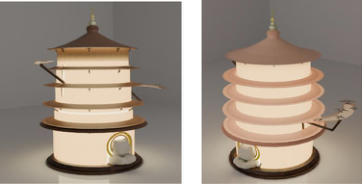
The following presents the design result derived from the emotional demands of cultural enthusiasts — the cultural and creative night light of the Wooden Pagoda of Ying County.
Figure 1: Cultural and creative night light of the Wooden Pagoda of Ying County for cultural Enthusiasts.
This cultural & creative night light (see Figure 1) is designed with reference to the shape and wood of Ying County Wooden Pagoda, featuring a minimalist style and integrated with hemp swallows and the tower-guarding cat.
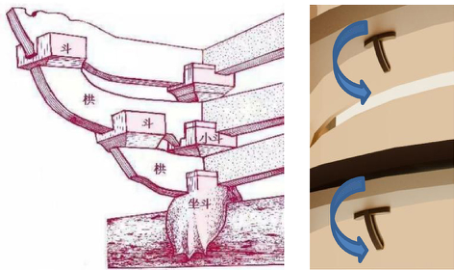
Figure 2: Brackets of the wooden pagoda of ying county (left) & eaves opening-closing mechanism in bracket style (right).
140 Zhong and Ren Beneath the lampshade of each eave of this cultural and creative night light, an eave opening-closing mechanism inspired by the bracket design is installed (see Figure 2), and the light angle can be adjusted by pressing down the eave of each layer.
Figure 3: Tower-guarding cat element (left) and tower-protecting swallow shape element (right).
This cultural and creative night light is designed with an ornament in the shape of a tower-guarding cat and a brightness adjustment lever shaped like a hemp swallow (see Figure 3), whose brightness can be adjusted by rotating the lever.
Framework Effect Verification—Expert and User Evaluation Five product design experts were invited to evaluate the designed cultural and creative products against the evaluation indicators of cultural expression, personalized design, emotional experience, functional rationality and technical feasibility, with a full score of 10 for each indicator. The results showed that the three products achieved an average score of 8.6, among which the scores for cultural expression and personalized design both exceeded 8.8. The experts commented that the products could well generalize and express the cultural elements of the Wooden Pagoda of Ying County, and the constructed AI-driven design framework featured high scientificity and practicality.
A total of 200 questionnaires were distributed to the target user groups, including 67 for the young group, 65 for the cultural enthusiast group and 68 for the family parent-child group, with an effective questionnaire recovery rate of 80%. The questionnaires were designed around dimensions such as product design satisfaction, cultural expression effect and personalized experience. Statistics indicated that 89% of the users expressed satisfaction or great satisfaction with the products, 91% believed that the products could well reflect the cultural characteristics of the Wooden Pagoda of Ying County, and 87% stated that the products met their emotional needs. The user evaluation results fully verified the effectiveness and practical value of the AI-driven cultural and creative design framework.
CONCLUSION
Taking the cultural and creative design of the Wooden Pagoda of Ying County as the research object, this study constructs a four-stage AI-driven
Generative AI-Enabled Innovative Design for Cultural Heritage: A Research 141 cultural and creative design framework consisting of intelligent extraction of cultural elements, dynamic mapping of user demands, emotionalized scheme generation, and human-machine collaborative optimization. The research results show that this framework can effectively address the problems of superficial cultural transformation, insufficient personalization, and low design efficiency existing in the current cultural and creative products of the Wooden Pagoda of Ying County. It realizes the in-depth integration of generative AI with the cultural and creative design of traditional culture, improves the efficiency and quality of cultural and creative design, and ensures the cultural authenticity and emotional expression of products. The designed cultural and creative products have been widely recognized by experts and users, which verifies the effectiveness and practical value of the framework.
This AI-driven cultural and creative design framework provides an expandable guide for the innovative design of traditional cultural and creative products in the AI era. It not only enriches the research achievements in the interdisciplinary field of generative AI and cultural and creative design, but also offers a new path for the digital inheritance and innovative development of traditional architectural culture.
In the era of the digital economy, the integration of generative AI and traditional culture is an inevitable trend in the development of the cultural and creative industry. This study aims to provide a reference for the innovative design of cultural and creative products of traditional culture and contribute to the living inheritance and digital innovation of traditional culture. The research theme is highly consistent with the Interdisciplinary Practice in Industrial Design track of AHFE 2026, with a particular focus on the innovation of design methods.
ACKNOWLEDGMENT
This research was funded by the Tianjin Municipal Art Science Planning Key Project, Research on the Construction and Development of Tianjin’s “Mountains, Sea, Rivers, Buildings, and Lively Atmosphere” Cultural Tourism Belt (Project No.: B24002).
I would like to express my sincere gratitude to my supervisor for the invaluable guidance throughout this research. My thanks go to the product design experts for their professional evaluations and all questionnaire respondents for their genuine feedback, which provided critical support for the study.
REFERENCES
Chi Zhang; Wanli Gu; Yan Gu; Changyuan Geng; Duk hwan Kim (2025), Research on the Application of Artificial Intelligence Technology in Color Matching in Product Appearance and Function Design [J], IET Software. Volume 2025, Issue 1. Dan Xiao (2025), Innovative Applications of Majiayao Pottery Patterns in Cultural
and Creative Product Design Within the Framework of Iconology [J], Innovation Series: Advanced Science. Volume 2, Issue 4.
Model into the Furniture Product Design for the Elderly [J], Journal of Mechanics in Medicine and Biology. Volume 25, Issue 05. Ji Li; Xiaohan Cao (2025). Research on the Application of Red Culture in Cultural and Creative Product Design under the Background of Artificial Intelligence [J], Journal of Tourism Management. Volume 2, Issue 6. Jing Liang (2024), The application of artificial intelligence-assisted technology in
cultural and creative product design [J] Scientific Reports. Volume 14, Issue 1. Jorge Alcaide Marzal; Jose Antonio Diego Mas (2025), Computers as co-creative assistants. A comparative study on the use of text-to-image AI models for computer aided conceptual design [J], Computers in Industry. Volume 164, Issue. Qianlong Xia; Jiajun Wang; Pengwei Jiao; Mohan Xu; Dingpeng Ma; Haotian Liang;
Sili Xu; Yanni Fan; Pengpeng Hu (2025), Emotional Revitalization of Traditional Cultural Colors: Color Customization Based on the PAD Model and Interactive Genetic Algorithm—Taking Liao and Jin Dynasty Silk as Examples [J], Applied Sciences. Volume 15, Issue 23. Runsheng Zhang; SeoYoon Sung (2025), Designers as Co-Creators: Reconfiguring Workflows and Creative Agency in AI-Augmented Design [J], Proceedings of the Association for Information Science and Technology. Volume 62, Issue 1. Vicente Chulvi (2025), Effectiveness of the AI using different typologies of design
methods [J], Research in Engineering Design. Volume 36, Issue 2. Wei Wu (2024), Application of traditional culture in modern cultural and creative product design in the era of artificial intelligence [J], Applied Mathematics and Nonlinear Sciences. Volume 9, Issue 1. Wei Zhu; Ying Lv; Kai Gong (2025), Research on Big Data and Artificial Intelligence
Empowering Emotional Design of Industrial Product [J], Journal of Big Data and Computing. Volume 3, Issue 4. Xin Zhang (2026), Smart Home Product Creation Under Emotional Design Principles and Consumer Perceptions [J], International Journal of Human–Computer Interaction. Volume 42, Issue 2. Ye Tingting (2025), Research on the Emotional Design of the Glaze Color Aesthetics
of the Tianqing Glaze of the Ru Kiln [J], Journal of Higher Education Teaching. Volume 2, Issue 6. Yujiu Liu (2025), Integrating AI and sustainability in cultural and creative product design for environmentally conscious innovations [J], International Journal of Information and Communication Technology. Volume 26, Issue 18. Zhang Hao; Bai Xiaofei; Ma Zengguang (2022), Consumer reactions to AI design:
Exploring consumer willingness to pay for AI-designed products [J] Psychology & Marketing. Volume 39, Issue 11.
LISTED IN THE AHFE DIGITAL BOOKSTORE CATALOGUE
Explore the complete digital volume
Affective and Pleasurable Design
Read this individual research paper free through the original publisher, or explore the full digital proceedings book.
ISBN 978-1-964867-80-9
Explore this ISBN in the AHFE Bookstore ↗Listed in the July 2026 bookstore catalogue; search by ISBN to confirm current availability · Digital book purchase optional