To improve work efficiency and reduce the risk of injury in agriculture, this study focused on altering the task sequence to reduce physical workload. Based on typical agricultural activities, three types of tasks were designed to involve different body parts and movement characteristics (lifting heavy objects, repetitive light work in a forward-bending posture, and holding heavy objects with one hand). The impact of different task sequences on physical movements was evaluated using the joint angles and center of pressure (COP) displacement measured during the lifting task. Body movement data were collected from 12 healthy participants (23.1±1.3 years old) using a motion capture system and force plates across six experimental protocols with different task sequences. The statistical analyses of the knee joint angle, hip joint angle, and COP displacement revealed no significant differences among the six protocols. The mean knee joint angle was approximately 100°, with a relatively high interparticipant variability. The hip joint angles ranged from approximately 138° to 144°, with slightly lower mean values observed when the protocol began with holding a heavy object with one hand. The average COP displacement was approximately 34 mm across all the protocols, although a slightly greater interparticipant variability was observed when repetitive forward-bending movements were performed in the initial phase. These results suggest that the joint angles and COP displacement obtained from a representative task may be useful indicators for evaluating the physical workload in multitask agricultural operations.
In Japan’s agricultural sector, the number of workers has been declining owing to population aging and increasing economic burdens (Statistics Department, Minister’s Secretariat, Forestry and Fisheries, 2025). Consequently, the amount of work assigned to each worker has increased. Consequently, the physical workload placed on workers has increased, leading to problems, such as reduced work efficiency and a higher risk of injury. In recent years, although mechanization has progressed in several areas of agriculture, certain delicate
tasks, such as livestock care and crop sorting, remain difficult to replace with machines, and therefore still rely heavily on manual labor. In addition, the machinery and systems that can replace such tasks are expensive and require considerable time and cost for implementation, which may further increase the financial burden on farm management. Therefore, there is a need for methods that can reduce physical workload while minimizing time and cost.
Previous studies have suggested that, when performing tasks of the same type, starting with tasks that impose a lower physical load can reduce the overall physical workload (Horton et al., 2012). However, relatively few studies have examined how the sequence of tasks influences the physical workload when tasks of different types are combined. Depending on the combination of tasks, adjusting the body usage to avoid repeatedly using body parts where fatigue has already accumulated may reduce the overall physical workload.
In this study, experimental tasks were designed with particular attention to the movements commonly observed in agricultural work to quantitatively evaluate the changes in physical workload caused by differences in task sequences. In addition, considering the practical applicability in field settings, the overall physical workload of the task sequence was assessed using indicators obtained from a single experimental task among the multiple tasks. Rather than using electromyography, which is commonly employed to assess the physical workload (Yaji et al., 2019) (Fujimura et al., 2004), the kinematic characteristics of body movement were extracted and analyzed using an optical three-dimensional motion capture system and a force plate.
EVALUATION OF PHYSICAL WORKLOAD CAUSED BY CHANGING THE SEQUENCE OF MULTIPLE TASKS This study was approved by the Ethics Committee for Research Involving Human Participants of Saitama University (approval no. R7-E-42). Twelve participants (male and female, 23.1±1.3 years old) took part in the experiment. Informed consent was obtained from all the participants.
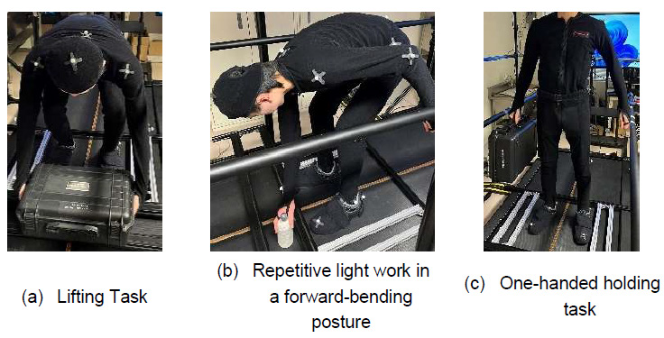
EXPERIMENTAL TASKS In this experiment, three experimental tasks were established to investigate the effects of task sequence on physical workload. Referring to the major movements commonly observed in agricultural work, the tasks were designed such that the body parts used and the movement characteristics differed. The three tasks involved lifting heavy objects, performing repetitive light work in a forward- bending posture, and holding a heavy object with one hand. An overview of the movements involved in the experimental tasks is shown in Figure 1.
The lifting task was designed with reference to agricultural activities, such as transporting harvested products and loading feed. The participants repeatedly performed a sequence of lifting and lowering a heavy object, defined as one cycle, for a total duration of four minutes. To standardize the movement timing among participants, an electronic beep was presented at five-second intervals. The weight of the object was set at 30% of the body weight of each participant.
Effect of Changing Task Sequence on Physical Workload in Agricultural Operations 107 Repetitive light work in a forward-bending posture was designed based on tasks, such as weeding and attaching milking equipment. The participants bent their upper body forward without flexing their knees and moved a weighted object back and forth in front of their toes using their dominant hand. This back-and-forth movement performed continuously for three minutes was defined as one cycle. To standardize the movement timing among participants, an electronic beep was presented at three-second intervals.
The one-handed holding task was designed with reference to activities, such as moving agricultural machinery or carrying a bucket of water. First, the participants lifted a weighted object from the side of their body using their dominant hand and maintained an upright standing posture for 45 s. Then, they placed the object on the ground and rested in an upright position for 15 s. This sequence of actions was defined as one cycle and was repeated for a total of three minutes. To control movement timing, an audio cue was presented so that the participants could place the object down and begin the resting period while standing upright. The weight of the object was set at 30% of the body weight of each participant.
Figure 1: Experimental tasks.
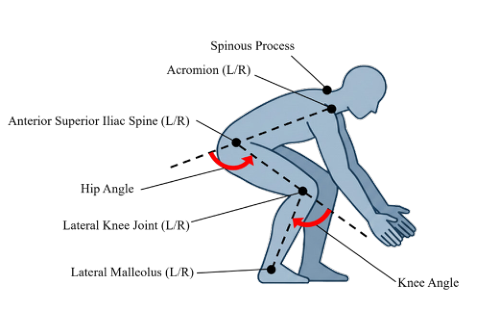
EXPERIMENTAL SETUP AND PROTOCOL An optical three-dimensional motion capture system (OptiTrack, NaturalPoint Inc.) and a force plate (FTMH-1244WA, Tec Gihan Co., Ltd.) were used in this experiment. The locations of the reflective markers are shown in Figure 2. The participants wore a suit and shoes designed for attaching reflective markers, which were placed on the left and right acromions, spinous process, left and right anterior superior iliac spines, the lateral sides of the left and right knee joints, and left and right lateral malleoli. The three-dimensional coordinates (X, Y, and Z) of each reflective marker and ground reaction forces (X, Y, and Z) were recorded at a sampling frequency of 200 Hz.
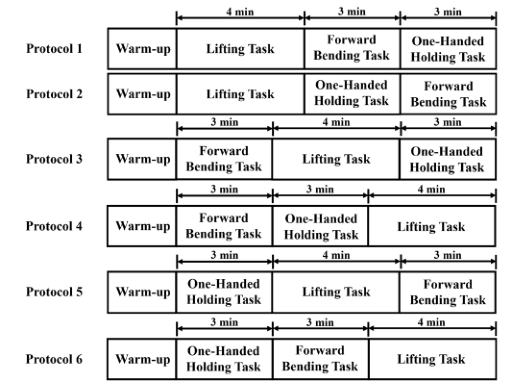
The experimental protocol is illustrated in Figure 3. Six experimental protocols were compared by altering the sequences of the three experimental tasks. Each protocol was performed on a separate day to eliminate fatigue. In addition, the order of the protocols was varied among the participants so that the sequence itself would not influence the results. To reduce the risk of injury, the participants were instructed on the ideal movement patterns beforehand and asked to perform sufficient warmup exercises before starting the experimental tasks.
Figure 2: Attachment positions of the reflective markers.Figure 3: Experimental protocols.
DATA ANALYSIS In a preliminary experiment conducted before this study, lifting tasks were performed while the load magnitude was varied. The results indicated that the physical workload can be quantitatively evaluated using the knee joint angle and center of pressure (COP) variation. Therefore, in this study, lifting tasks within the experimental protocols consisting of three tasks were analyzed using three kinematic indicators: maximum knee joint flexion angle, maximum hip joint flexion angle, and COP variation, with the hip joint angle added to the indicators used in the preliminary experiment.
Cubic spline interpolation was applied to the three-dimensional coordinate data to address the missing values caused by the occlusion of reflective markers. Data organization and processing were performed using data analysis software (VENUS3D R, Nobby Tech. Ltd.). For each cycle, the maximum flexion angles of the left and right knee joints and left and right hip joints were calculated. The mean values of the left and right angles across all the cycles during the four-minute task were defined as Kave and Have, respectively.
To remove noise, a fourth-order low-pass Butterworth filter with a cutoff frequency of 10 Hz was applied to the ground reaction force data. The distance between the mean COP position for each cycle and the COP position in each frame was calculated as the deviation. Based on the x- and y-axis components of the deviation, the root mean square (RMS) of the COP variation for all the frames within a cycle was calculated. The mean value across all the cycles during the four-minute task was defined as dave.
For the statistical analysis, the kinematic indicators Kave, Have, and dave were tested using the Friedman test at a significance level of 5%.
RESULTS
The distributions of Kave, Have, and dave for all the participants in each protocol are shown in Figure 4. The values of Kave, Have, and dave for all the participants in each protocol are listed in Table 1. The results of the statistical tests indicated that no significant differences among the protocols were observed for any of the indicators (Kave, Have, or dave) with respect to the task sequence.
However, when examining the distributions of each kinematic indicator, the variability in Kave was larger among the participants than that in Have, suggesting that the degree of knee flexion tended to vary considerably between the participants. For Have, the mean values in protocols 5 and 6 were slightly smaller, indicating a tendency for reduced hip flexion compared with the other protocols. For dave, a slightly larger variability was observed in protocols 3, 4, and 6, suggesting that individual differences among the participants were more pronounced in these protocols.
(a) Kave (b) Have
dave Figure 4: Distribution of kinematic indicators for each participant by protocols.
Table 1: Values of kinematic indicators for each participant by protocols.
Table available in the original PDF paper.
Protocol Kave [deg] Have [deg] dave [mm] 1 99.6±28.2 143.8±6.5 35.2±7.4 2 101.1±27.5 142.7±7.6 34.4±7.2
As no significant differences were observed among the protocols for any of the kinematic indicators, the results suggest that, under the conditions established in this study, the effect of altering the task sequence on the physical workload may be limited. The experimental tasks in this study were designed such that the primary body parts and movement characteristics differed between the tasks. Such differences are expected to suppress the use of body regions that experience high physical workloads and promote recovery from accumulated fatigue. However, when focusing solely on lifting tasks, it may be difficult to clearly identify the effects of changing task sequences produced by such mechanisms. Therefore, to evaluate the influence of task sequence on physical workload, it may be necessary to assess the entire protocol consisting
Effect of Changing Task Sequence on Physical Workload in Agricultural Operations 111 of multiple tasks and establish kinematic indicators capable of capturing the effects of accumulated physical workload.
When examining each kinematic indicator individually, no apparent trend among the protocols was observed for Kave. However, the variability among the participants was larger than that observed for Have, indicating greater individual differences. This may be because individual physical characteristics, such as height, leg length, and arm length, are compensated for through adjustments in knee flexion. Consequently, even when the body size differs considerably, the change in the physical workload at the lower back may be smaller than that at the knee joint.
For Have, slightly smaller mean values were observed in protocols 5 and 6, suggesting that, when the one-handed holding task was performed first, hip flexion during the lifting task tended to decrease. This finding may indicate that asymmetric body usage influences the accumulation of physical workload in the later stages of the protocol, leading the participants to avoid movements involving large hip flexion during subsequent tasks.
For dave, slightly greater variability was observed in protocols 3, 4, and 6. In these protocols, repetitive light work in a forward-bending posture was included in the early stages. During tasks that require maintaining the same posture, the participants may have had some degree of freedom in managing their physical workloads. Consequently, differences in muscle strength and flexibility among the participants may have influenced the magnitude of the physical workload experienced. Consequently, the residual workload that affects tasks performed later in the protocol may also have been strongly influenced by individual differences. These findings suggest that tasks performed in a forward-bending posture may increase individual variability in subsequent tasks. Overall, the results suggest that tasks performed in the early stages of a protocol may influence movement patterns in later tasks, as reflected in the joint angles and COP displacement.
Based on these findings, individual physical characteristics may cause the physical workload to concentrate on specific body regions, indicating that the appropriate use of equipment and tools is desirable. In addition, tasks involving asymmetric body usage may be more suitable for reducing physical workload when performed in the later stages of a work sequence. Furthermore, tasks that require maintaining the same posture may cause differences in the physical workload depending on the workers’ muscle strength and flexibility, highlighting the importance of work planning considering individual worker characteristics.
CONCLUSION
In this study, multiple experimental tasks with different characteristics were combined to quantitatively examine the effects of task sequences on the physical workload. No statistically significant differences were observed among the task sequences for any of the kinematic indicators. These findings suggest that, in a sequence of tasks composed of activities with substantially different characteristics, it is difficult to identify the effects of
the task sequence on physical workload based on a single task. Therefore, it may be necessary to establish kinematic indicators that are capable of consistently evaluating the physical workload across all the tasks within a work sequence.
However, differences in trends were observed in the joint angles and COP displacement, indicating that these indicators may provide an important perspective for evaluating the influence of tasks performed in the early stages of a work sequence from the viewpoint of body movement patterns.
REFERENCES
Fujimura, M. and Nara, I. (2004) The influence on lumbago in lifting weights measured by electromyography, Japanese Journal of Occupational Medicine and Traumatology, Volume 52, No. 6, pp. 341–347. Horton, L. M., Nussbaum, M. A., and Agnew, M. J. (2012) Effects of rotation frequency
and task order on localised muscle fatigue and performance during repetitive static shoulder exertions, Ergonomics, Volume 55, No. 10. pp. 1205–1217. Statistics Department, Minister’s Secretariat, Forestry and Fisheries. (November 28,
2025) Overview of the 2025 Census of Agriculture and Forestry (Preliminary Results). Website: https://www.maff.go.jp/j/tokei/kouhyou/noucen/pdf/census_25. pdf Yaji, M., Hiranai, K., Kuramoto, A., and Seo, A. (2019) Effect of sequential manual multiple tasks with repetitive motion of physical workload, The Japanese Journal of Ergonomics, Volume 55, No. Supplement., pp. 2D1–6.
LISTED IN THE AHFE DIGITAL BOOKSTORE CATALOGUE
Explore the complete digital volume
Affective and Pleasurable Design
Read this individual research paper free through the original publisher, or explore the full digital proceedings book.
ISBN 978-1-964867-80-9
Explore this ISBN in the AHFE Bookstore ↗Listed in the July 2026 bookstore catalogue; search by ISBN to confirm current availability · Digital book purchase optional