In conventional games, enhancing a character’s physical abilities leads to increased entertainment and exhilaration. However, in virtual reality (VR) games, the movements of the in-game characters and players are synchronized, enhancing the sense of physical presence and immersion. Therefore, it is believed that the entertainment value of VR games can be enhanced by extending the characters’ physical abilities. This study focuses on the impact of enhancing a character’s jumping ability in a VR game, which is a fundamental human movement. Our findings indicate that significantly increasing the jump height diminishes the sense of motor subjectivity. This is attributed to the incongruence between visual input and the anticipated sensation based on previous experience. We then investigated the senses that exhibited the largest discrepancies. We found that the discrepancies were particularly large in terms of speed and height, with a higher sense of levitation correlating to increased entertainment value. Future work will aim to propose a trajectory that can minimize the discrepancy in sensations of speed and height and enhance the sensation of floating.
In TV and smartphone games, such as role-playing and action games, play- ers control in-game characters using remote controls or control panels. The physical abilities of the characters are often higher than those of real indi- viduals, significantly enhancing the games’ entertainment and exhilaration. With the advent of VR games, using head-mounted displays (HMDs), there has been a shift toward synchronizing character movements with real-player actions, offering superior physical activity sensation and immersion com- pared to traditional games. However, directly translating this enhanced physical capability from traditional to VR games is challenging without inducing discomfort or diminishing the sense of exhilaration and immersion, because of the direct reflection of the player’s physical limitations in the game. Thus, devising a method to effectively extend the player’s physical capabilities in VR games without compromising autonomy or immersion could notably enhance the gaming experience.
Factor of Discomfort During Jumping Extended in Virtual Space 9
Currently, methods such as redirected walking and jumping aim to aug- ment real-world movements in VR, albeit with limitations in terms of extension magnitude, resulting in minimal impact on game exhilaration and entertainment. To achieve the same effect as traditional games, it is essential to explore expansion techniques that remain comfortable for the player.
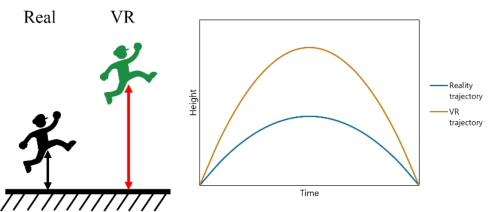
This study focuses on “jumping,” which is a fundamental human motion prevalent in both daily life and gaming. Figure 1 shows a comparison between real-world jumping and augmented VR jumping. Previous research indicates that the range for unrecognizable vertical jumps is 0.06 to 2.20 times larger than that in the real world (Hayashi et al., 2019). In our study, we inves- tigated the effects on players when they extended their leaps significantly beyond the above range, that is, within the range recognizable to them. The results showed that a large jump extension causes a gap between the player’s jump sensation and visual feedback, leading to reduced motor initiative. In addition, players may feel discomfort when they extend their jumps, partic- ularly when they fall. This section aims to clarify the three dimensions of discomfort associated with extensive leap augmentation: sensation, timing, and impact.
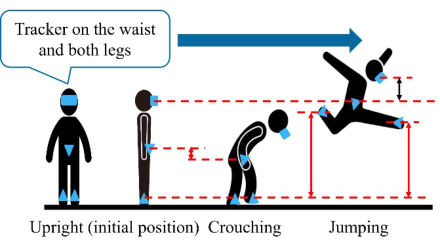
LEAP EXTENSION SYSTEM Our system comprised an HMD (VIVE Pro Eye, HTC), a motion tracker (VIVE Tracker, HTC), and a control PC, set up in an environment devel- oped using Unity 2021.3.5f1. As shown in Figure 1, trackers were attached to the participant’s waist and the instep, and the position coordinates of each foot were acquired. Jumping movements were categorized into three states: upright, crouching, and jumping. The coordinates of the HMD and the tracker in the upright state were defined as the initial positions. The crouch- ing state was defined as the time at which the waist coordinates on the vertical axis were lower than those at the initial position. When the coordinates of both feet and the head on the vertical axis were higher than the initial posi- tion, the robot was in a jumping state. In the jumping state, the difference between the coordinates of the HMD and the initial position was defined as the jumping height. The jumping height was changed by applying a specific expansion factor, as shown in Figure 1, to the jumping height, and the motion was expanded in VR.
Figure 1: Image of the leapfrog extension.
FACTOR ANALYSIS OF THE DISCOMFORT OF EXTENDED JUMPING After informed consent was obtained from the participants, the experiment was conducted as follows: participants first wore HMDs and trackers, and practiced sufficiently to be able to jump 0.25 m in VR. They then answered a questionnaire about their mood state using the Two-dimensional Mood Scale (TDMS) and jumped for one min. Subsequently, they performed an extended leap for one minute under five different conditions with randomly selected extension magnification. Participants then responded to a question- naire regarding their sensations and impressions of the extended leap. This was followed by another round of jumping in an extended state, after which they reported the onset timing of discomfort. Finally, a questionnaire regard- ing mood state was administered, followed by a one-minute rest period. These procedures were repeated five times under all conditions.
This study involved 10 adult males (average age 22.5 ± 1.1 years) to analyze the factors that caused discomfort during extended leaps within VR.
Previous studies have shown that higher jumps in reality are more notice- able, and considering frequent jumping actions per minute, the prespecified jumping height was set to 0.25 m. The magnification factors applied to the jumping height were defined as the extension factors, and were set as 0.207, 0.455, 2.20, 4.84, and 10.6 times, based on prior findings that leaps could not be perceived beyond a 2.20 magnification.
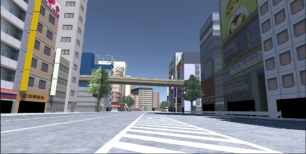
The VR environment simulated a cityscape to anchor the experiment in familiar daily objects and spatial perceptions, as shown in Figure 3.
Figure 2: Sequence of jumping movements.Figure 3: VR environment during the experiment.
Factor of Discomfort During Jumping Extended in Virtual Space 11
Questionnaire on the Senses A questionnaire on sensations was administered using the magnitude esti- mation method, extracting seven sensations during jumping: speed, height, force, weight, floating, time, and gravity. Velocity is the vertical speed. The sense of height is the sense of how high one jumps. Sense of force is the force of the legs used to jump. Weight is the sensation of the body weight. Floating sensation is the feeling of floating. Time is the time spent in the air. Gravity is the sensation of being pulled downward.
The senses of speed and height were obtained because of jumping; these are two of the most important senses in this study. The senses of force, weight, time, and gravity were analyzed within a physical framework describ- ing jumping dynamics, whereas the sense of floating was highlighted for its unique contribution to extended leap experiences.
Questionnaire on Impressions As shown in Table 1, twelve sensory word pairs were selected based on pre- vious studies (Hirai et al., 2022, Iimura et al., 2012, Ichikawa et al., 2022), and the questionnaire was administered via the semantic differential scale method.
Questionnaire on the Timing of Discomfort The purpose of this questionnaire was to investigate the timing at which respondents felt discomfort. The questionnaire asked whether the passenger felt discomfort at each magnification by selecting “yes” or “no.” If the pas- senger answered “yes,” the questionnaire asked the passenger to select from six timing options: “during take off,” “during ascent,” “at the top,” “during descent,” “during landing,” and “after jumping.”
Table 1. Sensory word pairs.
Table available in the original PDF paper.
1 dislike - like 2 flat - three dimensional 3 intense - calm 4 mechanical - humanly 5 closed - open 6 unexpected movement - movement within expectations 7 unpleasant - pleasant 8 boring - fun 9 intermittent movement - continuous movement 10 lacking in impact - powerful 11 unrealistic - realistic 12 artificial - natural
Two-Dimensional Mood Scale (TDMS) TDMS assesses psychological states in terms of activation and stability, with comfort and arousal levels, which are components of the psychological state. Participants’ responses generated scores reflecting these states. The measure- ment results are displayed on a “two-dimensional graph” with comfort and arousal levels as the two axes, allowing the user to visually understand the characteristics of psychological states and their changes in various situations.
The activation, stability, comfort, and arousal levels were calculated as scores from the questionnaire responses. As a general interpretation of the results, positive scores for activation, stability, and comfort indicated a com- fortable and favorable psychological state, whereas negative scores indicated an unpleasant and unfavorable psychological state. However, because there were large individual differences in psychological state, it was effective to measure the psychological state of the same individual multiple times and analyze the difference between a certain standard value and the measured value under special circumstances, or to implement interventions, such as exercise, and analyze the change in the measured value before and after the intervention.
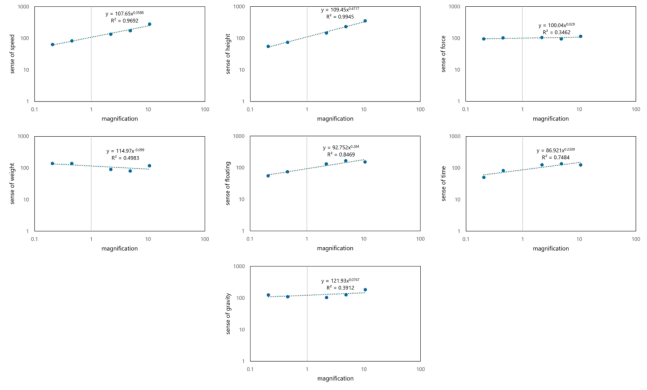
CONSIDERATION For the sensory questionnaire, we averaged the responses of the seven senses for each magnification factor and approximated them to the power of each sense, as shown in Figure 4. These figures are shown in a double-logarithmic graph; the formulas were calculated using a power approximation. These graphs suggested that the extension of the jump may affect all seven senses. Therefore, we analyzed discomfort-related sensations.
We categorized the seven senses into physical and psychological types. Physical sensations are those whose quantities can be mathematically esti- mated from physical equations, whereas psychological sensations are those whose quantities cannot be expressed physically.
Figure 4: Relationship between sensory volume and dilation magnification.
Factor of Discomfort During Jumping Extended in Virtual Space 13
The six physical sensations are speed, height, force, weight, time, and gravity, whereas the psychological sensation is floating.
For physical senses, we assessed the discrepancy between calculated sen- sory values and those provided by the experimental participants. For each sense, a theoretical equation for estimation was obtained and an approximate equation was calculated from the evaluation values related to the sense. The difference between the theoretical and approximate equations was defined as the sensory discrepancy coefficient. A higher coefficient indicates a greater disparity between expected and experienced sensations. The sensory discrep- ancy coefficients for each sense are presented in Table 2. Reducing these discrepancies could allow for comfortable extended jumps without losing the sense of movement autonomy.
The responses to the questionnaire regarding the timing of discomfort are shown in Table 3. Discomfort during ascent was common, except at a 2.20 times magnification, where participants reported no discomfort. There- fore, it was suggested that the respondents tended to feel discomfort during the ascent at the extension of the leap. This suggests a perception thresh- old for sensory discrepancy during leap extension, with discomfort primarily occurring during ascent because of unexpected height and speed sensations.
Table 2. Sense discrepancy coefficients.
Table available in the original PDF paper.
Sense unequal factor Sense of speed 0.641 Sense of height 0.528 Sense of weight 0.099 Sense of force 0.029 Sense of time 0.231 Sense of gravity 0.077
Table 3. Aggregate results of timing of discomfort.
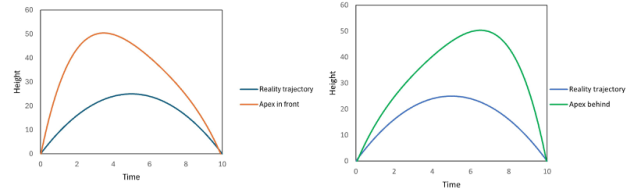
Figure 5: Leap trajectory with vertex shifted back and forth.
Adjusting leap trajectories could mitigate discomfort by aligning ascent and descent speeds with participant expectations. For example, modulating the speed to be slower during ascent and faster during descent, or vice versa, could lessen discomfort related to speed perception, as shown in Figure 5.
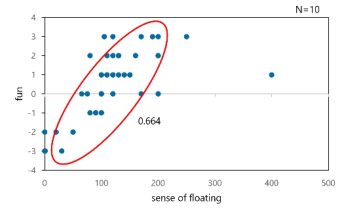
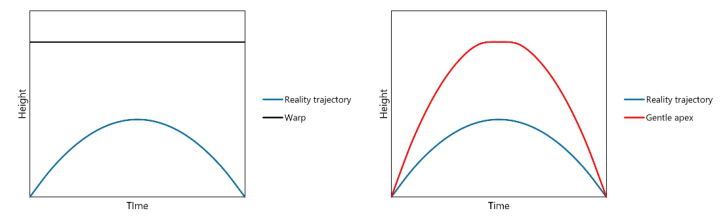
We considered the influence of floating on psychological sensations. As shown in Figure 6, Pearson’s correlation analysis was conducted between the floating sensation and the impression questionnaire “boring - interest- ing,” and a significant positive correlation was found at r = 0.664. This suggests a link between floating and amusement. Therefore, increasing the sense of floating may be beneficial for improving the entertainment value of jump extension systems. Therefore, we analyzed situations in which a sense of levitation was generated. Figure 4 shows that the sense of floating increases as the magnification factor increases. The same is also suggested by the expression for the power approximation. Therefore, a large jump exten- sion increases the sense of levitation and may lead to an improvement in entertainment. Next, Pearson’s correlation analysis was conducted between the sense of time and the feeling of floating, and a significant positive correla- tion was found at r = 0.867. This suggests a strong relationship between the sense of time and the feeling of floating. Therefore, it is thought that jumping trajectories that make people feel a sense of time will increase their sense of floating and lead to an improvement in entertainment. Thus, we considered a trajectory that remained at the apex for a long time as a trajectory that makes the user feel a sense of time spent in the air for a long period. For example, Figure 7 shows a gentle trajectory near the apex and a trajectory that warps toward the apex at the moment the leap is made.
Figure 6: Relationship between sense of floating and fun, and between sense of floating and sense of time.Figure 7: Warping orbit and gentle orbit near apex.
Factor of Discomfort During Jumping Extended in Virtual Space 15
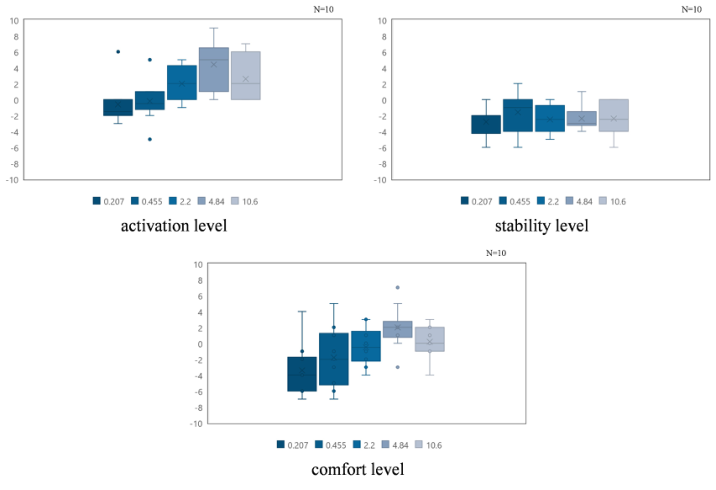
The “activity,” “stability,” and “comfort” levels were calculated from the responses on the TDMS, respectively. The differences were calculated for each item before and after the experiment for each magnification factor, as illustrated in Figure 8, which shows that “activity” and “comfort” increased as the magnification factor increased. However, in both cases, the highest values were obtained at 4.84 times, suggesting that the users felt the most comfortable at 4.84 times magnification.
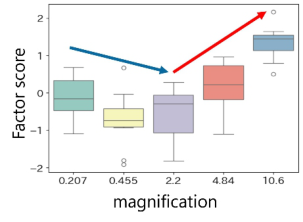
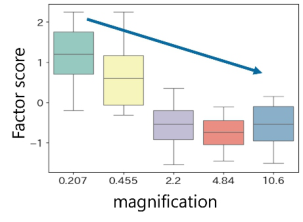
A factor analysis was conducted on the impression questionnaire using the results of the questionnaire for all conditions, and two factors were identified: entertainment and reality. The loadings for each factor are listed in Table 4. The factor scores for each condition and factor are shown in Figures 9 and 10, respectively. The factor scores for the entertainment factor were similar to those of the activity-level and comfort-level factors, indicating that this factor is considered to be an entertainment-related factor. Figure 9 also shows that the higher the expansion factor, the lower the factor score. This suggests that the higher the magnification factor, the more interesting and entertaining the game. The second factor consists of many sensory word pairs such as “unexpected movement - expected movement” and “unrealistic - realistic,” which are judged based on past life experiences. Figure 10 shows that the more realistic the jump, the lower the factor score. This suggests that the higher the magnification factor, the farther the impression of the movement from reality.
Figure 8: Relationship between TDMS results and dilation magnification.Figure 9: Factor scores for the entertainment factor.Figure 10: Factor scores for reality factor.Table 4. Factor loadings.
Table available in the original PDF paper.
Entertainment factor Reality factor
–0.61 –0.259
dislike - like –0.917 –0.006 flat - three dimensional –0.814 –0.012 closed - open –0.85 0.019 unpleasant - pleasant –0.88 –0.179 boring - fun –0.922 0.28 intermittent movement - continuous movement
–0.314 –0.724
lacking in impact - powerful –0.863 0.356 intense - calm 0.631 –0.58 mechanical - humanly –0.361 –0.801 unexpected movement - movement within expectations unrealistic - realistic –0.297 –0.869 artificial - nature –0.398 –0.848
CONCLUSION
In this study, we explored the sensory discrepancies in virtual reality jumping and identified when participants typically experienced discomfort. The most significant sensory discrepancies were related to speed and height. The most common time for sensing discomfort was during ascent. Regarding the enter- tainment value of the system, our findings indicate that a sense of floating and time enhances user enjoyment. Factor analysis based on a questionnaire survey on impressions of the system allowed us to identify entertainment
Factor of Discomfort During Jumping Extended in Virtual Space 17
and realism factors. Drawing on these insights, we advocate for a system design that preserves the autonomy of physical activity while augmenting the entertainment value of virtual jumps.
REFERENCES
Hayasi, D. Fujita, K. Takashima, K. Lindeman, R. Kitamura, Y. (2019) “Redirected Jumping: A method for manipulating the amount of movement during jumping in VR”, in: Virtual Reality Society of Japan, Volume 24, No. 4, pp. 341–350. Hirai, A. Suigiura, N. Uemati, A. (2022) “Impression evaluation of green land-
scapes using video and VR taken from viewpoints - Focusing on the difference of light environment Focusing on the difference of light environment”, in: The Japanese Society for Landscape Architects and Building Engineers, Volume 48, No. 1, pp. 39–44. Iimura, K. Nakmura, H. Okura, N. Komatu, T. (2012) “Experiments in quantification and evaluation of presence and reality”, in: The Japan Ergonomics Society, Volume 48, pp. 432–433. Ichikawa, Z. Kiko, T. Akiyoshi, M. (2022) “Effects of synchronized movement with a
virtual agent using Kinect on impressions of physical activity”, in: Virtual Reality Society of Japan, Volume 34, No. 3, pp. 663–668.
LISTED IN THE AHFE DIGITAL BOOKSTORE CATALOGUE
Explore the complete digital volume
Affective and Pleasurable Design
Read this individual research paper free through the original publisher, or explore the full digital proceedings book.
ISBN 978-1-958651-99-5
Explore this ISBN in the AHFE Bookstore ↗Listed in the July 2026 bookstore catalogue; search by ISBN to confirm current availability · Digital book purchase optional