This study aims to explore how embodied emotion theory can be applied to the design of smart seats to enhance users' physical comfort and emotional experience. Firstly, the article introduces the basic concepts and development history of embodied emotion theory. Then, it analyzes the current application of embodied emotion theory in product design and summarizes the relevant design principles. Subsequently, a product design scheme for a smart seat is proposed, which integrates sensor technology, data analysis, and feedback mechanisms. This scheme aims to adjust the user's emotional state by identifying their emotional status and setting the seat's posture accordingly. The effectiveness of this seat design in improving user emotion and comfort has been verified through experiments. Finally, the paper discusses the application prospects and potential value of smart seats in the field of human-computer interaction.
Embodied emotion theory, as an important theoretical framework in the fields of psychology and neuroscience, proposes the view that emotional experience is not solely the product of brain activity, but a comprehensive response of the entire bodily experience. This theory provides an innovative perspective for a deeper understanding of human emotions and behavioral patterns. Against the backdrop of continual technological advancement and the increasing popularity of smart home systems, smart seats have become a key component in enhancing the quality of home life. They not only offer the physical comfort of traditional seating but also achieve a higher level of personalized experience through integrated technology. In today’s fast- paced modern society, people often face increasing psychological stress and emotional challenges. Therefore, creating a living environment that can effec- tively regulate emotions and enhance comfort is particularly important. By integrating embodied emotion theory with advanced sensor technology, data analysis, and feedback mechanisms, smart seats can identify and respond to users’ emotional states, thereby adjusting the seat’s posture to achieve the purpose of regulating user emotions.
Intelligent Chair Product Design Based on Embodied Emotion Theory 95
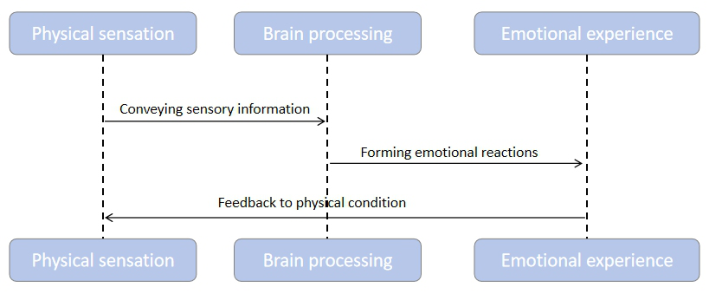
Embodied Emotion Theory and Its Development History Embodied Emotion Theory, originating from the second generation of cog- nitive science, proposes that the body plays a key role in understanding emotions, rather than being just an instrument of logical reasoning. This theory emphasizes that the expression, perception, processing, and under- standing of emotions are closely related to the body. Emotional experiences, perception of stimuli, or retrieval of emotional memories all activate similar psychological processing. The control of facial expressions or body move- ments, which are closely related to emotional expression, also affects the perception and understanding of emotions (Zhang Jing, Chen Wei, 2010).
Figure 1: Embodied emotion theory (drawn by the author).
The development history of Embodied Emotion Theory is a multi- disciplinary evolutionary process. Initially, in the early 20th century, psychol- ogists and philosophers like William James and Carl Lange began to focus on the connection between emotions and the body, proposing that emotional experiences are interrelated with physiological changes. With the rise of cog- nitive science in the mid-20th century, researchers paid more attention to the interaction between psychological processes and bodily states, but focused on cognitive processes in the brain. In the 1980s, the proposal of Embodied Cognition Theory, which posits that cognitive processes are closely related to the physical state of the body and the environment, offered a new perspective for emotion research. This theory evolved into Embodied Emotion Theory, emphasizing that emotions are not just the product of the brain but a com- prehensive response of the body and psychological processes. In the early 21st century, advances in neuroscience provided experimental support for this theory, especially with the use of functional Magnetic Resonance Imag- ing (fMRI) and other techniques, allowing researchers to directly observe the interaction between the brain and body in emotional states. In recent years, Embodied Emotion Theory has been further developed and deepened in fields such as psychology, neuroscience, cognitive science, and philosophy, forming an interdisciplinary comprehensive theoretical system. This offers a new per- spective and research methods for a deeper understanding of the complexity of emotional experiences.
CURRENT APPLICATION OF EMBODIED EMOTION IN DESIGN The application of Embodied Emotion Theory is very extensive, primar- ily reflected in the design field through product interaction design, smart wearable devices, and smart home products.
Table 1. Current status of application of embodied emotion theory in design.
Table available in the original PDF paper.
Category Product Interaction Design
Intelligent Wearable Devices
Smart Home Products Xiaomi Band 8 Xiaomi Smart Speaker
Name Xbox One S somatosensory game Picture
Equipped with an infrared emission module, it can voice control over 6000 brands of household appliances.
Real time monitoring and recording of physical data. For example, identifying heart rate, blood oxygen data, sleep records, and stress monitoring.
Description Through Kinect sensors, Xbox One S motion sensing games can achieve full body motion capture, converting your actions into real-time character actions in the game.
Current Status of Smart Seat Development With the continuous improvement of living standards, smart seats have become an indispensable smart home product in most households. The func- tionality of smart seats has evolved from initially providing relaxation effects based on vibration features to integrating more complex features as elec- tronic and computer technologies have developed. For example, the inclusion of a roller system capable of mimicking the kneading and rubbing actions of human hands. In recent years, with the advancement of artificial intel- ligence and sensor technology, massage chairs have begun to possess more intelligent functions. For instance, they can detect the user’s body condition and pressure points through sensors and automatically adjust the massage program. Moreover, the integration of multifunctionality has become a pop- ular trend in recent years. Smart massage chairs are not limited to massage functions but also incorporate advanced features like music playback, heat- ing, and zero-gravity recline, providing a more comprehensive relaxation experience.
Intelligent Chair Product Design Based on Embodied Emotion Theory 97
Table 2. Outlines the development history of smart seats.
Table available in the original PDF paper.
Time to Market 1975 1995 2023 Name Fuji “Mom Massage Chair” AUX multifunctional massage chair Fuji Corporation Pioneers “Air Chair”
Picture
Description Just one switch is needed to change the kneading and pounding, and the intensity can be freely adjusted. It can be used as a chair in the living room.
Through air bag massage, the whole body muscles are relaxed, and a leg massage function is installed to promote blood circulation in the legs.
Multi technology integration, simulating real massage feel, sleep aid technology, intelligent voice control, multimedia functions
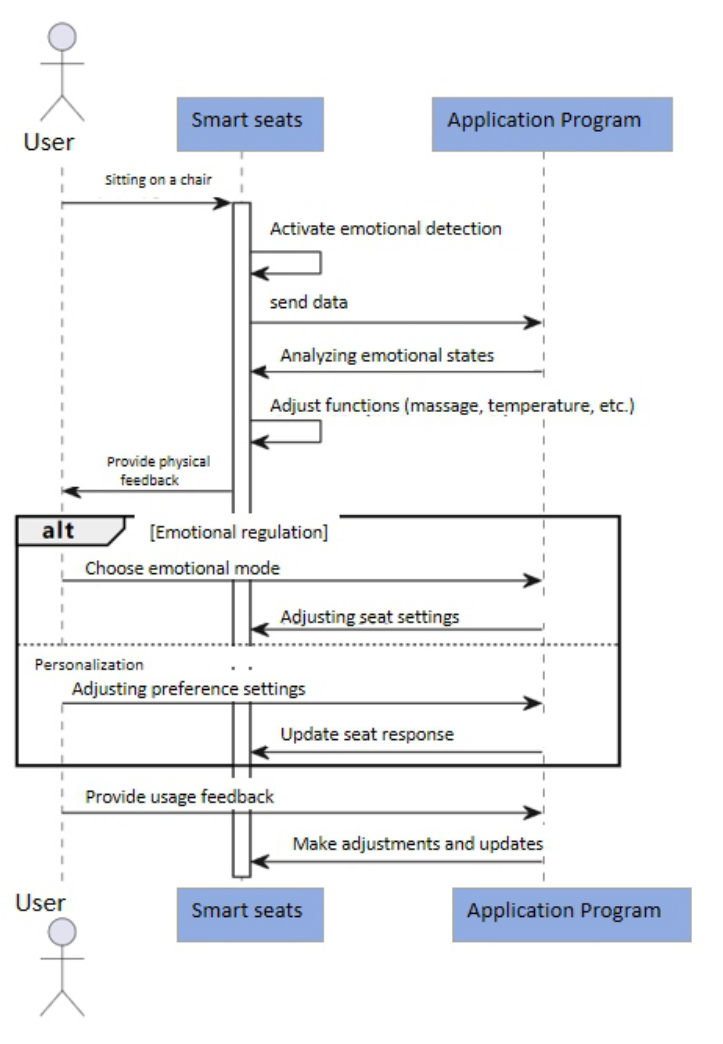
Smart Seat Design Practice Based on Embodied Emotion Theory The design principles for smart seats encompass five key aspects: comfort, emotional perception, adaptability, safety, and usability. The comfort prin- ciple emphasizes that the seat should provide good support and adjust to the user’s body shape, with appropriate cushion firmness and support distri- bution tailored for different body types. The emotional perception principle involves integrating sensing technologies like pressure and temperature sen- sors, and physiological signal monitors such as heart rate sensors, enabling the seat to detect the user’s emotional state and stress level. The adapt- ability principle dictates that the seat should automatically adjust to the user’s detected emotional and physical states, modifying features like cush- ion firmness, temperature, or vibration mode to aid relaxation or alertness. The safety principle is crucial, considering the sensitive data regarding the user’s health and behavior the seat might collect, necessitating stringent data security and privacy protection measures. Lastly, the usability principle ensures that the seat is user-friendly for all ages and skill levels, allow- ing easy operation and mastery regardless of physical ability or technical proficiency.
Figure 2: The theoretical framework of the smart seat (drawn by the author).
Intelligent Chair Product Design Based on Embodied Emotion Theory 99
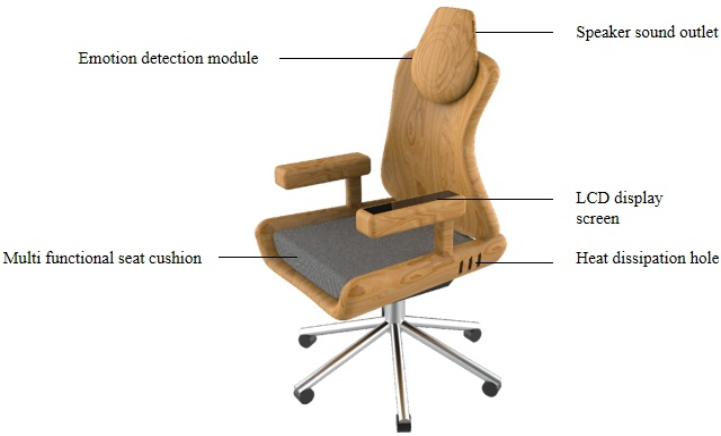
Presentation of Design Proposals This smart seat, designed based on Embodied Emotion Theory, integrates principles of comfort, emotional perception, adaptability, safety, and usabil- ity, aiming to provide comprehensive bodily support and interact with the user’s emotional state. Its ergonomic back design and adjustable headrest, armrests, and seat height ensure that users of all heights and body types can find their most comfortable sitting position. Smart sensing technology enables the seat to detect the user’s emotions and respond by adjusting the seat’s temperature or vibration, enhancing the user’s comfort and emotional satisfaction. The stability of the seat and its intuitive adjustment features ensure safety and ease of use, whether in motion or when changing settings. This seat is not just a piece of furniture but a smart companion, designed to optimize the user’s work and rest experience.
Figure 3: Smart seat design scheme (drawn by the author).
CONCLUSION
This study provides a detailed introduction to the basic concepts and devel- opment history of Embodied Emotion Theory and its application in smart seat design. By combining sensor technology, data analysis, and feedback mechanisms, the designed smart seat can recognize the user’s emotional state and adjust the seat’s posture to optimize the user’s emotion and comfort. This innovative design not only demonstrates the combination of technol- ogy and human care but also offers new ideas for the development of future smart home products. In the future, smart seat design based on Embodied Emotion Theory will further deepen the interaction with users’ emotions and physical states. By adopting more advanced physiological signal monitoring technologies, such as skin conductance response and brain waves, smart seats
will be able to achieve more refined emotion recognition and provide person- alized comfort adjustments. Additionally, design will focus more on meeting diverse user needs and adapting to different usage scenarios, such as integra- tion with other smart home devices, creating a smarter, more comfortable, and healthier living and working environment. As technology progresses and user needs evolve, the design of smart seats faces new challenges but also holds great opportunities, heralding innovation and development in the field of human-computer interaction.
ACKNOWLEDGMENT
This study was supported by the Research and Practice on Innovation and Entrepreneurship Talent Cultivation Mode of Product Design Specialization Based on “Industry-Teaching Integration and School-Enterprise Coopera- tion” of the Teaching Quality and Teaching Reform Project Construction Project of Undergraduate Colleges and Universities in Guangdong Province in 2021 (Project No. KA220160158).
REFERENCES
Barrett, Gendron Lisa Feldman. “Emotion Perception as Conceptual Synchrony.”
Emotion review: Journal of the International Society for Research on Emotions 10.2(2018). Ding Jun; Zhang Jing; Chen Wei. The Embodied View of Emotions: A Perspective Based on Second-Generation Cognitive Science [J]. Journal of Shandong Normal University (Humanities and Social Sciences), 2009, 54(03): 94–97. Huang Rong. The Impact of Embodied Emotion on Creative Thinking in Individuals
Prone to Depression [D]. Hubei University, 2022. Saarimki, Heini, et al. “Distributed affective space represents multiple emotion categories across the human brain.” Social Cognitive & Affective Neuroence (2018). Yu Yun. Yicai. 2022. New First-Tier Cities List Announced: Shenyang Falls Out,
Hefei Returns to New First-Tier! (With the Latest Complete List of 1–5 Tier Cities) [EB/OL]. (2022-06-01) [2023-11-25]. https://www.yicai.com/news/101430366.ht ml?code=101425010
LISTED IN THE AHFE DIGITAL BOOKSTORE CATALOGUE
Explore the complete digital volume
Affective and Pleasurable Design
Read this individual research paper free through the original publisher, or explore the full digital proceedings book.
ISBN 978-1-958651-99-5
Explore this ISBN in the AHFE Bookstore ↗Listed in the July 2026 bookstore catalogue; search by ISBN to confirm current availability · Digital book purchase optional