Masamitsu Nagayoshi, Keisuke Kisu, Keiichi Watanuki, Isao Inoue (2024). Evaluation of the Effect of the Candle Holder Pattern on Concentration and Mental Stress. In: Affective and Pleasurable Design. AHFE Open Access, vol. 123, pp. 1–7. https://doi.org/10.54941/ahfe1004670
In this study, we investigated the possibility of combining the concepts of candles and fractals to further enhance their relaxation and concentration effects. In the experiment, 30 participants performed the numeric addition task, followed by a rest task and then an addition task again. The three conditions of the resting task included a patterned and pattern-less candle holders and quiet resting condition without light (Control). Biometric measurements taken during the experiment, questionnaires administered before and after the experiment, and performance on the numerical addition task were used as evaluation indices. The results suggested that candle gazing significantly improved the concentration of the participants. In addition, the combination of candles and fractals caused more relaxation than the combination of candles alone.
Candles have long been used for lighting applications. However, with the development of lighting technology, their primary uses have changed. At present, candles are often used as a meditation tool, as the faint flickering light of candles emanates a sense of comfort and calm. In recent years, can- dles have been used to calm the mind and enhance concentration. Orderliness is a factor that defines the beauty of art, and it consists of two principal com- ponents: complexity and regularity (Cho, 2013). The fractal dimension (D), a subcomponent of orderliness, is a measure of complexity. A fractal is a geometric figure with self-similarities, that is, with the same overall shape at different scales. Fractal dimension is a value that quantitatively indicates the space a fractal consumes within a figure; it is expressed as a non-integer value of 1 ≤D ≤2. To investigate its relationship with aesthetic evaluation and human sensory evaluation of pleasantness, many researchers calculated
the fractal dimensions in landscapes and paintings. Robles et al. showed that complexity, engagement, and preference ratings increase with the frac- tal dimension (Robles et al., 2021). In this study, the possibility of further enhancing the relaxation and concentration effects of candles was investi- gated by combining the concepts of candles and fractals. A new method for promoting mental comfort and performance improvement is proposed in this paper.
EXPERIMENTS ON CONCENTRATION AND RELAXATION DURING CANDLE USE This study was aimed at evaluating the relaxation effect of a rest task and the concentration level in a subsequent stress task (numeric addition task), followed by a rest task and then a stress task.
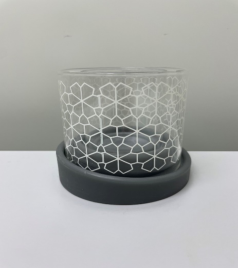
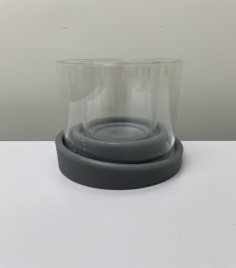
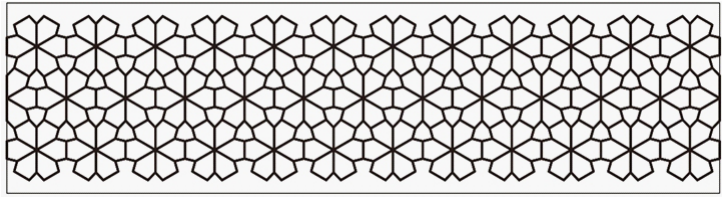
The experiment was conducted using patterned and pattern-less candle holders as shown in Figures 1 and 2, respectively. The overall design of the candle holder is shown in Figure 3.
The fractal dimension in the pattern of this candleholder was designed to be sufficiently high to improve its attractiveness and preference without compromising design quality (Robles et al., 2021). The fractal dimension of the pattern was analyzed by the box-counting method and was set to 1.7 in this study. Thirty healthy male and female subjects (27 males, 33.0±12.4 years old; 3 females, 36.7±6.60 years old) participated in the experiment. In the experimental environment, humidity and temperature were maintained at 50% and 26
C, respectively, which are considered to be comfortable for an office environment. The room lighting was turned on during the stress task and turned off during the candle gaze.
Informed consent was obtained from all the participants before the exper- iment. The participants cooperated in the experiment after receiving a suffi- cient explanation in advance. The experiment was conducted after obtaining approval from the Ethics Committee of Saitama University.
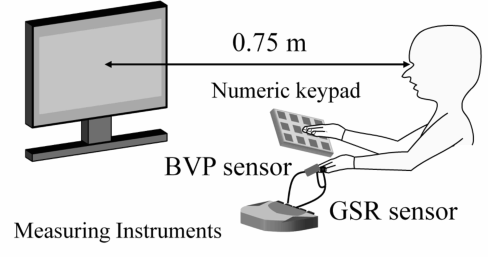
Figure 4 shows the experimental setup. Biometric measurements were performed using a Nexus-10 MARK II (manufactured by MIND MEIA) to measure the fingertip volumetric pulse (BVP) and skin conductance response (SCR). The participants was seated at a distance of 0.75 m in front of the monitor. The BVP sensor was attached to the mid- dle finger of the non-dominant hand, and the SCR sensors were attached to the index and ring fingers of the non-dominant hand of the participants.
The flow of each trial is shown in Figure 5. The participants sequentially performed a 5-min pre-rest, a 10-min numeric addition task, a questionnaire to test their level of concentration, a 5-min rest task, and a 10-min numeric addition task. Finally, the second concentration questionnaire, counted as one trial, was administered. The resting task consisted of three conditions: gazing at the patterned and pattern-less candle holders and a quiet resting condition without light.
Evaluation of the Effect of the Candle Holder Pattern 3
ANALYSIS METHODS Evaluation Index of Psychogenic Sweating
The SCR, generated by sweat gland activity owing to the excitation of the sympathetic nervous system, was used to evaluate psychogenic sweating. An increase in SCR indicates sympathetic dominance, whereas a decrease indicates parasympathetic significance.
Evaluation Index Based on Finger Volume Pulse Wave The Low frequency/High frequency (LF/HF) value was used to evaluate the fingertip volume pulse wave as an index of mental stress using the autonomic nervous system state; an increase in LF/HF is considered to be sympathetic dominant, and a decrease in LF/HF is parasympathetic significant.
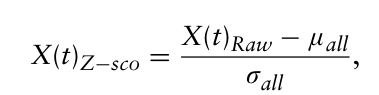
In the SCR evaluation, the Z-score was calculated by standardization using the following equation: , (1)
Equation reproduced from the original PDF.
where X(t)Raw is the original data before standardization, µall is the mean of the entire data, and σall is the standard deviation of the entire dataset.
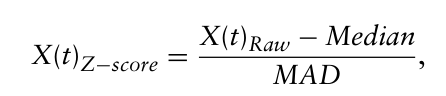
Evaluation Index of the Numeric Addition Task In the numeric addition task, evaluation, the Z-score was calculated by standardization using the following equation:
Equation reproduced from the original PDF.
MAD , (2) where X(t)Raw is the original data before standardization, median is the median of the entire dataset, and MAD is the median absolute deviation of the entire dataset.
EXPERIMENTAL RESULTS
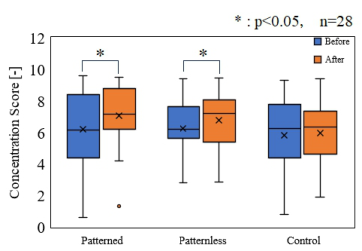
Figure 6 shows the concentration in the pre- and post-numeric addition tasks for each condition of the concentration questionnaire. The Wilcoxon signed- rank test was used to test the concentration of the participants before and after the numeric addition tasks in each condition, and significant differ- ences were found between the conditions in which participants gazed at the patterned candle holders and pattern-less candle holders.
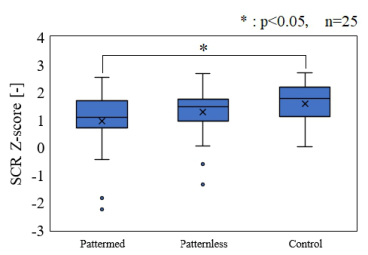
To evaluate the effect of the different rest task conditions on the SCR, the difference between the average SCR during the rest task and the average SCR
Evaluation of the Effect of the Candle Holder Pattern 5
of the previous rest was taken and the results compared between the three conditions are shown in Figure 7. A t-test using the Bonferroni correction revealed significant differences at the 5 % level of significance between the conditions in which participants gazed at conditions of the patterned candle holder and quiet rest without lights.
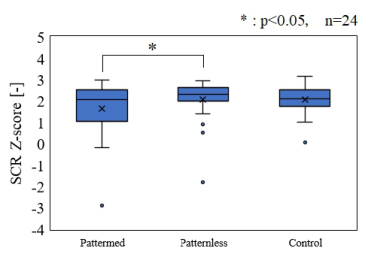
To evaluate the impact of differences in rest task conditions on the SCR before and after the experiment, the results comparing the difference between the mean SCR during post-rest and pre-rest across the three conditions are shown in Figure 8. A t-test using Bonferroni correction revealed signifi- cant differences at the 5% significance level between the condition where participants gazed at the patterned candle holder and patternless holder.
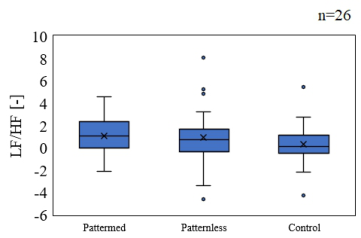
To evaluate the effect of the different rest task conditions on the LF/HF before and after the experiment, the difference between the post-rest and pre-rest LF/HF was compared among the three conditions. The results are shown in Figure 9. A t-test using the Bonferroni correction at a significance level of 5 % showed no significant differences.
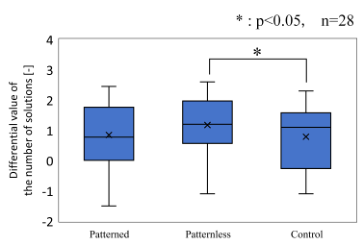
The results of comparing the difference in the number of responses to the pre- and post-numerical addition tasks between the three conditions for evaluating improvement in concentration are shown in Figure 10. A Wilcoxon signed-rank test using Bonferroni correction revealed significant differences between the condition in which participants gazed at conditions of the pattern-less candle holder and quiet rest without lights.
Figure 6: Comparison of concentration of pre- and post-numeric addition tasks.Figure 7: Comparison of the difference in average SCR Z-score between the break task and pre-rest between different conditions.Figure 8: Comparison of the difference in average SCR Z-score between the pre-rest and post-rest between different conditions.Figure 9: Comparison of the difference in LF/HF between the pre-rest and post-rest between different conditions.Figure 10: Comparison of the difference in the number of answers between pre and post-numeric addition task between different conditions.
DISCUSSION
In SCR, the patterned candle holder significantly increased in comparison to conditions of the pattern-less candle holder and quiet rest without lights. This suggested that the parasympathetic nervous system of the participants became dominant and they relaxed. This suggests that combining the con- cepts of candles and fractals is effective in relaxation. The results of the concentration questionnaire and the numeric addition task suggested that looking at the candles significantly improved concentration. This is consid- ered to be because they were practicing concentration meditation by gazing
Evaluation of the Effect of the Candle Holder Pattern 7
at a candle. Concentration meditation is a meditation method in which attention is focused on a single monotonous, low-stimulus object. Previous research has reported that meditation relieves the central nervous system’s stress response and suppresses sympathetic activity (Okuno, 2013), which is consistent with the results of the SCR in this experiment. In addition, since the effect of increased concentration after short periods of meditation has been reported in previous studies (Ishikawa et al., 2020), it is likely that subjective concentration was increased in the present study because the participants meditated with their attention focused on the candles. The reason why there was no significant difference in the number of responses between conditions of patterned candle holder and quiet rest without lights. in the numeric addition task is thought to be that the pattern appeared as a shadow, which increased the visual stimulation and prevented the subjects from concentrating on meditation.
CONCLUSION
In this study, we investigated the possibility of further enhancing the relax- ation and concentration effects of candles by combining the concepts of candles and fractals. In the experiment, participants performed the numeric addition task under three conditions: gazing at patterned and pattern-less candle holders as resting tasks and quiet resting condition without light. After the resting tasks, they performed the numeric addition task. The results of the concentration questionnaire and the numeric addition task suggested that gazing at candles significantly improved concentration. In addition, the com- bination of candles and fractals caused more relaxation than candles alone. In future, we will examine whether the same effect can be obtained using various patterns.
ACKNOWLEDGMENT
In conducting this research, we received invaluable assistance from Mr. Sakata in conducting the experiments. We express our deepest gratitude for his support.
REFERENCES
Cho, K., Haraguchi, M. (2013). Order and evaluation of paintings :approach from Kansei psychology (2), The 11th Conference of the Japanese Society for Cognitive Psychology. Ishikawa, H., Uchikawa, A., Kazama, N., Suzuki, M., Miyata, H. (2020). Impact
of 5-Minute Meditation Sessions at the Beginning of a University Class on the Psychological States of Undergraduates, Volume 5, No. 1, pp. 15–26. Okuno, M. (2013). A Review of Effects of Meditation on Stress-related Diseases, Journal of Mind-Body Science, Volume 22, No. 1, pp. 19–31. Okutani, I., Takase, T., A study of landscape value by using various fractal dimen-
sions of a color, Journal of Civil Engineering Information Processing System, Volum 10, pp. 221–228. Robles, K. E., Roberts, M., Viengkham, C., Smith, J. H., Rowland, C., Moslehi, S., Stadlober, S., Lesjak, A., Lesjak, M., Taylor, R. P., Spehar, B., Sereno, M. E. (2021). Aesthetics and Psychological Effects of Fractal Based Design, Frontiers in Psychol- ogy, Volume 12.
LISTED IN THE AHFE DIGITAL BOOKSTORE CATALOGUE
Explore the complete digital volume
Affective and Pleasurable Design
Read this individual research paper free through the original publisher, or explore the full digital proceedings book.
ISBN 978-1-958651-99-5
Explore this ISBN in the AHFE Bookstore ↗Listed in the July 2026 bookstore catalogue; search by ISBN to confirm current availability · Digital book purchase optional