Kanta Onimaru, Keiichi Watanuki, Kazunori Kaede, Yusuke Osawa (2024). Effects of Dual Tasking with Visual Display Terminal Work and Advertisement Presentation on Workers' Interest and Emotions. In: Affective and Pleasurable Design. AHFE Open Access, vol. 123, pp. 46–54. https://doi.org/10.54941/ahfe1004675
In recent years, the use of visual-display terminals (VDTs) such as PCs and cell phones, for work, is proliferating. To perform efficiently, workers must be able to concentrate on and become immersed in their work. Most VDT work is performed while connected to the Internet and unintended distractions such as Internet advertisements (that appear on the display during work) can interfere with concentration. Distracting advertisements are generally considered disturbing and socially problematic. Previous studies have reported that visually disturbing stimuli presented in the peripheral-visual field reduce the ability to concentrate on tasks that are performed using central vision and have suggested that Internet advertisements may adversely affect work efficiency and accuracy. In-feed advertisements that blend into the timeline of articles and SNS, and recommendation-widget advertisements at the bottom of certain articles have been attracting attention recently, and their market is rapidly expanding. These native advertisements deliver value in line with the interests of workers in a natural flow. They promote consumption and fulfil their fundamental role as advertisements. In this context, we plan to investigate appropriate advertisement-presentation conditions, for inclusion in the worker's field of vision, in which the advertisements are recognizable, and worker concentration is unaffected. We aim to consider advertisements that benefit both advertisers and workers. Our objective is to investigate the nature of the interest and emotions generated by the advertisements in the workers. A cognitive memory task will be created, and during its execution the system will place simulated advertisements on the monitor for effect analysis. Task results, subjective evaluation, and eye-gaze information will be used to investigate advertising-element effects (such as color and movement) on worker interest and emotion and the corresponding impact on work concentration. Therefore, this study will provide an in-depth understanding of advertisement impact on worker interests and emotions while examining advertisement presentation conditions that are beneficial to both advertisers and workers. The study will explore the benefits that Internet-advertising optimization can bring to individuals and will contribute to the development of more effective and acceptable advertising strategies.
In recent years, the proliferation of visual display terminal (VDT) devices such as computers and mobile phones has led to an increase in VDT-related tasks. To efficiently conduct VDT tasks, immersing oneself and concentrat- ing on the work are crucial factors. However, because many VDT tasks are performed online, concentration can be inadvertently hindered by various factors. A prime example is internet advertisements displayed during tasks. Although the advertising market is rapidly expanding, and advertisements exist as a beneficial medium for providing information and encouraging con- sumer behavior, they are often considered disruptive and have been socially problematized for unintentionally impeding concentration. Therefore, it is necessary to explore advertisements that can be recognized by workers as
Effects of Dual Tasking With Visual Display Terminal Work 47
beneficial in maintaining or enhancing their concentration on the task, ben- efiting both advertisers and workers. For workers, task and advertisement recognition are considered dual tasks, and exceeding the brain’s processing capacity with dual tasks can lead to a decline in performance. Furthermore, previous research (Kamata et al., 2021) reported that visual distractions pre- sented in the peripheral vision can decrease concentration on tasks performed using the central vision, suggesting that interest in visual stimuli can affect concentration levels. When considering advertisements as visual stimuli, pos- itive emotions towards advertisements may motivate information processing or enhance task performance if the content is engaging, whereas a lack of interest in advertisements can diminish concentration. Therefore, the emo- tions and interests evoked by advertisements are believed to be closely related to worker concentration, potentially maintaining or enhancing it. This study focuses on the impact of advertisements displayed during VDT tasks on work- ers’ emotions and interests and investigates how these factors affect workers’ concentration and task efficiency. This study makes a significant contribution to the literature because a better understanding of the effect of advertisement during dual tasking is likely to lead to more effective advertising design.
EXPERIMENT ON THE EFFECTS OF ADVERTISEMENTS DURING (VDT) TASKS Cognitive Memory Task
This task was developed using a serial memory task used in earlier studies (Kamata et al., 2021), (Ohno and Nakamura, 2018) to evaluate the ability to concentrate when a visual disturbance stimulus was shown in the periph- eral view. As shown in Figure 1, one of the nine square buttons placed on the monitor was randomly turned on for one second and then turned off. This was repeated seven times. The participants were instructed to memorize the position and order of the lit buttons. This phase is known as the “mem- ory phase.” After the buttons were turned on seven times, participants were asked to answer the questions by pressing them according to the memorized sequence. This phase was called the “answer phase.” A trial was considered successful when all seven answers matched.
Figure 1: Memory phase (A3).
Experimental Method This study was approved by the Ethics Committee on Research Involving Human Subjects of Saitama University (R4-E-21). Informed consent was obtained from all the participants.
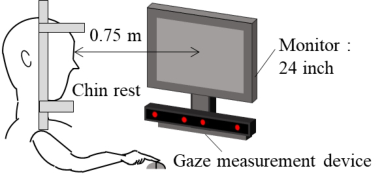
The experiment was conducted on nine healthy male subjects (22.7 ± 0.5 y old). The experimental setup is shown in Figure 2. An eye-tracking device (Tobii Pro Spectrum) was used to measure the gaze information during the experiment. The participants were seated in a chair at a 0.75 m from the center of the monitor, with their gaze horizontal, and their heads fixed using a chin rest. During this process, simulated advertisements were displayed on
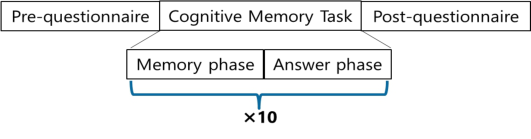
Figure 2: Experimental environment.Figure 3: Mock advertisements.Figure 4: Experiment flow of one condition.
Effects of Dual Tasking With Visual Display Terminal Work 49
the monitor as external stimuli, as shown in Figure 1. Six simulated advertise- ments were created based on actual Internet advertisements: three with text precedence (A1, A2, and A3), and three with image precedence (A4, A5, and A6), as shown in Figure 3. The advertisements were randomized to appear at the top, left, or right of the task to prevent habituation. For example, the appearance of the monitor during the memory phase when the A3 simulated advertisement was presented is shown in Figure 1. The experiment was con- ducted under seven conditions, one without simulated advertisements. The procedure for each trial is shown in Figure 4. Participants were first asked to complete a pre-experiment questionnaire regarding their level of concen- tration. They then performed a cognitive memory task under one of seven random conditions. This sequence from the memory phase to the answer phase was repeated ten times consecutively. After the task, participants were asked to complete a post-experiment questionnaire regarding their concen- tration level and impressions of the simulated advertisements during the task. This procedure was repeated for all seven conditions with sufficient time allowed between each condition to conduct the experiment.
VALUATION INDEX The correct task response rate, response time, and pre- and post- questionnaire scores were used as evaluation indices. In addition, the pupil diameter during the task was measured. The measured pupil diameter data required correction for missing pupil data owing to blinking and altered pupil data before and after blinking. Hershman et al., (2018) proposed that the eyelid signal and fluctuations before and after missing the pupil diameter data can be used to distinguish between the blink range and eyelid sig- nal. Therefore, the blink range was established using this blink detection method., then pupil diameter data in the blink range were extracted and linearly interpolated.
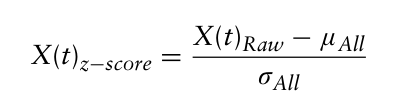
The Z-score was calculated by standardizing the correct task response rate, response time, and evaluation based on the questionnaire results, using the following equation:
(1)
Equation reproduced from the original PDF.
where µAll is the mean of each collaborator, σAll is the standard deviation of each collaborator, and X (t)Raw is the raw data of each collaborator.
RESULTS
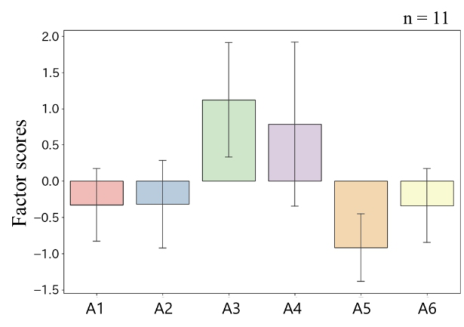
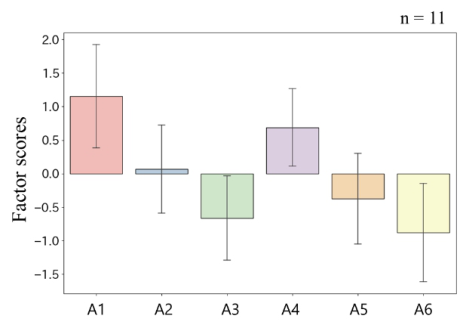
Factor analysis was conducted based on the subjects’ impressions of the simulated advertisements during the task. Table 1 lists the eigenvalues and contribution rates of each factor. Since the sum of the contribution rates was between 0.7 and 0.9, indicating that the original information could be explained, and eigenvalues greater than 1 were considered effective factors, the number of factors was set to five. Table 2 lists the adjectives with high factor scores for the first factor, and Figure 5 shows a graph of the factor
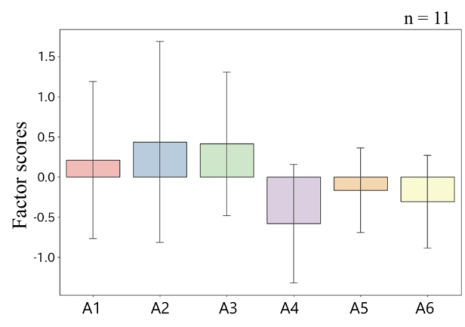
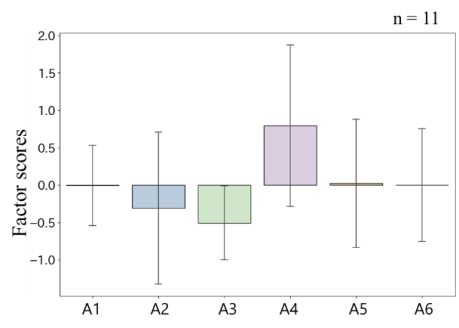
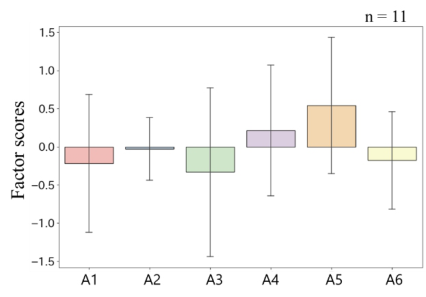
scores for each simulated advertisement. The first factor was characterized by high scores for “cluttered,” “ugly,” “oppressive,” and “resented,” hence it was identified as the nuisance factor. Table 3 lists the adjectives with high fac- tor scores for the second factor, and Figure 6 is a graph of the factor scores for each simulated advertisement. The second factor, with high scores for “plain,” “dark,” etc., was identified as the negativity factor. Table 4 lists the adjectives with high factor scores for the third factor, and Figure 7 shows a graph of the factor scores for each simulated advertisement. The third fac- tor was characterized by high scores for “felt intrusive,” “commonplace,” “easy to understand,” and “presence was noticeable,” indicating that it was perceived as typical advertising and found to be intrusive, hence labeled as the advertising universality factor. Table 5 lists the adjectives with high fac- tor scores for the fourth factor, and Figure 8 shows a graph of the factor scores for each simulated advertisement. The fourth factor, with high scores for “presence was noticeable,” “interested,” “unique,” was identified as the curiosity factor. Table 6 lists the adjectives with high factor scores for the fifth factor, and Figure 9 shows a graph of the factor scores for each simu- lated advertisement. The fifth factor, characterized by high scores for “light,” “bright,” “open,” was identified as the openness factor.
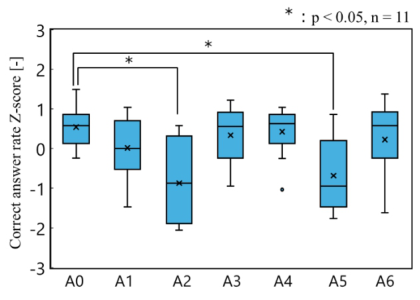
Figure 10 shows the accuracy of the tasks across all conditions in a box- and-whisker plot. Using the condition without simulated advertisements as a control and conducting Dunnett’s test, the average values for conditions A2 and A5 were found to have statistically significant differences at the 5% level. Therefore, concentration was inhibited by simulated advertisements A2 and A5.
Table 1. Eigenvalues and cumulative contribution rates for each factor.
Figure 6: Factor scores for negativity.Table 4. Factor scores for adjectives related to advertising universality.
Table available in the original PDF paper.
Negative-scoring Adjective Positive-scoring Adjective Factor Scores Felt intrusive Necessary −0.487 Unique Commonplace 0.465 Difficult to understand Easy to understand 0.433 Presence was unnoticeable Presence was noticeable 0.424
Figure 7: Factor scores for advertising universality.Table 5. Factor scores for adjectives related to curiosity.
Table available in the original PDF paper.
Negative-scoring Adjective Positive-scoring Adjective Factor Scores Presence was unnoticeable Presence was noticeable 0.49 Interested Indifferent −0.457 Unique Commonplace −0.371 Dark Bright −0.305
Figure 8: Factor scores for curiosity.Table 6. Factor scores for adjectives related to openness.
Table available in the original PDF paper.
Negative-scoring Adjective Positive-scoring Adjective Factor Scores Light Heavy −0.321 Dark Bright 0.312 Open Oppressive −0.266 Empathize Resent 0.264
Effects of Dual Tasking With Visual Display Terminal Work 53
Figure 9: Factor scores for openness.Figure 10: Correct answer rate all conditions.
DISCUSSION
The simulated advertisements impacted the workers’ emotions and inter- ests, which then affect concentration. Regarding the nuisance factor, Figure 5 shows that advertisements A3 and A4 scored high on factor 1. Therefore, it can be inferred that colors with high visibility and eye-catching qualities as well as a mismatch between the background and words evoke negative emo- tions associated with annoyance. For the second factor, Figure 6 indicates that in decreasing order of A1, A2, and A3 for text-predominant adver- tisements and A4, A5, and A6 for image-predominant advertisements, the negativity factor scores were high. Thus, it appears that the dullness of colors were perceived negatively. Regarding the third factor, advertising universal- ity, Figure 7 shows that the factor scores were high for text-predominant A1, A2, and A3 and low for image-predominant A4, A5, and A6. This suggests that the ease of imagining and high visibility of advertisements led to impres- sions of being commonplace and intrusive. For the fourth factor, curiosity, Figure 8 shows that A4 had a high score. Mismatches in words and back- grounds in A4’s advertisements likely influenced curiosity. Regarding the fifth
factor, the openness factor A5 scored high (Figure 9). Thus, it is believed that the background of A5 conveyed a sense of openness.
Next, we discuss the impact of impressions of simulated advertisements on concentration. Considering Figures 3 and 10, we explored the reason for the decrease in concentration associated with A2. A2, with its high legibil- ity of text and lack of attention-grabbing colors, was recognized as a typical advertisement and deemed annoying. This annoyance, a negative emotion, is believed to have led to a scatter in attention and a subsequent decrease in concentration. Similarly, A5 scored high on the openness factor, giving par- ticipants a sense of openness that inadvertently diverted their attention due to the advertisement’s background, leading to decreased concentration. On the other hand, advertisement A3, which was found to be the most annoy- ing, did not decrease concentration, which might be because a desire to avoid annoyance prevented a drop in concentration. These results suggest that neg- ative emotions towards advertisements can directly inhibit concentration, or even if concentration is maintained, the comprehension of advertisements is unlikely. Additionally, positive emotions towards advertisements can also lead to a decrease in concentration if too much attention is drawn to them.
CONCLUSION
In this study, we focused on the impact of advertisements displayed VDT tasks on emotions and interests and investigated how these emotions and inter- ests affect workers’ concentration. It was found that colors and backgrounds with high visibility and eye-catching qualities, as well as a mismatch between words and backgrounds, evoke negative emotions associated with annoy- ance. Moreover, negative emotions towards advertisements can directly inhibit concentration, or even if concentration is maintained, the comprehen- sion of advertisements is unlikely. In the future, by incorporating eye-tracking information such as gaze, we plan to analyze the relationship between emo- tions, concentration levels, and the understanding of advertisements. We will consider the definition of a balance between the understanding of adver- tisements and concentration levels and explore the conditions for presenting effective advertisements that maintain concentration.
REFERENCES
Hershman, R., Henik, A., Cohen, N. (2018). “A novel blink detection method based on pupillometry noise,” Behavior research methods, Volume 50, No. 1. pp. 107–114. doi: 10.3758/s13428-017-1008-1. Kamata, A., Kaneda, D., Nakamura, S. (2021). A basic study of visual distur-
bance stimuli in the peripheral visual field region that interfere with concentration during desk work, Information Processing Society of Japan, Human-Computer Interaction, Volume 2021-HCI-192, No. 2, pp. 1–8. Ohno, N., Nakamura, S. (2018). Investigation of the effect of perceptual sensitization in the peripheral visual field on the central visual field, The Institute of Electronics, Information and Communication Engineers, Human-Communication Basic Study Group, Volume 118 No. HCS2018-4, pp. 17–21.
LISTED IN THE AHFE DIGITAL BOOKSTORE CATALOGUE
Explore the complete digital volume
Affective and Pleasurable Design
Read this individual research paper free through the original publisher, or explore the full digital proceedings book.
ISBN 978-1-958651-99-5
Explore this ISBN in the AHFE Bookstore ↗Listed in the July 2026 bookstore catalogue; search by ISBN to confirm current availability · Digital book purchase optional