Kanta Onimaru, Keiichi Watanuki, Kazunori Kaede, Yusuke Osawa (2023). Effect of Presentation of Advertisements during Visual Display Terminal Work on Concentration. In: Affective and Pleasurable Design. AHFE Open Access, vol. 71, pp. 85–94. https://doi.org/10.54941/ahfe1003247
This study aimed to examine the effects that advertisements viewed during visual display terminal (VDT) work have on workers as well as the appropriate conditions under which advertisements should be presented to both consumers and advertisers. We investigated the manner in which the position and interest in advertisements affected people’s ability to focus. Mock advertisements were displayed on a monitor while participants completed a specially created cognitive memory exercise. We evaluated the effects on concentration based on the results of the exercise, subjective evaluations of concentration, and eye-gaze information. This shows that the self-perception of concentration may have been affected by the advertisement, except when the commercial was placed on the right side of the screen. Additionally, it was hypothesized that differences in the level of interest in advertisements and the condition of the workers affected their concentration.
Visual display terminal (VDT) use has increased recently because of the wide- spread use of personal computers and cell phones. To perform VDT tasks efficiently, it is important to immerse oneself in the work and focus on it. However, because most VDT work is performed online using internet, unintended factors can affect concentration. A typical example is internet advertisements that appear on a display when researching or learning on the web. A previous study reported that visual disturbance stimuli presented in the peripheral visual field reduced the ability to concentrate on tasks using the central vision (Kamada et al., 2021), suggesting that internet advertisements may have a negative effect on the efficiency and accuracy of tasks. These findings suggest that advertisements may be viewed as a “disadvantageous, and disturbing presence” on workers. In contrast, native advertisements have attracted notice recently, and the market for in-feed advertisements that blend into the timeline of articles, SNS, and recommendation widget advertisements
that appear as recommendations at the bottom of specific articles is growing rapidly (Ohno and Nakamura, 2018). Advertisements that deliver items in line with the consumer’s interests are naturally considered useful and promote consumption, fulfilling their original purpose of being advertising. Therefore, whether an advertisement is useful or annoying depends on the worker’s perception. The line separating the two is considered the two sides of the same coin. To make advertisements advantageous to both advertisers and workers, it is necessary to consider appropriate presentation conditions such that advertisements in the worker’s view are not considered a hindrance to their performance.
The goal of this study was to investigate the effects of advertisements displayed during VDT on workers concentration. First, we investigated the effect of the presentation position of advertisements on the workers’ concen- tration. We evaluated the effect of workers’ interest in advertisements on their ability to concentrate on their tasks, and whether their sentiments toward advertisements are positive or negative.
EXPERIMENT ON EFFECT OF PRESENTATION POSITION OF ADVERTISEMENTS ON CONCENTRATION DURING VDT WORK Cognitive Memory Task
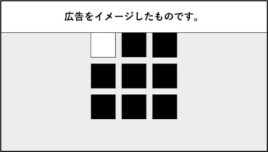
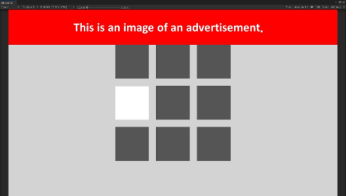
This task was developed using the serial memory task that was used in earlier studies (Kamada et al., 2021), (Ohno and Nakanura, 2018) to evaluate one’s ability to concentrate when a visual disturbance stimulus was shown in the peripheral view. As shown in Figure 1, one of the nine square buttons placed on the monitor was randomly turned on for one second and then turned off. This was repeated seven times. Participants were instructed to memorize the position and order of the lit buttons. This is known as the “memory phase.” After the buttons were turned on seven times, the participants were asked to answer the questions by pressing them according to the memorized sequence. This was called the “answer phase.” An answer was considered correct when all seven answers matched.
Experimental Methods The Ethics Committee on Research Involving Human Subjects at Saitama University (R4-E-21) approved this experiment. Informed consent was obtai- ned from all participants.
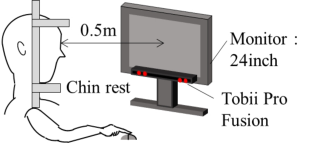
The experiment was conducted on nine healthy male subjects (22.2 ± 1.1 y old). The experimental setup is illustrated in Figure 2. An eye-tracking device (Tobii Pro Fusion) was used to measure the gaze information during the expe- riment. The participants were seated on a chair with their heads fastened with chin rests such that their gazes were 50 cm horizontally distant from the center of the monitor.
To present the cognitive memory task in the central visual field, the task was displayed in an area 16.5 cm in length and width from the center of the monitor. As shown in Figure 1, a mock advertisement is displayed on the monitor as an external stimulus. The image inside the image was labelled,
Effect of Presentation of Advertisements During Visual Display Terminal Work 87
“This is an image of an advertisement.” The position of the mock advertise- ment was determined based on the task. For four different scenarios, the position of the mock advertisement was set at the top, bottom, left, and right parts of the task area. For example, Figure 1 shows the memory phase monitor when a mock advertisement is presented in the top part of the task area.
The flow of each trial was as follows: The participants responded to a 15-item questionnaire on eye strain on a 7-point scale. Next, a simulated advertisement was displayed at a random position in one of the four conditi- ons, and a cognitive memory task was performed. The memory and response tests were repeated 20 times, with a 20-second rest period after every fifth test. Subsequently, the participants responded to another questionnaire that queried their subjective level of concentration on the task on a 7-point scale. The trials were conducted for all four conditions. Four evaluation indices were used: the number of correct responses to the cognitive memory task, the time required completing the task, a questionnaire on eyestrain before and after the task, and a subjective evaluation questionnaire on the degree of concentration after the task was completed.
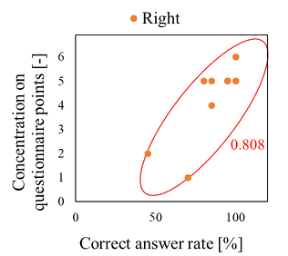
Experimental Results Wilcoxon’s signed-rank test was conducted on the percentage of correct responses to the task between the top and bottom conditions and between the left and right conditions, and no significant differences were found in the mean values. Figure 3 shows the relationship between the percentage of correct responses and the level of concentration for the task in the condition presented on the right side. Table 1 lists the calculated correlation coeffici- ents. The correlation coefficient r = 0.808 indicates a very strong positive correlation for the scenario shown on the right.
Figure 3: Relationship between correct answer rate and concentration.Table 1. Correlation coefficient.
Table available in the original PDF paper.
Position Correlation coefficient Top 0.0994 Bottom 0.164 Right 0.808 Left 0.187
EXPERIMENT ON EFFECT OF INTEREST IN ADVERTISEMENTS ON CONCENTRATION IN VDT WORK Experimental Methods
The Ethics Committee on Research Involving Human Subjects at Saitama University (R4-E-21) approved this experiment. Informed consent was obtai- ned from all participants.
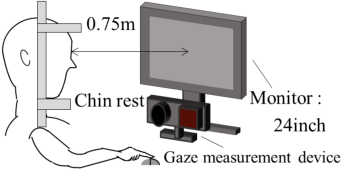
A cognitive memory task was developed in the same manner for this experiment. We changed the duration of the button blinking on and off to 0.5 seconds to adjust for the difficulty of the task. The experiment was conducted on 14 healthy male subjects (22.2 ± 1.0 y old). Figure 4 shows the experimental environment. An eye-tracking device (EyeLink 1000 PLUS) was used to measure the gaze information during the experiment. In this experiment, we investigated the influence of interest in advertisements on the concentration of workers and examined shallow interest (Tanaka, 2018). Shallow interest is considered emotional and temporary. In advertising, it is considered to be caused by eye-catching colors and movements that pique one’s interest. Therefore, we focused on the components of color and move- ment and created four different mock advertisements, using two different color schemes (black letters on a white background and white letters on a red background) and two types of movement (letters flowing from left to right and no movement). In terms of visibility, attractiveness, and readability, the level of interest in Level 1 was the lowest whereas that of Level 4 was the high- est. Table 2 summarizes the four types of simulated advertisements. As the text to be displayed inside the advertisement, “This is an image of an adverti- sement. (in English and in Japanese)” were prepared and displayed randomly
Effect of Presentation of Advertisements During Visual Display Terminal Work 89
Figure 4: Experiment environment.Table 2. Classification of mock advertisements.
Table available in the original PDF paper.
Condition Background Color Letters Color Movement Level 0 None None No movement Level 1 White Black No movement Level 2 White Black Letters flowing from left to right Level 3 Red White No movement Level 4 Red White Letter flowing from left to right
to prevent the effect of habituation. The experiment was conducted under five conditions (Levels 0–4). Level 0 being the condition without a simulated advertisement. Figure 5 shows the monitor screen during the memory phase of the Level 3 condition.
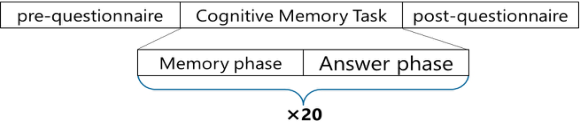
The flow of each trial, as shown in Figure 6, is described below. Before the task, the participants were asked to respond to a questionnaire on concentra- tion, eye strain, and their dominant hand and eye. Next, a cognitive memory task was performed in a random condition among the five Levels 0–4 con- ditions. The cognitive memory task was repeated 20 times from the memory to the response phases. After the task, the participants were asked to respond to a post-task questionnaire on concentration, eye strain, and mock adverti- sements. The aforementioned trials were conducted for all five conditions. A sufficient amount of time was provided for each test condition.
Valuation Index The correct task response rate, response time and pre- and post- questionnaires were used as evaluation indices. In addition, the pupil diameter during the task was measured.
The measured pupil diameter data required to be corrected for the presence of missing pupil data owing to blinking and the presence of altered pupil data before and after blinking. It has been proposed that the eyelid signal and the fluctuations before and after the missing pupil diameter data can be used to distinguish between the blink range and the eyelid signal (Hershman et al., 2018). Therefore, the blink range was established using the blink detection method described in an earlier study. The pupil diameter data in the blink range were extracted and linearly interpolated.
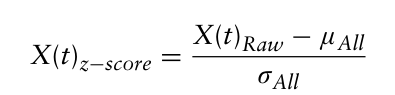
The Z-score was calculated by standardizing the correct task response rate, response time, and evaluation based on the questionnaire results using the following equation:
(1)
Equation reproduced from the original PDF.
where µAll is the mean of each collaborator, σAll is the standard deviation of each collaborator, and X (t)Raw is the raw data of each collaborator.
Experimental Results
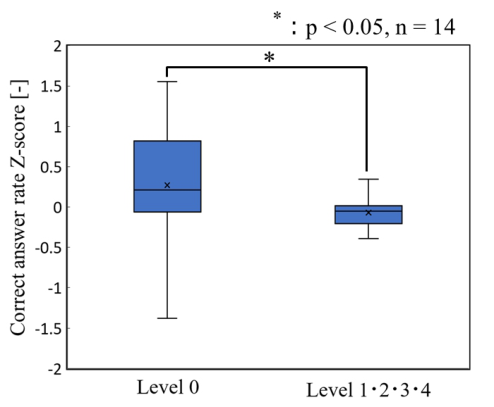
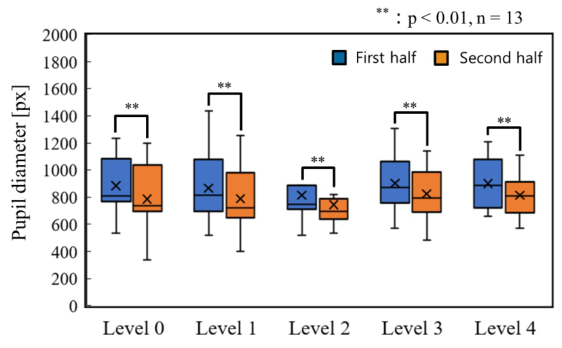
Figure 7 shows the box-and-whisker plots of the correct response rates to the task in the Level 0 condition without advertisements and in the Levels 1–4 condition with advertisements. The Mann-Whitney U-test was used to test for significant differences at the 5% significance level. The correct response rate was lower for the advertisements. Gaze information was analy- zed for 13 subjects, with the exception of one who was unable to calibrate the gaze measurement correctly. The first 10 trials of the 20 trials of the cogni- tive memory task conducted under one condition represented the first half, and the final 10 trials represented the second half. Figure 8 shows, for each test condition, the box-and-whisker plots of pupil diameters in the first and second halves of the task performance. Correspondence t-tests revealed signi- ficant differences in means at the 1% level of significance for all Level 0∼4 conditions.
In the questionnaire, there were many comments such as, “Red is quite assertive and always bothers me,” and “I didn’t mind it much just because there was no movement,” suggesting that the red color and movement of the mock advertisements had an influence on the participants in the experiment. Therefore, we conducted an analysis in the white, motionless Level 1 con- dition and the red or motionless Level 2∼4 conditions. Figure 9 shows the box-and-whisker plot of the percentage of correct responses in the first half
Effect of Presentation of Advertisements During Visual Display Terminal Work 91
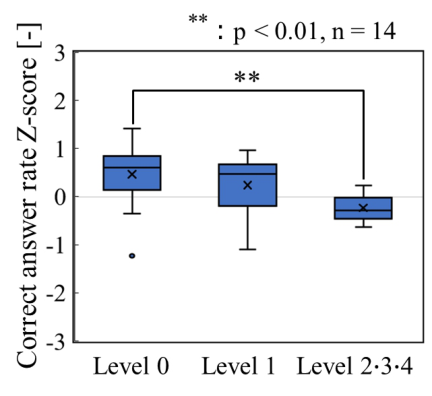
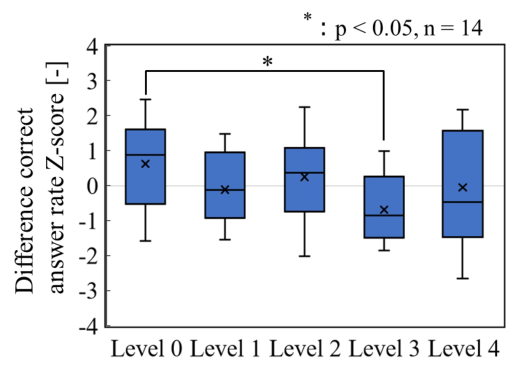
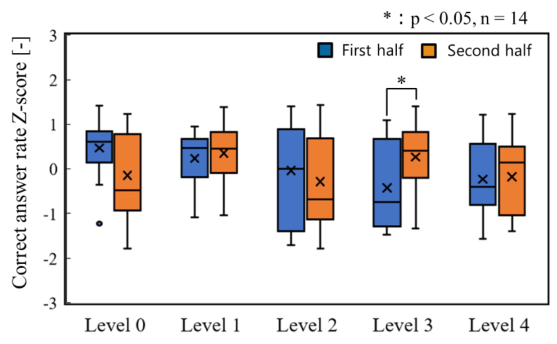
of the task among the combined Level 0, Level 1, and Levels 2–4 conditi- ons. The results of the Steel-Dwass test, a multiple comparison test, showed that there was a significant difference in the mean between the Level 0 and Levels 2∼4 conditions at the 1% level of significance. Figure 10 shows the difference in the percentage of correct responses between the first half and the second half of the task for each test condition, using the Dunnett test, a multiple comparison test, between the Level 0 condition and the Level 3 condition. Figure 11 shows a box-and-whisker diagram of the percentages of correct responses in the first and second halves of the task for each test condition. The results of the Wilcoxon signed-rank test for each condition showed that there was a significant difference in the mean values at the 5 % level only in the Level 3 condition.
Figure 9: Correct answer rate in the first half.Figure 10: Difference correct answer rate between first and second half.Figure 11: Correct answer rate in the first half and second half.
Effect of Presentation of Advertisements During Visual Display Terminal Work 93
DISCUSSION
An experiment on the effect of the presentation position of advertisements was discussed. Typically, the subjective concentration ability required to answer a questionnaire coincides with the concentration ability demonstra- ted during task performance. In cognitive memory tasks, the higher the performer’s concentration, the higher the percentage of correct responses (Kamada et al., 2021). Therefore, for Figure 3 and Table 1, we expected a positive correlation between the percentage of correct responses and subje- ctive concentration in all presentation position conditions. However, a strong positive correlation was observed only in the right-hand condition, sugge- sting that self-perception of concentration might have been disturbed by the simulated advertisement in other conditions.
A comparison of the correct response rates for the task in Figure 7 betw- een the conditions with and without advertisements showed that the correct response rate was lower in the condition with advertisements. Therefore, it can be assumed that the presence of advertisements decreased the degree of concentration.
Figure 8 demonstrates that the pupil diameter was smaller in the second half of the task than in the first half, indicating a lower level of arousal. This implies that the participants’ arousal level gradually subsided, as they grew accustomed to the tasks and advertisements during task performance.
A comparison of the correct response rate in the first half of the task in Figure 9 between the Level 0 condition and the combined Levels 2–4 condi- tion showed that the correct response rate was lower when the level of interest in the advertisement was high. Therefore, it can be considered that the degree of concentration on the task tends to decrease when the level of interest in the advertisement is high. The higher the attractiveness and visibility of the advertisement, the more the participants’ gaze moves and their attention is drawn to the advertisement, causing a decrease in concentration.
Figure 10 shows that there was a significant difference in the proportion of correct responses between the Level 3 and Level 0 conditions and that the percentage of correct responses increased in the Level 3 condition. In addition, when there were no advertisements, as in the Level 0 test condi- tion, the level of concentration gradually decreased because of fatigue while performing the task. Therefore, as the participants became accustomed to advertisements with a red background, their concentration, which had been dispersed by the advertisements returned, and they became more focused on the task. The reason for the lack of difference in the percentage of correct responses between the first and second halves of Level 1 is that the disper- sion of concentration immediately after the advertisement was presented was small, suggesting that the participants concentrated on the task. The reason for the lack of difference in the percentage of correct responses between the first and second halves of Levels 2 and 4 is thought to be that the partici- pants were less accustomed to the advertisements, and their concentration remained scattered.
Based on the above, we believe that a condition with a low level of inte- rest is appropriate for presenting advertisements to avoid reducing workers’
concentration levels. However, if the level of interest is low, the advertisement is unlikely to be eye-catching or recognizable. Therefore, one condition for presenting advertisements that are advantageous to both advertisers and wor- kers is to use colors with high visibility and attractiveness. This is because it is easier to become accustomed to color than motion in advertisements, and is thought to be closer to the presentation conditions of advertisements that maintain concentration while entering the field of vision. In the future, it will be necessary to analyze gazing point and gazing time to investigate eye movements caused by differences in the level of interest in advertisements.
CONCLUSION
In this study, we examined the effects of advertisements displayed during VDT work on workers and investigated the effects of the position of the advertise- ment presentation and interest in the advertisement on concentration. It was proposed that the self-perception of concentration might have been disturbed by the simulated advertisements, except in the correct condition. Additio- nally, we found that different levels of interest in advertisements affected the ability to concentrate. These results suggest that colors with high visibility and attractiveness are more suitable than movement as a presentation condi- tion for advertisements. In the future, we propose to investigate the influence of the level of concentration on deep interest by conducting an analysis invo- lving gaze information, such as gazing, and we will consider the conditions for presenting advertisements that maintain the level of concentration while drawing attention to the advertisement.
REFERENCES
Hershman, R., Henik, A., Cohen, N. (2018). “A novel blink detection method based on pupillometry noise,” Behavior research methods, Volume 50 No. 1. pp. 107–114. doi: 10.3758/s13428-017-1008-1. Kamada, A., Kanada, D., Nakanura, S. (2021). A basic study of visual disturba-
nce stimuli in the peripheral visual field region that interfere with concentration during desk work, Information Processing Society of Japan, Human-Computer Interaction, Volume 2021-HCI-192 No. 2, pp. 1–8. Ohno, N., Nakamura, S. (2018). Investigation of the effect of perceptual sensitization in the peripheral visual field on the central visual field, The Institute of Electronics, Information and Communication Engineers, Human-Communication Basic Study Group, Volume 118 No. HCS2018-4, pp. 17–21. Tanaka, E. (2015). Classification of interest in science, Educational Psychology
Studies, Volume 63 No. 1, pp. 23–36.
LISTED IN THE AHFE DIGITAL BOOKSTORE CATALOGUE
Explore the complete digital volume
Affective and Pleasurable Design
Read this individual research paper free through the original publisher, or explore the full digital proceedings book.
ISBN 978-1-958651-47-6
Explore this ISBN in the AHFE Bookstore ↗Listed in the July 2026 bookstore catalogue; search by ISBN to confirm current availability · Digital book purchase optional