Ryo Suetake, Keiichi Watanuki, Kazunori Kaede, Yusuke Osawa (2023). Effects of Difference in Listening Tempo on Task Performers. In: Affective and Pleasurable Design. AHFE Open Access, vol. 71, pp. 95–101. https://doi.org/10.54941/ahfe1003248
When performing a task with a set time limit, the performer may make numerous errors due to impatience and haste. By contrast, a moderate mental load caused by a time limit improves the time-to-performance ratio. Time pressure (TP) refers to the mental strain imposed by the time limit to the performer. Despite numerous studies on the effects of TP on task performers, no consistent findings regarding the relationship between TP and the method of presenting and communicating time have been obtained. There are various methods to make task performers aware of time; each method of presentation and communication may have a psychological impact on task performers. The objective of this study was to clarify the effects of the method of presenting the time remaining to perform a task on mental load and concentration in a time-limited task and to compare the influences between presentation conditions using biometric measurements and a subjective evaluation questionnaire.The experiment evaluated these effects on task performers in terms of fingertip volume pulse wave and stress sweating.The task was a continuous addition task modeled after the Uchida–Kleppelin test that lasted 5 minutes. Five Japanese male university students (21.8±0.8 years old) were each tested on four different conditions. The conditions were as follows: no time presentation, visual time presentation, alarm every 30 seconds, and both visual and alarm presentation.The LF/HF was used to evaluate finger volume pulse waves, and galvanic skin response (GSR) was used to assess mental arousal. GSR analysis in each presentation condition revealed that GSR in the no time presentation condition was higher than in the other three conditions, with some variation. Previous studies have suggested that the greater the awareness of the remaining time, the more likely participants were to feel anxious. Therefore, GSR was assumed to be higher in the no time presentation condition because the task performers were more actively aware of the time remaining than in the other conditions. The results suggest that the TP may be higher in the no time presentation condition than in the condition with time presentation. In addition to the presentation method used in this experiment, there are other methods of time presentation, such as second-hand or metronome sound. In these methods, the frequency of the time information presentation can be controlled by adjusting the Beats Per Minutes (BPM). In a study in which computation tasks were performed while listening to music and task performance was compared based on the type of music and BPM, it was shown that task performance varied depending on the type of music and BPM. Therefore, we conducted an experiment using a metronome, which is not affected by the type of music, to evaluate the effect of BPM differences on task performers. By changing the frequency of time information presentation, we expect to control psychological effects such as impatience and anxiety by intentionally adjusting the opportunity for task performers to be aware of time.
In the past decades, various studies have been conducted to improve work efficiency. One example is performing work while listening to music, which is thought to improve concentration and facilitate productivity (Abe and Ara- gaki, 2010). As the term “music therapy”suggests, listening to music has been reported to relieve mental stress (Hotta et al. 2007). To verify this effect, stu- dies have beenconducted using various types of music, such as classical and jazz music. However, the magnitude of the effect varies depending on the piece of music being listened to, and different pieces of music are considered representative of each genre. Replicating the results with music other than that used in the study is not always possible, even if the music has similar characteristics. Therefore, there are no consistent findings regarding the type of music that improves work efficiency or relieves mental stress. One reason is that many genres and instruments are used in music, as well as various elements, such as tempo, melody, and harmony. Many of these elements are believed to interact with each other, and there are countless patterns in the effect that each piece of music has on the listener, depending on the combi- nation of the elements. Therefore, it is necessary to isolate a single element to obtain knowledge related to its effects. Consequently, several previous stu- dies have used a method to separate the “tempo” element. Unlike genres or
melodies, tempo can easily be expressed as an independent parameter, and it is possible to reproduce sounds of different tempos by changing the beats per minute (BPM) of a metronome. Previous studies using this method have eva- luated worker performance in various tasks. However, it can be predicted that listening to tempo sounds during work may influence the mental stress expe- rienced by the worker during the task as well as areas that are not subjectively noticed by the worker. To evaluate this effect, the present study conducted an experiment to obtain objective indices based on emotional evaluation and biometric measurements before and after task performance. Furthermore, the analysis results were used to evaluate the subjective and latent effects on the worker when performing a task while listening to sounds of different tempos.
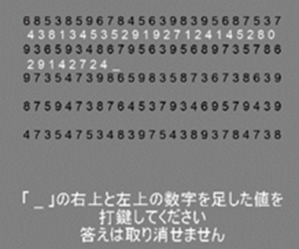
TIME-LIMITED CONTINUOUS ADDITIVE TASK EXPERIMENTS To evaluate the relationship between the tempo of the sound and the emoti- onal change in the task performer, a continuous addition task simulating the Uchida-Kraepelin test (Uchida, 1957) was prepared, and a subjective evalu- ation questionnaire regarding the participant mood state and sound tempo was used during the experiment. The continuous addition task used in this experiment is illustrated in Figure 1. Note that at the bottom of Fig. 1, there is Japanese text that means “Please enter the value obtained by adding the upper right and left numbers of the “_”; the answer is irrevocable.
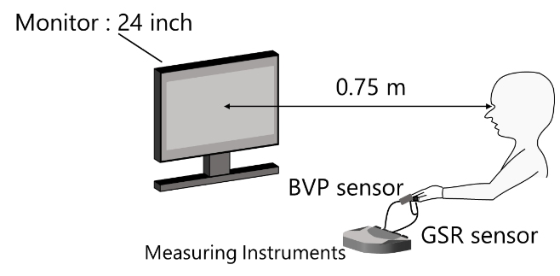
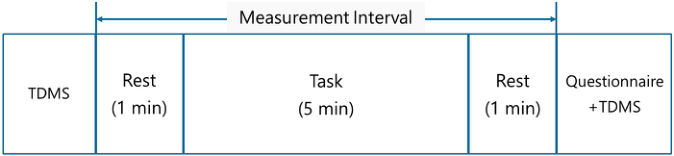
Figures 2 and 3 show the environment and experimental protocol, respe- ctively. A NeXus-10 Mk II (Mind Media, Inc.), a multi-physiological sensor, was used to measure the biometric data with a sampling period of 128 Hz. A wireless noise-canceling headset WH-CH710N, SONY was used to listen to the tempo sounds. The participant wore the headset during the experiment and sat 0.75 m away from the monitor with the sensor attached to his non- dominant hand. The headset was set to the noise-canceling mode during the task, and the task was performed while listening to a metronome at the BPM of each condition.
This experiment was approved by the Ethics Committee on Research Involving Human Subjects at Saitama University (R4-E-25). Oral informed consent was obtained from all participants.
Figure 1: Task image.
Effects of Difference in Listening Tempo on Task Performers 97
In the continuous addition task, participants solved for the sum of two adjacent numbers in a random number sequence displayed on the screen by entering the value of the last digit of the sum on a numeric keypad. In these tasks, a new number sequence was displayed every minute, regardless of the number of answers, in accordance with the original Kraepelin test. Additi- onally, a practice test was conducted prior to the experiment to avoid the effects of numeric keypad input and task habituation.
The Two-Dimensional Mood Scale (TDMS) was administered before and after the experiment to measure the following four psychological states: “acti- vation”, “stability”, “comfort”, and “arousal”. The Visual Analog Scale (VAS) questionnaire was administered only after the experiment, and the par- ticipants were asked to respond to the following questions: tempo preference, concentration, and time pressure (TP). The experiment consisted of three tri- als with 12 male Japanese participants (22.3 ± 1.1 years old), and each trial consisted of a task in which the participants listened to sounds under diffe- rent tempo conditions. In setting the tempo condition, 60 BPM was used as the standard tempo, referring to the average number of responses of approxi- mately 60 /min in the continuous addition task experiment without listening to tempo sounds that had been conducted beforehand. In addition, referring to the condition setting in a previous study (Takahashi and Honda, 2013), a tempo of ±30 BPM was adopted as the reference tempo, and three conditi- ons of 30, 60, and 90 BPM were set. The experiment was counterbalanced to suppress bias caused by differences in the order of trials in the three con- ditions, and participants were asked for their impressions of the experiment after completion.
ANALYSIS METHOD Evaluation Index Based on Finger Volume Pulse Wave
LF/HF values, which are used as an index of mental stress by utilizing the autonomic nervous system, were used to evaluate the finger volume pulse waves. The LF/HF values obtained during the post-task rest and pre-task rest periods were averaged, and the difference was considered the evaluation index.
Evaluation Index by Psychogenic Sweating The skin electrodermal response (GSR), which is generated by the activity of sweat glands due to excitation of the sympathetic nervous system, was used to evaluate psychogenic sweating (Nakagaki et al. 2006). The GSR was obtained for one minute of rest before and after the task and for five minutes during the task. The difference between the mean of the post-task rest and the mean of the pre-task rest divided by the standard deviation of the pre-task rest was used to compare the results across conditions of the tempo of the sound being listened to.
Emotional Evaluation Before and After the Continuous Addition Task For TDMS scores other than “arousal level”, a positive score indicates a pleasant and favorable psychological state, whereas a negative score indi- cates an unpleasant and unfavorable psychological state. The results of the pre-task rest measurements were used as the baseline, and post-task rest mea- surements were evaluated by subtracting the baseline from the post-task rest measurements.
EXPERIMENTAL RESULTS To compare each index between the two groups, a t-test or Wilcoxon signed- rank test was performed, and Bonferroni’s multiple comparison method was used to correct for differences.
Experimental Results Using Biometric Measurements
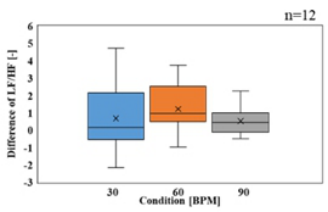
Figure 4 shows the results of the analysis of the differences between the post- and pre-task rest LF/HF values and the GSR for the 12 participants in each tempo condition.
Results of the Emotion Rating Questionnaire
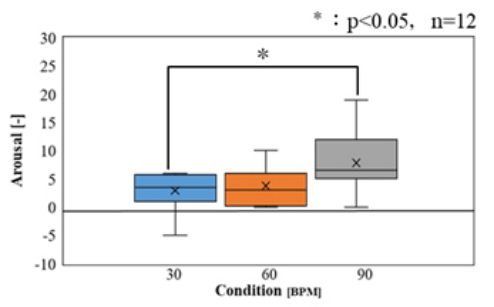
Figure 5 shows the difference between the “arousal level” item of the TDMS before and after the task for each tempo condition. The results were tested for each tempo condition and found to be significantly different between 30 BPM and 90 BPM at the 5% level of significance.
Experimental Results on the VAS Questionnaire
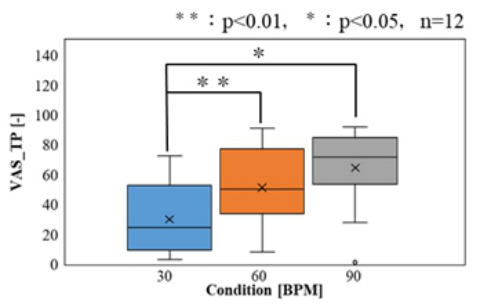
Figure 6 shows the results of the “TP” item of the VAS questionnaire for each tempo condition. The results for each tempo condition showed a significant
Effects of Difference in Listening Tempo on Task Performers 99
Figure 4: Relationship between conditions and bio-information.Figure 5: Relationship between conditions and arousal.Figure 6: Relationship between conditions and TP.
difference at the 1% level between 30 BPM and 60 BPM and at the 5% level between 30 BPM and 90 BPM.
Experimental Results on the Performance of the Sequential Addition Task The results of the tests on the number of responses, the number of correct responses, and the percentage of correct responses for each tempo condition
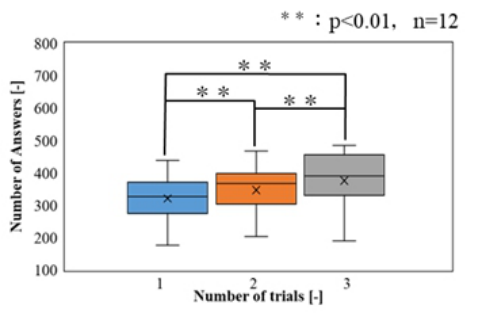
Figure 7: Relationship between the number of trials across all conditions and the number of answers.
showed no significant differences at the 5% level. To observe the effect of growth on the ability to solve the task over time, the results of the task were categorized by the number of experiments. The results are shown in Figure 7. The test results showed that there was a significant difference at the 1 % level in the “number of answers” item for all combinations of each condition.
DISCUSSION
The results of the TDMS and VAS questionnaires together suggest that task performance at a listening tempo of 30 BPM tends to reduce perceived TP and produce a more active mood state. Therefore, it is thought that listening to 30 BPM sounds a state of mind suitable for activity in the participants and suppresses the anxiety and impatience caused by TP, enabling them to engage calmly in the task.
The task results showed that the “number of answers” significantly incre- ased with the number of times the experiment was conducted. This indicates that the effects of task habituation cannot be fully corrected by using prior practice problems. Considering the possibility that this effect may be related to mental stress, concentration, and subjective TP, we analyzed each item by the number of times the experiment was conducted and found no significant difference at the 5% level for all items except “number of answers”. The- refore, the effect of the number of times the experiment was conducted was considered significant only in terms of the percentage of correct responses.
In the comments after all the experiments, several participants responded that they felt impatient when they made a mistake in the task while liste- ning to a tempo of 60 BPM or higher or when the timing of the metronome sound and the input timing were off. This suggests that in tasks in which the participants listened to a tempo close to or faster than the natural tempo of their answering, they may have been psychologically motivated to match their input timing to that tempo. Consequently, it can be inferred that the input timing is delayed owing to errors and that the input timing shifts from the
Effects of Difference in Listening Tempo on Task Performers 101
answer tempo to match the sound tempo, which arouses impatience and anxi- ety. Because the workers’ response tempo is generally faster than 30 BPM, it can be considered that the response tempo is faster than the sound tempo when the sound tempo is 30 BPM, making it less likely to arouse impatience and anxiety when a mistake is made.
CONCLUSION
The purpose of this study was to evaluate the effects of sound tempo on the mental stress and emotional state of workers during work. As a result, when the workers worked while listening to a sound at a tempo of 30 BPM, the TP they felt decreased, and they tended to be in a more active mood state. Individual differences in the number of responses to the continuous addition task were significant in the results of this experiment. This suggests that the working tempo of each participant had a significant effect on the number of responses to the sequential addition task. Therefore, it is assumed that the tempo that considers the individual response characteristics can be found by measuring the work tempo of each participant in advance and calculating and presenting the high and low tempo in proportion to that. This method can be used to determine the tempo that contributes to the improvement of work efficiency and alleviation of mental stress, based on the base work tempo information, and can be adapted for each individual.
REFERENCES
Abe, M, Aragaki, N. (2010). “Effects of Different Tempo of Background Music on Work Efficiency”, proceedings of the Conference of the Cognitive Science Society of Japan, Volume 27, No. 3. pp. 853–859. Hotta, H, Sawamura, K, Inoue, T. (2007). Heart Rate Variation During Music
Listening by Tempo According to the Subject’s Heart Rate, Research in Clinical Educational Psychology, Volume 33, pp. 1–8. Uchida, Y, (1957). “New Aptitude Test Method - Uchida-Kraepelin Mental Test-”, in: Nikkan Kogyo Shimbun. Takahashi, Hiroshi, Honda, Hirohiko. (2013), Basic Research on Induction of
Unconscious Operation Characteristics by Auditory Stimuli (Simple Calculation Task Performance Control by Beat Sound)”, Transactions of the Japan Society of Mechanical Engineers, C ed., Volume 79, No. 799, pp. 467–468. Nakagaki, N, Ishizawa, A, Aoyama, M, Hoshino, M, Shitara, T, Takeda, A. (2006), Stress from Blood Draws in Children and Its Association with Changes in Skin Properties, Bulletin of Gunma Perth University, No. 2, pp. 221–231.
LISTED IN THE AHFE DIGITAL BOOKSTORE CATALOGUE
Explore the complete digital volume
Affective and Pleasurable Design
Read this individual research paper free through the original publisher, or explore the full digital proceedings book.
ISBN 978-1-958651-47-6
Explore this ISBN in the AHFE Bookstore ↗Listed in the July 2026 bookstore catalogue; search by ISBN to confirm current availability · Digital book purchase optional