Masashi Okubo, Tsukasa Takami, Akihiro Tatsumi (2023). Effect of Enlightenment Video for Walk on Motivation and Action. In: Affective and Pleasurable Design. AHFE Open Access, vol. 71, pp. 110–119. https://doi.org/10.54941/ahfe1003250
Due to the impact of the COVID-19 virus resulting in recommendations to work from and stay home, people have fewer opportunities to walk. However, a study on physical activity and exercise conducted by Japan’s Ministry of Health, Labour and Welfare indicates that the risk of lifestyle diseases may be decreased by several percentage points through an increase in physical activity, walking. As such, it is necessary to consider the content and presentation method of material that encourages behavior modification away from a lifestyle with little walking. Regarding behavior modification, Matsumoto’s model for behavior change stages indicates that people go through five stages: precontemplation, contemplation, preparation, action, and maintenance. To encourage change in the contemplation stage, [Matsumoto] suggests the importance of people thinking negatively of themselves due to their lack of physical activity and thinking positively of themselves if engaging in physical activity. Furthermore, Saito reports that in advertisements that aim to create desire to purchase and interest, presenting advertisements in the medium of video contributes to behavioral change.Under this context, this study will evaluate the effects that enlightenment videos about walking, created with a focus on content and wording, have on number of steps and awareness toward walking. In addition, we will focus on people’s temperaments and consider what enlightenment videos are effective for such temperamentsThis study evaluated the effects that enlightenment videos about walking, created with a focus on content and wording, have on number of steps and awareness toward walking. Before the experiment, we expected that participants with stronger approach temperaments would greatly increase their number of steps by viewing the positive video, and those with stronger avoidance temperaments would greatly increase their steps by viewing the negative video. The experiment results show that number of steps increased for the group with strong approach temperaments who viewed the positive video, but the number of steps decreased for those with strong avoidance temperaments who viewed the negative video. In other words, people with stronger approach temperaments may be more likely to increase their number of steps by viewing enlightenment videos compared to those with weaker approach temperaments. Also, this may demonstrate that explanations of the positive effects of walking are more effective in contributing to an increase in number of steps than explanations of the negative effects of not walking.
Due to the impact of the COVID-19 virus resulting in recommendations to work from and stay home, people have fewer opportunities to walk. However, a study on physical activity and exercise conducted by Japan’s Ministry of Health, Labour and Welfare indicates that the risk of lifestyle dis- eases may be decreased by several percentage points through an increase in physical activity, walking in particular (Repor, 2021). As such, it is necessary to consider the content and presentation method of material that encou- rages behaviour modification away from a lifestyle with little walking. In regards to behaviour modification, Matsumoto’s model for behaviour change stages indicates that people go through five stages: precontemplation, con- templation, preparation, action, and maintenance (Matsumoto, 2021). To encourage change in the contemplation stage, Matsumoto suggests the impor- tance of people thinking negatively of themselves due to their lack of physical activity and thinking positively of themselves if engaging in physical activity. Furthermore, Saito reports that in advertisements that aim to create desire to purchase and interest, presenting advertisements in the medium of video contributes to behavioural change (Saito, 2013).
Effect of Enlightenment Video for Walk on Motivation and Action 111
Under this context, this study will evaluate the effects that enlightenment videos about walking, created with a focus on content and wording, have on number of steps and awareness toward walking. In addition, we will focus on people’s temperaments and consider what enlightenment videos are effective for such temperaments.
EVALUATION EXPERIMENT Experiment Objective and Method
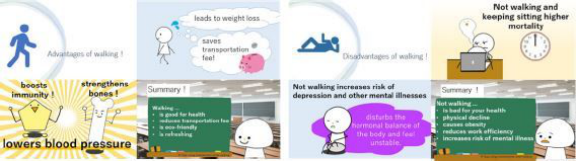
In this experiment, experimental participants watch an enlightenment video about walking, and changes in awareness toward walking are evaluated by comparing their number of steps and answer results from questionnaires con- ducted one week prior and one week after viewing the video. Two types of videos have been created in advance: a “positive video”that explains only the positive effects of walking (such as that it is good for your health and mood), and a “negative video” that explains only the negative effects of not walking (such as that it is bad for your health and mood). Figure 1 shows a portion of the content from the positive video and the negative video. Also note that the positive video is accompanied by upbeat background music while the negative video is accompanied by gloomy background music.
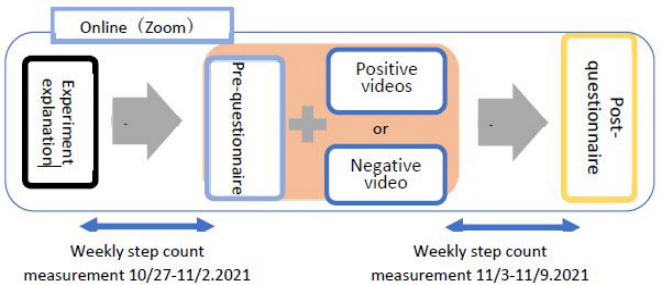
Figure 2 shows the experimental procedure. First, experimental parti- cipants are given a detailed explanation of the experiment and then give permission to have their number of steps measured and to answer questi- onnaires. One week after the experiment instructions are given, participants
Figure 1: Contents of “positive video” (left) and “negative video” (right).Figure 2: Experimental procedure.
report their number of steps for the week and answer a pre-questionnaire. Next, the experimental participants are divided into two groups at random, with one group shown the positive video and the other group shown the negative video. One week after viewing the video, participants report their number of steps for the week and answer a post-questionnaire. The experi- mental participants are 43 students from Doshisha University. Note that due to data deficiencies, analyses were conducted with 29 of the participants’ results. Also note that Zoom was used to show the videos and that Google Forms was used for the questionnaires.
Questionnaires
Table 1 shows questions from the survey regarding awareness toward wal- king, and Table 2 shows the approach-avoidance temperament questionnaire. In the pre-questionnaire, participants answer questions regarding their awa- reness toward walking, their approach-avoidance temperament, and their
Table 1. Questionnaire for walking.
Table available in the original PDF paper.
Q1 I like to walk. Q2 Walking is good for health. Q3 Walking is good exercise. Q4 Walking can decrease transportation expenses. Q5 Walking is good for the environment. Q6 Walking is refreshing. Q7 Walking is tiring. Q8 Walking takes extra time. Q9 I don’t want to walk when the weather is bad. Q10 Walking limits me to only nearby locations. Q11 Walking is an inconvenient form of transportation. Q12 I walk more than most people. Q13 I have fewer opportunities to walk due to the COVID-19 pandemic. Q14 I want more opportunities to walk. Q15 I want to walk with proper form.
Temperament Q2 Approach I feel very energized when I think about my dreams. Q4 I immediately get excited when I get an opportunity to do something that I like. Q5 I get excited and feel motivated at even small things. Q8 I am always on the lookout for positive opportunities and experiences. Q10 I am strongly influenced when something good happens to me. Q11 When I desire something, I feel a strong urge to fulfil that desire.
Q1 Avoidance I am a very sensitive person by nature. Q3 I get anxious at even small things. Q6 I feel anxiety and fear very intensely. Q7 I respond very strongly when something bad happens. Q9 I feel a strong urge to run away when something bad is about to happen. Q12 I am quick to imagine what bad things may happen to me.
Effect of Enlightenment Video for Walk on Motivation and Action 113
number of steps for the week. In the post-questionnaire, the participants again answer questions regarding their awareness toward walking and their number of steps for that week.
The questions from the survey regarding awareness toward walking, as shown in Table 1, have been created based on the questionnaire used by Ichihashi et al. (Ichihashi 2010). All questions are answered on a scale of one through seven.
The approach-avoidance temperament questionnaire, as shown in Table 2, is a questionnaire that measures the degree to which an individual shows intention to approach positive stimuli and the degree to which they show intention to avoid negative stimuli (Elliot, 2002), (Kakinuma, 2018). All questions are answered on a scale of one through seven, with higher total scores on the six questions regarding approach temperament indicating a stronger approach temperament, and with higher total scores on the six questions regarding avoidance temperament indicating a greater avoidance temperament.
In this experiment, t-tests were used to perform all statistical analyses for number of steps, and Wilcoxon signed-rank tests were used to perform all statistical analyses for the questionnaires.
Results for All Experimental Participants, the Positive Video Group and the Negative Video Group
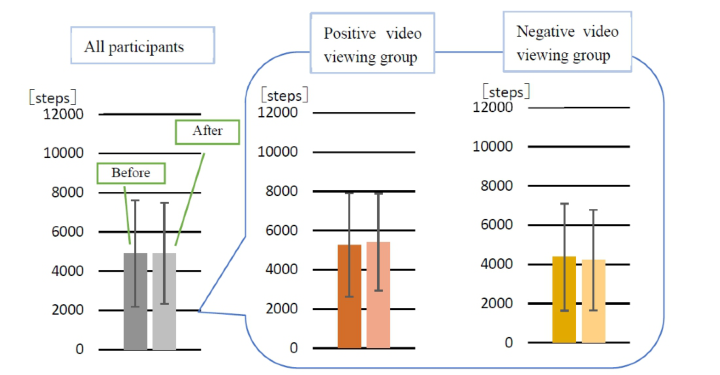
Figure 3 shows the weeks’ average number of steps for (left) all experimental participants, (centre) the group that viewed the positive video and (right) the group that viewed the negative video.
The positive video group showed an increase in average number of steps, but no statistically significant difference was observed. However, the nega- tive video group showed a decrease in average steps after viewing the video compared to before, and a statistically significant difference was observed.
Figure 3: Average and standard deviation of number of steps per week for all partici- pants(left), for positive video viewing group (centre) and for negative video viewing group (right).
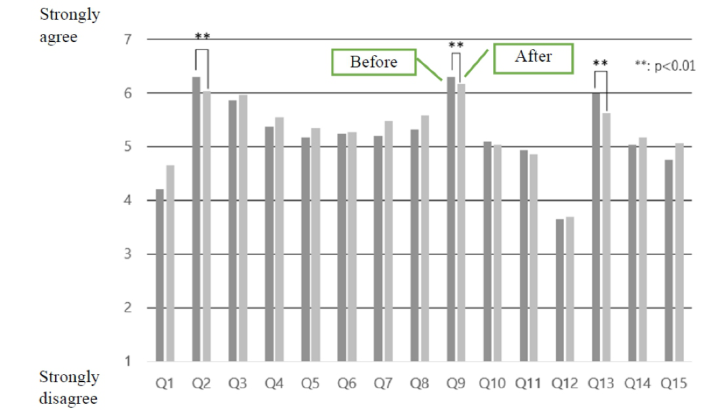
Figure 4 shows the results of the awareness surveys on walking for all experiment participants. Answer results from Question 2 (“Walking is good for health.”), Question 9 (“I don’t want to walk when the weather is bad.”) and Question 13 (“I have fewer opportunities to walk due to the COVID-19 pandemic.”) showed decreased ratings after viewing the video compared to before, and statistically significant differences were observed. Ratings for Questions 2 through 6 were expected to increase while ratings for Questions 7 through 11 and 13 were expected to decrease, meaning that generally favourable results were achieved when looking at the entire experimental participant group, with the exception of Question 2.
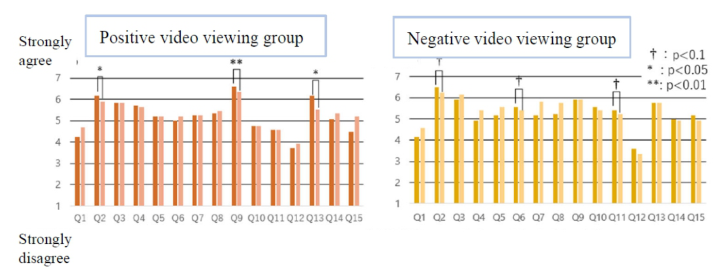
Figure 5 shows the results of the awareness surveys on walking for (a) the group that viewed the positive video and (b) the group that viewed the nega- tive video. In the group that viewed the positive video (a), answer results for Question 2 (“Walking is good for health.”), Question 9 (“I don’t want to
Figure 4: Results of awareness survey on walking of all participants.Figure 5: Results of an awareness survey on walking in the (left) positive video viewing group and (right) negative video viewing group.
Effect of Enlightenment Video for Walk on Motivation and Action 115
walk when the weather is bad.”), and Question 13 (“I have fewer opportu- nities to walk due to the COVID-19 pandemic.”) showed decreased ratings after viewing the video compared to before, and statistically significant diffe- rences were observed. Similarly, in the group that viewed the negative video (b), answer results for Question 2 (“Walking is good for health.”), Question 6 (“Walking is refreshing.”), Question 11 (“Walking is an inconvenient form of transportation.”) showed decreased ratings after viewing the video compared to before, and statistically significant differences were observed. These results indicate that watching the positive video may be slightly more effective.
Results Categorized Based on Approach-Avoidance Temperament Questionnaire Answers Based on the approach-avoidance temperament questionnaire results. Using the average score 29.65 from the two surveys reported in Kakinuma et al.’s research (Kakinuma, 2018), those who scored higher than 29.65 on the approach portion were categorized in the high approach group, while those who scored lower than 29.65 were categorized in the low approach group. Similarly, using 27.72 as the average score, those who scored higher than 27.72 on the avoidance portion were categorized in the high avoidance group, while those who scored lower than 27.72 were categorized in the low avoidance group. Moreover, those with both higher approach scores and higher avoidance scores were categorized into a high approach-high avoida- nce group (5 people); those with higher approach scores and lower avoidance scores were categorized into a high approach-low avoidance group (12 peo- ple); those with lower approach scores and higher avoidance scores were categorized into a low approach-high avoidance group (5 people); and those with lower approach scores and lower avoidance scores were categorized into a low approach-low avoidance group (7 people).
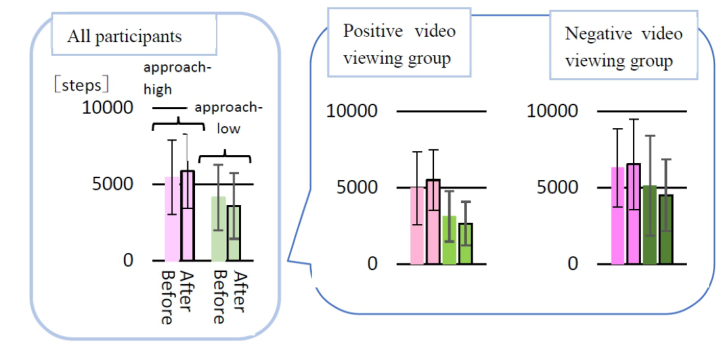
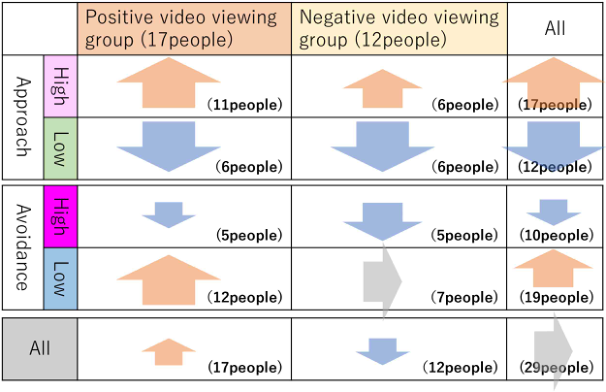
Figure 6 shows the average weekly number of steps categorized by appro- ach scores for (left) all experimental participants, (centre) the group that viewed the positive video, and (right) the group that viewed the negative video. No group showed a statistically significant difference in the number of weekly steps before viewing the video compared to after, but regardless of the type of video watched, the high approach group’s average number of steps increased while the low approach group’s average number of steps decreased.
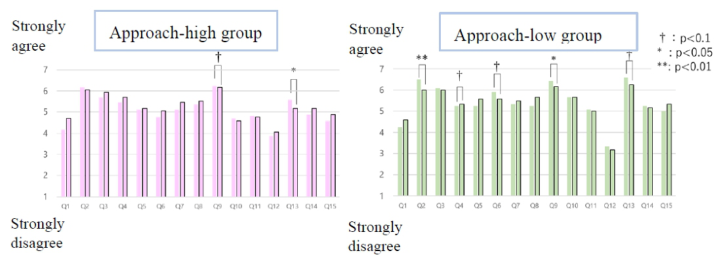
Figure 7 shows the results of the awareness survey on walking categori- zed by approach scores for all experimental participants. Regarding the high approach group (a), answer results for Question 9 (“I don’t want to walk when the weather is bad.”) and Question 13 (“I have fewer opportunities to walk due to the COVID-19 pandemic.”) showed decreased ratings after viewing the video compared to before, and statistically significant differe- nces were observed. Regarding the low approach group (b), answer results for Question 2 (“Walking is good for health.”), Question 6 (“Walking is refreshing.”), and Question 9 (“I don’t want to walk when the weather is bad.”) showed decreased ratings after viewing the video compared to before, and statistically significant differences were observed. Answer results for
Figure 6: Average number of steps per week compared with high and low approach temperament (left) all participants, (centre) positive video viewing group and (right) negative video viewing group.Figure 7: Result of awareness survey on walking categorized by (left) high and (right) low approach temperament.
Question 4 (“Walking can decrease transportation expenses.”) showed incre- ased ratings after viewing the video compared to before, and a statistically significant difference was observed. These results suggest that the high appro- ach group displayed a positive effect from viewing the video compared to the low approach group.
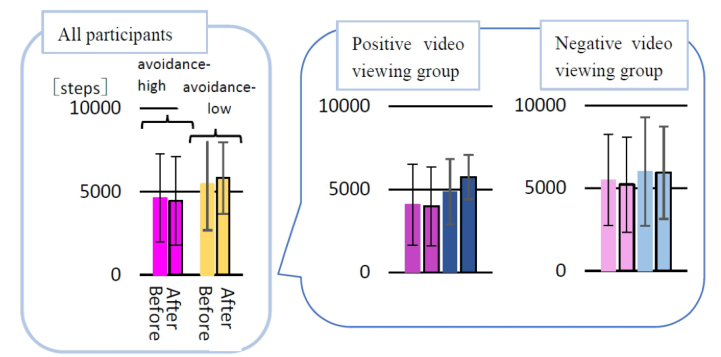
Figure 8 shows the average weekly number of steps categorized by avoida- nce scores for (left) all participants, (centre) the group that viewed the positive video, and (right) and the group that viewed the negative video. No group showed a statistically significant difference in the number of weekly steps before viewing the video compared to after, but the high avoidance group in all participants category showed a decrease in average number of steps, and the low avoidance group showed an increase in average number of steps.
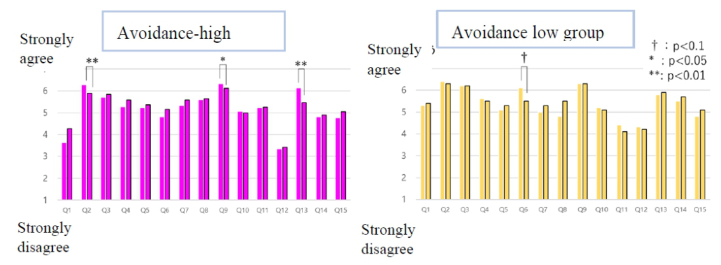
Figure 9 shows the results for the awareness survey on walking catego- rized by avoidance scores for all experimental participants. Regarding the high avoidance group (left), answer results for Question 2 (“Walking is good
Effect of Enlightenment Video for Walk on Motivation and Action 117
Figure 8: Average number of steps per week compared with high and low avoidance temperament (left) all participants, (centre) positive video viewing group and (right) negative video viewing group.Figure 9: Result of awareness survey on walking categorized by (left) high and (right) low avoidance temperament.
for health.”), Question 9 (“I don’t want to walk when the weather is bad.”), and Question 13 (“I have fewer opportunities to walk due to the COVID-19 pandemic.”) showed decreased ratings after viewing the video compared to before, and a statistically significant difference was observed. Regarding the low avoidance group (right), answer results for Question 6 (“Walking is refreshing.”) showed decreased ratings after viewing the video compared to before, and a statistically significant difference was observed.
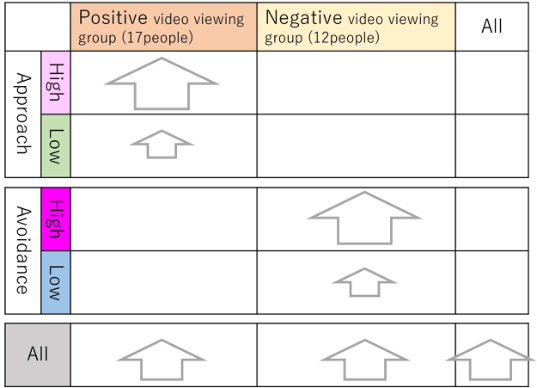
DISCUSSIONS This study evaluated the effects that enlightenment videos about walking, created with a focus on content and wording, have on number of steps and awareness toward walking. Figure 10 shows the pre-experiment hypothe- sis, and Figure 11 shows the overall experimental results for weekly average number of steps. Before the experiment, we expected that participants with
Figure 10: Pre-experiment hypothesis of average number of steps per week made in advance.Figure 11: Summary of experimental results of average number of steps per week.
stronger approach temperaments would greatly increase their number of steps by viewing the positive video, and those with stronger avoidance tempe- raments would greatly increase their steps by viewing the negative video. The experiment results show that number of steps increased for the group with strong approach temperaments who viewed the positive video, but the num- ber of steps decreased for those with strong avoidance temperaments who viewed the negative video. In other words, people with stronger approach temperaments may be more likely to increase their number of steps by viewing enlightenment videos compared to those with weaker approach tempera- ments. Also, this may demonstrate that explanations of the positive effects of
Effect of Enlightenment Video for Walk on Motivation and Action 119
walking are more effective in contributing to an increase in number of steps than explanations of the negative effects of not walking.
CONCLUSION
This study evaluated the effects that enlightenment negative and positive videos about walking, created with a focus on content and wording, have on number of steps and awareness toward walking. Results showed that informing people about the positive aspects of walking may contribute to an increase in the number of steps compared to explanations about the negative aspects of not walking. In addition, those with stronger approach temperaments may be more likely to increase their number of steps after viewing the enlightenment videos compared to those with weaker approach temperaments.
ACKNOWLEDGMENT
This work was supported by JSPS KAKENHI Grant Number 21K11988.
REFERENCES
Elliot, A. J., Thrash, T. M. (2002). Approach avoidance motivation in personality: Approach and avoidance temperaments and goals. Journal of Personality and Social Psychology, 82, 804–818. Ichihashi, Yuki. Fujita, Motohiro (2010), Survey analysis concerning walking con-
sideration in daily life, Japan Society of Civil Engineers Chubu Branch Research Presentation. Kakinuma, Kyosuke, (2018), Development of Japanese Version of Approach- Avoidance Temperament Questionnaire (ATQ), Japanese Journal of Social Moti- vation vol. 9. Matsumoto, Chiaki, (2021), Behavioural change stage model, e-health-net, Ministry
of Health, Labour and Welfare. Report of Ministry of Health, Labour and Welfare (2021), https://www.mhlw.go.jp/english/policy/health-medical/data-based- health/dl/211124-01.pdf. Saito, Tsukasa. (2013), Interpretation from survey results | Effect of video advertisements on attitude change and synergistic effect with TV commercials, Wire Column, https://www.exchangewire.jp/2013/11/27/wirecolumn-dac-saito-3/.
LISTED IN THE AHFE DIGITAL BOOKSTORE CATALOGUE
Explore the complete digital volume
Affective and Pleasurable Design
Read this individual research paper free through the original publisher, or explore the full digital proceedings book.
ISBN 978-1-958651-47-6
Explore this ISBN in the AHFE Bookstore ↗Listed in the July 2026 bookstore catalogue; search by ISBN to confirm current availability · Digital book purchase optional