Masashi Okubo (2021). Emergence of Self Awareness Using Shared Knowledge. In: Advances in Affective and Pleasurable Design. AHFE Open Access, vol. 14. https://doi.org/10.54941/ahfe100571
Because of the progress of Internet and search engine represented by Google, the value of idea is increasing instead of the value of knowledge. Mind Maps are the famous and useful method to support imagination and association. However, to make the Mind Maps by oneself causes the partial knowledge and idea. From this viewpoint, we have proposed the idea generation support system by using the shared knowledge made by the colleagues who have same background and Google Suggest. To investigate the effectiveness of shared knowledge and Google Suggest on the idea generation, we performed a couple of experiments. As a result, the performance by using the proposed system with shared knowledge was superior to others, and also the subjects tend to prefer the proposed system with shared knowledge.
As a recent trend of university learning, Learning Commons and Active Learning have appeared in the education institutes (OECD report, 2008, Holmgren,2010 and Roy, 2008) .Learning Commons is a new service of the university library and has been suggested. Learning Commons is defined as "A service to provide a space enabling the learning style that some students collaborate and have a discussion with the information, which is obtained from various information resources including digital information and printed media. The service provides not only the computer facilities and printed matters, but also a support by the library staff to the self-leaning of students who use these information." in Ministry of Education, Culture, Sports, Science and Technology (Ministry of Education, 2014).This can be regarded as a new function for libraries having a sense of stagnation due to the digitization of documentations and development of Internet, and also as a change to the style of learning in common according to the social requirements arising from the limitation to categorize and interrelate an enormous volume of information by oneself in the information society.
The view of Learning Commons has rapidly developed around the department of humanities, and the discussion about its effectiveness has just begun in the department of science and technology. Meanwhile, Project Based Learning (PBL) has been already adapted to both departments. PBL is intended to make the students, who have different background, collaborate and understand each position and the meaning to take a role through the project. In fact, PBL is used in various ways to play an important role in the university education.
The learning method described above requires the (project) team participants to have the imagination and association skills. This study focuses on "idea" and describes the experimental results about the effectiveness of using a group idea generation on the idea by oneself. The idea method such as Mind Maps are used to create a new idea and find a meaning to the undefined thing, and are proposed as an effective method to find the cause and solution of the problem (Buzan,1995 and Wright, 2011). However, using Mind Maps for the idea generation and thought by oneself may cause the limited and partial idea. For this reason, the shared knowledge, the synthesis of Mind Maps made by the colleagues who have same background, gives self-awareness and supports a new idea generation. However, the shared knowledge becomes less as the idea generation is expanded. To make up for this problem, we have proposed the utilization of prediction candidate function used on search engines.
IDEA GENERATING SUPPORT BY USING SHARED KNOWLEDGE The Mind Maps, advocated by Tony Buzan, is one of the thinking and idea methods (Buzan and Buzan,2010). This is a visible indication of thoughts in the human brain with the same method of thinking. The Mind Maps are used to find a solution because it improves the memory, organization (understanding), and idea. The step is, to place a target topic at the center of sheet, expand the linked words in the radial direction, and repeat this action. The sample of Mind Maps is shown in Figure 1.
Figure 1. Example of Mind Maps.
Figure available in the original PDF paper.
Making the Mind Maps by oneself tends to the partial field or direction of idea generation according to his/her background and thought. We think that integrating Mind Maps, made with a same topic by multiple people into the knowledge shared among the participants (hereinafter called "shared knowledge") and presenting this knowledge enable to find a direction of new idea. We therefore propose the idea generation support system, using the shared knowledge. (See Figure 2) .
ideas ideas ideas ideas ideas Shared Knowledge
aha!
Figure 2. Idea generation support using shared knowledge
Figure available in the original PDF paper.
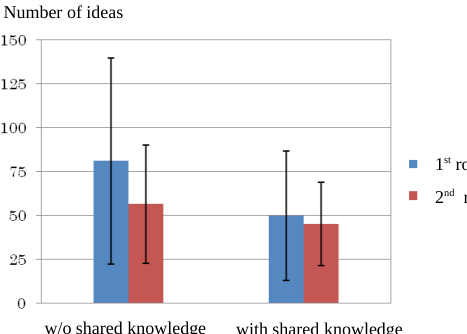
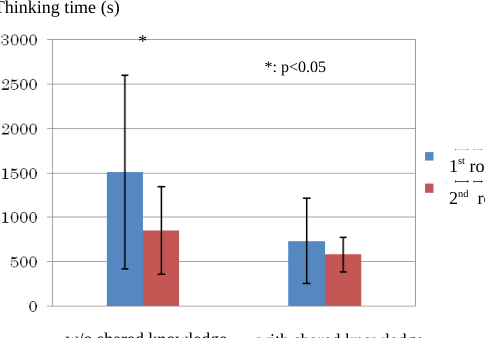
We performed a couple of evaluation experiments to verify that the presence of shared knowledge can help the self- idea generation. To prevent a large difference of information amount obtained from the shared knowledge between the topics, 100 keywords are registered as the shared knowledge for each topic. In consideration of the effect of order, 6 patterns of experiments, combining 3 topics with the self-idea or using the shared knowledge, were performed for 18 graduate students consisted of 17 males and one female. The average and standard deviation of number of idea by self-idea and those by using the shared knowledge are shown in Figure 3. The number of idea generation in Figure 3 shows that even if the self-idea is stopped, a new idea generation is increased by using the shared knowledge. This result proves that the shared knowledge can support a self-idea. Also, the average and standard deviation of thinking time for one idea by self-idea and those by using the shared knowledge are shown in Figure 4. The thinking time for one idea by self-idea at the second is shorter than the first. Especially, the time for idea by self-idea has 5% of significant difference between the first and second. From these results, it is found that the shared knowledge can support a new self-idea generation, and the repeated use of shared knowledge enables the improvement of self-imagination.
Number of ideas
1st round 2nd round
w/o shared knowledge with shared knowledge
Figure 3. Number of ideas without shared knowledge (left) and with it (right).
Thinking time (s) *: p<0.05 *
1st round 2nd round
w/o shared knowledge with shared knowledge
Figure 4. Thinking time for each idea without shared knowledge (left) and with it (right).
COMPARISON OF IDEA GENERATION SUPPORT BETWEEN SHARED KNOWLEDGE AND GOOGLE SUGGEST The shared knowledge has a high possibility of effectiveness on self-idea generation. When the group in the class makes the Mind Maps with a given topic, it isn’t so difficult to create the shared knowledge, however when using a personal topic, it may become difficult to create the shared knowledge. Also, the larger Mind Maps is created, the smaller information can be obtained from the shared knowledge. For this reason, instead of the shared knowledge, we propose the idea generation support using Google Suggest, the keyword prediction function of Google (Notess, 2009).. Google Suggest is the way to predict what a user wants to search for from a character string input in Google search box and display the candidate list of keywords (see Figure 5). In this function, the frequently-searched words and phrases and the frequently-clicked those are selected as the candidate of keywords. These keywords are extracted from the usage history by unspecified users, not from the partial knowledge of a person or community. In other words, Google Suggest has a high possibility of being the well-balanced shared knowledge. The outline of proposed system is shown in Figure 6.
Search keyword
Google Suggest
Figure 5. Example of Google Suggest
Figure available in the original PDF paper.
search search search search ideas Google Suggest
aha!
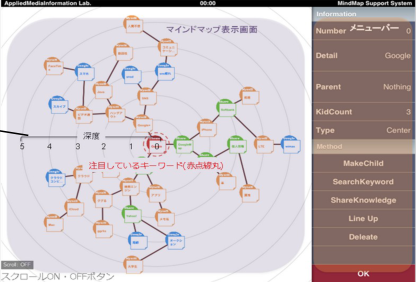
Figure 6. Outline of idea generation support system using Google Suggest The proposed system is developed for the application on iPad (Apple inc.). The example of graphical user interface is shown in Figure 7. The left side of the screen shows a currently-prepared Mind Maps by a user. The user can refer to the keyword information in the right side of the screen, and create, edit, and delete the listed keywords. The candidate list of keywords, obtained from Google Suggest proposed in this research, is also displayed in the right side menu.
Figure available in the original PDF paper.
Depth
Figure 7. Graphical user interface of proposed system.
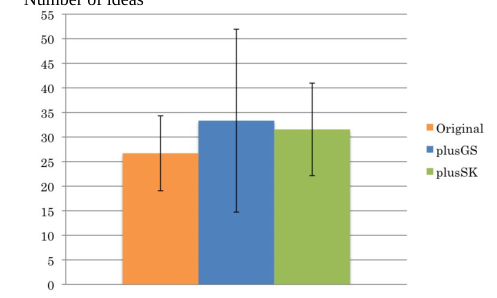
We verify the usability of the proposed idea generation support system. First of all, to investigate the influence of the effectiveness of the reference keywords obtained from Google Suggest, we compared between the general Mind Maps and the Mind Maps using the support system. Next, focusing on the reference keywords used in the creation, the difference in the effectiveness of the candidate reference keywords was compared between Google Suggest and the shared knowledge. The experiment was performed three times for 36 students in their 20’s (See Figure 8). In consideration of the effect of learning order, 36 patterns of learning, made through combination of 6 topics and 6 learning methods, were given to 36 participants. The average and standard deviation of number of idea generation for each learning is shown in Figure 9. There were no significant difference between Google Suggest and the shared knowledge.
Explanation 1st creation of MindMap
Questionnaire 2nd creation of MindMap
Questionnaire 3rd creation of MindMap
Questionnaire Final questionnaire
Figure 8. Experimental procedures.
Figure available in the original PDF paper.
Number of ideas
Figure 9. Average and standard deviation of number of ideas
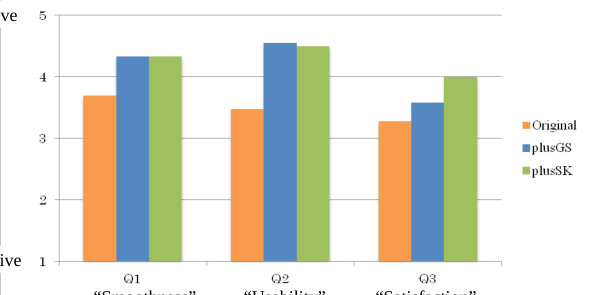
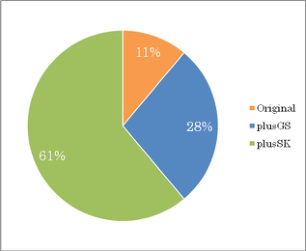
After the experiments, the participants answered questionnaires about “Smoothness”, “Usability”, “Satisfaction” and the ranking of satisfaction among the created Mind Maps. The result of questionnaire is shown in Figure 10 and 11. According to the questionnaire, the performance with the shared knowledge was superior to others. Google Suggest was second.
We classified the reference keywords for each depth of idea. The average is shown in Figure 12. A line chart in the Figure 12 is the average ratio of the reference keywords out of keywords for each depth of idea. In the case of depth 1 and 2, the candidate reference keywords obtained from the shared knowledge is more than that from Google Suggest, with 5% of significant differences. On the other hand, in depth 3 to 5, the candidate reference keywords obtained from Google Suggest is more than that from the shared knowledge, with 5% of significant difference. This is because the number of reference keywords from the shared knowledge is smaller as the depth becomes deeper, however the number of that from Google Suggest does not change.
positive
negative “Smoothness” “Usability” “Satisfaction”
Figure 10. Results of questionnaires.Figure 11. Results of questionnaire about usage.
Used keywords/ suggest keywords Number of ideas
Depth of Mind Maps
Figure 12. Number of ideas and referred keywords for each depth of idea.
Figure available in the original PDF paper.
CONCLUSIONS
In the information society, the various types of information can be accessed through the internet anytime, anywhere, and by anyone who wants to know. This leads that the ability to expand the idea based on the information
becomes more important than to have a lot of information. In this research, using the proposed system, we verified effectiveness of the shared knowledge made by the colleagues who have same background and the idea by
unspecified users on the self-idea. As a result, it is found that there is a possibility that the shared knowledge is effective for the idea generation and its learning. It is also found that the idea by other people who have the same
background is preferred than that using the candidate referred keywords of Goggle Suggest. However, the shared knowledge needs the advance preparation and tends to be less by depth of idea. We think it desirable to use the idea
with the prediction candidate function of Google Suggest as the second best. Further clarification of the process to get the idea realized from various information, and further development of the support system are excepted in the
future.
REFERENCES
Buzan, T. (1995),” The Mind Map Book”, BBC Books. Buzan, T., Buzan, B. (2010) ”The Mind Map Book: Unlock Your Creativity, Boost Your Memory, Change Your Life”, Pearson Education Ltd. Holmgren, R. A. (2010), “Learning Commons: A Learning-Centered Library Design”, College & undergraduate libraries,
Volume 17, pp.177 – 191. Ministry of Education (2014), “Glossary”, Ministry of Education, Culture, Sports, Science and Technology website, http://www.mext.go.jp/b_menu/shingi/gijyutu/gijyutu4/toushin/attach/1301655.htm Notess, G. R (2009), “Google Suggest”, Online (Weston, Conn.), Volume 33 No.5 , 33 pages. OECD report (2008), “ US Academic Libraries; Today’s Learning Commons Model”, OECD publishing Roy, R. (2008), “Active Learning”, Mathematics Teaching, volume 211, 36pages. Wright, J. (2011), “Teaching and assessing mind maps”, Perlinguam : a journal of language learning, Volume 22 No.1.
LISTED IN THE AHFE DIGITAL BOOKSTORE CATALOGUE
Explore the complete digital volume
Advances in Affective and Pleasurable Design
Read this individual research paper free through the original publisher, or explore the full digital proceedings book.
ISBN 978-1-4951-2109-8
Explore this ISBN in the AHFE Bookstore ↗Listed in the July 2026 bookstore catalogue; search by ISBN to confirm current availability · Digital book purchase optional