Wang Dahua, Xiao Hongrui (2021). Cognitive Training Profile for Older People in China. In: Advances in Affective and Pleasurable Design. AHFE Open Access, vol. 14. https://doi.org/10.54941/ahfe100558
Nowadays China is facing a serious problem of aging population. Older people suffer losses in aspects, especially in cognitive function. It is necessary and worthwhile to design effective cognitive training programs, based on our knowledge of cognitive aging mechanisms, to help older people maintain and improve their cognitive abilities. The present paper aims to introduce the development of cognitive training program for older people from the following three aspects: a) the status quo of aging society in China, b) cognitive aging and its underlying mechanisms, and c) the approach and practice of cognitive training.
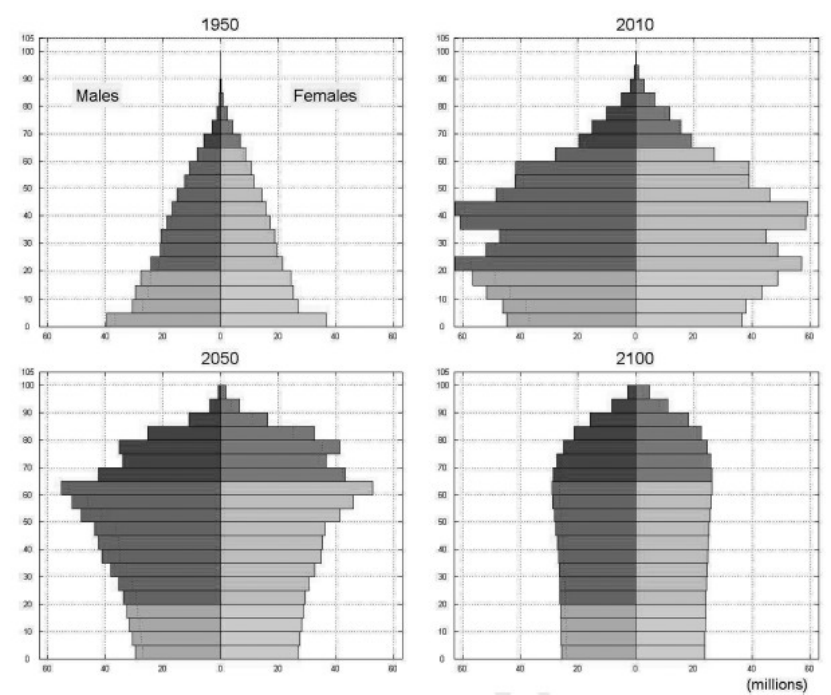
Since 1999 China has become an aging society in light of the international standard (i.e. 10% of total population aged over 60 years). Currently, China remains its aging acceleration period (as can be seen in Figure 1). The Sixth
Chinese National Population Census showed that by 2010 the number of people aged above 60 years had reached 178 million, accounting for 13.26% of the total population. Moreover, the latest data reveal that the population aged
over 60 years has already exceeded 200 million (Woo, 2013). By 2050, nearly thirty percent of Chinese people would be older adults. The huge number of aged people brings serious challenge to China and thus calls for efforts
from all aspects.
With regard to the psychological field, a significant mission is to help older adults effectively maintaining their mental health and cognitive function, as well as sustaining fair engagement in social life and productive activities.
The concept of “active aging” could be very helpful to fight against the negative stereotypes towards aged people.
An old age does not necessarily mean the end of participation in society. Older adults should still be viewed as active social participants and competent contributors of our society. "Participation" is a key concept of "active
Edited by T. Ahram, W. Karwowski and T. Marek aging" which was put forth in the Second World Assembly on Aging (Stenner, McFarquhar, & Bowling, 2011). A
lot of studies have demonstrated that social activity and social engagement contribute to better cognitive abilities, better health condition and higher level of well-being (e.g. Herzog et al., 1998; Pinquart et al., 2000). Thus,
intervention on older adults’ social activities could be a valid way to help older adults’ achieving successful aging, and maintaining a good quality of life (QoL).
Figure 1. Age structure of China, 1950, 2010, 2050, and 2100. Source: UNDESA (2011).
COGNITIVE AGING AND UNDERLYING MECHANISMS As people age, they usually experience physical, psychological and social loss. Decline of cognitive function is one
of the most serious and common losses among the older adults. The decline exhibits typically as slower reaction, memory impairment, and deficiency in anti-interference. This degeneration directly impacts older adults’ QoL. It’s
not uncommon to hear an older adult saying that “I have already forgotten the rest numbers after dialing just two digits” , “Please speak slowly, I can’t catch you,” “I’m not as sharp as I used to be,” or “I’m much fresher in the
morning but feel like rusted in the evening” and so on. All these complaints indicate that older people usually care very much about their cognitive function and they feel very worried when they experience decline in cognition.
Edited by T. Ahram, W. Karwowski and T. Marek Take dementia as an example, it is a serious disease occurred increasingly with aging. People with dementia could
suffer from impairment of memory, attention, language, and problem solving, which leads to a worsen QoL (Finkel, 2000).
In general, cognitive function could be grouped into to two sorts, namely crystallized intelligence and fluid intelligence (Cattell, 1971). Earlier in the field of cognitive aging, it was assumed that age-related changing patterns
of these two intellectual abilities are different. As crystallized intelligence is the ability related to learned skills, knowledge, and experiences, it may not decrease but rather improve somewhat with aging. On the contrary, fluid
intelligence is the capacity to think logically and solve problems in novel situations, and is independent of acquired knowledge, so it usually declines in old age. However, later evidence showed that both crystallized and fluid
abilities follow a decline pattern after around 70 years old (Schaie, 1996).
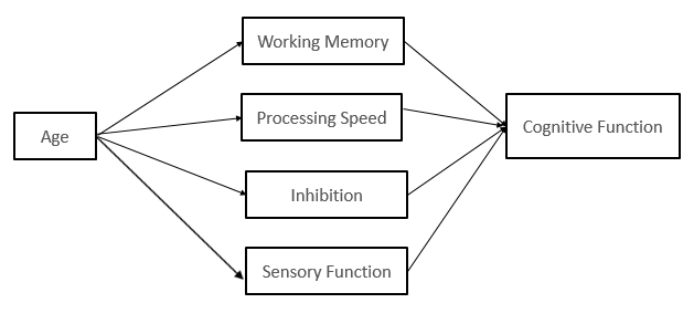
Much research has examined the mechanisms underlying cognitive aging in recent decades. By far, there are four major mechanisms that have been demonstrated to well account cognitive decline in the area of aging psychology
(as can be seen in Figure 2): (a) working memory function theory, (b) processing speed theory, (c) defect of inhibition theory, and (d) sensory function theory. Working memory is the most sensitive to decrease with aging
among all cognitive function (Hertzog, Dixon, Hultsch, & MacDonald, 2003). Craik and Byrd (1982) developed an important framework related with the construct of working memory to explain cognitive aging. They suggested that
older adults are deficient in the ability to engage in what they called “self-initiated processing” determined by working memory, which makes older adults less competent in cognitive tasks. The processing speed theory of
cognitive aging proposed by Salthouse (1985) argues that slower processing speed leaves more time for workingmemory contents to decay, thus reduces effective capacity, and results in lower level of cognitive performance.
Another explanation is the inhibition hypothesis advanced by Hasher and Zacks (1989). This theory assumes a general deficit in old age in the ability to inhibit irrelevant, or no-longer relevant, information. Therefore, working
memory tends to be cluttered with irrelevant contents that reduce the effective capacity for relevant content. Finally, Baltes and Lindenberger (1994) argued that sensory function is a more fundamental index of cognitive aging. They
proposed the “common cause” hypothesis, namely sensory function, as a general index of neurobiological architecture, is fundamental to cognitive function and thus is a powerful mediator of the influence of age on
cognitive abilities.
Figure 2. The mechanisms of cognitive aging
Edited by T. Ahram, W. Karwowski and T. Marek
COGNITIVE TRAINING PROFILE: APPROACH AND PRACTICE Cognitive plasticity of older adults
Although age-related decline in cognitive function is an indisputable fact, it does not mean that there is no way to cope with it. As a matter of fact, many empirical studies have revealed that not only young but also older brain
presents cognitive plasticity despite that young people may get more benefits than their older counterparts. For instance, a study found that older subjects’ performance on matrix test significantly increased after training (Jaeggi,
Buschkuehl, Jonides, & Perrig, 2008). Another study conducted in China supports Jaeggi's results independently (Fei, Qin, Li, & Li, 2009). It’s noteworthy that even more fundamental abilities could be improved in performance
after training. Take our own research as an example, older adults’ some primary mental abilities benefited from a 5week speed training program (Wang, Huang, Peng, & Chen, 2012). There are also other studies suggesting that the
cognitive aging among aged people is amenable to prevention and amelioration (Lytle, Vander Bilt, Pandav, Dodge, & Ganguli, 2004; Fillit et al., 2002; Scarmeas & Stern, 2004). So it is effective and feasible to design practical
activities that aim at maintaining and improving older adults’ cognitive function.
Design principles of cognitive training profile The principles of designing cognitive training program may include following considerations. First, the training
program should involve some core components of cognition for older people, such as the primary mental abilities (i.e. five basic abilities according to Thurstone’s theory), the four abilities serving as the underlying mechanisms of
cognitive aging, and other abilities sensitive to aging process (e.g. prospective memory). Second, our cognitive training program should be designed in favor of older people’s interests and motivation. So the training mode should
be sort of entertaining style rather than dull and tedious research style in laboratory. Hence, the program is designed into a set of mini games that can be administered as intellectual sports game. We call this highly ecological training
program practiced in communities as Senior Brain Game (SBG). Accordingly, the training program or the game should have diversity, fun and flexible degree of difficulty. Third, the program should be better designed and
administered as group training rather than individual training. Piles of studies have found that older people benefit more from group training (Liang, Moreland, & Argote, 1995; Moreland & Myaskovsky, 2000; Helbostad, Sletvold
& Moe-Nilssen, 2004), as the participants have chances to not only practice their cognition, but also engage in team cooperation, social activities and communication. And finally, the training program should be widely applicable into
as many older people dwelling in communities or institutions as possible. Thus, it’s better not to use expensive, specialized, or high technique materials or tools to serve the training. All materials shall be very handy in daily life.
Content of the training programs According to the theories and principles mentioned above, we put forward eight components of cognitive function to
be trained for the older adults, namely processing speed and sensory functioning, working memory, inhibition, mental arithmetic, prospective memory, spatial orientation, linguistic competence, and executive capacity.
Accordingly, a training profile with eight modules are designed, and each module is composed of five activities or
Edited by T. Ahram, W. Karwowski and T. Marek games. Take the module of processing speed and sensory functioning for example, the five games include (1) digit
comparison (decide whether two strings of digits are identical), (2) pattern comparison (quickly identify which one of the 4-6 figure patterns is the same with the sample one), picture-match (find as many as possible pairs of pictures
that are exactly the same in limited time), finger walking (use fingers alternatively as required to walk along the arrow on a geometric map), hitting ping-pong (hit a ping-pong repeatedly with a paddle as many times as possible in
limited time). Although the games of the eight training modules address different aspects of cognitive function, we maintain that they are not independent from each other. Rather, we prefer the integration of the eight parts as a
whole. Hence, our ultimate goal of the training profile concentrates onto the promotion of cognitive function integrally, rather than strengthening a certain single component.
With regard to one round of SBG, 3 or 4 activities would typically take 40 minutes if there are four groups (e.g. 5 persons per group) of older participants. The activities could be flexibly revised in length and difficulty according to
the education background and cognitive impairment of the participants.
Organization and implementation of the training profile: a case of SBG In order to concretely describe how to organize and carry out the cognitive training program, we would like to
introduce a case of SBG conducted in one community of Beijing. The community committee, a distal official department of government in China, helped assemble older residents together to participate into the SBG. In this
case, there were 40 older residents who attended the SBG. They were randomly divided into five groups, each with eight members. The SBG was composed of four games and one relaxing activity. One of our graduate played as the
host who was responsible for clearly interpreting the rules of the games to the participants, and instructing and leading the whole process. For each group of participants, a volunteer was arranged to assist the host concerning
clarifying the rules to the group members, and helping them play the games orderly and smoothly. The first game called “do to the opposite” demanded participants to respond in opposite to the host’s instruction. For example,
when the host commanded “turn left”, the participants must turn their body to the right; when the host ordered “look up”, they must bow their head down. Later on, the tasks gradually became more difficult. For instance, when the
instruction was “There is a small water-melon on the top”, the participants must gesticulate a big water-melon down their chest. This game was mainly designed to train older adults’ inhibition function. The second game was “digit
comparison”. The third was called “recite backwards” as participants must recite a digit string in backward order.
The number of figures successively increased until it reached participants’ maximum memory capacity. This game mainly aimed at promoting older people’s working memory. The fourth game was “skip number seven”. Starting
from a random number, all participants successively one by one counted number loudly. But when meeting a number containing “7” as its one digit or a number that could be exactly divided by 7, the participants must report
“pass” instead of the number per se. This game mainly aimed at promoting the competence of mental arithmetic.
The volunteer assistants helped scoring for each group and ranking their total grades. The champion team who earned the highest grade was honored a special prize. The rest participants also gained consolation prize. At the end
of the SBG, there was a relaxing session for all participants. The host taught and led the older people to play a finger gymnastic to exercise their finger flexibility.
The effects of the cognitive training profile Given the ecological validity and the applicability we pursue, this profile could not be assessed strictly in light of
Edited by T. Ahram, W. Karwowski and T. Marek lab-based experiment. Although data to do pre- and post-test comparison lack, we gathered comments of participants
and organizers after the SBGs. From the feedbacks of the older players as well as the community committees, we are confident about the effects of the cognitive training profile. There are mainly three aspects of reasons to treat the
implementation of the SBG valuable. First, it promotes the older people’s enthusiasms of participating and cooperating in social activities. As we could see, the older adults actively participated and cooperated with each
other so that they shared in a warm atmosphere. When asked about their feeling of the SBG, older adults often mentioned that "everyone was very happy to play the games together, and we had fun from exercising our minds. So
it was very good”, “I think community should carry out more such interesting activities for us”, and so on. Second, it helps older participants maintain and improve cognitive function, which is the primary goal of the profile. Though
there are no data so far to indicate the amplitude of promotion, the heightened cognitive efficacy and motivation could be obviously observed. “Some of we old people did have bad memory, so the memory activity was
necessary,"" my performance in the game was ok, I had always thought that I was old and had a blocked head.
Actually I can do much better than I think. It seems that I should not give up." And last, it brings older participants positive experiences and thus helps them improve their emotional well-being. As the SBG is designed as a contest
between groups, the players feel excited and entertained during the whole process. When errors occur, they often laugh at themselves or each other with kindness. "The characteristics of the games were to make older people happy.
I enjoy lots of fun here”. Additionally, the training profile helps conveying the ideology of living an active life in old age. By experiencing the SBG, older people might stop accepting cognitive deterioration passively. For the elderly,
actively exercising their brains is just as important as physical exercise because our brains follow the same rule of "use it or lose it".
CONCLUSIONS
To age without much recession is a desire for most people. How to keep a clear head when going into old age is a key question to be solved for researchers working in the area of cognitive aging. So far, the general conclusion for
the possibility of maintaining or promoting older people’s brain function via cognitive training is positive. However, there is still a long way to go concerning identifying the effective and efficient strategies for all kinds of older adults.
Our training profile of the SBG is one of the attempts. And we need more robust and direct empirical evidences before we draw a conclusion that we have found a key. Moreover, there are huge inter-individual differences among
aging people, so much more efforts are required to be invested into this matter.
REFERENCES
Cattell, R. B. (1971). Abilities: their structure, growth, and action.
Craik, F. I., & Byrd, M. (1982). Aging and cognitive deficits.Aging and cognitive processes (191-211): Springer.
Feiyue, Q., Qinqin, W., Liying, Z., & Lifang, L. (2009Study on improving fluid Intelligence through cognitive training system based on gabor stimulus. Paper presented at the Information Science and Engineering (ICISE), 2009 1st International
Conference on.
Fillit, H. M., Butler, R. N., O'Connell, A. W., Albert, M. S., Birren, J. E., Cotman, C. W., Kuller, L. H. (2002). Achieving and maintaining cognitive vitality with aging. Paper presented at the Mayo Clinic Proceedings. Affective and Pleasurable Design (2021)
Edited by T. Ahram, W. Karwowski and T. Marek Finkel, S. (2000). Introduction to behavioural and psychological symptoms of dementia (BPSD). International Journal of
Geriatric Psychiatry.
Hasher, L., Zacks, R. T., & May, C. P. (1999). Inhibitory control, circadian arousal, and age.
Hertzog, C., Dixon, R. A., Hultsch, D. F., & MacDonald, S. W. (2003). Latent change models of adult cognition: are changes in processing speed and working memory associated with changes in episodic memory? Psychology and aging, 18(4), 755
Herzog, A., Franks, M. M., Markus, H. R., & Holmberg, D. (1998). Activities and well-being in older age: effects of self-concept and educational attainment. Psychol Aging, 13(2), 179.
Jaeggi, S. M., Buschkuehl, M., Jonides, J., & Perrig, W. J. (2008). Improving fluid intelligence with training on working memory. Proceedings of the National Academy of Sciences, 105(19), 6829-6833
Lindenberger, U., & Baltes, P. B. (1994). Sensory functioning and intelligence in old age: a strong connection. Psychology and Aging, 9(3), 339
Lytle, M. E., Vander Bilt, J., Pandav, R. S., Dodge, H. H., & Ganguli, M. (2004). Exercise level and cognitive decline: the MoVIES project. Alzheimer Disease & Associated Disorders, 18(2), 57-64
Liang, D. W., Moreland, R., & Argote, L. (1995). Group versus individual training and group performance: The mediating role of transactive memory. Personality and Social Psychology Bulletin, 21(4), 384-393.
Moreland, R. L., & Myaskovsky, L. (2000). Exploring the performance benefits of group training: Transactive memory or improved communication? Organizational Behavior and Human Decision Processes, 82(1), 117-133.
Helbostad, J. L., Sletvold, O., & Moe-Nilssen, R. (2004). Home training with and without additional group training in physically frail old people living at home: effect on health-related quality of life and ambulation. Clinical Rehabilitation, 18(5), 498-
508.Organization, W. H. (2002). Active ageing: a policy framework, a contribution of the World Health Organization to the second United Nations world assembly on ageing. Madrid (ES): WHO
Park, D. C., Lautenschlager, G., Hedden, T., Davidson, N. S., Smith, A. D., Smith, P. K. (2002). Models of visuospatial and verbal memory across the adult life span. Psychology and aging, 17(2), 299
Pinquart, M., & Sörensen, S. (2000). Influences of socioeconomic status, social network, and competence on subjective wellbeing in later life: a meta-analysis. Psychol Aging, 15(2), 187.
Salthouse, T. A. (1985). Speed of behavior and its implications for cognition.
Scarmeas, N., & Stern, Y. (2004). Cognitive reserve: implications for diagnosis and prevention of Alzheimer’s disease. Current neurology and neuroscience reports, 4(5), 374-380
Schaie, K. W. (1996). Intellectual development in adulthood: The Seattle longitudinal study: Cambridge University Press.
Stenner, P., McFarquhar, T., & Bowling, A. (2011). Older people and ‘active ageing’: subjective aspects of ageing actively.
Journal of health psychology, 16(3), 467-477 United Nations Department of Economic and Social Affairs. (2011). World population prospects: The 2010 Revision. New York:
United Nations.
Wang, D., Huang, Y., Peng, H., & Chen, X. (2012). Can older adults promote their processing speed by training?. Acta Psychologica Sinica, 44(4), 469-477.
Woo, J. (2013). Meeting the needs of an aging population in China: Public health and policy implications. Journal of Clinical Gerontology and Geriatrics, 4(2), 31-32
Zacks, R. T. (1989). Working memory, comprehension, and aging: A review and a new view. Psychology of Learning & Motivation, 22, 193-225
LISTED IN THE AHFE DIGITAL BOOKSTORE CATALOGUE
Explore the complete digital volume
Advances in Affective and Pleasurable Design
Read this individual research paper free through the original publisher, or explore the full digital proceedings book.
ISBN 978-1-4951-2109-8
Explore this ISBN in the AHFE Bookstore ↗Listed in the July 2026 bookstore catalogue; search by ISBN to confirm current availability · Digital book purchase optional