Yuki Asano (2022). Reflection on Ideas through Verbalisation and the use of the Results. In: Kansei Engineering. AHFE Open Access, vol. 40, pp. 29–35. https://doi.org/10.54941/ahfe1001757
In recent years, the work of industrial designers has not been limited to exterior design, but has also extended to the realm of idea generation for business and services.Industrial designers need to communicate their ideas logically in meetings and presentations; however, it is often difficult to communicate the ideas under consideration to others. This is because the idea is not logically fostered even within the originator himself or herself. One method of defining ideas that have not been formulated within oneself is “reflection.”Especially in the field of education, there have been many studies on how to question one’s own arguments and gain new insights through introspection and objective reflection.In this study, we discuss how the results of verbalizing and reflecting on ideas can be utilized.The Inverted Triangle is a framework for verbalizing and reflecting on ideas.This framework is sometimes used in English education in elementary schools in the United States. In the U.S., where there are many different ethnic groups, there are many families that do not use English at home, so it is used as a teaching tool to help students create logical sentences in English. The contents of the book are summarized by narrowing down the issues from broad to narrow meanings.In my previous research, I examined and improved a framework for reflection of ideas based on the Inverted Triangle. However, so far my research has been limited to examining the contents of the framework itself and improving it.The way to utilize the results of filling out the form has been left to the user’s judgment. In this study, we examined the results of the subjects’ idea reflection, and categorized and staged the methods of utilization.Eight items in the Inverted Triangle have been modified for idea reflection. The experiment was conducted on 9 subjects in January 2019 and 12 subjects in February 2019; the first time, only the Inverted Triangle was filled out, and the second time, a preparation sheet consisting of four items was prepared and filled out in advance.From the results of the questionnaire after completion of the sheet, we qualitatively interpreted the tendency to fill in each item during the reflection, and the contents of the modification of the work after completion of the sheet, and discussed how to utilize the results of the reflection of ideas. As a result, it was found that there are two types of reflection: reflection that deepens the understanding of the content within oneself, and reflection that includes awareness and leads to revision of the work. The method of utilizing the results of reflection was classified according to the tendency.
industrial design, and it is a subject that is actively discussed in the business schools (Srikant, 2015). Examples include the ID Design Camp (IIT Institute of Design, 2022) and MITidm’s combined instruction in design and business (MITidm, 2022).
Research has also been conducted on innovation models that sustainably connect interdisciplinary stakeholders to co-create value (Chen-Fu, 2019). Several studies and ideas have been proposed to create innovative ideas related to design thinking (Christian, 2019; Maurício, 2019). The studies on creativity have described its importance in terms of Neural Correlates (Koryna, 2014).The ideas generated may be clear to an adept entrepreneur or someone who is accustomed to idea generation. However, the ideas gene- rated may be fragmented or vague. Some studies have focused on the role of ingredient branching as lack of clarity of a service makes it difficult for users to have high expectations (Alfonso, 2019). Alfonso has studied verbalizing and introspection of the ideas generated. In addition, the author has studied the effect of verbalizing and reflecting on the generated ideas, and confir- med their effect on improving the ability to transmit ideas (Asano, 2018) and increasing confidence in one’s own ideas by using the idea reflection prepa- ration sheet (Asano, 2019). The essence of metacognition is verbalization, which activates one’s own problem-finding attitude and encourages one to find some significance in the metacognition of others (Masaki, 2019). The purpose of this study is to examine the use of the results when verbalizing ideas for reflection.
REFLECTION ON IDEAS The concept of “reflection” is studied extensively in the fields of philosophy, education, and business.
In his book, Schön discusses “reflection in action” and “reflection in pra- ctice”. He also mentions about “knowledge in action” while referring to the fact that it is often impossible to say what kind of knowledge is responsible for the intuitive and unconscious actions of everyday life. He explains the importance of “reflection in action,” and mentions its difficulty also (Schön, 1983). In “What is reflective practice?” Schön summarizes the factors that constrain reflection in action, and states, “When we think about what is happening now, we are confronted with complexity. This means that some situations are not suitable or should not be reflected upon, because reflection is done by pausing the movement. However, it does show the effectiveness of reflection in action when it is performed correctly. (Schön, 1983).
In a paper revisiting the previously mentioned concept of Schön’s practice, Okamura states, “Reflection can involve thinking with language or with- out language” (Okamura, 2017). Thus, there are many different approaches to reflection, especially in the field of education. In Japan, the Ministry of Education, Culture, Sports, Science and Technology (MEXT) has included ‘reflection’ as an important keyword in education, while emphasizing on the five types of challenges for creating better high schools: vision, mission, action, reflection, and promotion (MEXT, Japan, 2022). There are meth- ods called process records (Kakuta, 2019) and one-page portfolio assessment
Reflection on Ideas through Verbalization and the Use of the Results 31
Figure 1: Inverted triangle (Asano, 2019).
Figure available in the original PDF paper.
(OPPA) (Hori, 2019). In the field of education, worksheets are used as tea- ching materials to encourage students to reflect independently, and teachers are involved in interacting with them.
Many studies have determined that looking back objectively through the act of reflection can lead to a re-evaluation of one’s own arguments and gene- rate new insights. Similarly, through the act of reflection we can objectively analyze ourselves and events, which might lead to new discoveries.
As for reflection in design, research has been conducted to document the actions taken during the workshop (Nambu, 2013; Harada, 2010). In this research, when the ideas have converged to some extent and have been narro- wed down to one, the framework of the inverted triangle is used to verbalize the reflection in design.
ABOUT INVERTED TRIANGLE The Inverted Triangle (Sumiko, 2011) is a framework that is used in English language education in the elementary schools in the U.S. It helps the students structure their sentences for logical writing in such a way that it gradually becomes narrower in terms of content. This framework has been modified for idea generation in the author’s previous research. The Inverted Triangle is used as an effective method to narrow down the content for idea generation, which is similar to its use for logical writing (see Figure 1).
In a previous study, an inverted triangle, whose content was improved for idea generation, was used as a proposal for a reflection method for idea generation (Asano, 2018). The results showed that the use of the idea refle- ction preparation sheet contributes to the improvement of confidence in ideas (Asano, 2019). The process of filling out the Inverted Triangle was as follows. In each of the studies, the results of the questionnaires and interviews condu- cted with the participants were discussed in terms of improving their ability to communicate and their confidence in their ideas. However, they did not consider how to utilize the results of their reflections on their own ideas. In this study, we discuss the use of the reflection results.
DETAILS OF THE EXPERIMENTS CONDUCTED The experiment was conducted twice. The content of the experiment was a half-day workshop in which participants experienced the process of consi- dering ideas, narrowing down the ideas, reflecting on the narrowed down ideas, and looking back.
32 Asano
Table 1. Time Schedule (Asano, 2019).
Table available in the original PDF paper.
The experiment was conducted on nine subjects in January 2019 and 12 subjects in February 2019. On the first day, only an Inverted Triangle was filled out. On the second day, a preparation sheet for reflection was prepared and filled out before the Inverted Triangle was filled. The two experiments were conducted in consideration of the effect of overlapping members on the results, and care was taken to ensure that there were no overlapping members. The common theme of both the workshops was the proposal of portable speakers.
In each workshop, the participants were first divided into groups of three or four people for brainstorming and discussion. Then, each of them wrote down their individual product ideas (product name, concept, function and usage, shape, etc.) on an A4 paper. Afterwards, they verbalized and filled in the Inverted Triangle or the Reflection Sheet and Inverted Triangle for reflection. After the reflection time, they had time to revise their work, con- sidering the possibility that their own evaluation of the idea might change. Finally, each participant presented a presentation.
RESULTS: USING THE RESULTS OF REFLECTION This section discusses the use of the results of the survey conducted during the two workshops, and the results of the reflection based on the revision of the works.
1: Items on the Inverted Triangle were difficult to fill (6 levels) The ease of filling out the Inverted Triangle was checked on a six-point scale for of the each item.
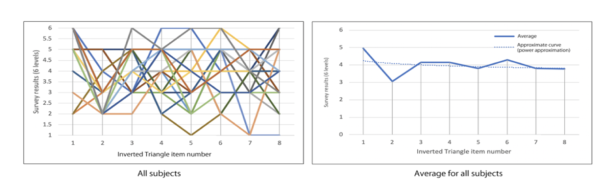
1-1: About the graph showing the results of all subjects (see Figure 2).
There was no overall trend in the results, as there were variations among the subjects for of the each item.
The average rating of all subjects was within the range of three to five out of six for all the items. The approximation curve showed a gradual downward trend from items 1 to 8, which are broadly defined contents. This indicates that, on an average, the narrower the content, the more difficult it is to fill the Inverted Triangle.
There was no difference in the tendency depending on whether the preparation sheet for self-reflection was used.
1-2: The results of checking the tendency of the subjects individually.
Reflection on Ideas through Verbalization and the Use of the Results 33
Figure 2: Items in the inverted triangle that were difficult to fill out (6-point scale).
Approximately 38% of the subjects showed a downward trend in the approximate curve as they felt it was difficult for them to narrow down their content from a broader content. About 29% of the participants sho- wed an upward tendency as they found it easier to write from broad to narrow content. About 33% of the participants felt that their overall writing style remained unchanged.
A t-test was used to determine the significant differences between the sub- jects with an upward trend and those with a downward trend in each of the eight items. The t-test highlighted that significant differences were found only for items 1, 3, and 8. Since it was easier to write in the Inver- ted Triangle, which proceeds from the broadest to the narrowest content, suggests that there was some difficulty in filling out the Inverted Triangle at the beginning. The free writing comments of the subjects who had an upward trend indicated that they either had doubts about the idea or lost confidence in the idea after listening to the others presentations.
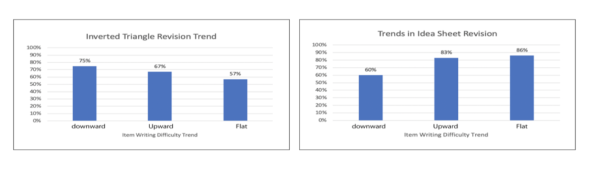
2: Inverted Triangle, Revision Status and Pattern of the Work At the time of the reflection on the Inverted Triangle, a questionnaire was given to the participants to see if they had revised the contents after filling the Inverted Triangle and the idea sheet of the work. The figure shows the tendency of each revision categorized by their tendency.
The corrections in the Inverted Triangle were most frequently made when there was a downward trend in the difficulty of completing the items, followed by an upward trend, and finally a sideways trend.
On the idea worksheet, 86% of the participants revised their work in the horizontal trend, 83% of the participants in the upward trend, and approximately 60% of the participants in the downward trend, in terms of difficulty in filling out the items. We speculate that many of the parti- cipants in the downward trend did not feel the need to revise their work because they had already established a broad content of their ideas in their own minds.
In the free-text comments, there were many comments such as “I was able to organize my thoughts through reflection,” and “My understanding of my own ideas deepened. These comments suggest that reflection had the effect of organizing the work itself and deepening their understanding.
34 Asano
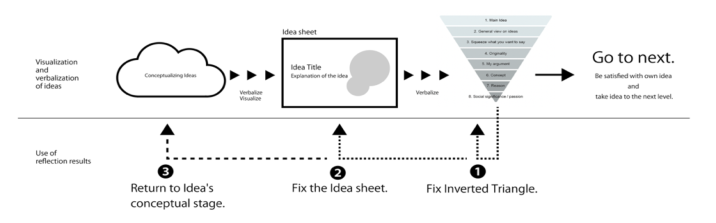
Figure 3: Correction through reflection.Figure 4: Use of results.
CONCLUSION
We qualitatively interpreted the tendency to fill each item in the reflection and the content of the revision of the work after filling in the items, and discussed how to utilize the results of the reflection of ideas. As a result, it was found that there are two types of reflection: reflection that deepens the understanding of the content within oneself, and reflection that includes awareness and leads to the revision of the work. According to this tendency, the ways of utilizing the results of reflection were categorized, as shown in the figure below (Figure 4).In the case of revising an idea, the following three stages were found.
1) Patterns to revise the Inverted Triangles that verbalize ideas. 2) Patterns for revising idea sheets (noting the appearance and language of ideas) 3) A pattern of modifying the idea itself in the first place The significance of reflection is to gain awareness of one’s own actions (Kakuta, 2019). If, by reflecting on an idea, one realizes that one’s thinking needs to be revised, the results will be used to determine whether the language or design needs to be revised or whether the idea itself needs to be significantly revised, depending on the situation.
If you notice a problem, especially in the broadest sense, you need to go back to an earlier stage and reconsider. The method of using the results of the Inverted Triangle and the idea reflection will vary depending on the con- tent of the awareness. Since the difficulty in filling out the form depends on the person’s feeling when filling it out, I feel it is important to confront the impressions one has while filling it out.
Reflection on Ideas through Verbalization and the Use of the Results 35
REFERENCES
Alfonso, S., Maddalena, D, V., Clara, B., Maria, P., Gennaro, R. (2019), “Applying Ingredient Branding Strategy to Improve Competitiveness in Service Systems”, AHFE International Volume 8, pp. 515–526. Chen-Fu, Y.,Chih-Shiang, W., Yin, G., Tung-Jung, S.(2019),”Transformative Service Design: From Technology to Dechnology”AHFEInternational Volume 10, pp. 210–221. Christian, Z., Freimut, B. (2019) “Success Factors and Approaches of Service Fasci-
nation – A Research Framework”, AHFE International Volume 8, pp. 537–548. Donald A, Schön. (1983) “The Reflective Practitioner: How Professional Think in Action, Bsic Books.”, (=2001, Translated by Manabu, S. Kiyomi, A. “The Reflective Practitioner”, Yumiru Publication. pp. 76–121.) Donald A, Schön. (1983). “The Reflective Practitioner”, (=2007, Translated by Shoi-
chi, Y. Kenji, M. “The Reflective Practitioner How Professionals Think in Action”, pp. 294–296.) IIT Institute of Design (2022), “ID Design Camp”, https://id.iit.edu/design-camp/ MITidm.(2022), “MITidm About”, https://idm.mit.edu/about/ Koryna, L. (2014) “Creativity and Its Neural Correlates”, AHFE International Volume 10, pp. 135–141 Masaki, S., Hideyuki, N., Haruyuki, F. (2019), “Co-creation of Values in Desi-
gning Service through a Custom of Meta-cognition”, AHFE International Vol. 8, pp. 391–399. Maurício, M., Birgit, M., Gregório, V. (2019), “Prejudice and Innovation: A Critical Relation for Designing Potentially Innovative Solutions”, AHFE International Volume 8, pp. 199–209. Ministry of education, culture sports, science and technology-Japan (2022), “Mirai
noshokuinshitsu”, https://www.mext.go.jp/mirashoku/about/index.html ed Yutaka, Kakuta. (2019)”Kyoshinotameno processrecord”, Kaneko Shobo, p. 14–19. Hori, Tetsuo. (2019) “Ichimai Portoforiohyoka OPPA ichimai no Yoshi no kanou-
sei”, Toyokan Publication. Misako, Nambu., Yasushi, Harada., Takumi, Okayama. (2013) “Expert and novice performance in Real Time Documentation”, Japanese Society for the Science of Design, The 60th ANNUAL CONFERENCE of JSSD, pp. 8B–12. Miyuki, Okamura.(2017), “Revisiting Donald Schön’s “Reflection-In-Action”: from
an Examination of his “Epistemology of Practice”, Nihon kyoshikyoikugakkai, Dai 76 gou, pp. 64–74. Srikant, D., Caitlin N, B.(2015), “Design Thinking and Innovative Problem Solving” Shaping Entrepreneurial Mindsets: Innovation and Entrepreneurship in Leader- ship Development, pp. 119–137. Sumiko,R., (2011) “America no shogakkounimanabueigo no kakikata (Writing
English to learn from American elementary school.)”, Cosmopia Co. Ltd, p. 60. Yasushi, Harada. (2010) “Extraction of “Knowing How”from Documentation Wall, and consideration for Designing Tools for Documentation” Japanese Society for the Science of Design, The 57th ANNUAL CONFERENCE of JSSD, pp. A14. Yuki, Asano., Hironori, T., Naoya, K„ Toru, N., Ayumi, M., Hirokazu, O., Tatsuya,
A. (2018) “Introspection method to improve idea transmission ability in pro- duct development”, International P2M Society Research Presentation Conference proceedings, 2018 Spring, pp. 166–184. Yuki, Asano., Hironori, T., Ayako, N., Naoya, K., Toru, N., Ayumi, M. (2019), “Introspection preparation sheet for the unique description improvement of ideas re-interpretation” International P2M Society Research Presentation Conference proceedings, 2018 Spring, pp. 373–392.
LISTED IN THE AHFE DIGITAL BOOKSTORE CATALOGUE
Explore the complete digital volume
Kansei Engineering
Read this individual research paper free through the original publisher, or explore the full digital proceedings book.
ISBN 978-1-958651-16-2
Explore this ISBN in the AHFE Bookstore ↗Listed in the July 2026 bookstore catalogue; search by ISBN to confirm current availability · Digital book purchase optional