Misato Akiba, Wonseok Yang (2022). Learning to Read Music by Differences in Perception of Information. In: Kansei Engineering. AHFE Open Access, vol. 40, pp. 9–15. https://doi.org/10.54941/ahfe1001754
The development of information technology and devices has made it easier for everyone to take and share videos and photos, and many number of information has become available in the world. For example, when learning how to play a musical instrument, a game, or a household appliance, they can effectively understand it from videos and images on YouTube or Instagram, instead of reading an instruction manual or a reference book. Whereas the piano is difficult to practice efficiently because repetition and reading music are said to be the two most important elements needed to acquire the skill. Therefore, continuous practice is essential, but many people give up halfway. Focusing on reading music, we have to process multiple pieces of information on the score simultaneously in a short period of time while playing the piano. However, for beginners, it’s difficult to keep reading the necessary information from a score where information is concentrated in many symbols at the tempo of the performance. This research examines how to make it easier for beginners to recognize and remember information about music notation and how to use the information obtained more naturally. To this end, we clarified the process by which beginners learn and recognize information about musical notation in piano learning activities and clarified the characteristics that are expressed when they perform using the recognized knowledge.Firstly, we investigated whether learners would get support in an application whose purpose was to support reading practice. We found that the support could be categorized into three types, and that learning about pitch, rhythm, and keyboard position was important for beginners. To clarify the differences in these learning procedures depending on the level of proficiency, we conducted behavioral observations of beginners and experienced pianists practicing reading music, summarized their behavioral procedures into ordinal data, and conducted a Dematel analysis. As a result, we’re able to classify the level of proficiency into three levels: beginners (subjects with no piano experience), experienced (subjects with less than one year of piano study), and proficient (subjects with more than seven years of piano study). Based on the results of the questionnaire and interviews, we’re able to discover common issues such as beginners (1) not being able to practice smoothly because they couldn’t establish a procedure, (2) taking a long time to read the pitch of notes from the score, and (3) finding it difficult to read the rhythm from the score. From the above research, we examined new information display methods and innovations for the three types of information in music notation: pitch, rhythm, and sequence. In the case of pitch, it’s thought that information can be recognized efficiently by using the properties of color. For rhythm, we extracted information from the score and organized it in a new way, which reduced the error rate and led to more efficient practice. Also, with the information organized, even beginners were able to efficiently find the regularities and similarities in the score, which led to smooth read music.
In recent years, with the transition to Society. 5.0 and a society where all people and things are connected by Internet of Things (IoT), there is a great deal of information available in the world (Cabinet Office), (Kawashima and Morimoto, 2011). When learning something, people have come to empha- size the importance of understanding efficiently from videos and images such as YouTube and Instagram, and efficiently obtaining the desired informa- tion from a lot of information. While learning to play the piano makes it difficult to practice reading music due to repetitive practice, and the bar- rier to pursuit is high. There is a difference in processing ability between beginners and experts due to differences in metacognition (Hallam, 2001). This shows that there is a difference between beginners and experts in the amount of information in music notation that can be processed at one time, and this leads to a difference in skill (Kasahara et al. 2016a). From the stru- cture of Newell and Simon’s information system model and Atkinson and
Shiffrin’s multiple storage models of memory, it has been revealed that there are three stages in human memory, and since people actively recognize infor- mation while interpreting it based on existing knowledge, information that is easily connected to existing knowledge is easier to remember (Newell and Simon, 1972), (Atkinson and Shiffrin, 1968), (Inoue, 2013). Therefore, one of the reasons why beginners have difficulty in reading music and give up learning involves metacognition, where they have little musical knowledge and can process only a small amount of information in the score at a time (Colombo and Antonletti, 2016). As can be seen from models of the process of acquiring piano skills and the cognitive process during reading music, effi- cient cognition can be promoted in music notation by considering the nature of cognition, memory, and visual information (Toma and Nakahira, 2012), (Kasahara et al. 2016b), (Nagai et al. 2018). There are many learning systems for piano beginners. Some systems use key spacing to present scoring accor- ding to individual skills (Matsubara et al. 2006), systems that use scoring to assist with performance errors (Yamada and Nakahira, 2011), and systems that use interactivity and color senses to visually present notation (Roers et al. 2014), (Kuo and Chuang, 2011). Though these systems are for beginners to understand as presenting information, they are inadequate as cognition read music. Research on the process of reading music and cognition focused on the relationship between the acquisition of knowledge of reading music and eye movement, and the reading strategies of piano players according to their level of proficiency, considering that efficient training of reading abi- lity leads to performance skills (Toma and Nakahira, 2012), (Kasahara et al. 2015), (Nagai et al. 2017). These focus on eye movement and clarify the information that is paid attention to in piano learning. However, to solve the problem of learning methods for beginners, it’s necessary to look at appro- priate information clarifying behavioral differences by skill level. Therefore, innovations are needed in addition to the existing display methods to observe the learners’ behavior and, based on their features, to make performance sym- bols and other information on the score memorable to the learners so that they can recognize and memorize them efficiently. In this study, we clarify the process by which beginners learn and recognize information about music scores in piano learning activities, and based on the results of this study, we examine information presentation methods that enable more natural use of music score information.
RESEARCH METHOD In this research, we clarify the process by which beginners learn and recognize information about music scores in piano learning activities and investigate the features they express when they perform using the recognized knowledge. The following steps were taken to clarify the behavioral differences between beginners and experienced.
1) As a preliminary experiment, we surveyed eight iOS applications that support read music practice and categorized them into three: (1) items related to music notation, (2) items related to retention rate, and
Learning to Read Music by Differences in Perception of Information 11
(3) items related to operation method. We were able to classify the learning support for beginners by applications into three categories: ima- gining pitch and rhythm, remembering the relationship between scales and keyboard positions, and remembering the relationship between note shapes and the number of beats. 2) To clarify the differences in behaviors and practice procedures presen- ted by beginners and experienced, the reading practice behaviors of 10 subjects each were observed. From the behavioral results, differences in proficiency were classified into three categories, and the features of each were clarified. Based on these results, a behavioral model was created by the DEMATEL method (Si et al. 2018), (Chen, 2007). 3) After the behavioral observation, we interviewed the subjects and clarified the behavioral characteristics of beginners. 4) Based on the results of these surveys and experiments, we examined new ways of displaying information and innovations in music notation in terms of the differences between beginners and experienced, in terms of pitch, note length, and rhythm.
RESEARCH CONTENTS AND RESULT Results from Behavioral Observation Experiments
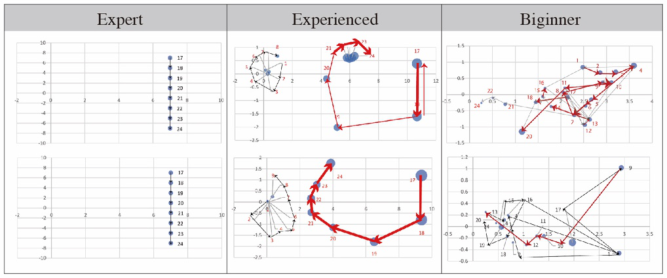
Behavioral observation experience was conducted to clarify the process of acquiring and recognizing music notation information in different levels of piano learning proficiency. A total of 20 subjects, 10 beginners (5 of whom had no musical experience) and 10 experienced, were asked to practice rea- ding music for a maximum of 10 minutes. The sequence data was created by checking the portions of the experiment in which the subjects worked. The order was determined by dividing the scores into bars and assigning numbers to each bar to denote the order of the subject’s actions. Based on this order data, a DEMATEL method was conducted to create a behavioral model for each subject’s skill level. The behavioral model created based on these experiments was classified into three levels according to the level of skill: (1) beginners: subjects with no piano experience at all, (2) experienced: subjects with less than one year of peer learning, and (3) expert: subjects with more than seven years of piano learning, and part of the behavioral model is shown in Figure 1.
Expert: A key feature of an expert is that there is no hesitation in the procedure. The score was about 15 seconds, but the average training time was extremely short (28 seconds), and it was found that there was almost no replay.
Experienced: As for the main feature, the first was that the procedures were established and practiced without hesitation, as were the behavioral models of the expert. Secondly, they practiced repetitive parts, many of which were common to them. Subjects tended to alternate between practicing with both hands and returning to one-handed practice. The last point was the confirmation of the octave, and during the practice, the subjects were seen hitting the keys while saying the note names aloud.
12 Akiba and Yang
Figure 1: Behavioral models by proficiency level.
Beginner: The first main feature of beginners is that there is a lot of variabi- lities subject to subject. Secondly, the number of times they showed keystroke behavior was small. Finally, the average practice time was 600 seconds, nearly double that of experienced users, which led to the use of the upper limit of practice time.
Results of Interview We conducted interviews with the subjects to clarify the differences in their behavioral features. Especially in beginners, there were characteristic beha- viors, and the main feature of these behaviors was the difficulty to read note heights. Many beginners have made mistakes in reading the D4 and B4. One reason for this is that it is hard to read them instantly due to their skewe- red shape on the staff. The further away from the middle “C4”, the more difficult it was to read, so the subject had to count from that position and fill in the ruby to figure out the note name. Moreover, they also struggled to distinguish the keys. Many beginners made mistakes playing D4, G4, and A4. Some said that it was difficult to distinguish keys that had the same shape, and that they couldn’t grasp the distance between keys. Another big differe- nce between beginners and experienced/experts is the difference in practice methods. The beginner’s behavior was scattered and unorganized, like repla- ying a stumbling block again or playing from start to finish repeatedly. In the interviews, subjects said that they didn’t know what to do and it took them a long time to read the information. Beginners spent most of their practice time on writing note names and practicing with the right hand and were only able to devote time to certain parts.
CONSIDERATION Based on the results so far, the following five methods can be used to provide present information on pitch, note length, and rhythm to beginners. (1) sup- port the establishment of practice procedures, (2) intuitively indicate the pitch of notes using methods other than text, (3) assist with rhythm using methods other than notation, (4) indicates the length of notes using forms other than notes and (5) separate display of notation. The main feature of this method
Learning to Read Music by Differences in Perception of Information 13
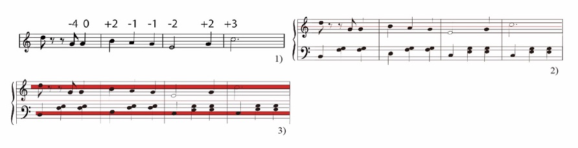
Figure 2: Display information about the pitch of the sound 1) Score with Numbers, 2) Score with red lines, 3) Sheet music with a red C4.
of displaying information is an intuitive way to indicate the pitch of a note using a method other than writing. All the beginners wrote the note names on the score, but there were many cases where they sounded notes in different octaves during the performance. This suggests that while the use of letters makes it easier to recognize the information as note names, it also reduces concentration on the notes and makes it harder to focus on the pitch of the notes. it is also necessary to use other assists for rhythm. Since it is difficult for beginners to read rhythms from notation, it is thought that assisting other than notation can disperse the points that are difficult and make it easier to read music since it is not necessary to read all the information at once.
Consideration of Music Notation Display Methods Information Display Method for Pitching For the method of displaying information based on the pitch of the note, we created three patterns (1) displaying the difference in pitch of the note in front in one-note increments, (2) displaying the line in the middle of the staff in red, and (3) displaying the line indicating the note of C4 in red) and conducted an evaluation experiment with five beginners. Particularly effe- ctive was the method in which the line indicating the note of C4 was shown in red. The results of the experiment showed that the time spent writing the note names was the most effective, and the time spent writing the note names and practicing with the right hand could be used to practice using the keybo- ard (Table 1). The fact that many beginners focused on counting the pitch of C4-based notes also led to better music playback. Previous studies have also shown that the use of color in music notation can be visually comprehensible for beginners (Kuo and Chuang, 2013), (Gregorian and Milyartini, 2020). By using color, subjects were able to instantly determine the pitch of the notes.
Information Display Method for Sound Length and Rhythm Based on the results of the experiment and discussion, for beginners who find the rhythm to be the most difficult part of the score, we considered a different way of displaying information from the score. We thought it would be easier to organize the information and establish the procedure by displaying the rhythm information with the length of the notes indicated by black boxes, as shown in Figure 3. To make it possible to visually judge the front and backbeats, we divided one measure into six parts and had the participants use the score we had studied. As a result, all the subjects sang “1, 2, 3, 4, 5, 6” while looking at the rhythm information display and confirmed the rhythm with their hands. It was also observed that subjects noticed their
14 Akiba and Yang
Table 1. Change in practice time for each subject.
Table available in the original PDF paper.
Subject Right-hand practice time
Left-hand practice time
Both-hands practice time
Time to write the sound name
(s)
(s)
(s)
(s) A Use existing scores 500.0 90.0 10.0 210.0 Use new scores 63.0 12.0 525.0 0.0 B Use existing scores 540.0 20.0 0.0 183.0 Use new scores 73.0 38.0 289.0 0.0 C Use existing scores 198.0 248.0 0.0 154.0 Use new scores 44.0 42.0 514.0 0.0 D Use existing scores 84.0 163.0 32.0 321.0 Use new scores 32.0 18.0 550.0 0.0 E Use existing scores 53.0 175.0 0.0 372.0 Use new scores 53.0 27.5 469.5 0.0
Figure 3: Display information about the rhythm.
Figure available in the original PDF paper.
own mistakes related to rhythm, which is thought to facilitate independent practice. Moreover, the number of keystrokes increased by more than three times for all subjects, suggesting that by dispersing the information from the score, the information is organized and can be read smoothly.
CONCLUSION
The purpose of this research was to examine how to make it easier for begin- ners to recognize and remember information about music notation, and how to make use of the information obtained more naturally. To this goal, we cla- rified the process by which beginners learn and recognize information about musical notation in piano learning activities and investigated the characteri- stics that they express when they perform using the recognized knowledge. To clarify these differences, behavioral observation showed that beginners have problems in reading practice procedures, note pitches, and rhythms and that it is necessary to consider new ways of displaying the three types of infor- mation in music notation: note pitch, note length, and sequence. To do this, we used the color properties for note height and extracted and organized the score information for note length. Thus, we were able to study a new infor- mation display method that supports independent and efficient learning of music reading, which has been one of the barriers for piano learners.
REFERENCES Atkinson, R.C., Shiffrin, R.M.(1968). Human memory: a proposed system and its control processes, Psychology of learning and motivation Volume 2, pp. 89–195. Cabinet Office. (Feb 9, 2022). Society 5.0: https://www8.cao.go.jp/cstp/english/soc
iety5_0/index.html.
Learning to Read Music by Differences in Perception of Information 15
Chen-Yi, H., Ke-Ting, C. and Gwo-Hshiung, T. (2007). FMCDM with Fuzzy DEMA- TEL Approach for Customers’ Choice Behavior Model, International Journal of Fuzzy Systems Volume 9 No. 4, pp. 236–246. Colombo, B., Antonletti, A. (2016). The Role of Metacognitive Strategies in Lear-
ning Music: A Multiple Case Study, Cambridge University Press 2016 Volume 34, pp. 95–113. Gregorian, S., Milyartini, R. (2020). Color Usage Study in Poco Piano Book for Beginner Young Children, In 2019 2nd International Conference on Arts and Design Education (ICADE 2019). Hallam, S. (2001). The development of metacognition in musicians: Implications for
education, British Journal Of Music Education Volume 18 No. 1, pp. 27–39. Inoue, M. (2013). Textbook of Interface Design, Maruzen Publishing. Kasahara, S., Nakahira, K. T. and Kitajima, M. (2016a). Relationship between spacetime trajectories of eye movements in score reading and piano performance skills, Information Processing Society of Japan Volume 78 No. 4, pp. 381–382. Kasahara, S., Nakahira, K. T. and Kitajima, M. (2016b). Identification of factors
of difficulty levels of music for piano players using space-time trajectories of eye movements in score reading, Forum on Information technology Volume 15 No. 3, pp. 281–282. Kasahara, S., Nakahira, K.T. and Kitajima, M. (2015). Feature extraction in score reading strategies of skilled / unskilled piano players using eye-movement data, Forum on Information technology Volume 14 No. 3, pp. 307–310. Kawashima, H., Morimoto, S. (2011). An Analysis of Effects of Solving Digi-
tal Divide, the National Conference of the Japan Society for Socio-Information Studies Volume 26, pp. 55–58. Kuo, Y. T., Chuang, M. C. (2013). A proposal of a color music notation system on a single melody for music beginners, International Journal of Music Education Volume 31 No. 4, pp. 394–412. Matsubara, M., Toyama, N. and Saito, H. (2006). A Computer-Assisted Lea-
ning System for Piano Novice, IIPSJ SIG Technical Report Volume 64 No. 14, pp. 79–84. Nagai, T. & Nakahira, K.T. and Kitajima, M. (2018). Musical score difficulty level determination using visual behavior data while sight-reading, Forum on Information technology Volume 17 No. 3, pp. 291–292. Nagai, T., Nakahira, K.T. and Kitajima, M. (2017). Analysis of the relationships
between the proficiency levels of piano playing and the changes in visual behavi- ors while reading score and performing piano, Information Processing Society of Japan Volume 2017 No. 20, pp. 1–7. Newell, A., Simon, H. A. (1972). Human problem solving, Englewood Cliffs, NJ: Prentice-Hall Volume104 No. 9, pp. 920. Roers, K., Rohlig, A., Weing, M., Gugenheimer, J., Konings, B., Klepsch, M., Schaub,
F., Rulzio, E., Seufert, T. and Weber, M. (2014). P.I.A.N.O.:Faster Piano Learning with Interactive Projection, ITS Children and Learning, pp. 149–158. Si, S. L., You, X. Y., Liu, H. C. and Zhang, P. (2018). DEMATEL technique: A systematic review of the state-of-the-art literature on methodologies and applications, Mathematical Problems in Engineering Volume 2018, p. 33. Toma, W., Nakahira, K. T. (2012). Description analysis of processes for acqui-
ring piano playing skill using eye-movement tracking while reading music scores, Forum on Information technology Volume 11 No. 3, pp. 559–560. Yamada, K., Nakahira, K.T. (2011). Designing of Piano Study Supporting System for Beginners, In IEICE Conferences Archives. The Institute of Electronics, Information and Communication Engineers, pp. 709–712.
LISTED IN THE AHFE DIGITAL BOOKSTORE CATALOGUE
Explore the complete digital volume
Kansei Engineering
Read this individual research paper free through the original publisher, or explore the full digital proceedings book.
ISBN 978-1-958651-16-2
Explore this ISBN in the AHFE Bookstore ↗Listed in the July 2026 bookstore catalogue; search by ISBN to confirm current availability · Digital book purchase optional