Wonseok Yang, Misato Akiba (2023). Relation between the reality of digital and texture information using Onomatopoeia. In: Interdisciplinary Practice in Industrial Design. AHFE Open Access, vol. 100, pp. 178–188. https://doi.org/10.54941/ahfe1002984
In recent years, virtual spaces and metaverse using VR technology have been attracting attention from web and application infrastructure services, and it has become commonplace to represent real information in the digital world. The spread of multiple devices has made it possible for anyone to browse and collect information on the web. Against this background, many businesses are accelerating the shift to e-commerce, meaning information on the texture of objects must be read digitally, creating a gap between the impression of the web and reality. Therefore, information that is difficult to read from such visual information is increasingly supplemented by elements such as language, motion, and sound. Among these, a verbal presentation can accurately convey ambiguous information, and among the verbal elements, onomatopoeia can be used to express detailed information as well as impressions based on sensitivity. In a previous study, it was found that onomatopoeic impressions have an intimate relationship with texture information through a system that can quantitatively capture onomatopoeic impressions. With the proliferation of e-commerce, the use of onomatopoeia is considered effective in narrowing the gap between digital images and impressions.This study clarifies the extent to which users can capture texture impressions from images and how the presentation of onomatopoeia affects texture impressions.In this experiment, 12 samples were displayed on the PC screen and evaluated in six categories (slippery/sticky, flat/uneven, smooth/rough, soft/hard, warm/cold, and moist/dry). The evaluation was performed using the SD method. In addition, we presented the appropriate onomatopoeia for each sample and conducted the same evaluation to clarify how the impression changed with and without onomatopoeia. The results indicated that the impression was positive for all samples, with significant results for four samples (slippery, soft, sticky, and uneven). In particular, the impression was reversed for all samples except for the slippery sample, indicating that onomatopoeia had a significant effect on the impression of the object. These results suggest that the respondents had little experience with objects and could not narrow down their impressions to a single texture image; their impressions were low without onomatopoeia, and the presentation of onomatopoeia enhanced the texture image. In addition, there were six samples with high impressions (smooth, flat, warm, rough, hard, and dry) even without the presentation of onomatopoeia. The tendency for high impressions is thought to be that the respondents can read the mono impression from the image and imagine the tactile texture from the visual information because it is difficult to cause a shift in recognition.In conclusion, the presentation of onomatopoeia is effective when the texture of an object can be read as multiple impressions, and it was found to have a positive effect on the impression of the object. Therefore, we believe that ambiguous texture impressions can be expressed and the gap between reality and onomatopoeia can be narrowed by presenting linguistic information.
The proliferation of multiple devices has created an environment in which anyone can browse and collect information on the Web. Thus, research on technologies to enhance information reality on digital screens, such as web and application infrastructure services, as well as virtual spaces and meta- verses using virtual reality technology is generating interest. As consumption activities of users are accelerating, particularly on e-commerce sites, oppor- tunities to read the textural information of objects digitally are increasing, and problems are arising because of the discrepancy between the impressions of an object on the screen and in physical reality. Therefore, some devices have been developed that use elements such as language, motion, and sound to compensate for the problem of information recognition, which is difficult
Relation Between the Reality of Digital and Texture Information 179
to achieve with visual information alone. One method is to enhance com- prehensibility by linguistic presentation and accurately convey ambiguous information. Among language elements, an onomatopoeia expresses detailed information and symbols based on sensitivity. Onomatopoeia is an indispen- sable method of linguistic expression in Japanese and is currently used to describe the state, appearance, and tactile qualities of objects. In information collection, the traditional search method of “Googling” using search engi- nes is now replaced with “tagging” using hashtags on social media and other tools. Moreover, searches using appropriate words that can evoke empathy within people, such as “cute” and “fashionable,” have become mainstream. In addition to nouns, verbs, and adjectives, an onomatopoeia, as an adverb, is used as a type of sensory word that can fulfill this function. Against this back- ground, an onomatopoeia is a linguistic expression used in daily life. Previous studies have shown a close relationship between onomatopoeias and textural information. Hayakawa et al. created a two-dimensional distribution map of onomatopoeias related to tactile sensations, and positioned materials evo- ked by onomatopoeias on the distribution map. Consequently, they observed three axes—roughness, hardness, and wetness—that were in conflict with each other. They revealed that onomatopoeias affect different impressions of tactile objects (Hayakawa et al. 2010). In addition, a system capable of quan- titatively capturing onomatopoeic impressions made it possible to quantify the fine expressions of onomatopoeias and concretely express the textural information of objects (Komatsu et al. 2009) (Akiyama et al. 2011) (Wata- nabe et al. 2014) (Shimizu et al. 2014) (Sakamoto et al. 2016). Therefore, onomatopoeias are considered to be effective in narrowing the gap between impressions of digital images and reality, with e-commerce sites becoming more widespread in many businesses. However, in many cases, the impres- sion of a texture from an image when the textural information is read digitally and when it is actually touched differs, and the emotional aspect is also con- sidered to be affected by how the texture impression is received. IWASA et al. found that the same sample showed a change in discomfort with tactile tex- ture owing to differences in naming (Iwasa et al. 2015). In other cases, the received and tactile impressions varied depending on the type of onomatopo- eia (Yuting et al. 2017) (Kwon et al. 2017). Therefore, when onomatopoeias with completely different meanings are presented, the impression of a texture may change.
Based on the above, this study aimed to clarify how the presentation of an onomatopoeia related to a texture affects the impression of the texture read from a screen. We clarify whether the onomatopoeia presented has a stronger verbal influence and a greater effect on the impression of a texture read from a screen than onomatopoeias with corresponding or opposite meanings.
WHAT IS ONOMATOPOEIA Onomatopoeia is a general term for onomatopoeic and mimetic words that express human feelings and sensations based on sounds in nature and actual actions (Inose, 2007). For example, the word “sticky” becomes “goo goo goo” when expressed as an onomatopoeia. In English, a single word has
180 Yang and Akiba
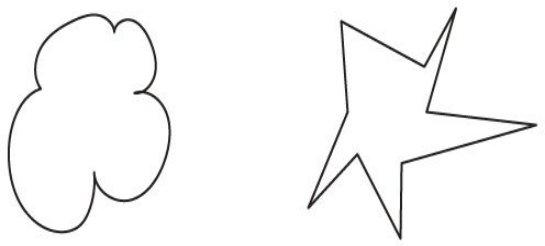
elements of a verb and an adjective, and an onomatopoeia can be used as an adverb to express more detailed nuances in words and thus plays an important role in Japanese expression. Onomatopoeias consist of the same vowel–consonant combination, i.e., /s/a/k/, e.g., “saka-saka” and “kasa- kasa,” but in different orders and with different meanings. Hamano showed that a Japanese onomatopoeia has a specific meaning depending on a particu- lar sound or combination of sounds (Hamano, 1986). A basic onomatopoeia is a repetitive expression, such as “fuwa-fuwa”; however, patterns such as “fuwa-” and “fuwari” also exist that use a combination of sounds to express sensory information that is difficult to express in words (Tamori, 1998) An onomatopoeia not only has a specific meaning depending on the sound of its words but also attracts attention in other senses, such as graphical information. Gestalt psychologist Köhler presented the words “maluma”and “takete” and two figures (Figure 1). We subsequently conducted an expe- riment to find a combination of figures that matched the images of these words. The results showed that respondents tended to answer “maluma” for the round figure on the left and “taketa for the angular figure on the right in Figure 1 (Köhler, 1929). A similar experiment by Ramachandran and Hubbard is also notable for the bouba-kiki effect, in which, as in the experiment by Köhler, the words “bouba” and “kiki” represent the rounded figure on the left and the angular figure on the right, respectively, in Figure 1 (Ramachandran et al. 2001).
This bias toward onomatopoeic expressions for meaningless figures sug- gests that these expressions present certain trends and effects for the shapes of the surfaces of objects and other elements.
RELATION BETWEEN TEXTURE AND ONOMATOPOEIA Because an onomatopoeia enables fine expressions, it can be used to pro- vide meanings indicative of different senses, such as touch and texture, which are expressed differently by different people. An onomatopoeia has a meaning, similar to words having meanings. Studies have quantified the information possessed by onomatopoeias, making it possible to express tex- tural information numerically (Fujisawa et al. 2006) (Shimizu et al. 2014).
Relation Between the Reality of Digital and Texture Information 181
The onomatopoeic impression system developed by Shimizu et al. expres- ses even soft-looking expressions such as “fuwa-fuwa” and “wafu-wafu” as different texture impressions because each item has a different impression value. The method of expressing a texture differs from person to person, and the same expression varies in degree between individuals. Therefore, by expressing an impression numerically, matching the meaning of an onomato- poeia and improving the impression of a texture become possible. Using this system, the relationship between an onomatopoeia and a tactile texture can be visualized. This facilitates the expression of a texture on the Web using the composition ratio of each onomatopoeic sensory word and allows sea- rching for information on desired objects and things using onomatopoeias (Ishibashi et al. 2011) (Doizaki et al. 2013) (Doizaki et al. 2015). This sugge- sts that onomatopoeias have a strong influence on the expression of textural information.
RESEARCH METHOD In this research, we conducted the following research and experiments to clarify how the presentation of onomatopoeia affects the impression of tex- ture read from images, and whether the presentation of onomatopoeia with the opposite meaning affects the impression of both words and texture information read from images.
1. Preliminary Survey
Subjects: 102 person (42 males, 60 females, average age 23.8 years)
Content: 1) To determine whether they use sensitivity words, including onomatopoeia, when reading information from images, and
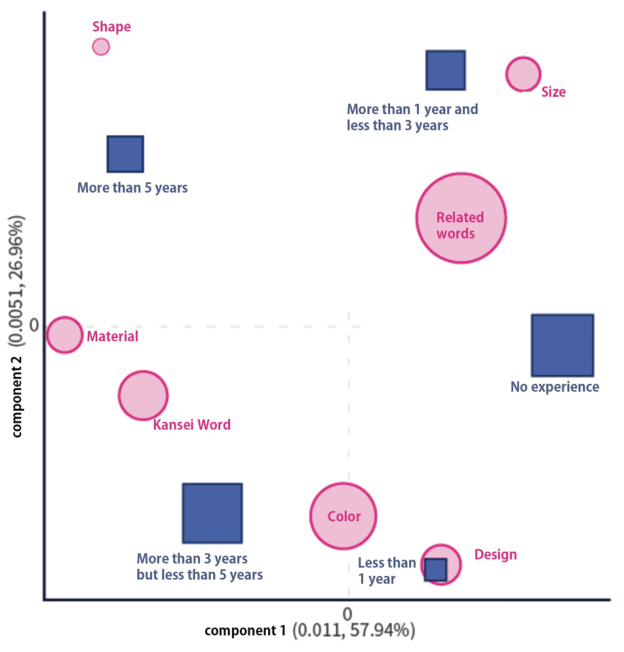
2) To clarify what kind of words are recalled As a result of the questionnaire, it was found that those with more years of design experience tended to use more sensory words, suggesting that their daily observation of objects led to a greater abundance of words.
2. To clarify how the presentation of onomatopoeia affects impressions, 12 samples with different textures were prepared. The experiment was conducted on 40 subjects (20 men and 20 women, average age 22.4 years, average experience 4.38 years), who had more than 3 years of design experience and were familiar with the representation of objects from the preliminary survey. 3. The experiment was conducted by dividing the subjects into two groups, as different naming of the same texture may give different impressi- ons (Iwasa et al. 2015). Group 2 was evaluated in the same way with negative texture onomatopoeia. 4. The tactile texture is composed of dimensions such as roughness, col- dness, wetness, and hardness, or it is composed of Soft/Harsh, Thin/Th- ick, Relief, and Hard, etc (Picard 2003) (Shirado et al. 2005). The texture expression is composed of multiple dimensions. In this study, the SD method is used to evaluate the five main material dimensions presen- ted by Nagano et al. and the six evaluation items “warm - cold,” “hard
182 Yang and Akiba
- soft,” “wet - dry,” “slippery - sticky,” “bumpy - flat,” and “smooth - rough” from the research by Sakamoto et al. (Nagano et al. 2011) (Sakamoto et al. 2016). 5. Since there were 40 subjects with data without onomatopoeia presenta- tion and 20 respondents with positive and negative onomatopoeia data, respectively, the Welch test was used to check for equality of variance to determine if significant results were obtained and to clarify the degree of influence of onomatopoeia presentation on texture impression.
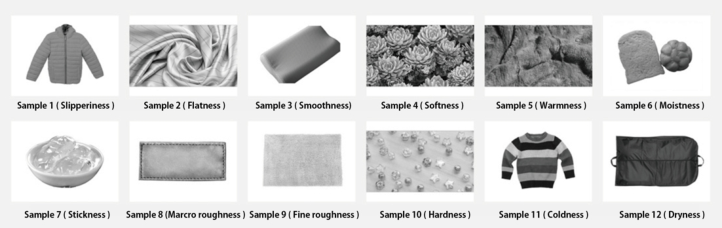
RESEARCH CONTENTS AND RESULT From the onomatopoeia map for touch and the material map (Sakamoto et al. 2016), 12 samples related to tactile texture were selected from free sites according to the evaluation items (Figure 2). The list of onomatopoeia used is shown in Table 1, with positive onomatopoeia corresponding to the tactile texture of the samples and negative onomatopoeia corresponding to the axis opposite to the tactile texture of the samples. In the experimental flow, the room environment was adjusted to 450 Lux, and the sample images were presented on a MacBook Pro 13-inch. Both groups first viewed the
Figure 2: Response analysis of imaged words by years of experience.
Relation Between the Reality of Digital and Texture Information 183
Figure 3: List of sample.Table 1. List of onomatopoeia.
sample without onomatopoeia and rated it on a 6-item, 7-point scale. Then, positive onomatopoeia was presented to Group 1 and negative onomatopoeia to Group 2, and the same evaluation was conducted. The onomatopoeia was displayed in the lower left corner of the sample image.
For each item, the scores were “warm (1) - cold (7),” “hard (1) - soft (7),” “wet (1) - dry (7),” “slippery (1) - sticky (7),” “uneven (1) - flat (7),” and “smooth (1) - rough (7),”with Table 2 showing the average value of each. The lower the score for samples 1, 3, 5, 6, 8, and 10, the stronger the impression of the item corresponding to that sample, especially for samples with scores less than 1-3. Samples 2, 4, 7, 9, 11, and 12 were defined as the higher the numerical value, the stronger the impression of the item corresponding to that sample, especially for samples with numerical values of 5 or higher. The
five samples that had higher impressions with no onomatopoeia presentation were 1, 2, 5, 9, 10, and 12.
Result of Positive Onomatopoeia When presented with positive onomatopoeia, impressions of the item were positive. The five samples with particularly significant results were samples 1, 4, 7, 8, and 11. As a common result, with the exception of sample 1, the impression of the object was lower when no onomatopoeia was presented, so the presentation of onomatopoeia increased the impression of the object. In particular, samples 4, 7, and 8 were far apart in their impressions of the object without the onomatopoeia, and changed to impressions that were close to reversed.
Result of Negative Onomatopoeia When negative onomatopoeia was presented, the impression of the item was negatively affected. In other words, it acted on the impression that the onoma- topoeia implied. The nine samples with particularly significant results were 1, 2, 3, 4, 6, 7, 9, 10, and 12. With the exception of sample 5, the sam- ples with high impressions without onomatopoeia were strongly influenced by the presentation of negative onomatopoeia. In the case of negative ono- matopoeia, two patterns were obtained: one in which the impression of the onomatopoeia was strongly influenced by the onomatopoeia and the impres- sion of the onomatopoeia was exactly what it meant, and the other in which the impression changed from the no onomatopoeia state, but was not influ- enced by the meaning of the onomatopoeia due to the impression of the no onomatopoeia state. These results indicate that the presentation of the tex- ture onomatopoeia pulls on the meaning of the onomatopoeia in most of the samples.
CONSIDERATION Based on the above results, the following conclusions can be drawn. First, except for Sample 1, the items that already had high impressions without ono- matopoeias were positively affected by the presentation of onomatopoeias. However, it was impossible to determine a difference. This suggests that the presentation of onomatopoeias may match a texture impression and increase the confidence of a user about texture impressions for items whose texture can be judged from an image or can be imagined from the experience of the user.
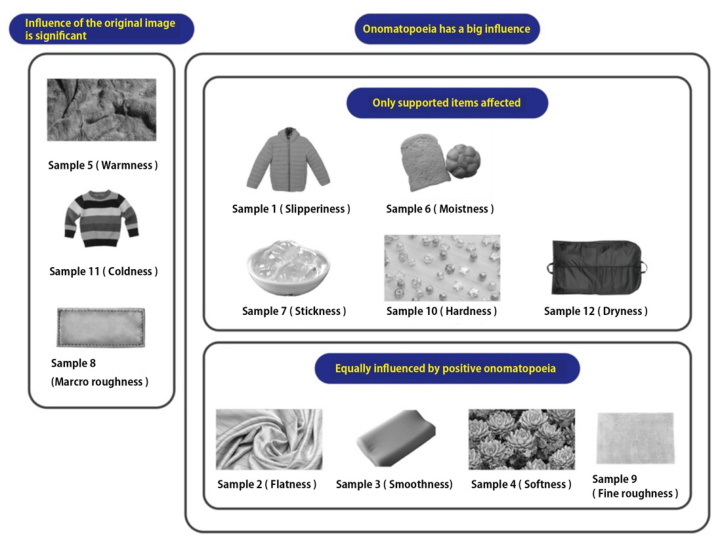
Second, for all samples that approached the original impressions by presen- ting positive onomatopoeias, except for Sample 1, the impressions without the onomatopoeias were poor and the impression of the object was positively affected by the presentation of the onomatopoeias. In particular, the impres- sions of Samples 4, 7, and 8 without onomatopoeias were different from those with the onomatopoeias; the impressions were almost reversed. Proba- bly because of the lack of experience with the objects used as the samples and the inability to narrow down to a single image, the impression level without the onomatopoeias was low. Thus, the presentation of the onomatopoeias
Relation Between the Reality of Digital and Texture Information 185
Figure 4: Summary of considerations.
helped the respondents imagine the textures of the objects. For example, for Sample 7, without the onomatopoeias, several patterns of impressions (silky, sticky, and plunging) were obtained for “sticky” impressions such as gel-like smoothness and jelly-like tactile sensation. For the same sample, the word “gooey” provides the impression of “sticky” whereas the word “smooth” that of “slippery.” The influence of texture onomatopoeias is considered to be strong for objects with multiple meanings.
Third, positive texture images (warm, soft, smooth, flat, smooth, and wet) and negative texture images (cold, hard, dry, uneven, rough, and sticky) were considered to be related. The reason for this is that the impression levels of “smooth” or “soft” were positively affected in most samples on using the positive onomatopoeias. Therefore, when expressing a texture with a positive effect, an onomatopoeia should be selected and presented, as it may improve items other than those for which the impression level is originally intended to be increased. As for the onomatopoeias with a negative texture image, “rough,” “hard,” and “dry” were considered to be particularly relevant. In Sample 9, when the onomatopoeic word “crumbly,” which has the element of a “rough”impression, was presented, no change was observed in the “rough” impression, whereas the “hard” and “dry” impressions were strongly affe- cted. The “crumbly” onomatopoeia may have provided the impression of coarseness and hardness because the impressions without it were “soft” and “spongy.” The fact that these onomatopoeic words were used with negative onomatopoeias showed a similar trend suggests that the impression of an onomatopoeia itself, regardless of the object, has a large impact.
186 Yang and Akiba
Fourth, nine samples including the sample with the highest impression under the no-onomatopoeia condition (except for Sample 5) showed a ten- dency to provide opposite impressions of the negative onomatopoeia. This suggests that the degree of influence of words is strong because even if an image of an impression is created in the absence of onomatopoeia, the impression is presented as an onomatopoeia. The degree of influence of an onomatopoeia changed the impression drastically for the corresponding item only. For the other items, there were two patterns: one was the ori- ginal impression and the other was almost the same as the result of the impression when the onomatopoeia was used with a positive onomatopoeia. Therefore, it can be considered that there are two types of onomatopo- eia: those that affect an onomatopoeia as it is meant and those that are affected by an onomatopoeia while considering the image of the original impression. However, not all these affect the meaning of an onomatopo- eia. Samples 5 and 8 showed a change in the impression when a negative onomatopoeia was presented. However, there was no effect on the impres- sion of that item, suggesting that the impression of the imagined texture is stronger than that of the onomatopoeia. In particular, Sample 11 did not show a significant change when an onomatopoeia corresponding to a warm cold item was presented, suggesting that it was less affected by the texture onomatopoeia.
CONCLUSION
The presentation of both positive and negative onomatopoeias had a positive effect on the impressions of items to which they corresponded, indicating that a texture onomatopoeia affects the impression of an object. In the case of positive onomatopoeias, the impression of the texture did not change much from the original impression, and the presentation of the onomatopoeias made the impression of a texture more vivid. However, in the case of negative onomatopoeias, the impression was significantly different from that based on the original image, and the negative onomatopoeias also made the impression of a texture more vivid. In the case of negative onomatopoeia, the impression of a texture was much different from that based on the original image and the influence of the words of the onomatopoeia was considered to be strong. Specifically, the presentation of positive onomatopoeias, which improve the image of a texture, has a more positive effect on the original impression, whereas the presentation of negative onomatopoeias, which have completely different meanings, is influenced by the meaning of the words if the image of the state without onomatopoeias is weak. The above results indicate that onomatopoeias can be used as a method of communication. From the above, it can be concluded that the presentation of onomatopoeias is effective in expressing the impression of an object, even in a digital form. In addition, even when an onomatopoeia with a meaning completely different from that of the corresponding texture is presented, observer tendency is to prioritize verbal information over visual information. Therefore, avoiding presenting words that are misrepresented is important.
Relation Between the Reality of Digital and Texture Information 187
REFERENCES
Akiyama, H. Komatsu, T and Kiyokawa, S. (2011). “Proposing an Objective Digitizing Method for Expressing One’s Impressions Derived from Onomatopoeias”, IPSJ SIG technical reports, No. 23, pp. 1–7. Doizaki, R. Iiba, S. Abe, T. Okatani, T and Sakamoto, M. (2013). “Product Recom-
mendation Method Based on Onomatopoeia Image Evaluation System”, The 27th Annual Conference of the Japanese Society for Artificial Intelligence, 2013, pp. 3N1OS01a1-3N1OS01a1. Doizaki, R. Iiba, S. Okatani, T and Sakamoto, M. (2015). “Possibility to Use Product Image and Review Text Based on the Association between Onomatopoeia and Texture”, Transactions of the Japanese Society for Artificial Intelligence, Volume 30, No. 1, pp. 124–137. Fujisawa, N. Obata, F. Takada, M and Iwamiya, S. (2006). “Impression of audi-
tory imagery associated with Japanese 2-mora onomatopoeic representation”, Acoustical Society of Japan, Volume 62, No. 11, pp. 774–783. Hamano, S. (1986). “The sound-symbolic system of Japanese (ideophones, onomatopoeia, expressives, iconicity)”, University of Florida. Hayakawa, T. Matsui, S and Watanabe, J. (2010). “Classification Method of
Tactile Textures Using Onomatopoeias”, The Virtual Reality Society of Japan, Volume 15, No. 3, pp. 487–490. Inose, H. (2007). “Translating Japanese onomatopoeia and mimetic words”, Translation research projects, No. 1, pp. 97–116. Ishibashi, K and Miyata, K. (2011). “An Emotion Input Method Using Onomato-
poeia and its Application for Image Query”, The 25th Annual Conference of the Japanese Society for Artificial Intelligence, 2011, pp. 1C2OS4b10-1C2OS4b10. Iwasa, K and Komatsu, T. (2015). “Naming of an object affects visually-induced tactile impression and emotional valence. An investigation using the tactile ono- matopoeia.”, Transactions of the Japanese Society for Artificial Intelligence, Volume 30, No. 1, pp. 265–273. Köhler, W. (1929). “Gestalt psychology.” Komatsu, T. Kiyokawa, S and Akiyama, H. (2009). “Attributes to express intuitive
impression of onomatopoeias and their digitalization”, Human-Agent Interaction Symposium 2009. Kwon, J. Yoshino, J. Kosahara, M. Nakauchi, S and Sakamoto A. (2017). “Relation between naturalness and luxuriousness through onomatopoeia expressing texture”, The Japanese Journal of Psychonomic Sciense 2017, Volume 36, No. 1, pp. 40–49. Nagano, H. Okamoto, S and Yamada, Y. (2011). “Research Directions in Structuring
of Tactile Dimensions of Material Textures”, The Virtual Reality Society of Japan, Volume 16, No. 3, pp. 343–353. Picard, D. Dacremont, C. Valentin, D and Giboreau, A. (2003). “Perceptual dimensions of tactile textures” Acta psychologica, Volume 114, No. 2, pp. 165–184. Ramachandran, V. S., and Hubbard, E. M. (2001). “Synaesthesia--a window into
perception, thought and language” Journal of consciousness studies, Volume 8, No. 12, pp. 3–34. Sakamoto, M. Tahara, T and Watanabe, J. (2016). “A system to Visualize Individual Variation in Tactile Perception using Onomatopoeia Map”, Transactions of the Virtual Reality Society of Japan, Volume 21, No. 2, pp. 213-216. Shimizu, Y. Doizaki, R and Sakamoto M. (2014). “A System to Estimate an Impres-
sion Conveyed by Onomatopoeia”, Transactions of the Japanese Society for Artificial Intelligence, Volume 29, No. 1, pp. 41–52.
188 Yang and Akiba
Shirado, H and Maeno, T. (2005). “Modeling of human texture perception for tactile displays and sensors.” In First Joint Eurohaptics Conference and Symposium on Haptic Interfaces for Virtual Environment and Teleoperator Systems. World Haptics Conference. pp. 629–630. IEEE. Tamori, I. (1998). “Characteristics of Japanese onomatopoeia”, Acoustical Society
of Japan, Volume 54, No. 3, pp. 215–222. Watanabe, J. Kano A and Sakamoto, M. (2014). “Trend Visualization of Emotional Judgments on Materials in Contact Using Distribution Map of Japanese Onoma- topoeic Words”, International Journal of Affective Engineering, Volume 13, No. 2, pp. 353–359. Yuting, X. Gobara, A, Sasaki, K and Yamada, Y. (2017). “Viscid Onomatopoeiae
Alter Visual Disgust”, Cognitive Studies, Volume 24, No. 3, pp. 360–375.
LISTED IN THE AHFE DIGITAL BOOKSTORE CATALOGUE
Explore the complete digital volume
Interdisciplinary Practice in Industrial Design
Read this individual research paper free through the original publisher, or explore the full digital proceedings book.
ISBN 978-1-958651-76-6
Explore this ISBN in the AHFE Bookstore ↗Listed in the July 2026 bookstore catalogue; search by ISBN to confirm current availability · Digital book purchase optional