Reiji Harada, Wonseok Yang (2026). The Impact of Differences in UX Writing on Users’ KANSEI: Framing Effects of Variations in Tone and Style. In: Interdisciplinary Practice in Industrial Design. AHFE Open Access, vol. 222, pp. 121–131. https://doi.org/10.54941/ahfe1007752
As internet businesses expand, customer service and guidance conversations are being replaced by short UI texts, such as app and e-commerce copywriting, notification messages, and button labels. Users infer a service’s attitude and sense of security from a single line of text and decide on their next action (sign up, purchase, continuation). Wording directly impacts trust, familiarity, and motivation, especially in high-uncertainty situations, such as onboarding or input errors. Thus, the tone and style of UX writing determine the quality of the experience. Moran (2016) also reported that nearly identical content could influence brand impressions based on tonal differences. Therefore, this research quantitatively clarified the effects of stylistic tone on emotional responses and continued actions through impression evaluations and behavioral logs. In the registration task, impressions of four writing styles were organized into two factors: “cognitive value” and “emotional value,” revealing trade-offs. A humble polite style maximized cognitive value, whereas a friendly tone maximized emotional value. Continued usage intent increased through emotional value, although resistance (e.g., perceived overfamiliarity) was also observed. In a subsequent voluntary continuation task involving 46 university students, the median number of responses was the highest for the friendly conversational tone, which descriptively exceeded the formal polite tone. However, the difference in the dropout rates between groups was not statistically significant. Meanwhile, for the friendly tone, “reliability/reassurance” and “individuality/enjoyment” functioned as separate axes, showing a tendency for their coexistence to lower dropout risk. Consequently, designing a writing style that aligns with emotions, and not just the accuracy of information, can potentially encourage continued usage. This research suggests a strategy that strategically switches the tone within the bounds of maintaining reliability, depending on the usage context and value orientation.
The advancement of ICT has shifted activities such as purchasing, reservations, and learning from offline to online. Nonverbal cues, such as tone of voice, facial expressions, and interpersonal distance, which were previously obtained through conversation, become constrained within the UI. As recipients infer the attitude and relational dynamics of the service from limited textual information, subtle differences in tone and style have become more influential in shaping impressions and decision making. HCI research has shown that people treat Received February 19, 2026; Revised April 13, 2026; Accepted May 3, 2026; Available online July 20, 2026
122 Harada and Yang computers as social actors and apply the norms of interpersonal interaction (e.g., politeness , reciprocity) to them (Reeves & Nass, 1996; Nass & Moon, 2000). It has been reported that language expression in dialogue agents can influence trust formation and continued usage intent (Bickmore & Cassell, 2001; Lankton et al., 2015). Meanwhile, UX writing focuses on designing short texts like copy, notifications, and button labels, providing a framework to construct personality impressions such as “formal/casual” or “respectful/ colloquial” through ToV (Tone of Voice). Moran (2016) reported that even nearly identical content can influence brand perception and affect evaluations of trust and expertise based on tone differences. However, few studies have quantitatively verified the impact of tonal and stylistic variations on user impression evaluations and actual behaviors within text-centric UIs. Further, Japanese possesses linguistic resources that allow subtle adjustments to social distance and emotion through choices, such as honorific versus plain style, honorific language, and sentence-final particles (Ide, 1989; Maynard, 1997; Fukushima, 2008). While studies have reported that differences in politeness/ friendliness affect impressions in voice interactions, research quantitatively verifying which value dimensions (trust/sincerity vs. familiarity/enjoyment) are evoked by similar manipulations in text-based UIs, and how these link to continuation intent and behavior via impression evaluation remains limited. Therefore, this research aims to experimentally clarify how differences in tone and style in Japanese UIs alter users’ impression evaluations and further influence usage intention and continued behavior (time until dropout and number of responses).
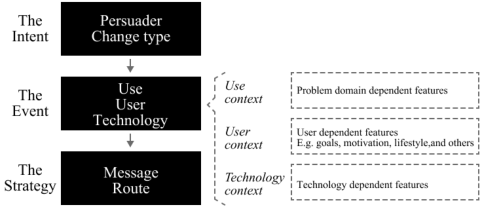
SOCIAL INTERACTION IN LANGUAGE-CENTERED INTERFACES Research on human–computer interaction (HCI) has shown that people treat computers as social actors and apply norms similar to those used in interpersonal interactions (Reeves & Nass, 1996; Nass & Moon, 2000). From this perspective, studies on conversational agents and interfaces have reported that linguistic expressions such as politeness and empathy can influence trust formation and the intention to continue use (Bickmore & Cassell, 2001; Lankton et al., 2015). Oinas-Kukkonen and Harjumaa (2009) proposed a Persuasive Systems Design (PSD) framework, organizing design elements that promote attitude and behavior change through support, such as dialogue and credibility support, as shown in Figure 1.
Figure 1: Analyzing the persuasion context in persuasive systems design (Oinas- Kukkonen& Harjumaa, 2009).
The Impact of Differences in UX Writing on Users’ KANSEI 123 In recent years, in the context of multimodal conversational agents involving speech, embodiment, and vision, paralinguistic information such as tone, speech rate, and pitch—not only the words themselves—has been examined for its influence on persuasiveness, trust, and decision making. For example, Pias et al. (2024) showed that the combination of a voice assistant’s perceived tone (positive/neutral/negative) and impressions of age and gender is associated with persuasiveness and purchase decisions, suggesting that modality-derived cues can shape judgments in addition to the content of the utterance. However, in situations such as onboarding or input errors in mobile apps, where text is the primary cue, modalities such as voice, facial expression, and timing are constrained, and these findings may not be generalizable. Rather, a single limited line of text (tone, style, sentence-final form) may function excessively as a social cue and directly shape impressions and subsequent actions. However, quantitative studies linking tone differences in text-centered UIs to actual behavior remain scarce.
UX WRITING AND LINGUISTIC CHARACTERISTICS OF JAPANESE UX writing focuses on designing short texts within the UI (copies, notifications, button labels, etc.) and has been systematized as a factor influencing user comprehension, decision-making, and impression formation (Redish, 2012; Holm, 2019). Specifically, Tone of Voice (ToV) is a framework for constructing a system’s personality impression through writing style and tone, organized as a continuum such as formality/friendliness (Moran, 2016). However, many existing studies have focused solely on measuring impression evaluations and attitudes (such as usage or recommendation intent), with limited examples consistently verifying how tonal differences affect actual behavior (e.g., retention rates, time to churn, and completion rates). Furthermore, while UX theory reports that affective evaluations correlate with attitude formation and usage intent (Hassenzahl, 2004; Hassenzahl et al., 2010), it remains unclear which affective dimensions are activated by “subtle linguistic manipulations” like tone and style variations, and how these connect to continued behavior.
Furthermore, Japanese possesses linguistic resources that can adjust “distance” and “emotional tone” with minimal changes. Specifically, linguistic choices, such as honorific and non-honorific forms, honorific language structures, and sentence-ending patterns, have been noted as crucial means of indicating social distance and the degree of consideration (Ide, 1989). Furthermore, conversational studies have shown that sentence-final expressions, including sentence-final particles, play a role in constructing interpersonal stances and emotional nuances (e.g., empathy/agreement, assertion/emphasis) (Maynard, 1997; Fukushima, 2008). In addition, in voice dialogue contexts, differences in politeness/friendliness have been reported to influence impression evaluations (Ouchi et al., 2018). However, text-centric UIs such as mobile apps do not clarify which value axes (trust/sincerity vs. familiarity/enjoyment) similar linguistic forms evoke and how they connect to actions (registration, retention, and churn). Findings on ToV primarily from English-speaking contexts may not fully account for the effects of Japanese’s “fine-tuning through sentence endings and honorifics.”
Table 1: Japanese linguistic features and their interpersonal and affective functions Linguistic Feature Example Primary Impressions / Functions Representative Studies
Table available in the original PDF paper.
Ide (1989)
Polite form (desu/ masu)
–desu / –masu Politeness, reliability, social distance Plain form –da / –suru Directness, equality, informality Ouchi et al. (2018)
Fukushima (2008)
Sentence-final particle “ne”
–desu ne Empathy, consideration, alignment with the user
Maynard (1997)
Sentence-final particle “yo”
–desu yo Assertion, emphasis, speaker authority
RESEARCH METHOD This research investigated the effects of text tone and style on users’ perceptions and subsequent behavioral changes within online services, following the procedures outlined below (Figure 2).
Figure 2: Research flow.
Figure available in the original PDF paper.
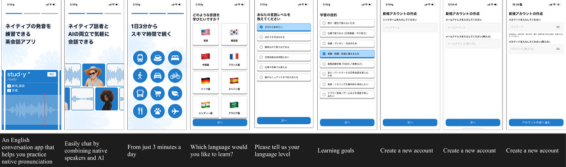
Step 1: Examining the Impact of Differences in Tone and Style on Impression Ratings This research aims to clarify the impact of different UX writing styles on psychological evaluation during initial use (onboarding). A within-subjects experiment was conducted using a language learning app prototype (Figure 3) with 20 university students (aged 20–23). Four text tones were set: “T1: Formal Polite (Standard Honorific Style)”, “T2: Friendly Conversational (Casual Speech, Frequent Use of Concluding Particles)”, “T3: Direct and Concise (Noun-Ending Sentences)”, and “T4: Humble Polite (High-Level Honorifics)”. After completing the account registration task for each prototype, the participants responded to a 12-item impression evaluation using the SD method, a 41-item questionnaire (Table 2), and a semi-structured interview.
Figure 3: Prototype used in the experiment.Table 2: Survey questions.
Table available in the original PDF paper.
Category Questionnaire Basic Information 0-1. Gender Male / Female / Other 0-2. Age (Open-ended) 0-3. Occupation Employee / Student / Homemaker / Other
Overall Impression (Semantic Differential Scale)
Overall impression of the app’s tone and manner 1-1. Distant — Friendly 1-2. Mechanical — Human-like 1-3. Boring — Fun 1-4. Untrustworthy — Trustworthy 1-5. Anxious — Reassuring 1-6. Unprofessional — Professional 1-7. Negative — Positive 1-8. Insincere — Sincere 1-9. Cold — Warm 1-10. Generic — Unique 1-11. Amateurish — Sophisticated 1-12. Unkind — Kind
2-1. Ease of Operation Overall, how easy was the account registration process? (1: Very difficult — 7: Very easy) 2-2. Clarity of Instructions How clear were the explanations and instructions displayed within the app? (1: Very unclear — 7: Very clear) 2-3. Comprehension of Password Note Did you immediately understand the content when you read the note on the password setting screen (the “8 characters or more...” part)? (1: Did not understand at all — 7: Understood immediately) Behavioral Intention 4-1. Intention to Use If this app were officially released, would you like to use it? 4-2. Intention to Complete Registration Did you want to complete the registration process for this app? 4-3. Intention to Recommend Would you recommend this app to your friends or colleagues? 4-4. Intention to Continue Use Did you feel like you would want to use this app continuously? (All items: 1: Strongly Disagree — 7: Strongly Agree)
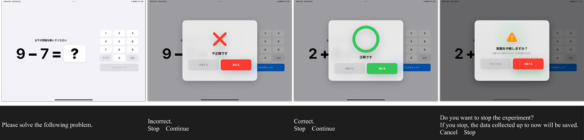
The objective of this research was to quantitatively verify how differences in writing style affected continued engagement and dropout risk. Based on the findings from Experiment 1, Experiment 2 assigned 46 university students to four conditions (T1–T4) and asked them to perform simple calculation tasks on an iPad for up to 20 minutes. Only UX writing for feedback and progress presentations was manipulated.
Figure 4: Prototype used in the experiment.
Participants could choose to “interrupt” at any time, after which they switched to watching YouTube (could not return to the calculation). Under these conditions, the total number of questions answered, time until dropout, and continuation/dropout were recorded as behavioral logs, followed by a final questionnaire (Table 3).
Table 3: Survey questions.
Table available in the original PDF paper.
Category Questionnaire Basic Information Same as step1
Overall Impression Same as step1 Writing Style Same as step1
Task Experience (7-point scale)
How boring was the task?( Very boring ⇔ Very enjoyable) Was the difficulty level appropriate?( Very difficult ⇔ Very easy) How enjoyable was the task?( Very boring ⇔ Very enjoyable) Did you feel a sense of accomplishment?( Did not feel at all ⇔ Felt strongly)
Intention Reason for Behavior (Multiple choice)
Reasons for Continuing (Only for those who completed the task) Did not get bored / Did not feel monotonous / Did not get tired / Maintained concentration / Could foresee the end or pace / Felt a reason or purpose to continue / Maintained motivation / Other Reasons for Quitting (Only for those who stopped midway) Got bored / Felt monotonous / Got tired / Lost concentration / Could not see the end / Could not feel a reason or purpose to continue / Could not maintain motivation / Other
Results on Examining the Impact of Differences in Tone and Style on Impression Ratings Factor analysis using the SD method (verifying impressions across styles) revealed a three-factor structure in T1. However, two axes were dominant
The Impact of Differences in UX Writing on Users’ KANSEI 127 across all conditions: one related to Function/Reliability (“reliability, sincerity, sophistication”) and another related to Emotion/Affinity (“friendliness, warmth, enjoyment”). Therefore, common factors F1 = Cognitive Value (reliability, sincerity, sophistication) and F2 = Emotional Value (approachability, warmth, enjoyment) were defined, and factor scores were calculated.
Repeated measures two-way ANOVA (Style × Factor) revealed a significant main effect of Style: F(3,57) = 9.323, p < .001, a main effect of Factor: F(1,19) = 66.725, p < .001, and a very strong interaction. This indicates that style does not merely enhance or diminish perceptions of “good/bad,” but rather switches which value axis is activated.
Furthermore, the multiple regression analysis of usage intent showed that initial adoption intent (Q4-1) in T4 was significantly positively influenced by F1(β = 0.23, p < .001, R² = 0.51) at T4 (Table 4), indicating that trust and formality can motivate adoption at the entry stage. In contrast, continued usage intention (Q4-4) was primarily driven by F2, with a significant positive effect confirmed especially at T2 (β ≈ 0.37, p < .01, R² = 0.43) (Table 7). Furthermore, registration completion intention (Q4-2) showed a significant negative effect of F2 at T4 (β ≈ −0.30, p < .05; model p < .10), while F1 showed a tendency toward a positive contribution at T1 (p < .10). Conversely, the intention to recommend to others (Q4-3) only formed a significant model at T1, where F2 showed a positive influence (β ≈ 0.34, p < .05) (Tables 5, 6).
Semi-structured interviews revealed that T2 was personified as a “friend/ partner,” with participants discussing its ease of onboarding and reduced psychological burden during failures. However, it was also suggested that depending on its portrayal, it could elicit rejection reactions such as being perceived as “too familiar” or “forcedly human-like.”
Table 4: Results for intention to continue using.
Table available in the original PDF paper.
Table 5: Results for intention to complete registration.
Table available in the original PDF paper.
Table 6: Results for intention to recommend to others.
Table available in the original PDF paper.
Table 7: Results for intention to continue using.
Table available in the original PDF paper.
Results on Examining the Impact of UX Writing Tone on Behavior Change First, in the factor analysis of the 12 SD items, the evaluation structure partially changed due to the repetitive work context, and T2 differentiated into three factors: reliability/security, kindness/interpersonal emotion, and individuality/enjoyment. T1 yielded two factors: “Mechanical/Anxiety” and “Sincerity/Positive Reliability”; T3 yielded “Emotional/Security” and “Cognitive/Formality”; T4 yielded ‘Warmth’ and “Psychological Distance/ Dehumanization.” This particularly indicated that excessive politeness can simultaneously induce positive emotions and a sense of distance. In behavioral logs, the median number of responses before dropout was highest for T2=334 questions, approximately 2.9 times that of baseline T1=116 questions, indicating a descriptive statistical tendency for friendly writing styles to increase continuation rates (Table 8).
Table 8: Median number of responses before dropout by writing style.
Table available in the original PDF paper.
However, the overall comparison of survival curves (log-rank test) showed no significant difference with χ² = 3.5, df = 3, p = 0.3. Pairwise comparisons (after Bonferroni correction) also revealed no significant differences, indicating no statistically significant differences in the individual writing styles alone (Table 9).
Table 9: Results of the Cox proportional hazards model in T1.
Table available in the original PDF paper.
We then examined the relationship between “impression → churn risk” using Cox proportional hazards models. At T2, as shown in Table 11, the interaction between “reliability/reassurance × individuality/enjoyment” showed a significant trend (HR = 0.461, p = 0.086), indicating that higher levels of both simultaneously may reduce churn risk by approximately 54% (Concordance = 0.881). At T1, as shown in Table 10, a trend was observed where higher “Sincerity/Positive Reliability” reduced dropout (HR = 0.576).
The Impact of Differences in UX Writing on Users’ KANSEI 129 However, no effect was confirmed at T3 (Table 13). At T4, predictive accuracy was low (Concordance = 0.548) as shown in Table 13, suggesting that the strong “reliability” evaluation observed in Experiment 1 may have limited predictive power for sustaining repetitive tasks. Overall, sustained behavior cannot be fully explained by “enjoyable” or ‘reliable’ alone. Particularly in the friendly style, the simultaneous presence of “reliability × enjoyment” appears to support continued engagement.
Table 10: Results of the Cox proportional hazards model in T1.
Table available in the original PDF paper.
Table 11: Results of the Cox proportional hazards model in T2.
Table available in the original PDF paper.
Table 12: Results of the Cox proportional hazards model in T3.
Table available in the original PDF paper.
Table 13: Results of the Cox proportional hazards model in T4.
Table available in the original PDF paper.
Through Experiments 1 and 2, it was confirmed that variations in UX writing tone can shift impressions away from a single dimension of “likability” and instead establish them along multiple axes of cognitive value (trust/sincerity) and emotional value (friendliness/enjoyment). In the onboarding (registration) phase, a polite and formal tone can support initial actions by building trust. Conversely, in the retention phase, a friendly tone tends to increase emotional engagement, boosting both retention intent and usage volume. However, retention behavior cannot be fully explained by “enjoyable” or “trustworthy” alone. Particularly with the friendly tone, the ability to balance reliability/reassurance with distinctiveness/enjoyment was suggested to potentially reduce churn risk.
CONCLUSION
Previous research has shown that language expressions and ToV in interactive interfaces can influence trust and impression formation. Persuasive Systems Design (PSD) organizes these as design elements encompassing dialogue support and trustworthiness support from the perspective of behavior change. However, quantitative verification has been limited to considering how subtle differences in tone and style within text-based UIs are connected to actual registration and retention behaviors via affective evaluation. Addressing this gap, the present research demonstrates that differences in tone and style within UX writing can be evaluated by users not solely based on a single “likability” dimension, but rather across multiple value dimensions: cognitive value based on trustworthiness and sincerity, and emotional value based on familiarity and enjoyment. Furthermore, the value axis that emerges depends on style, and tradeoffs between the two may occur depending on the usage context. Additionally, this research indicates that the role styles play differs between “introduction” and “retention,” rather than concluding the superiority of one style over another. Although statistical significance was not reached in the overall retention differences across styles, the friendly conversational style (T2) showed the potential to support continued action when it not only evoked emotional engagement, but also aligned with cognitive reassurance. Conversely, the humble polite style (T4) tended to lower barriers to initial introduction through trust building, but was less likely to connect directly to the motivation for repetitive continued action. Direct and concise (T3) enhances information transmission efficiency, but struggles to generate emotional engagement, suggesting a difficulty in strongly driving behavioral change. Formal politeness (T1) functions as a stable style that maintains relationships through sincerity while avoiding excessive emotional appeal. Therefore, UX writing design requires strategic selection of vocabulary, honorific forms, sentence-ending moods, and interpersonal distance based on prioritized values (trust acquisition/emotional engagement) clarified according to the service phase (onboarding or retention) and context (learning, repetition, error/emergency situations). This approach replaces blanket optimization like “just write politely” or “just make it easy to understand.” Practically, a hybrid approach might be effective: using a style strong in trust-building for onboarding, fostering attachment with a style that enhances emotional engagement during routine learning/repetition phases, and reducing cognitive load with conciseness during errors or similar situations. While this research focused on Japanese UI, the framework can be extended to multilingual UI by emphasizing that users interpret text as “perceived tone” rather than the linguistic form itself.
REFERENCES
Bickmore, T. and Cassell, J. (2001) ‘Relational agents: A model and implementation of building user trust’. In: Proceedings of the SIGCHI Conference on Human Factors in Computing Systems (CHI ’01). New York: Association for Computing Machinery, pp. 396–403. doi: 10.1145/365024.365304. Fukushima, Kazuro. (2008). Characteristics of the sentence-final particles “yo” and
“ne” based on listeners’ impression. The Science of Reading, 51(2), 66–73.
The Impact of Differences in UX Writing on Users’ KANSEI 131 Hassenzahl, M. (2004) ‘The interplay of beauty, goodness, and usability in interactive
products’. Human–Computer Interaction, 19(4), pp. 319–349. doi: 10.1207/ s15327051hci1904_2. Hassenzahl, M., Diefenbach, S. and Göritz, A. (2010) ‘Needs, affect, and interactive products: Facets of user experience’. Interacting with Computers, 22(5), pp. 353–362. doi: 10.1016/j.intcom.2010.04.002. Holm, L. (2019) Improving Task Performance in User Experience Writing: a
validation of two methods in digital and in-person user contexts. Independent thesis (Master), KTH Royal Institute of Technology, School of Electrical Engineering and Computer Science (EECS). Available at: https://kth.diva- portal.org/smash/record.jsf?pid=diva2%3A1337219 (Accessed: 19 January 2026). Ide, S. (1989) ‘Formal forms and discernment: Two neglected aspects of universals of linguistic politeness’. Multilingua, 8(2–3), pp. 223–248. Jordan, P.W. (2000) Designing pleasurable products: An introduction to the new
human factors. London: Taylor & Francis. Lankton, N.K., McKnight, D.H. and Thatcher, J.B. (2014) ‘Incorporating trust-intechnology into Expectation Disconfirmation Theory’. The Journal of Strategic Information Systems, 23(2), pp. 128–145. doi: 10.1016/j.jsis.2013.09.001. Maynard, S.K. (1997) Japanese communication: Language and thought in context.
Honolulu: University of Hawai’i Press. Moran, K. (2016) ‘The four dimensions of tone of voice’. Nielsen Norman Group.
Available at: https://www.nngroup.com/articles/tone-of-voice-dimensions/ (Accessed: 19 January 2026). Nagamachi, M. (1995) ‘Kansei engineering: A new ergonomic consumer-oriented technology for product development’. International Journal of Industrial Ergonomics, 15(1), pp. 3–11. doi: 10.1016/0169-8141(94)00052-5. Nass, C. and Moon, Y. (2000) ‘Machines and mindlessness: Social responses to
computers’. Journal of Social Issues, 56(1), pp. 81–103. doi: 10.1111/0022- 4537.00153. Norman, D.A. (2004) Emotional design: Why we love (or hate) everyday things.
New York: Basic Books. Oinas-Kukkonen, H. and Harjumaa, M. (2009) ‘Persuasive systems design: Key issues, process model, and system features’. Communications of the Association for Information Systems, 24(1), pp. 485–500. Ouchi, S., Sakamoto, D. and Ono, T. (2018) ‘Should Speech Dialogue System Use
Honorific Expression? Comparative Study on Understanding Impressions of Different Politeness Utterances’. In: HAI Symposium 2018 Proceedings (HAI 2018). Paper P-30. Available at: https://hai-conference.net/proceedings/HAI2018/ pdf/P-30.pdf (Accessed: 19 January 2026). Pias, S.B.H., Huang, R., Williamson, D., Kim, M. and Kapadia, A. (2024) ‘The Impact of Perceived Tone, Age, and Gender on Voice Assistant Persuasiveness in the Context of Product Recommendations’. In: ACM Conversational User Interfaces 2024 (CUI ’24), July 08–10, 2024, Luxembourg, Luxembourg. ACM, New York, NY, USA, 15 pages. doi: 10.1145/3640794.3665545. Redish, J. (2012) Letting go of the words: Writing web content that works. 2nd edn.
Burlington, MA: Morgan Kaufmann. Reeves, B. and Nass, C. (1996) The media equation: How people treat computers, television, and new media like real people and places. Stanford, CA: CSLI Publications. Schütte, S. (2005) Engineering emotional values in product design: Kansei Engineering
in development. PhD thesis. Linköping University. Tractinsky, N., Katz, A.S. and Ikar, D. (2000) ‘What is beautiful is usable’. Interacting with Computers, 13(2), pp. 127–145. doi: 10.1016/S0953-5438(00)00031-X.
LISTED IN THE AHFE DIGITAL BOOKSTORE CATALOGUE
Explore the complete digital volume
Interdisciplinary Practice in Industrial Design
Read this individual research paper free through the original publisher, or explore the full digital proceedings book.
ISBN 978-1-964867-98-4
Explore this ISBN in the AHFE Bookstore ↗Listed in the July 2026 bookstore catalogue; search by ISBN to confirm current availability · Digital book purchase optional