Miyo Yamanaka, Wonseok Yang (2026). Exploring Enhanced Notation Display Methods to Support Music Reading Acquisition. In: Interdisciplinary Practice in Industrial Design. AHFE Open Access, vol. 222, pp. 111–120. https://doi.org/10.54941/ahfe1007751
Learning piano requires learners to master both repetitive practice and music reading. Music reading demands the rapid and simultaneous processing of multiple pieces of score information. However, many beginners struggle to acquire effective music-reading skills and often discontinue learning. Although previous studies have identified differences in the information-processing capacity between advanced learners and beginners, the behavioral mechanisms underlying beginners’ difficulties remain unclear. This study examines how learners at different proficiency levels perceive and practice music reading during piano performances. Behavioral observation experiments were conducted with 20 participants, including beginners, experienced learners, and advanced learners. Practice behaviors were recorded, coded into ordinal data, and analyzed using DEMATEL to model the characteristic behavioral patterns across proficiency levels. The results revealed clear differences in the practice strategies. The advanced learners demonstrated stable and efficient practice sequences, whereas the beginners showed greater variability, fewer key-pressing actions, and longer practice durations. Based on these findings, this paper proposes a notational display method that provides intuitive visual support for pitch and rhythm. Highlighting reference pitches and separating beat-count information from the score facilitates beginner recognition and understanding of musical notation. These findings suggest that beginners’ difficulties reading music arise from both cognitive processing limitations and the absence of established practice strategies. This study demonstrates the potential of designing beginner-friendly notation systems by incorporating intuitive visual cues into musical notation.
Advances in information technology and digital devices have significantly transformed how people acquire and process information in their daily lives. Today, individuals can easily record and share images and videos, resulting in an information-saturated environment. When learning how to use machines, games, or household appliances, people increasingly rely on visual media, such as YouTube or Instagram, rather than written manuals. Consequently, there is a growing emphasis on efficiently extracting relevant information from large volumes of content, and users have become accustomed to well- organized, visually intuitive interfaces provided by websites and applications. In contrast, learning to play an analog instrument such as the piano relies Received February 20, 2026; Revised April 14, 2026; Accepted May 2, 2026; Available online July 20, 2026
112 Yamanaka and Yang heavily on acquiring music-reading skills, which require repeated practice over extended periods. Piano practice is inherently less efficient than interactions with digital devices, making sustained engagement more challenging for beginners. In particular, reading music poses a high entry barrier as learners must simultaneously process multiple types of musical notation information within a limited timeframe while performing. Previous research by Kasahara et al. has shown that beginners and advanced learners differ in the amount of musical notation information they can process simultaneously, and that this difference leads to disparities in performance. Human memory comprises several stages, including sensory, short-, and long-term memory. Among the information stored in the sensory memory, attended information is transferred to short-term memory, after which related knowledge is retrieved from long-term memory. Humans actively recognize information by interpreting it in relation to existing knowledge stored in long-term memory; therefore, information that can be easily associated with prior knowledge is generally considered easier to memorize. To resolve these issues, it is necessary to focus on the memorization-related behavioral characteristics that emerge through analog learning practices prior to the use of ICT, such as smartphones. In particular, attention should be paid to differences in these behavioral characteristics across proficiency levels. Based on these behavioral characteristics, this study argues that, in addition to existing display methods, a new approach is required to enable learners to efficiently recognize and memorize information in musical notation represented by symbols.
OVERVIEW OF THE STUDY This study investigated differences in behavioral patterns across proficiency levels during piano practice and explored design of musical notation display methods to support beginners’ learning through the following steps:
(1) Survey of existing music reading support applications (2) Behavioral observation experiment across proficiency levels during piano practice (3) Examination of musical notation display methods based on identified
behavioral characteristics
Step 1: Survey of Existing Music Reading Support Applications In recent years, the widespread use of tablet devices with on-screen keyboards has facilitated piano practice, leading to the development of various applications that support music reading. The purpose of this survey was to examine the instructional content provided by such applications and to identify the essential elements that learners are expected to acquire through their use. The survey revealed several common features shared across multiple music reading support applications.
Table 1: Survey of existing music reading support applications.
Table available in the original PDF paper.
Based on the survey results, the types of support required for learners were identified. The three particularly important elements were as follows. These elements were regarded as fundamental for effective music reading acquisition and were applied in subsequent experiments and in the design of musical notation display methods.
A. Visual support for understanding pitch and rhythm B. Support for memorizing the relationship between scales and keyboard positions C. Support for memorizing the relationship between note shapes and beat
counts
Step 2: Behavioral Observation Experiment Across Proficiency Levels During Piano Practice The purpose of this experiment was to clarify the processes by which beginners learn and cognitively perceive score-related information during piano practice and to investigate the behavioral characteristics that emerge when learners apply perceived information during performance. To achieve this, the experiment focused on identifying differences in learning behaviors across proficiency levels. A behavioral observation experiment was conducted with a total of twenty participants, consisting of ten beginners and ten experienced learners. Among beginners, five had no prior musical experience, including experience with other instruments. Participants were asked to engage in free music reading practice for a maximum duration of ten minutes. All practice sessions were recorded for subsequent analysis. Sequential data representing practice procedures were generated based on recorded videos. The data were analyzed using the DEMATEL method to construct behavioral models. The resulting models are classified by proficiency level. Participants were categorized into three groups: beginners with no piano experience, experienced learners with less than one year of piano training, and advanced learners with more than seven years of piano experience. This classification was determined by considering the difficulty levels of the musical scores used in the experiment. Through this analysis, we identified several behavioral characteristics specific to each proficiency level.
Figure 1-1: Behavioral model of an advanced learner (Participant D).
Figure 1-2: Behavioral model of an advanced learner (Participant E).
Figure 1-1,1-2 shows a behavioral model representative of advanced learners. The following characteristics were identified from the advanced learners’ behavioral models. First, advanced learners demonstrated established procedural routines and performed with minimal hesitation. Second, advanced learners exhibited extremely short practice durations. The average practice time for advanced learners was 28 s.
Figure 2-1: Behavioral model of an experienced learner (Participant H).
Figure 2-2: Behavioral model of an experienced learner (Participant I).
Figure 2-1,2-2 shows a behavioral model representative of experienced learners with less than one year of piano experience. The average practice time for this group was 380 s. Similar to advanced learners, the participants in this group demonstrated established procedural routines and performed with minimal hesitation. However, unlike advanced learners, they frequently engaged in repeated partial practice. The repeatedly practiced sections tended to be similar across participants, indicating common areas of difficulty. In addition, these learners often returned to one-handed practice when they encountered difficulty repeating the same section with one hand before reintegrating both hands. Furthermore, many participants were observed verbally confirming octave relationships by vocalizing scale patterns, such as “C–D–E–F–G–A–B–C,” while pressing the keys during practice.
Figure 3-1: Behavioral model of a beginner (Participant F).
Figure 3-2: Behavioral model of a beginner (Participant G).
Figure 3-3: Behavioral model of a beginner (Participant L).
Figure 3-3: Behavioral model of a beginner (Participant M).
Several behavioral models of beginner participants are shown in Figures 3-1 to 3-4. The following characteristics were identified from the beginners’ behavioral models. First, there was considerable variability in the practice behaviors among beginners. Unlike advanced and experienced learners, beginners did not follow consistent practical procedures. Second, beginners demonstrated a lower frequency of key-pressing actions than experienced learners. Third, beginners required significantly longer practice durations. The average practice time for beginners was 600 s, indicating that all beginner participants used the fully allotted practice time.
Step 3: Examination of Musical Notation Display Methods Based on Identified Behavioral Characteristics Based on the experimental results, this study explored design improvements in musical-notation display methods.
Figure 4: Highlight position C in red.
Many beginners were observed to determine pitch height by counting from the reference note “C.” Focusing on this behavior, a display method was designed in which the position of the note C was highlighted in red (Figure 4).
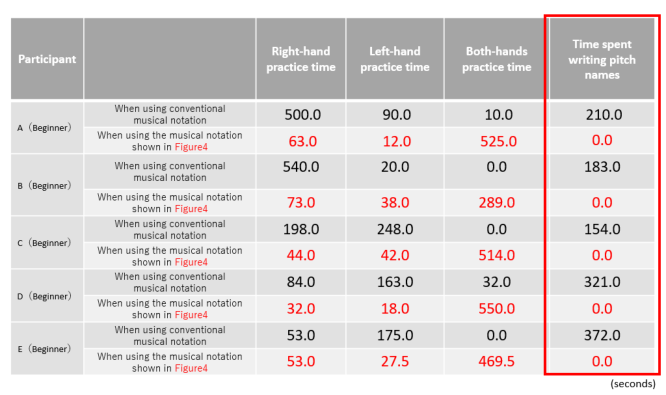
Table 2: Beginners’ behaviors when using Figure 4.
Table available in the original PDF paper.
These visual cues were intended to provide a stable reference point for pitch recognition. When using the redesigned score, all five beginner participants stopped writing their pitch names directly on the score. Their practice behaviors became more similar to those of experienced learners, suggesting that visual emphasis on the reference pitch supported more efficient pitch recognition.
Figure 5: Rhythm representation using numbers and blocks.
Rhythms were identified as the elements that beginners found most difficult to understand. Therefore, rhythm-related information was intentionally separated from traditional musical notation and presented independently. The display was designed to allow learners to accurately perceive beat counts without relying solely on note shapes, as shown in Figure 5.
Table 3: Changes in beginners’ error rates when using Figure 5.
Table available in the original PDF paper.
The error rate decreased when this rhythm display method was combined with conventional musical notation. Furthermore, the characteristically low number of keystrokes observed in beginners improved, and their practice routines began to exhibit greater regularity.
CONCLUSION
Previous studies have examined differences in eye movements with and without musical knowledge and have discussed the abilities required for efficient knowledge acquisition. Other research has shown that beginners and advanced learners differ in the amount of musical notation information they can process simultaneously, and that this difference leads to disparities in performance. However, few studies have examined differences in practice procedures and behavioral patterns. The present study focused on practice behaviors and investigated the characteristics of beginner pianists that extend beyond eye movements by conducting behavioral observations across different proficiency levels. The experimental results revealed that beginners had not yet established stable practice procedures and exhibited fewer keystrokes during practice. Reading music is essential to the efficient development of piano performance skills and provides a foundation for independent learning. Although the proposed display methods demonstrate positive effects, further investigation is required to evaluate their effectiveness in greater detail. In addition, variations in color and shape may influence learning outcomes. Through continued validation and iterative refinement of these design elements, more effective and intuitive music-reading support methods can be developed.
REFERENCES
Atkinson, R. C. & Shiffrin, R. M. (1968). Human memory: A proposed system and its control processes. In Spence, K. W. & Spence, J. T. (Eds.), The Psychology of Learning and Motivation (Vol. 2, pp. 89–195). New York: Academic Press. Hirata, C. (2009). Relationship between music-reading ability and improvement
of instrumental performance skills: Focusing on keyboard harmonica and recorder. Journal of Music Education, 7(1). [in Japanese]. Available at: https://doi. org/10.20614/jjomep.7.1_104 Inoue, K. (2013). Textbook of Interface Design. Tokyo: Maruzen Publishing. [in Japanese]. Kasahara, S., Nakahira, K. & Kitajima, M. (2015). Extraction of music-reading
strategies by piano performers of different proficiency levels based on eye- tracking data. Proceedings of the 14th Forum on Information Technology (FIT). [in Japanese]. Available at: https://www.ieice.org/publications/conference-FIT- DVDs/FIT2015/data/pdf/J-002.pdf Kasahara, S., Nakahira, K. & Kitajima, M. (2016). Relationship between spatiotemporal patterns of visual behavior during music reading and piano performance skills. [in Japanese]. Available at: https://ipsj.ixsq.nii.ac.jp/ record/163560/files/IPSJ-Z78-5Z-07.pdf Kimura, A. (2016). Music-reading instruction in elementary school music education:
A survey of pupils’ abilities and instructional practice proposals. Bulletin of the Graduate School of Education, Shiga University, 19, 15–28. [in Japanese]. Available at: http://hdl.handle.net/10441/15005 Mizobe, C. & Dodo, A. (2019). Music-reading ability among students in teacher training programs for early childhood and elementary education: A survey of first-year university students. Hijiyama University Journal of Teacher Education. [in Japanese]. Available at: https://hijiyama-u.repo.nii.ac.jp/record/451/files/09. pdf
120 Yamanaka and Yang Nagai, T., Nakahira, K. & Kitajima, M. (2017). Analysis of the relationship between
piano experts and beginners focusing on changes in visual behavior during music reading and performance. IPSJ Technical Report, 2017-CE-142(20). [in Japanese]. Available at: http://oberon.nagaokaut.ac.jp/ktjm/Japanese/PAPERS(J)/IPSJ- CLE23_nagai.pdf Nagai, T., Nakahira, K. & Kitajima, M. (2018). Music difficulty evaluation using visual behavior patterns during music reading. Proceedings of the 17th Forum on Information Technology (FIT). [in Japanese]. Available at: https://www.ieice.org/ publications/conference-FIT-DVDs/FIT2018/data/pdf/J-036.pdf Newell, A. & Simon, H. A. (1972). Human problem solving. Englewood Cliffs, NJ:
Prentice-Hall. Rasmussen, J. (1983). Skills, rules, and knowledge; signals, signs, and symbols, and other distinctions in human performance models. IEEE Transactions on Systems, Man, and Cybernetics, SMC-13(3), 257–266. https://doi.org/10.1109/ TSMC.1983.6313160 Toma, W. & Nakahira, K. (2012). Description of piano performance skill acquisition
processes based on eye movement analysis during music reading. Proceedings of the 11th Forum on Information Technology (FIT). [in Japanese]. Available at: https://www.ieice.org/publications/conference-FIT-DVDs/FIT2012/data/pdf/K- 013.pdf Wakamiya, Y. (2013). Development of musical expression: A study of learning content through sight-reading practice. Bulletin of Teikyo University Faculty of Education, 1, 97–109. [in Japanese]. Available at: https://appsv.main.teikyo-u. ac.jp/tosho/kyoiku-38-09.pdf
LISTED IN THE AHFE DIGITAL BOOKSTORE CATALOGUE
Explore the complete digital volume
Interdisciplinary Practice in Industrial Design
Read this individual research paper free through the original publisher, or explore the full digital proceedings book.
ISBN 978-1-964867-98-4
Explore this ISBN in the AHFE Bookstore ↗Listed in the July 2026 bookstore catalogue; search by ISBN to confirm current availability · Digital book purchase optional