Hiyori Miyazaki, Wonseok Yang (2026). Modeling the Creative Thinking Processes of Design Experts and Novices. In: Interdisciplinary Practice in Industrial Design. AHFE Open Access, vol. 222, pp. 88–99. https://doi.org/10.54941/ahfe1007749
The rapid advancement of generative AI is transforming design workflows from manual "modeling" into the sophisticated "selection" and "reconstruction" of a multitude of generated options. Within this paradigm shift, it is a pressing issue to clarify the boundary between "implementation capabilities," which AI can rapidly replace, and the essential "curation capabilities" that humans must assume. This research aims to establish a definition of the new creative thinking processes required in the AI era from an ontological perspective by visualizing the unconscious cognitive processes of experienced designers. Previous research on design expertise has faced difficulties in extracting pure cognitive structures because physical factors, such as drawing skills, act as noise. Therefore, this research verified the differences in cognitive strategies between experts and novices using a unique abstract composition task that eliminated physical skills and tool familiarity. Experiments were conducted with 10 experts and 10 novices, and an integrated analysis of operation logs and interviews using the FBS (Function-Behavior-Structure) framework revealed that experts spent approximately twice as much time on "pause" and "evaluation" processes compared to novices. These results demonstrate that while the novice's creative process is a "linear task of filling in blanks," the expert's process is a "recursive exploration" involving repeated critical dialogue with the generated results based on internal criteria. This "intentional pause" constitutes the tacit knowledge unique to humans in the AI era and lies at the core of future design education. Ultimately, this suggests that the role that humans must play is shifting from simple implementation to advanced curation and judgment capabilities.
The rapid advancement and proliferation of generative AI technologies are catalyzing an irreversible paradigm shift in the definition of “creativity” within the design and modeling domains. In an era where AI can substitute “implementation” with speed and precision surpassing human capabilities, the essence of the design workflow is transforming from physical production skills to the high-level “curation” of innumerable generated options and the “construction of meta-structures” that imbue meaning (Tsao,2025). During this transformational period, the core of creativity that humans must assume lies not in “explicit knowledge” describable as AI prompts, but in “embodied tacit knowledge”—the ability to perceive pre-linguistic aesthetic equilibrium and make situational judgments. A comparative Received February 19, 2026; Revised April 11, 2026; Accepted April 25, 2026; Available online July 20, 2026
Modeling the Creative Thinking Processes of Design Experts and Novices 89 research of design experts (EXP) and novices (NOV) serves as an effective approach to elucidating the essence of this “human-specific creative thinking.” As indicated by Donald Schön’s concept of “Reflective Practice” (Schön,1983) and Dorst and Cross’s “co-evolution of problem and solution,” (Dorst & Cross, 2001) it is established that the expert’s creative process is not a mere linear task, but possesses a “recursive structure” involving repeated dialogue with generated artifacts. This “judgment process based on embodied tacit knowledge,” as demonstrated by experts, represents a model that is diametrically opposed to the behavior of the current AI, which linearly outputs probabilistic optimal solutions. Consequently, elucidating and defining the ontology of this tacit knowledge, which remains difficult for AI to mimic, is a pressing issue for establishing future design education and human-AI collaboration models.However, in many previous studies, “physical skills” (such as manual dexterity in sketching or modeling) significantly interfered with performance, making it difficult to isolate and extract only the pure “cognitive judgment processes” occurring internally within experts. Therefore, the purpose of this research is to eliminate noise, such as proficiency in physical operations or familiarity with specific tasks, and extract and analyze only the pure structures of thought.
Changes in Creative Activities in the AI Era Recent advancements in generative AI have permeated creative activities in art and design, sparking numerous studies on the impact of human-AI collaboration on creativity. With the proliferation of Large Language Models (LLMs), experts are inadvertently converting previously unverbalizable “tacit knowledge” into “explicit knowledge”—learnable and mimicable by AI—through the processes of providing examples, correcting outputs, and explaining contexts. While this raises concerns regarding the potential devaluation of expert uniqueness, a parallel dynamic is emerging, wherein AI automation of routine tasks allows experts to concentrate on distinctively human judgments and complex problem-solving (Ganuthula and Balaraman, 2023). Furthermore, the iterative process of prompting, selecting, and refining AI outputs is identified as a “collaborative externalization,” in which designers’ ineffable sensibilities and judgment criteria are rendered visible through dialogue with AI (Musiienko, 2026). Thus, the role of generative AI in creative activities is far from monolithic; it varies significantly based on the utilization strategies and interactions within the design environment. Consequently, there is an urgent need to deepen our understanding of unverbalized “tacit knowledge” and explore how it can be preserved and leveraged within AI co-creation frameworks. Specifically, the value of human creativity must be redefined not as the processing capacity to efficiently reach a “correct” answer but as the power of “sensemaking”—the ability to acutely detect subtle “fluctuations” and “dissonance” within a myriad of generated options and to weave unique narratives from them. This capacity is the locus of human superiority in creative activities.
The essence of design practice resides in the exercise of “knowledge” that cannot be verbally articulated. Michael Polanyi’s concept of “tacit knowledge,” (Polanyi, 1966) grounded in the insight that “we can know more than we can tell,” demonstrates that knowledge is deeply rooted in somatic experience and intuition. This tacit knowledge serves as the wellspring of creativity and innovation in design (Von Krogh, Ichijō, and Nonaka, 2000), constituting the core of advanced expertise that transcends mere information transmission. As elucidated by Nonaka and Takeuchi’s SECI model (Nonaka and Takeuchi,1995), this knowledge has traditionally been transmitted within studio education through the process of “Socialization,” which involves imitation and shared experiences. Furthermore, taxonomies of tacit knowledge define it across relational, somatic, and collective dimensions, revealing that “aesthetic discernment” in design practice represents a nucleus of expertise in which embodied sensations and sociocultural contexts are intricately fused (Collins, 2010). Thus, tacit knowledge is a pivotal element in defining the essence of creative activities in design and art domains. However, due to its inherent subjectivity and somatic nature, it presents significant challenges regarding the uncertainty of educational transmission and the establishment of objective analytical methodologies. Previous studies have been largely limited to treating practitioners’ introspective data and behavioral traces in isolation, failing to elucidate the dynamic coupling between cognitive intent and physical operation. This research focuses on bridging physical operations with cognitive intent to externalize the unconscious process of “structuring.” Specifically, we examine how experiential knowledge manifests as behavioral trends and strategic differences between experts and novices.
Visualizing Creative Thinking Using the FBS Framework As the analytical framework for this research, we adopted the Function– Behavior–Structure (FBS) ontology proposed by Gero et al (Gero, 1990). This framework conceptualizes the design object through three variables— “Function,” “Behavior,” and “Structure”—and describes the design process as a universal ontology consisting of eight fundamental processes: Formulation, Synthesis, Analysis, Evaluation, Documentation, and three types of Reformulation (Gero, 2004).
Figure1: FBS framework.
In recent years, Kan and Gero have established methodologies for objectively evaluating the productivity of design activities by introducing
Modeling the Creative Thinking Processes of Design Experts and Novices 91 “Markov models” to statistically analyze transitions between FBS variables, as well as “entropy analysis” to measure the diversity of thought(Kan and Gero, 2005, 2008). Furthermore, Yu and Gero have attempted to observe design processes multimodally by combining eye-tracking technology with FBS coding to identify which physical structures (S) designers focus on and which cognitive evaluations (Bs) they perform(Yu and Gero, 2015). Building on these precedents, this research employs the FBS framework as an analytical foundation to synchronize and integrate physical operation logs with cognitive processes derived from retrospective interviews. Specifically, by comparing the time occupancy of each process and the transition probabilities between processes for experts (EXP) and novices (NOV), we examine in detail the processes of “judgment” and “meta- structure construction” that humans must undertake in design within the generative AI era.
RESEARCH METHOD In this research, we conducted an experiment using a custom-developed panel construction tool. The participants consisted of 20 individuals: 10 design experts (EXP) and 10 design novices (NOV). We analyzed the creative process using operation logs recorded during task performance and semi- structured interviews conducted post-task.
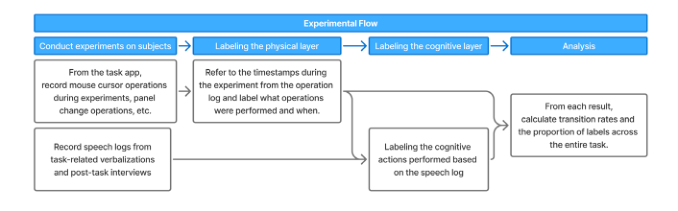
Figure 2: Research flow.
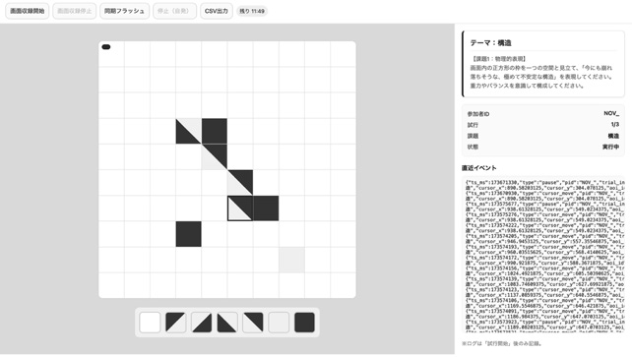
About Panel Construction Tools The panel construction tool used in this research is a proprietary application that allows users to create digital patchwork or geometric patterns by arranging tiles with different colors, patterns, and orientations on a 10×10 grid (see Figure 3).
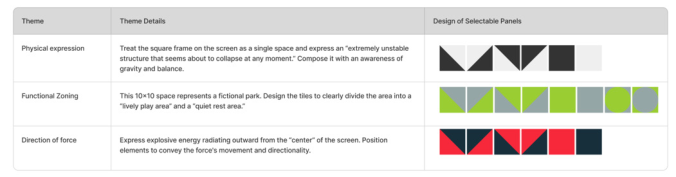
The tool is designed to record all mouse operations by the participant as physical logs. Specifically, actions such as tile selection, placement, cursor coordinates, movement velocity, and click operations are saved with millisecond- precision timestamps.Participants were tasked with freely constructing panels based on three abstract themes within a 15-minute time limit per theme. The colors and patterns of the constituent materials differed for each theme (see Figure 4).
Figure 3: Panel construction tool UI.Figure 4: Theme and pattern design.
However, the system allowed participants to voluntarily press a “Stop” button to proceed to the next theme if they judged their panel configuration to be complete. Additionally, upon the completion of each theme, participants performed a self-evaluation of their final constructed panel on a 7-point scale. The experiment was conducted in a quiet, controlled environment to exclude external noise, using a 13-inch monitor and a standard optical mouse. During the task, the Think-Aloud Protocol was employed to acquire utterance logs regarding what the participants were thinking and what they intended to do next.
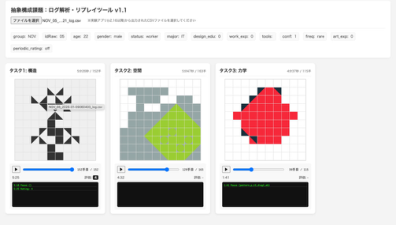
Regarding the Post-task Interview Immediately following the task, while the participants’ memories remained vivid, semi-structured interviews were conducted regarding behavior in each phase of task execution. This was done using a panel construction replay tool based on the Video-Stimulated Recall method. The replay tool’s UI was designed to display a step-by-step replay of the board, highlights of pause durations, final self-evaluations, trial time per task, and the total number of operations (see Figure 5).
Figure 5: Replay tool UI.
In a retrospective review of the recorded operation screens, we conducted interviews with the participants focusing on specific elements critical to our analysis. First, we explored the transformation of their intent by asking how external information, such as the visual appearance of placed tiles, influenced changes in motifs or compositional rules during the creative process. Additionally, we investigated their cognitive states during specific pauses to determine whether periods of halted hand movement stemmed from hesitation, observation, or waiting for inspiration. We also examined their self-evaluation of operations, prompting them to articulate any specific dissatisfactions or gaps between their expectations and reality when deleting or fine-tuning tiles. Finally, all interview audio was transcribed verbatim and synchronized with the temporal axis of the operation logs, serving as essential data to supplement the cognitive context underlying their physical actions.
Analysis Method In this research, we adopted a methodology to identify the eight processes of the FBS framework by integrating the evaluation of physical characteristics derived from operation logs with the cognitive context obtained from interview logs. The analysis proceeds according to the following steps.
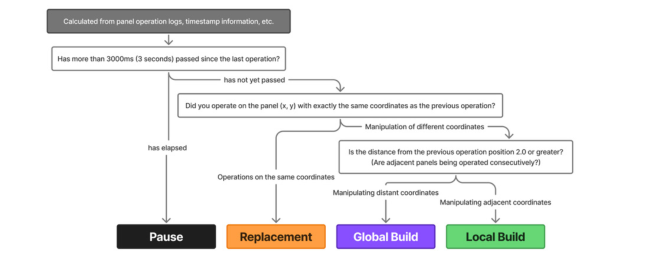
First, based on mouse events and coordinate data, we performed labeling at the physical layer according to the following logic. The label types and definitions are shown below (see Figure 6).
Figure 6: Physical processing flowchart.
94 Miyazaki and Yang Next, for each segment, we cross-referenced physical behaviors with introspective reports from the interviews to evaluate and identify the most appropriate label among the eight FBS processes. Note that the definitions of the eight processes were redefined to adapt to the specific nature of this task. The evaluation criteria for the processes are as follows:
Table 1: Test of normality.
Table available in the original PDF paper.
Formulation: The process of confirming task requirements (themes) and setting the goal (Expected Behavior) regarding what to create and how to compose it.
Synthesis: The process of placing structures (Structure) to implement the expected behavior.
Analysis: The process of observing the generated board to interpret its features or meaning (Structure Behavior). This involves mere factual recognition (e.g., “red tiles are adjacent,” “an odd shape has formed”) without judgment of quality.
Evaluation A state where subsequent operations involve deletion or clearly intentional manipulation, and verbalizations include comparisons and judgments between expectation and the current state (e.g., “Does this match my image?”, “Is the color contrast good?”).
Documentation The process of recording the rationale for operations (e.g., “I did this because I thought X”) or judging the completed product to determine the final form.
Reformulation I The process of modifying only the structure without changing the goal (e.g., fine-tuning positions or deletion).
Reformulation II The process of changing the initial goal itself to a new one based on structural analysis results. This corresponds to a “creative shift” where new ideas are discovered from accidental shapes.
Reformulation III The process of redefining the fundamental functional requirements or the interpretation of the theme itself.
Given the nature of this task, Formulation and Documentation (occurring primarily at the start and end) and Reformulation III (precluded by the requirement to adhere to the theme) were deemed insignificant for comparative analysis. Therefore, we focused our labeling on Synthesis, Analysis, Evaluation, Reformulation I, and Reformulation II. Based on these analysis results, we calculated the “time occupancy rate,” “average task completion time,” and “filling timing” for each process to compare experts (EXP) and novices (NOV).
RESULT
Average Work Time and Filling Phase for Each Group According to the experimental specifications, participants were permitted to voluntarily terminate the task at their own discretion within the 15-minute time limit. Consequently, variations occurred in the total work duration for
Modeling the Creative Thinking Processes of Design Experts and Novices 95 each participant. Additionally, as the initial state of the task involved 100 “blank (white)” grid spaces that required replacement with pattern tiles, this research defined the “Filling Phase” as the moment when all 100 spaces were first occupied. We then calculated the timing of this phase as a percentage of the total work time. The table below presents the average total work time and average timing of the Filling Phase for each group.
Table 2: Average work time and completion phase for each group.
Table available in the original PDF paper.
Group Average Task Time Completion Phase (Timing %) EXP 13m43s 50.8%
NOV 10m31s 72.6% The results indicate that the Expert (EXP) group’s average work time was 13 minutes 43 seconds, which was significantly longer than the Novice (NOV) group’s 10 minutes 31 seconds. A particularly notable disparity was observed in the “Filling Phase.” While the NOV group required 72.6% of their total time to fill the board, the EXP group completed this phase at 50.8%, effectively the midpoint of the process. These findings strongly suggest a structural difference in the creation processes of the two groups. For novices, “filling the blanks” constituted the primary objective, leaving only about 27% of the time for post-filling review and modification. In contrast, experts constructed the overall image rapidly in the first half and dedicated the remaining ~50% of the time to adjusting and reconstructing the board. In other words, for experts, the act of filling the board was not “completion,” but merely “laying the groundwork” for subsequent refinement.
For Each Operation Time Occupancy Rate We calculated the time occupancy of the physical layer for both experts and novices. The results are shown in the table below.
Table 3: Test of normality.
Table available in the original PDF paper.
EXP NOV Physical (Action) Physical (Action)
Physical Layer Occupancy (%)
Physical Layer
Occupancy (%)
Avg Time (min) Average Per Task
Avg Time (min) Average Per Task Pause 62.29 8.20 min Pause 56.60% 5.61 min
Local Build 22.95% 3.02 min Local Build 28.12% 2.79 min Global Build 10.68 1.41 min Global Build 11.04% 1.09 min
Replacement 4.08 0.54 min Replacement 4.24% 0.42 min
96 Miyazaki and Yang A significant finding is the difference in Pause (stationary time). In this research, “Time Occupancy” was calculated as the average percentage of time each process occupied relative to the total task duration (100%). Comparing Pause occupancy, the EXP group recorded 62.29%, whereas the NOV group recorded 56.60%, a difference of approximately 5.7 percentage points. Furthermore, the average total duration for the EXP group was approximately 2.6 minutes longer than that of the NOV group.
This indicates that while novices tended to judge the work as “complete” and terminate the task relatively early, experts engaged with the task for a longer duration. Moreover, experts did not simply work longer; they maintained a higher proportion of time where their hands were stopped. This suggests they allocated more resources to internal planning and introspection rather than mere physical operation.
Regarding the Occupancy Time of Cognitive Layer Labels for Each Operation We calculated the time occupancy of the cognitive layer for both groups based on the assigned labels. The results are shown in the table below.
Table 4: Test of normality.
Table available in the original PDF paper.
EXP NOV Cognitive (Think) Cognitive (Think)
FBS Label Occupancy (%)
Physical Layer Occupancy (%)
Avg Time (min) Average per task
Avg Time (min) Average per task Analysis 43.67% 5.75 min Analysis 46.50% 4.61 min
Synthesis 35.71% 4.70 min Synthesis 41.10% 4.07 min Evaluation 35.71% 2.36 min Evaluation 9.33% 0.92 min
Reformulation-I 1.97% 0.26 min Reformulation-I 2.17% 0.22 min Reformulation-II 0.74% 0.10 min Reformulation-II 0.91% 0.09 min
The most pronounced difference was observed in the Evaluation process. Experts spent 17.92% of the total process on evaluation, whereas novices spent only 9.33%. Conversely, regarding Synthesis (physical placement operations), the NOV group exceeded the EXP group.
This data elucidates the nature of the “long pauses” observed in experts. The ratio for Analysis (reading the current state) was comparable between the two groups (EXP: 43.67%, NOV: 46.50%), indicating that novices “look” at the board just as experts do. However, the overwhelming difference in Evaluation suggests that experts are not merely gazing at the board but are engaging in “critical thinking that compares their Internal Criteria (Be) with the Current State (Bs).”
In contrast, the NOV group showed a high ratio of Synthesis and an extremely low ratio of Evaluation. This implies they prioritized the “act”
Modeling the Creative Thinking Processes of Design Experts and Novices 97 of placing tiles sequentially without interposing “judgment.” Quantitatively, this confirms that the expert design process consists of an iterative cycle of “Implementation → Critique → Correction,” whereas the novice process tends to be a linear accumulation of.
Qualitative Analysis From Interview Logs In addition to the quantitative analysis of operation logs, qualitative analysis of post-task interviews further clarified the differences in cognitive strategies between the two groups.
Many participants in the Novice (NOV) group recalled concrete existing objects (e.g., “palm tree,” “seesaw”) immediately after the task began and set their goal as the reproduction of these objects. This “goal setting with a correct answer” prevented hesitation but simultaneously weakened the motivation to modify the placed tiles. Indeed, novices frequently made statements prioritizing completion, such as, “Once I recalled what I wanted to draw, I didn’t hesitate,” or “I didn’t fix it because it was too much trouble.” This resembles an AI optimization process that attempts to traverse the shortest path to an objective function.
Conversely, experts (EXP) stated, “There was no goal; I thought of the next move based on the results of my trials,” or “I observed the whole regularly and looked for dissonance.” The exploration was initiated without a clear finished image. Notably, some experts remarked, “It looked too stable, so I intentionally reduced elements,” indicating that they intentionally destroyed and reconstructed the established order based on internal aesthetic criteria (Be).
These interview results suggest that the quantitative data mentioned above (high Evaluation ratio and long Pauses in EXP) represents not a stagnation of thought, but rather “trial and error to explore abstract values, without aiming solely for an easy landing on a concrete object.”
Summary of Result This research quantitatively elucidated the differences in creative thinking between experts (EXP) and novices (NOV) in an abstract composition task using the FBS framework. The analysis revealed that despite experts having a longer total task duration than novices, they allocated 62% of that time to “Pauses.” Furthermore, whereas novices required 72% of the total time to fill the board, experts completed the filling phase at the 50% mark, dedicating the remaining half of their time to post-generational refinement. Notably, the time occupancy of “Evaluation”—the process of judging quality—was approximately double for experts compared to novices. These facts indicate that while the novice process is a “linear task of filling blanks,” the expert process is a “recursive dialogue oscillating between implementation and critique.” The prolonged pauses of the experts were not hesitation but rather active cognitive time spent collating internal ideals with reality.
CONCLUSION
The “linear process” of novices revealed in this research demonstrates an extremely high affinity with the optimization processes of current generative AI, which outputs the most probabilistically valid solution to an input and attempts to fill blanks via the shortest path. In contrast, the experts’ behavior involved the intentional destruction and reconstruction of consistent structures once they were generated.
This research’s core insight is that the essence of human creativity lies not in the ability to efficiently generate solutions, but in “cognitive durability”—the capacity to delay facile concretization and convergence on existing patterns, intentionally remaining in a state of uncertainty. The “conscious latency” of experts suggests that processes such as Schön’s “reflection-in-action” and Dorst & Cross’s “co-evolution of problem and solution” are not merely conceptual but have acquired contemporary significance as a “resistance to automated generation.” In an era where AI completes “implementation” instantaneously, the cost humans must incur is structurally shifting from “time to create” to “time to pause”—stopping to question the optimal solutions presented by the output.
Based on these findings, this research offers a new perspective on design education in the AI era. It is not about humans mimicking the “fluent answers to open-ended questions” at which AI excels. Rather, the decisive difference between algorithmic processing and human creative thinking lies in what we term the “critical retention capability”—the ability to intentionally suspend judgment on blanks that AI would fill in seconds, and to repeat inefficient destruction and reconstruction. We conclude that the pause time observed in experts is not mere stagnation, but an indispensable cognitive cost required to perform “contextualization” and “value fixation”—tasks that are difficult for AI to perform autonomously.
REFERENCES
Bender, E. M., Gebru, T., McMillan-Major, A., & Shmitchell, S. (2021). “On the Dangers of Stochastic Parrots: Can Language Models Be Too Big?,” Proceedings of the 2021 ACM Conference on Fairness, Accountability, and Transparency, 610–623. Collins, H. (2010). Tacit and Explicit Knowledge. University of Chicago Press. Dorst, K., & Cross, N. (2001). “Creativity in the design process: co-evolution of
problem-solution,” Design Studies, 22(5), 425–437. Ganuthula, V. R. R., & Balaraman, K. K. (2025). “The Paradox of Professional Input: How Expert Collaboration with AI Systems Shapes Their Future Value,” arXiv preprint arXiv:2504.12654. Gero, J. S. (1990). “Design prototypes: a knowledge representation schema for
design,” AI Magazine, 11(4), 26–36. Gero, J. S., & Kannengiesser, U. (2004). “The situated function-behaviour-structure framework,” Design Studies, 25(4), 373–391. Kan, J. W. T., & Gero, J. S. (2008). “Acquiring information from linkography in
protocol studies of designing,” Design Studies, 29(4), 315–337. Kan, J. W. T., & Gero, J. S. (2008). “Entropy measurement of designing,” in: Gero, J.
S. (Ed.), Proceedings of the 3rd International Conference on Design Computing and Cognition (DCC’08). pp. 23–42. Springer.
Modeling the Creative Thinking Processes of Design Experts and Novices 99 Musiienko, O. (2026). “From maker to curator: a scoping review of generative
artificial intelligence in design higher education,” . Nonaka, I., & Takeuchi, H. (1995). The Knowledge-Creating Company: How Japanese Companies Create the Dynamics of Innovation. Oxford University Press. Polanyi, M. (1966). The Tacit Dimension. Doubleday. Schön, D. A. (1983). The Reflective Practitioner: How Professionals Think in Action.
Basic Books. Tsao, J., Liang, C. X., Nogues, C., & Wong, A. (2025). “Perceptions and integration of generative artificial intelligence in creative practices and industries: a scoping review and conceptual model,” AI & Society. Von Krogh, G., Ichijo, K., & Nonaka, I. (2000). Enabling Knowledge Creation: How
to Unlock the Mystery of Tacit Knowledge and Release the Power of Innovation. Oxford University Press. Yu, R., & Gero, J. S. (2018). “Using eye-tracking to study designers’ cognitive behaviour when designing with CAAD,” Proceedings of the 52nd International Conference of the Architectural Science Association.
LISTED IN THE AHFE DIGITAL BOOKSTORE CATALOGUE
Explore the complete digital volume
Interdisciplinary Practice in Industrial Design
Read this individual research paper free through the original publisher, or explore the full digital proceedings book.
ISBN 978-1-964867-98-4
Explore this ISBN in the AHFE Bookstore ↗Listed in the July 2026 bookstore catalogue; search by ISBN to confirm current availability · Digital book purchase optional