Yong-Gyun Ghim, Junghoon Baek (2026). Designing Facial Expressions for Service Robots: A Context-Specific Approach. In: Interdisciplinary Practice in Industrial Design. AHFE Open Access, vol. 222, pp. 156–166. https://doi.org/10.54941/ahfe1007755
While facial expressions are widely adopted in service robots as rendered faces on their screens to facilitate communication and interaction, it remains unclear how they should be designed according to specific service contexts. This paper argues that the appropriate level of realism and detail in robot facial expressions depends on a robot's task nature, level of social interaction, and service journey. We propose a design space constructed from two axes, realism and number of facial features, and map 24 screen-based service robot faces onto it. The mapping of restaurant, retail, and delivery robot faces reveals a lack of context-specific design patterns and an over-reliance on minimal expressions, with 75% of collected faces lacking a mouth. Drawing on service marketing literature, we construct a service journey map for restaurant server robots and identify emotions required along the service flow. These analyses expose a gap between research and practice, leading to a structured, three-stage design process for context-specific robot facial expressions.
With the increasing deployment of service robots across various sectors of the service industry, facial expressions have been broadly adopted in service robots either as physical faces or rendered faces on a screen (Kalegina et al., 2018) to better facilitate communication and interaction (Blow et al., 2006; Cárdenas et al., 2024). Their use on service robots aligns with anthropomorphic design approaches (Song et al., 2021) in human-robot interaction (HRI) as a way of enhancing understandability and interactions (Duffy, 2003; Złotowski et al., 2015). By mimicking human facial expressions, they attempt to communicate a robot’s identity, intention, and emotions, regulate interaction, and form social relations (Blow et al., 2006; Chesher and Andreallo, 2021; Song et al., 2023). In particular, many contemporary service robots adopt rendered faces and their expressions on a screen display in place of a human-like physical head, leveraging their affordability, ease of programming, design flexibility, and animation capability (Kalegina et al., 2018; Fernandes et al., 2025). While the degree of resemblance to human facial expressions of the rendered faces varies significantly across robots (Kalegina et al., 2018), numerous service
Designing Facial Expressions for Service Robots: A Context-Specific Approach 157 robots are designed with simple, geometric facial shapes and fewer features on their rendered faces. Indeed, Jo and Hong (2025) show in their study conducted with the elderly that simple and geometric facial shapes were preferred over detailed and human-like ones.
However, it remains unclear what levels of realism and detail (Blow et al., 2006) in robot facial expressions are most acceptable to people interacting with service robots in specific use contexts, especially considering the wide variety of service contexts. Studies on robot morphology and perception argue that the level of anthropomorphism depends on the use context (Goetz et al., 2003; Złotowski et al., 2020; Roesler et al., 2022). For instance, a functional-looking robot morphology places more emphasis on task-oriented purposes than on social interactions or mere anthropomorphism. Designing a delivery robot with realistic facial features and expressions would not be desirable, considering the robot’s limited social interaction with humans due to its task nature. At the same time, as service robots undergo multiple stages along their service journey – for example, greeting customers, receiving orders, delivering food, addressing special incidents, etc., for a restaurant server robot – their communication and interaction needs change at each stage, resulting in different facial expressions.
In this paper, we argue that facial expressions for a service robot should be designed according to the robot’s specific use context, including its task nature, level of social interaction, and service and interaction journey. Focusing specifically on restaurants, delivery, and retail stores as use contexts, we explore a design approach for facial expressions of service robots. The following sections consist of three parts. First, we examine anthropomorphic design approaches in HRI and theories and applications of facial expressions from the literature. Through this, we uncover the relationship between the degree of realism and detail in facial expressions and human perception in relation to service contexts, from which we develop a conceptual framework and propose a design space map for robot facial expressions. We populate this map with 24 screen-based rendered faces of service robots collected online, group them based on their specific use context, and analyze their positioning and emotions. Second, we identify the types of emotions from the literature in service marketing that need to be communicated by service providers at various points along service journeys in restaurants. We construct a service journey map for restaurant server robots on which the emotions of both robots and humans are arranged along the service flow and in relation to interactions. Then, we revisit the mapping to see if the collected robot faces address the variety of emotions required in the actual service situations. Finally, we discuss the findings and implications from the mapping and analysis and propose a structured design process for robot faces, followed by the study’s limitations and future research directions.
ANTHROPOMORPHISM AND ROBOT FACIAL EXPRESSION Anthropomorphic Design in HRI
Anthropomorphism is defined as people’s tendency to attribute human characteristics to non-human entities or artifacts (Duffy, 2003; Epley et al., 2007; Fink, 2012; Roesler et al., 2022). By projecting intelligence
158 Ghim and Baek and emotions onto non-humans, people make them feel more familiar and understandable. HRI and robotics have leveraged this tendency in the design of robot appearance, interaction, and behavior through an anthropomorphic design approach, as represented by humanoids and robot facial expressions. However, while anthropomorphic design is considered to enhance understandability of robots, enable social connections, and facilitate interactions (Epley et al., 2007; Fink, 2012), people’s positive appraisal of robots does not increase linearly with increasing levels of anthropomorphism. Rather, the desired level of anthropomorphism varies across robots, resulting from the Uncanny Valley effect (Mori, 1970), an expectation gap (Duffy, 2003; Lohse, 2011; Złotowski et al., 2015), and context dependence (Fink, 2012; Roesler et al., 2022). For example, Goetz et al. (2003) argue that robot appearance and behavior should match task types: anthropomorphism benefits socially interactive contexts but hinders purely functional tasks. If a robot’s anthropomorphism does not match people’s preferences and expectations in its use context, people may feel uncomfortable, misunderstand its capabilities, or become disappointed, which will negatively affect its acceptance. Accordingly, the level of anthropomorphism should be carefully determined and designed into a robot’s appearance, interaction, communication, and behaviors.
There is a wide range of service robots for various tasks and contexts, such as restaurants, hotels, supermarkets, and delivery, among others. Their level of social interaction differs depending on their task nature, leading to different preferences for anthropomorphism. Roesler et al. (2022) argue that “anthropomorphic robots are preferred for the social domain, in which tasks are more associated with human communication behavior,” while low anthropomorphism is suitable for tasks with physical demands. Although no clear preference for the anthropomorphism level was found for the service domain due to the lack of diverse tasks and sociability in their study design, a service robot’s anthropomorphism level is also likely dependent on sociability in its specific context when considering the service domain’s wide spectrum of social and physical demands.
Facial Expressions on Service Robots This relationship between context and anthropomorphism level extends to robot faces, as supported by prior research on robot facial expressions. Kalegina et al. (2018) find that preferences for the level of anthropomorphism - represented as realism and detail - in rendered robot faces vary depending on the use context. Indeed, the number and type of facial features influence the perception of a robot’s human-likeness (DiSalvo, 2002). Among facial features, eyes are considered the most important element for emotional expressions as well as the most common feature, followed by the mouth (Kalegina et al., 2018; Song et al., 2021; Jo and Hong, 2025). A lack of mouth in robot faces results in less accurate interpretation of displayed emotions, particularly among Westerners (Oidekivi et al., 2021). The degree of smile, determined by the mouth opening size, affects people’s perception of a robot’s emotion significantly
Designing Facial Expressions for Service Robots: A Context-Specific Approach 159 (Blow et al., 2006). Turning back to eyes, pupils and irises are common facial features that make up the eyes, yet they are missing in many robot faces. Pupils are particularly an important element affecting perceptions of friendliness, trustworthiness, and human-likeness. Without them, a face appears soulless (Kalegina et al., 2018). In short, pupils and mouth are critical facial features for communicating emotions and inducing positive perceptions.
Design Space Map for Robot Faces Several studies on robot faces adopt McCloud’s (1993) design space for cartoon faces (Duffy, 2003; Blow et al., 2006; Han et al., 2013; Kalegina et al., 2018; Chesher and Andreallo, 2021). It is constructed from a triangular space with the top, left, and right vertices representing abstract, realistic, and iconic, respectively. Along the horizontal axis, the details of a face decrease towards iconic. From the top vertex towards the bottom of the triangle, the realism of a face increases. For instance, an android head can be positioned at realistic and a simplistic head with minimal facial features at iconic, while a mechanistic, functional, and minimally human-like head leans towards abstract (Duffy, 2003). This design space has been discussed as useful in mapping a variety of robot faces according to their degree of realism and details, so the degree of a robot face’s human-likeness can be measured and controlled.
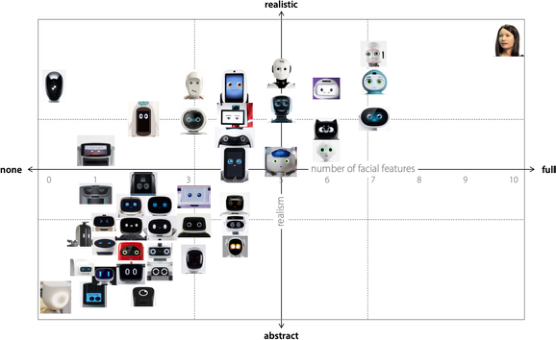
However, we consider this triangular design space to be rather confusing because iconic is not necessarily high in realism in the sense of anthropomorphism, and the decrease of detail can also lead to increasing abstractness. Instead, we propose a rectangular design space constructed from two axes meeting perpendicularly: the vertical axis represents the degree of realism, and the horizontal axis corresponds to the number of facial features (Figure 1). As a face’s realism increases, it moves upward towards realistic; as it decreases, it moves towards abstract. The horizontal axis is adopted from the spectrum of realism and detail in Kalegina et al. (2018). Selecting eyes, mouth, nose, eyebrows, cheeks, hair, ears, eyelids, pupils, and irises as the 10 main facial features, they introduced a linear scale from 0 to 10 along which robot faces are arranged according to the number of their facial features. Likewise, robots with a larger number of facial features are positioned towards the right end of the space. Additionally, the design space is divided into nine cells by dotted lines to classify faces into low, middle, and high levels of realism and facial features.
Figure 1 shows 43 robot faces mapped on the design space, with an android robot’s head (full facial features, high realism) positioned at the top right corner and a companion robot’s face (no facial features, low realism) at the bottom left. As a robot face moves upward and to the right in the design space, its anthropomorphism level increases.
Figure 1: Design space for robot faces.
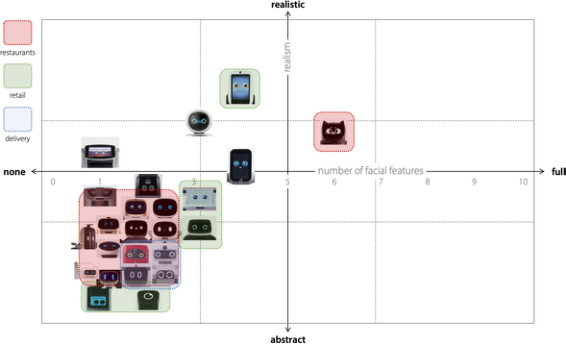
We collected images of 24 screen-based robot faces in the service domain, including restaurants, hotels, retail stores, airports, and delivery, and mapped them on the design space (Figure 2). After an initial gathering of robot faces from the web using search terms representing each context, we filtered out faces that are not rendered on a screen or that fall outside the service context, such as those of elderly care robots and educational robots. On the mapped design space, we highlighted restaurant, retail, and delivery robot faces in red, green, and blue boxes, respectively.
Figure 2: Mapping of service robot faces in the design space.
Overall, most faces are positioned in the lower left quadrant, between one and three facial features, and at the low and medium realism levels. This suggests an overall tendency in the current facial designs of service
Designing Facial Expressions for Service Robots: A Context-Specific Approach 161 robots toward minimal facial features and geometric, abstract shapes, with some exceptions. All restaurant robot faces, except one, are positioned in the lower left quadrant with either one or two facial features. Similarly, faces for delivery robots are positioned toward the bottom left, but more concentrated in the low feature / low realism cell. All their eyes are depicted as two circles or slightly modified versions, and treated with a thick stroke suggesting the presence of pupils. Compared to restaurant robots, delivery robots’ faces are less varied, all with two facial features, eyes and pupils, none with a mouth, and at about the same level of realism. On the other hand, faces for retail stores are more broadly positioned on the map, between one and four facial features and from low to high realism. Across service contexts, 75% of the collected faces lack a mouth, using eyes as the main medium of expressing emotions. This limits the robots in expressing subtle and various emotions. While we observe differentiations across contexts - no face with a mouth for delivery; four out of ten with a mouth for restaurants; and one out of five for retail - no coherent direction for face design that addresses context-specific emotions is visible, either within a context or between contexts.
ROBOT EMOTIONS ALONG A SERVICE JOURNEY It is crucial for service robots to exhibit emotions appropriately, according to the situation. The findings of Goetz et al. (2003) on the effects of a robot’s playfulness and seriousness on perception and compliance suggest that emotional expressions in facial design should be differentiated according to the contextual situation. Jo and Hong (2025) emphasize the appropriateness of facial expressions to the specific situation along the interaction journey. Yu and Ngan (2019) even argue for the need for smiles to be moderated depending on the situation. While a smile generally increases customer satisfaction during a service encounter (Barger and Grandey, 2006), and many rendered faces of service robots exhibit happy and smiley expressions, robot faces need to be designed to accommodate a variety of emotions relevant to specific situations and communicate them appropriately.
During a service encounter, customers experience a range of emotions over time as they receive service delivery and interact with employees and the servicescape. This set of emotional responses, referred to as consumption emotions (Westbrook and Oliver, 1991), influences satisfaction with the service (Dubé and Morgan, 1998; Maguire and Geiger, 2015). This implies the importance of understanding the emotional journey of customers during service and designing the service system to maximize positive emotions while minimizing negative ones. By examining the temporal perspective of emotional changes during service, Maguire and Geiger (2015) identify interactions with and assessment of service staff as factors causing consumption emotions, along with waits. As service robots take on the roles of human service providers, this emotional journey should be accommodated in an interaction journey between customers and robots, so that robots can effectively communicate relevant emotions throughout the service.
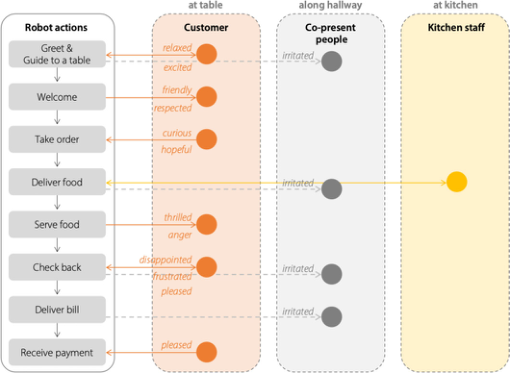
For example, Figure 3 illustrates a service and interaction journey for restaurant server robots. The overall sequence of the robots’ actions is
162 Ghim and Baek adopted from the service blueprints for restaurants in Hummel and Murphy (2011) and Hossain et al. (2017), by replacing human server actions with robot actions and considering both the interaction with kitchen staff and encounters with other customers co-present in the restaurant space. A closer examination of this journey reveals numerous interactions and encounters between a server robot and humans: at least six different interactions with the customers the robot serves, one with the kitchen staff, and four encounters with people as the robot navigates the hallway.
According to Han et al. (2010), consumption emotions in restaurants include excitement, comfort, annoyance, and romance as four dimensions and 32 specific emotions under them, such as interested, grateful, entertained, friendly, relaxed, irritated, angry, and sentimental, among others. As we integrate these emotions into the service and interaction journey in Figure 3, we find that a mix of different emotions emerges at each step while emotions change along the journey. For example, when customers are greeted and guided to a table, they may feel relaxed about finding a table and excited about the prospect of having a meal. When food is served, they may feel thrilled to finally have food in front of them, but frustrated or angry if they waited too long or received the wrong dish. In the meantime, people passing by in the hallway may feel irritated as the robots block their way. To respond to such diverse consumption emotions, the robot needs to exhibit various types of emotions along its journey that are specific to tasks, interactants, and customer emotions. On the other hand, the service and interaction journey for delivery robots would be very different, with fewer and different types of interactions and emotions.
As seen in Figure 2, many facial expressions in current service robots consist of eyes represented as simple geometries with the occasional addition of simplified smiles. They are limited in conveying the various and subtle emotions necessary during the actual service encounter, particularly for restaurants and retail stores that involve more social interactions than delivery tasks.
Figure 3: Service and interaction journey for restaurant server robots.
DISCUSSION
Study Findings and Implications This study reveals two key findings. First, no clear pattern is recognizable in the design space mapping with regard to context-specific face design. Although simple and minimal face designs are prevalent, mostly concentrated in the lower left quadrant, differences in realism and detail are not distinct across the service contexts. On the other hand, the range of variation in realism and detail within each context differs: medium for restaurants, large for retail, and small for delivery. Contrary to prior research suggesting a correlation between sociability in a context and the anthropomorphism level and its subsequent effect on the preferred anthropomorphism of robot faces, the mapping does not reveal a clear pattern in this regard. For example, given the delivery context’s minimum sociability among the three contexts, its robot faces are supposed to have the least realism and facial features. However, they are positioned to exhibit more realism than some of the retail robots and more facial features than over half of the restaurant robots. Additionally, the retail robot faces’ wide scatter across a broad range of realism and facial features exemplifies a lack of a cohesive, context-specific design approach for robot faces.
Second, service robots require a broader range of emotional expressions beyond the dominant use of smiley and blank faces. These findings reaffirm the need for clearer design guidance and suggest the importance of developing context-specific guidelines for determining appropriate levels of realism and detail in service robot facial expressions. The absence of a mouth warrants particular attention. As one of the critical facial features for communicating emotions, its absence in 75% of collected robot faces contradicts prior studies.
The above findings illustrate a gap between prior research and commercialized face designs, leading to the following implications. Instead of designing facial expressions through a systematic and context-specific approach, existing service robot faces appear to be driven by ad-hoc aesthetic choices and the operational efficiency of sharing the same design across multiple platforms, as observed by the authors during the face image collection. This gap necessitates a structured design approach whereby designers deliberately and meticulously position their face designs within a specific area in the design space, by determining a particular level of realism and facial features that are specific to the service context and the subsequent emotion types.
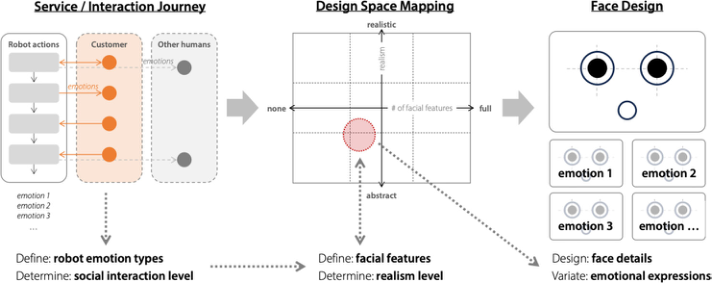
Structured Process for Face Design Based on the findings and discussions above, we propose a design process and guidance for robot facial expressions that address a robot’s tasks, interaction nature, and pertinent emotions in a specific service context. The process comprises the following three stages (Figure 4).
1) A robot’s emotions are extracted, and its level of social interaction is determined from an analysis of the service and interaction journey. 2) Based on stage 1, the number and types of facial features are defined, and their realism level is determined. This leads to mapping on the design space, which provides designers with visual means for regulating the level of anthropomorphism in comparison to other robot faces. 3) Within the territory defined in the previous two stages, designers configure facial features and develop face details while varying the face design to accommodate a range of emotions defined in stage 1.
By methodically translating the actual service journey and task / interaction nature into the design of robot faces, this structured approach will help designers create facial expressions appropriate for a given service context in terms of their anthropomorphism level and the required variety of emotions, rather than merely creating cute and friendly expressions.
Figure 4: Process for robot face design.
Limitations and Future Studies This study is limited in that the robot face samples used for the analysis were confined to a small number of commercially available examples found online, lacking comprehensive representation of service robot designs. Additionally, the design space mapping relied on static images of the robot faces, failing to capture diverse expressions and their dynamic effects in actual interaction situations. Finally, the study relied on the authors’ subjective judgment for the design space mapping. Although the number of facial features could be objectively determined, the judgment on the degree of realism remained subjective.
Accordingly, the following empirical studies will be beneficial for validating the findings in this paper. A user evaluation study is necessary, where a variety of robot faces are presented in realistic service scenarios, such as ordering food in a restaurant setting, either through animations or an immersive virtual reality (VR) experience. In this user study, the effects of facial feature adjustments - including the presence and absence of a mouth - and of varying realism levels on perceived anthropomorphism, affect, and capabilities will be measured. Furthermore, the use of animations or VR will enhance the accuracy of the evaluation of facial expressions, especially since emotions are not static but dynamically changing and translated into quick, subtle transitions of expressions.
CONCLUSION
In this study, we examined theories, approaches, and applications for designing rendered faces on service robots. The mapping of 24 service robot faces on the design space comprising facial features and realism revealed a lack of focused positioning within a context as well as a lack of clear distinction between contexts. The identification of a restaurant server robot’s emotional journey on its service and interaction journey map showed that the majority of the collected robot faces are limited in expressing the various emotions required for certain service contexts. These analyses exposed a gap between research and practice, leading to the need for a structured approach to designing facial expressions. With the three-stage process for context-specific robot face design, we expect designers to effectively address appropriate anthropomorphism and diverse emotions that are relevant and specific to a given service context.
REFERENCES
Barger, P. B., & Grandey, A. A. (2006). Service with a smile and encounter satisfaction: Emotional contagion and appraisal mechanisms. Academy of management journal, 49(6), 1229–1238. Blow, M., Dautenhahn, K., Appleby, A., Nehaniv, C. L., & Lee, D. C. (2006).
Perception of robot smiles and dimensions for human-robot interaction design. In 2006 RO-MAN 2006 (pp. 469–474). IEEE. Cárdenas, P., García, J., Begazo, R., Aguilera, A., Dongo, I., & Cardinale, Y. (2024). Evaluation of robot emotion expressions for human–robot interaction. International Journal of Social Robotics, 16(9), 2019–2041. Chesher, C., & Andreallo, F. (2021). Robotic faciality: The philosophy, science and
art of robot faces. International Journal of Social Robotics, 13(1), 83–96. DiSalvo, C. F., Gemperle, F., Forlizzi, J., & Kiesler, S. (2002). All robots are not created equal: The design and perception of humanoid robot heads. In Proceedings of the 4th conference on Designing interactive systems: Processes, practices, methods, and techniques (pp. 321–326). Dubé, L., & Morgan, M. S. (1998). Capturing the dynamics of in-process consumption
emotions and satisfaction in extended service transactions. International Journal of Research in Marketing, 15(4), 309–320. Duffy, B. R. (2003). Anthropomorphism and the social robot. Robotics and autonomous systems, 42(3–4), 177–190. Epley, N., Waytz, A., & Cacioppo, J. T. (2007). On seeing human: a three-factor
theory of anthropomorphism. Psychological review, 114(4), 864. Fernandes, R., Costa, L., Machado, P., & Kelner, J. (2025). An Exploratory Study on Emotions Conveyed Through Facial Expressions in Screen-Face Social Robots: Cultural Perception and Design Implications in Developing Countries. In IFIP Conference on Human-Computer Interaction (pp. 319–342). Cham: Springer Nature. Fink, J. (2012). Anthropomorphism and human likeness in the design of robots
and human-robot interaction. In International conference on social robotics (pp. 199–208). Springer. Goetz, J., Kiesler, S., & Powers, A. (2003). Matching robot appearance and behavior to tasks to improve human-robot cooperation. In 2003 RO-MAN (pp. 55–60). IEEE. Han, H., Back, K. J., & Barrett, B. (2010). A consumption emotion measurement
development: a full-service restaurant setting. The Service Industries Journal, 30(2), 299–320.
166 Ghim and Baek Han, J., Kang, S., & Song, S. (2013). The design of monitor-based faces for robot-
assisted language learning. In 2013 IEEE RO-MAN (pp. 356–357). IEEE. Hossain, M. Z., Enam, F., & Farhana, S. (2017). Service Blueprint a tool for enhancing service quality in restaurant business. American Journal of Industrial and Business Management, 7(7), 919–926. Hummel, E., & Murphy, K. S. (2011). Using service blueprinting to analyze restaurant
service efficiency. Cornell Hospitality Quarterly, 52(3), 265–272. Jo, S., & Hong, S. (2025). The Development of Human-Robot Interaction Design for Optimal Emotional Expression in Social Robots Used by Older People: Design of Robot Facial Expressions and Gestures. IEEE Access. Kalegina, A., Schroeder, G., Allchin, A., Berlin, K., & Cakmak, M. (2018). Characterizing
the design space of rendered robot faces. In Proceedings of the 2018 ACM/IEEE International Conference on Human-Robot Interaction (pp. 96–104). Lohse, M. (2011). Bridging the gap between users’ expectations and system evaluations. In 2011 RO-MAN (pp. 485–490). IEEE. Maguire, L., & Geiger, S. (2015). Emotional timescapes: The temporal perspective
and consumption emotions in services. Journal of Services Marketing, 29(3), 211– 223. McCloud, S. (1993). Understanding Comics: The Invisible Art. Harper Collins. Mori, M. (1970). The uncanny valley. Energy, 7(4), 33–35. Oidekivi, M., Nolte, A., Aabloo, A., & Kruusamäe, K. (2021). Identifying emotions from facial expression displays of robots-results from a survey study. In 2021 14th International Conference on Human System Interaction (HSI) (pp. 1–5). IEEE. Roesler, E., Naendrup-Poell, L., Manzey, D., & Onnasch, L. (2022). Why context matters:
the influence of application domain on preferred degree of anthropomorphism and gender attribution in human–robot interaction. International Journal of Social Robotics, 14(5), 1155–1166. Song, Y., Luximon, A., & Luximon, Y. (2021). The effect of facial features on facial anthropomorphic trustworthiness in social robots. Applied Ergonomics, 94, 103420. Song, Y., Tao, D., & Luximon, Y. (2023). In robot we trust? The effect of emotional
expressions and contextual cues on anthropomorphic trustworthiness. Applied Ergonomics, 109, 103967. Westbrook, R. A., & Oliver, R. L. (1991). The dimensionality of consumption emotion patterns and consumer satisfaction. Journal of consumer research, 18(1), 84–91. Yu, C. E., & Ngan, H. F. B. (2019). The power of head tilts: Gender and cultural
differences of perceived human vs human-like robot smile in service. Tourism Review, 74(3), 428–442. Złotowski, J., Proudfoot, D., Yogeeswaran, K., & Bartneck, C. (2015). Anthropomorphism: Opportunities and challenges in human–robot interaction. International journal of social robotics, 7(3), 347–360. Złotowski, J., Khalil, A., & Abdallah, S. (2020). One robot doesn’t fit all: aligning
social robot appearance and job suitability from a Middle Eastern perspective. AI & SOCIETY, 35(2), 485–500.
LISTED IN THE AHFE DIGITAL BOOKSTORE CATALOGUE
Explore the complete digital volume
Interdisciplinary Practice in Industrial Design
Read this individual research paper free through the original publisher, or explore the full digital proceedings book.
ISBN 978-1-964867-98-4
Explore this ISBN in the AHFE Bookstore ↗Listed in the July 2026 bookstore catalogue; search by ISBN to confirm current availability · Digital book purchase optional