Domagoj Bui, Yong-Gyun Ghim (2023). Industrial Design Guidelines for Robot Acceptance: The Role of Morphological Elements of Mobile Service Robots in a Restaurant Environment. In: Interdisciplinary Practice in Industrial Design. AHFE Open Access, vol. 100, pp. 169–177. https://doi.org/10.54941/ahfe1002983
With the advancement of technology, robots are increasingly being utilized in the service industry. While researchers have argued that human-like robots are more acceptable in a service context, they can also cause more discomfort than robots with a functional appearance. Although it has been studied that a robot’s appearance affects how people perceive its capabilities, there is a lack of detailed explanations on which design elements influence human perception and acceptance of robots, and how. This study hypothesizes that robots with a functional appearance can be more accepted by introducing certain lifelike features from anthropomorphic robots. This study aims to identify the design elements and their relationships to perceived attributes of mobile service robots in service environments. After examining the relationship between robot morphology and human perception, three robot attributes are defined: perceived characteristics, capabilities, and warmth. Three design elements of form, color, and interface are then extracted from prior studies that form the perceived attributes. A case study of two robots was conducted, one with a lifelike appearance and the other with a functional one. Finally, design guidelines are proposed based on these design elements to assist industrial designers in creating more acceptable designs for mobile service robots.
The use of robots has increased beyond industrial settings, and that is particu- larly apparent in the hospitality industry. Mobile service robots are gradually playing important roles in restaurants, and recent technological innovati- ons will further accelerate this transition toward close collaboration between robots and humans. However, service robots need to possess certain human qualities when interacting with humans for that transition (Bartneck & Forlizzi, 2004). People assume the robot’s capabilities based on what they perceive from its appearance, interface, and movement (Wright et al., 2013; Bartneck et al., 2020). Individual characteristics and features of robot appe- arance that affect the human perception of robots and acceptance need more research (Schaefer et al., 2012). Our research delves into the importance of specific design elements. First, we examine the relationship between robot
morphology and human perception, and then define the perceived attribu- tes of robots (characteristics, capabilities, and warmth). We hypothesize that robots with functional appearance can be better accepted through an introdu- ction of certain lifelike features from anthropomorphic robots while reducing the expectation gap normally found in lifelike robots. Second, we extract three design elements from prior studies that form the perceived attributes, and then conducted a case study of two robots, one with a lifelike appearance and the other with a functional one and examine our hypothesis. Finally, we propose design guidelines based on these design elements to help industrial designers create more acceptable designs for mobile service robots.).
ROBOT DESIGN AND HUMAN PERCEPTION Robot Morphology
The robots are transitioning from being just tools into being integrative par- tners in human-robot teams (Schaefer et al., 2012), and a service environment is dealing with a wide variety of users and working areas and could benefit a lot from such a transition. The robots analyzed in this research are mobile service robots for a restaurant environment. Researchers divided them into human-like or anthropomorphic, and machine-like robots (Phillips et al., 2017). While service robots have shown a wide range of the level of anth- ropomorphism between lifelike and functional designs, a restaurant context provides an equal opportunity for both types of morphology, which differen- tly affect perceptions of the robot’s characteristics and capabilities (Bartneck et al., 2009; Kunold et al., 2022). As the morphological boundaries between human-like, anthropomorphic, zoomorphic, and caricatured robot groups vary depending on researchers, we group them all under ‘lifelike’ robots. Additionally, we renamed the machine-like category into ‘functional’ to avoid the connection to industrial robots.
Anthropomorphic robots resemble humans in appearance, behavior, or social cues (Bartneck et al., 2020) and activate the perception of similarity to oneself (Barco et al., 2020). They are rated higher in perceived compete- nce and capabilities (Kunold et al., 2022). If robots look like us, we expect them to behave and be capable like us – that has not been accomplished yet (Bartneck et al., 2020). For robots with a human-like appearance, the overly high expectations of the characteristics and capabilities compared to actual functions creates an expectation gap (Komatsu et al., 2012). When the expectations are not met (Lohse, 2011), people easily abandon the use or do not accept the robot (de Graaf et al., 2017). Additionally, anthropomorphic robots have much higher discomfort ratings than functional ones (Kunold et al., 2022) which could be a result of the phenomenon of the uncanny valley, because anthropomorphic forms are preferred when robots have some degree of human-like appearance, but are not identical to humans (Mori, 1970). In social roles in hospitality, anthropomorphic ones receive significantly higher warmth ratings than functional robots (Kunold et al., 2022). If a robot’s design is transparent by matching the visual cues with the function, people are more likely to accept it. Moreover, designs using aesthetics to demonstrate functional capabilities are more successful overall (Uggirala et al., 2004).
Industrial Design Guidelines for Robot Acceptance 171
Thus, robot appearance should be designed to allow users to form prefer- red mental models about capabilities and limitations (Kunold et al., 2022; Phillips et al., 2017).
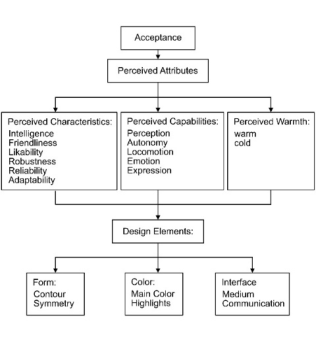
Perceived Attributes Design features cause attribution of certain abilities to a robot (Kunold et al., 2022). People expect robots to have specific attributes and rate robots accor- dingly. Additionally, some attributes are more important than others, and they include the social and cooperative attributes, and task related attribu- tes (Lohse, 2011). Perceived attributes also influence perceived usability and actual robot use. Firstly, performance-based attributes identified in robot capabilities are the best predictor of trust (Schaefer et al., 2012), and gre- ater human-likeness is connected to higher capability perception. Secondly, robot characteristics or features and robot warmth are the key attributes of social perception that drives acceptance (Kunold et al., 2022). We devised the attributes as perceived characteristics, perceived capabilities, and percei- ved warmth. Perceived characteristics are formulated by the question “What is the robot’s personality perceived like?” and include intelligence, friendli- ness, likability, robustness, reliability, and adaptability. Perceived capabilities are formulated by “What does it seem the robot can do?” with the qualities of perception, autonomy, locomotion, emotion, and expression. Perceived warmth is answering the question “How drawn is the user to the robot?” and indicated the robot’s approachability between warm and cold. Figure 1 illustrates the relationship between robot acceptance, perceived attributes, and design elements.
Design Elements Research into the impact design elements have on acceptance has been limi- ted. Still, it has been argued that perception of those basic elements influences
Figure 1: Top-down diagram of design elements influencing acceptance.
172 Bui and Ghim
attribution and acceptance. Robot’s color, texture, material, their interrelati- ons, and proportions were found to be correlated to its internal characteristics and to the perception of the robot’s capabilities (Wright et al., 2013). We argue that the users’ perception of the design elements influences these attributes to lower or improve the robot’s acceptance.
Three design elements are extracted from prior research based on their visual importance: form, color, and interface.
Form: The form is evaluated through the perception of contour bias (Lidwell et al., 2010), which suggests a preference for curved contours over sharp-angled ones due to the strong associations between the shapes and objects (Bar & Neta, 2006). Sharp edges represent harm and are quicker to capture and retain attention (Larson et al., 2007). The interrelations of shapes are also important in design, with symmetry being a preferred fea- ture (Palmer, 1985; Palmer et al., 2013). Global shapes are not affected by local ones while local features need to be processed while being aware of the whole (Navon, 1977). Shapes placed at the center are perceived as visually more important (Palmer et al., 2008).
Color: In mobile service robots, white, metallic gray, with black details are currently the most used colors. All grays, or achromatic colors, are easily influenced by colors from surrounding areas. They convey incorruptibility and abstraction (Itten, 1970). Furthermore, white is perceived as very active and relatively light (Ou et al., 2004). According to the ecological valence theory (EVT), people are attracted to objects with colors that look good to them for better survival.
Interface: Some of the most important robot behavior and appearance characteristics that show social intelligence (Bartneck & Forlizzi, 2004) in human-robot interaction include displaying personality traits and interacti- vity, as users expect two-way communication. If a robot’s interface displays human-like emotions and behavior, it shows social intelligence and can improve robot acceptance (Picard, 2003).
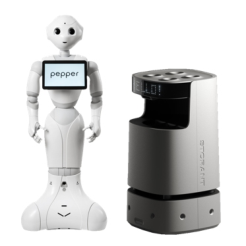
CASE STUDY We carried out a case study to examine the impact of design elements on the perception of robots and evaluate how these elements can be applied to the currently burgeoning functional robot design. The study involved comparing one lifelike robot and one functional looking robot, both presented as still images (Figure 2). They were analyzed according to the theories in psycho- logy, art, and design by comparing the design elements and assessing their influence on the perceived attributes.
Study 1: Pepper Form: Curved contours are preferred over sharped-angled ones (Bar & Neta, 2006). In that sense, Pepper’s curved form can be considered to elicit a positive impression. The shape of the body is formed to resemble a human feminine figure symmetrical on the vertical axis. The presence of arms and hands can make people assume that it does similar jobs as a human with arms and hands does. However, it can only greet the guests, so this causes an
Industrial Design Guidelines for Robot Acceptance 173
Figure 2: Pepper Restaurant Robot (left) and Storant Café Server Bot (right).
expectation gap. Pepper effectively makes only the larger form perceived by hiding its functional details like sensors, ventilation openings, and creases for moving parts with specific placement. The screen interface is located in the perceptual center. Thus, the robot can be perceived as intelligent, friendly, and likable. With discernable hands and a head, the robot can be attributed with the capabilities of autonomy, locomotion, and expression. As it is similar to humans and highlights its own perception, it can be perceived as warm.
Color: Pepper is almost completely white, with grey inserts to highlight the joints. The only chromatic color is the light blue illumination around the eyes, ears, and wheels. The color palette makes it fit in any environment, even cluttered and very multicolored ones. Additionally, its sterile color reduces the expectation gap by being less human. Colored light details highlight the perceived capability of perception, and the light gray details highlight the perceived capability of locomotion, although none of those capabilities are functioning where they are visually placed. All of these can make Pepper attributed as likable, reliable, and robust. The colors are also used generally in the tech industry to convey the feeling of high-tech, thus, the robot can be perceived as capable of autonomy Based on the color properties, Pepper can be perceived as cold.
Interface: The interface of this robot consists of two parts – the face which listens and talks with the corresponding visual cues, and the tablet compu- ter with a large screen that shows the content. The face, although stylized, resembles the natural order and look of a human face. The eyes are big, and the nose and ears are softly modeled. All the proportions are over- or under- emphasized to resemble a human or an animal baby. The eyes and ears are illuminated, highlighting capabilities. The screen is detached from the body with a rectangular shape and a black color around the bezel. As the graphics on the screen are entirely customizable, they do not afford analysis. A com- bination of facial features and a screen allows two-way communication with perception and expression. The interface is at the center, the place where it is expected to be, and at the right height for users. Pepper’s interface can thus be perceived as intelligent, friendly, and reliable, and as capable of perception and expression. It can also be rated as warm because the simple and car- toonish facial features underpinned by the expressive and interactive screen make the interaction more natural.
174 Bui and Ghim
Study 2: Storant Form: Storant Café Server Bot has a simple and monolithic form overall. It lacks any visual cues that resemble a living being. The appearance affords the basic function of carrying small items. The main form is a vertically elon- gated cube with rounded corners. It is more angular than Pepper and has some sharp corners and edges around the wheelbase block and the black gar- bage disposal hole. It is vertically and radially symmetrical. Its sensors are perceived as a single line instead of multiple objects due to the laws of pro- ximity and good continuation (Navon, 1977). Storant can be perceived as reliable and robust but lacks human personality characteristics. The robot can be also perceived as capable of perception, but its locomotion is not visu- ally addressed, which could create an expectation gap. Its form can be rated as cold.
Color: The overall color scheme is gray, which lacks character with the absence of any chromatic-colored details. Though this helps it blend in with its surroundings, the palette does not make it look particularly alive or active, failing to lessen its machine-like qualities. The screen and disposal areas are completely black, resembling a threatening mouth. The lack of color highlights on its sensors, function features, and loco- motion, makes Storant seem static and unresponsive. The robot can be attributed only with reliability, be perceived as capable of autonomy, and as cold.
Interface: The interface is comprised of a single monochrome LED matrix at the top of the robot. It has no resemblance to the human face. Its shape and colors, the white lettering on a black background, do not afford a posi- tive perception. However, the interface is positioned in an expected location and at an appropriate height for use. It is not directly interactive but can display relevant information in real time. There is not much visual noise in the system, avoiding the issue of divided attention (Preece et al., 2015). Based on its interface, this Café Server Bot has the characteristic of intelligence. Its ability to react gives the perceived capability of expression. Finally, it can be regarded as warm due to its lack expressive and emotional visual cues for communication.
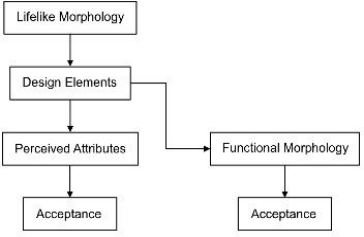
DESIGN GUIDELINES Prior research has found that there are some general effects of and recom- mendations for the appearance of lifelike robots that can be further applied to the design of functional-looking robots to increase their acceptability. One important aspect is incorporating lifelike appearance features and effe- cts into the functional looking robot so that the robot can be perceived as more approachable and warmer while avoiding the potential expectation gaps (Figure 3).
Form: A robot should have curve-contoured or rounded forms to avoid causing unpleasant feelings in users. Sharp edges can be used to guide the users’ visual search and draw attention to something on the robot that is of importance. The body of a robot should be designed with a symmetrical
Industrial Design Guidelines for Robot Acceptance 175
Figure 3: Incorporating design elements of lifelike robots to functional looking robots.
composition of functional elements, with smaller elements always arran- ged vertically or horizontally symmetrical to enhance its natural appearance. Smaller elements, that are intended to go unnoticed by users, should be arran- ged to follow the contours of the larger forms or grouped together in a line and be similar in shape and size to abide by the Gestalt laws. Both the geo- metrical and perceived centers are essential for a good robot design. It is recommended that important elements, such as interfaces, are placed at the center of the robot’s body.
Color: Designers should choose colors carefully for certain shapes and elements to avoid association with unpleasant real-life objects. Achroma- tic colors are recommended for the robot body because neutral colors go well with the surroundings. In general, when combined with lifelike features, they afford attributions preferable for service robots. At the same time, it is recommended to add chromatic details or highlights as achromatic colors are also perceived as rigid and abstract. Without them, the functional robot may not feel lively and expressive, which can decrease essential perceived chara- cteristics or capabilities. Adding chromatic highlights to the body parts that mimic eyes, ears, mouth, or limbs will make those parts look more capable and expressive. Designers should be aware of the expectation gap and leve- rage colors for enhancing the perception of invisible functionality, such as hidden sensors.
Interface: A robot’s interface has a crucial role in the communication of its attributes, either in an explicit or subtle way. For example, facial expressions, which are one of the main characteristics of lifelike robots, can contribute to the enhancement of perceived attributes by implementing them on the visual interface of functional looking robots. The arrangement and positi- oning of these elements should follow the human face to remain perceived as warm. The visual interface should be designed in a way that draws focus to the eyes on the interface. It should be designed as naturally as possible for interaction and communication with the users. It should show expression, perception, and behavior directly to the users via the form elements and colors according to the guidelines presented earlier in this section. Designers should also consider a proper level of redundancy for the optimal level of noise on the interface to deal with issues of attention and memory in human-robot interaction.
176 Bui and Ghim
CONCLUSION AND DISCUSSION In this study, we endeavored to find out how the design elements of form, color, and interface affect users in perceiving desirable attributes and ena- bling robot acceptance. A case study with a lifelike and a functional looking robot was conducted, and specific design elements were examined through the lens of theories on the expectation gap and Uncanny Valley. We discussed that certain features of human-likeness from lifelike robots can be applied to functional looking robots to improve robot acceptance. Finally, industrial design guidelines were proposed based on the design elements examined ear- lier. These guidelines can inform designers for the decision-making in their practice and encourage further research on each of the design elements. Alth- ough this case study points to the rules and preferences that shape attribution users make with robots, they mostly stem from research in art and psycho- logy. Further research involving testing with humans is needed to eliminate the possibility of biases in each of the design element categories. Additionally, studies with human involvement are required to determine the causality betw- een the design elements, perceived attributes, and their role in acceptance. Thus, the results of exact design elements that influence better acceptance in both lifelike and functional looking robots can be better verified.
REFERENCES
Bar, M., & Neta, M. (2006). Humans prefer curved visual objects. Psychological Science, 17(8), 645–648. Barco, A., de Jong, C., Peter, J., Kühne, R., & van Straten, C. L. (2020). Robot
Morphology and Children’s Perception of Social Robots: An Exploratory Study. Companion of the 2020 ACM/IEEE International Conference on Human-Robot Interaction, 125–127. Bartneck, C., Belpaeme, T., Eyssel, F., Kanda, T., Keijsers, M., & Šabanovi´c, S. (2020).
Human-Robot Interaction: An Introduction. Cambridge University Press. Bartneck, C., Kuli´c, D., Croft, E., & Zoghbi, S. (2009). Measurement Instruments for the Anthropomorphism, Animacy, Likeability, Perceived Intelligence, and Perceived Safety of Robots. International Journal of Social Robotics, 1(1), 71–81. Bartneck, C., & Forlizzi, J. (2004). A design-centred framework for social human-
robot interaction. RO-MAN 2004. 13th IEEE International Workshop on Robot and Human Interactive Communication (IEEE Catalog No.04TH8759), 591–594. de Graaf, M., Ben Allouch, S., & van Dijk, J. (2017). Why Do They Refuse to Use My Robot? Reasons for Non-Use Derived from a Long-Term Home Study. Proceedings of the 2017 ACM/IEEE International Conference on Human-Robot Interaction, 224–233. Itten, J. (1970). The Elements of Color. John Wiley & Sons. Komatsu, T., Kurosawa, R., & Yamada, S. (2012). How Does the Difference Betw-
een Users’ Expectations and Perceptions About a Robotic Agent Affect Their Behavior? International Journal of Social Robotics, 4(2), 109–116. Kunold, L., Bock, N., & Rosenthal-von der Pütten, A. (2022). Not All Robots are Evaluated Equally: The Impact of Morphological Features on Robots; Asses- sment through Capability Attributions. ACM Transactions on Human-Robot Interaction, 12(1), 3:1-3:31.
Industrial Design Guidelines for Robot Acceptance 177
Larson, C. L., Aronoff, J., & Stearns, J. J. (2007). The shape of threat: Simple geometric forms evoke rapid and sustained capture of attention. Emotion (Washington, D. C.), 7(3), 526–534. Lidwell, W., Holden, K., & Butler, J. (2010). Universal Principles of Design, Revi-
sed and Updated: 125 Ways to Enhance Usability, Influence Perception, Increase Appeal, Make Better Design Decisions, and Teach Through Design. Rockport Publishers. Lohse, M. (2011). Bridging the gap between users’ expectations and system evaluations. 2011 RO-MAN, 485–490. Mori, M. (1970). Bukimi no tani (the uncanny valley). Energy, 7(4), 33–35. Navon, D. (1977). Forest before trees: The precedence of global features in visual
perception. Cognitive Psychology, 9(3), 353–383. Ou, L.-C., Luo, M., Woodcock, A., & Wright, A. (2004). A study of colour emotion and colour preference. Part I: Colour emotions for single colours. Color Research & Application, 29, 232–240. Palmer, S. E., Schloss, K. B., & Sammartino, J. (2013). Visual Aesthetics and Human
Preference. Annual Review of Psychology, 64(1), 77–107. Palmer, S. E., Gardner, J. S., & Wickens, T. D. (2008). Aesthetic issues in spatial composition: Effects of position and direction on framing single objects. Spatial Vision, 21(3–5), 421–449. Palmer, S. E. (1985). The role of symmetry in shape perception. Acta Psychologica,
59(1), 67–90. Phillips, E., Ullman, D., de Graaf, M., & Malle, B. (2017). What Does A Robot Look Like?: A Multi-Site Examination of User Expectations About Robot Appearance. Proceedings of the Human Factors and Ergonomics Society Annual Meeting, 61, 1215–1219. Picard, R. W. (2003). Affective computing: Challenges. International Journal of
Human-Computer Studies, 59(1), 55–64. Preece, J., Sharp, H., & Rogers, Y. (2015). Interaction Design: Beyond Human- Computer Interaction. John Wiley & Sons. Schaefer, K., Sanders, T., Yordon, R., Billings, D., & Hancock, P. (2012). Classifica-
tion of Robot Form: Factors Predicting Perceived Trustworthiness. Proceedings of the Human Factors and Ergonomics Society Annual Meeting, 56, 1548–1552. Uggirala, A., Gramopadhye, A. K., Melloy, B. J., & Toler, J. E. (2004). Measurement of trust in complex and dynamic systems using a quantitative approach. International Journal of Industrial Ergonomics, 34(3), 175–186. Wright, J., Sanders, T., & Hancock, P. A. (2013). Identifying the Role of Attribu-
tions in Human Perceptions of Robots. Proceedings of the Human Factors and Ergonomics Society Annual Meeting, 57(1), 1288–1292.
LISTED IN THE AHFE DIGITAL BOOKSTORE CATALOGUE
Explore the complete digital volume
Interdisciplinary Practice in Industrial Design
Read this individual research paper free through the original publisher, or explore the full digital proceedings book.
ISBN 978-1-958651-76-6
Explore this ISBN in the AHFE Bookstore ↗Listed in the July 2026 bookstore catalogue; search by ISBN to confirm current availability · Digital book purchase optional