Luka Brodarič, Snježana Babić (2025). The Adoption of Artificial Intelligence Tools in Education: A Case Study of Primary and Secondary School Teachers in Pula, Croatia. In: Human Systems Engineering and Design (IHSED2025): Future Trends and Applications. AHFE Open Access, vol. 198, pp. 299–308. https://doi.org/10.54941/ahfe1006809
The integration of Artificial Intelligence (AI) into education offers numerous opportunities to enhance teaching effectiveness, personalize learning, and increase student engagement. Simultaneously, it raises many questions regarding teachers' digital competencies, ethical challenges, institutional readiness, and the general acceptance of AI-based tools. This paper presents the results of a case study conducted among primary and secondary school teachers in the city of Pula, Croatia, with the aim of examining their attitudes, readiness, and perceived challenges concerning the use of AI in teaching practice. \nData were collected through a structured questionnaire that covered digital habits, self-assessed skills, prior experience with AI tools, and the perception of usefulness and potential risks. The research results show that most respondents recognize AI's potential to improve teaching quality, support individualized approaches, and foster student creativity. However, concerns were expressed regarding the accuracy of AI-generated content, the potential reduction in student social interaction, and unresolved ethical issues. The lack of education and clear institutional guidelines was highlighted as a significant barrier to successful implementation.\nThe study contributes to a deeper understanding of teachers' perceptions of AI's role in education and points to the need for a strategic approach to introducing these technologies into the school system.
The integration of artificial intelligence (AI) in education is considered a transformative, with potential to alter pedagogical practices. Despite global discourse, a gap in empirical research persists, particularly regarding the experiences and attitudes of primary and secondary school teachers in specific regional contexts. This study addresses that gap by exploring the extent to which primary and secondary school teachers in Pula, Croatia, utilize AI tools and systems. It also examines their perceptions of the benefits and challenges associated with these technologies, contributing a focused case study to the broader understanding of AI adoption in education.
THEORETICAL BACKGROUND The incorporation of artificial intelligence (AI) tools in education is a key area of modern research, focusing on educators perceptions and attitudes toward AI literacy. Contemporary studies highlight common trends, advantages, and difficulties to provide context for the present case study. Research broadly acknowledges AI’s potential to improve teaching and learning by enabling personalized experiences and administrative efficiency (Fitria, 2021; Stankovi´c et al., 2024). The perceived effectiveness of AI tools is vital for teacher engagement and acceptance, as educators recognize their promise to save time and enhance instructional quality (Li et al., 2024). These findings, including the perceived ability to foster student creativity and facilitate personalized instruction, align with the survey used in this study (Li et al., 2024). Despite these benefits, AI integration brings challenges. Ethical issues, such as data privacy and algorithmic biases, are often raised (Fitria, 2021; Stankovi´c et al., 2024). Pedagogical concerns also emerge, including the potential decline in critical thinking and reduced social interactions among learners (Chounta et al., 2022; Stankovi´c et al., 2024). Perceived obstacles often involve a lack of professional training, inadequate resources, and the absence of clear institutional policies (Chounta et al., 2022). Concerns also exist regarding AI’s potential to diminish the teacher’s role and increase administrative burdens (Stankovi´c et al., 2024). These recognized challenges are directly linked to the current study’s survey, which explores participants’ worries about ethical issues and systemic constraints. Research indicates an urgent need for curricula and professional training to enhance AI literacy in educators (Casal-Otero et al., 2023). The creation and validation of tools to assess AI literacy are also essential, often outlining affective, behavioral, cognitive, and ethical aspects (Ng et al., 2024). These concepts align with the survey questions related to self-evaluated skills, attitudes towards AI’s advantages, and worries about ethical challenges (Ng et al., 2024; Chounta et al., 2022).
RESEARCH METHODOLOGY The study was conducted in the city of Pula, Croatia, with a focus on primary and secondary school teachers. A total of 11 primary and 11 secondary schools operate within the city’s educational system. Based on a voluntary and anonymous approach, the research was conducted from June to July 2025. Data were collected via an online survey, created using the Google Forms platform. The survey was distributed to the targeted population of educators. A total of 77 participants completed the questionnaire. The research instrument was designed for data collection via an online survey. The questionnaire was developed based on the Technology Acceptance Model (Davis, 1989) and the Unified Theory of Acceptance and Use of Technology (Venkatesh et al., 2003), as well as previous research (Kalra, 2024; Konecki et al., 2025; Casal-Otero et al., 2023; Ng et al., 2024; Yim & Wegerif, 2024). The questionnaire is organized in six different parts. The former section is related to the demographic factors of participants. The second part is devoted to the frequency of the use of internet and AI tools in everyday life. The third
The Adoption of Artificial Intelligence Tools in Education 301
part is an assessment of the skills the participants perceive they have with AI tools and their overall attitude toward the application of AI in an educational setting. The fourth section is devoted to the frequency of the application of particular types of AI tools. The fifth part deals with the objective of the use of AI tools in the teaching process. The sixth section gauges the attitudes and perceptions of the participants on the advantages and the difficulties of utilizing AI, on a five point Likert scale, where 1 is the lowest and 5 is the highest. These dimensions of measurement were developed in order to give a better overall picture of the subject, not only in terms of general digital habits and perceptions but also in terms of the particular application and expressed attitudes.
RESULTS AND DISCUSSION
PARTICIPANTS The study included 77 teachers from primary and secondary schools in Pula, Croatia. The majority of the respondents were female (76.62%), with male participants accounting for 22.08% of the sample.
In terms of age, the largest group of respondents was between 31 and 40 years of age (36.36%), followed by those in the 51–60 age bracket (22.08%) and the 41–50 age bracket (20.78%). The professional experience of the participants was also varied, with the largest proportion having between 4 and 10 years of experience (28.57%). The majority of respondents (92.21%) held a university-level degree.
A near-equal distribution of participants was observed across the two types of educational institutions. Teachers from primary schools represented 57.14% of the sample, while those from secondary schools accounted for 42.86%. The subject areas taught by the participants were varied. The most represented categories were Social Sciences and Humanities, along with Vocational Subjects, both comprising 19.48% of the sample. This was followed by Language and Communication (16.88%), Natural Sciences and Mathematics (15.58%), and Information Technology and Technical Subjects (14.29%). Smaller proportions were in the “Other” and Arts categories.
RESULTS
A analysis of self-assessed skills and ability shows that teachers generally rate their skills as moderate, with an average score of 2.94 on a five-point scale. Regarding prior experience with AI education, a majority of the respondents, 59.74%, indicated that they have not participated in any education about AI tools but would be willing to do so. A smaller portion of teachers, 28.57%, reported having participated in a single education. A very small percentage of participants, 7.79%, have attended multiple educations, while 3.90% expressed no interest in AI-related education.
The digital habits of the respondents show a high level of internet usage, both in their daily lives and for professional purposes. The majority of teachers (58.44%) use the internet for 1 to 3 hours per day, while 20.78% use it for 3 to 5 hours. Furthermore, internet usage for preparing and conducting
302 Brodariˇc and Babi´c
lessons is highly frequent. A substantial portion of the participants use the internet for these professional purposes either daily (37.66%) or several times a week (42.86%). In contrast, the frequency of general AI tool usage in daily life is more varied. The largest group of respondents (32.47%) use AI tools occasionally (1–2 times per week), followed by those who use them rarely (28.57%). A smaller number of teachers reported using AI tools often (19.48%) or very often (5.19%) in their daily lives, while 14.29% stated they never use them.
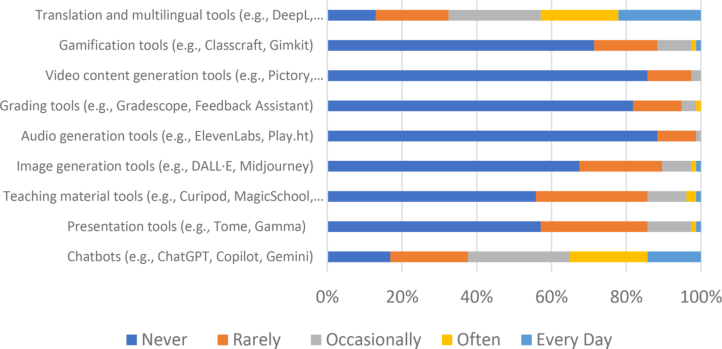
Figure 1: Frequency of AI tool usage among primary and secondary school teachers in Pula (N = 77).
The results of the Mann-Whitney U test showed that there were no statistically significant differences (all p > 0.05) between elementary and secondary school teachers in their assessment of the benefits (improved teaching quality, time savings, student empowerment, creativity stimulation, individualization of teaching, ease of use) and challenges (additional effort, reduced teacher role, ethical dilemmas, lack of training, administrative burden, hindering critical thinking, reliability of information, reduced social skills, lack of school guidelines) related to the use of artificial intelligence in education. The results of the Mann–Whitney U test (Table 1) show statistically significant differences between primary school teachers in the city of Pula who use artificial intelligence tools (N = 29) and those who do not (N = 15). Users reported higher scores for improving teaching quality (U = 360.5, Z = 3.54, p < .001), saving time (U = 338.0, Z = 2.98, p = .002), empowering students (U = 354.0, Z = 3.38, p < .001), encouraging creativity (U = 366.0, Z = 3.68, p < .001), individualization of teaching (U = 351.5, Z = 3.32, p = .001), and ease of use (U = 346.5, Z = 3.19, p = .001) compared to teachers who had not used AI tools in their teaching. On the other hand, non-users of AI tools expressed greater agreement with the statements that it requires additional effort (U = 73.5, Z = −3.57, p < .001), reduces the role of the teacher (U = 56.5, Z = −3.99, p < .001),
The Adoption of Artificial Intelligence Tools in Education 303
lacks training (U = 135.0, Z = −2.04, p = .035), and increases administrative burden (U = 113.0, Z = −2.59, p = .008).
Other items, such as ethical dilemmas, interference with critical thinking, information reliability, reduction in social skills, and lack of school guidelines, did not show significant differences between the two groups of primary school teachers (all p > .05). Finally, the intention to use AI tools was significantly higher among users (U = 373.0, Z = 3.85, p < .001) compared to non-users.
Table 1: Mann–Whitney U test results comparing AI tool users (N = 29) and non users (N = 15) among primary school teachers in Pula.
Table available in the original PDF paper.
Item Primary School Teachers in Pula U Z P
Users of AI Tools Non-Users of AI Tools (N = 29) (N = 15) Mean Rank Sum of Rank Mean SD Mean Rank Sum of Rank
Lack of school guidelines 20.67 599.5 3.79 0.86 26.03 390.5 4.13 0.83 164.50 –1.31 0.169 Intention to use 27.86 808.0 4.38 0.90 12.13 182.0 2.73 1.16 373.00* 3.85 0.000
*p<0.01, **p<0.05; Source: Authors
The results of Spearman’s correlation analysis showed that the intention to use AI tools among primary school teachers in the city of Pula is most strongly associated with perceived benefits. The highest coefficients were obtained for the statements that AI saves time (r = .74, p < .001), improves teaching quality (r = .70, p < .001), and enables individualized learning
304 Brodariˇc and Babi´c
(r = .68, p < .001). Moderate positive associations were found for the statements that AI is easy to use (r = .61, p < .001), empowers students (r = .54, p < .001), and stimulates creativity (r = .48, p = .006). Negative associations were noted for the perception that AI requires additional effort (r = −.35, p = .020) and increases the administrative burden (r = −.32, p = .030). Other statements, including ethical dilemmas (r = −.09, p = .490), reliability of information (r = −.12, p = .360), critical thinking (r = −.15, p = .280), social skills (r = −.19, p = .190), and lack of school guidelines (r = −.14, p = .300), did not show a statistically significant association with the intention to use AI tools. In the context of secondary schools in the city of Pula, based on the results of the Mann-Whitney U test (Table 2), significant differences were indicated between secondary school teachers who use artificial intelligence tools (N = 24) and those who do not use them (N = 16). Users reported higher scores for improving teaching quality (U = 86.0, Z = −3.24, p = 0.001), saving time (U = 97.5, Z = −2.91, p = 0.004), empowering students (U = 110.0, Z = −2.52, p = 0.012), encouraging creativity (U = 81.5, Z = −3.39, p = 0.001), individualization of teaching (U = 111.0, Z = −2.48, p = 0.013) and ease of use (U = 115.5, Z = −2.34, p = 0.019). Non-users of AI tools in the classroom expressed greater agreement with the statements that it requires additional effort (U = 80.0, Z = −3.37, p = 0.001), reduces the role of teachers (U = 81.5, Z = −3.34, p = 0.001), lacks training (U = 105.5, Z = −2.56, p = 0.011), and increases administrative burden (U = 121.5, Z = −2.11, p = 0.035). The remaining items, ethical dilemmas, interference with critical thinking, information reliability, reduction in social skills, and lack of school guidance, did not show significant differences between the participant groups (all p > 0.05). Finally, the intention to use AI tools was significantly higher among users (U = 69.0, Z = −3.74, p < 0.001) compared to non-users of AI tools.
Table 2: Mann–Whitney U test results comparing users (25) and non-users (9) of AI tools among secondary school teachers in Pula.
Table available in the original PDF paper.
Item Secondary School Teachers in Pula U Z P
Users of AI Tools Non-Users of AI Tools (N = 25) (N = 9) Mean Rank Sum of Rank Mean SD Mean Rank Sum of Rank
Lack of school guidelines 15.38 384.5 3.60 1.22 23.39 210.5 4.56 0.53 59.5 –2.07 0.030 Intention to use 21.36 534.0 4.32 0.90 6.78 61.0 2.22 0.97 209.0 3.77 0.000
*p<0.01, **p<0.05; Source: Authors Spearman’s rank correlation was also performed on the collected data to examine the relationship between teachers’ perceptions of AI tools and their intention to use them among secondary school teachers (N = 40). The results showed the strongest positive correlations for saving time (r = .72, p < .001), improving the quality of teaching (r = .69, p < .001), and stimulating creativity (r = .66, p < .001). Moderate positive correlations were found with individualized instruction (r = .62, p < .001), ease of use (r = .57, p = .001), and empowering students (r = .53, p = .002). Negative correlations were found with the perceptions that AI requires additional effort (r = −.38, p = .018) and reduces the teacher’s role (r = −.35, p = .027). Lack of training and additional administrative burden showed weaker negative associations (r = −.31, p = .049; r = −.29, p = .061). Other items, including ethical dilemmas, hindering critical thinking, reliability of information, reduction in social skills, and lack of school guidelines, were not significantly associated with the intention to use AI tools (all p > .05).
DISCUSSION
The results of the research in this paper show several important forms of behavior of primary and secondary school teachers in the city of Pula in the perception and intention to use artificial intelligence tools in education. First, the comparison between the participants of this research, primary and secondary school teachers, did not reveal significant differences in the assessment of benefits and challenges, which suggests that attitudes are shaped more by individual experience and level of digital competences than by the type of educational institution. The first results on self-evaluated
306 Brodariˇc and Babi´c
knowledge and previous experience provide more information about teachers preparedness to AI integration. Although there are no major differences in the attitudes, there are slight differences noted in the perceived skills and experiences between the two groups of people. Teachers in primary schools reported slightly higher average scores on a 5-point scale (2.98 and 2.77) both on self-evaluated AI skills and AI application skills in an educational setting than their peers in secondary schools (2.88 and 2.73, respectively). The results concerning digital competence and the desire to employ AI tools are an essential aspect of AI literacy, which is claimed by past studies (Casal-Otero et al., 2023; Ng et al., 2024). The review of the previous experience proves that formal training is important. Most of the teachers in both primary (59.09%) and secondary schools (60.61%) have not engaged in education related to AI but indicated that they would like to do so. This enthusiasm to take part in professional development shows the readiness to integrate even more. Among primary school teachers, a clearer difference in the perception between users and non-users of AI tools in education was observed. Users emphasized benefits such as improved teaching quality, time savings and personalization of learning, while non- users emphasized additional effort, administrative burden and a reduction in the role of teachers. Such results are in line with previous research indicating that the experience of direct application shapes more positive attitudes (e.g. Chounta et al., 2022; Stankovi´c et al., 2024). Similarly, in secondary schools, users showed more pronounced positive perceptions compared to non-users, although the difference was somewhat less pronounced than in primary schools. This may point to a higher level of digital competence of secondary school teachers, but also to different pedagogical practices. Correlation analysis additionally confirms that the intention to use the tool is strongly related to the perception of benefits, especially with saving time, improving the quality of teaching and creativity. On the other hand, barriers such as additional effort and administrative burden are negatively related to intention to use. It is interesting that questions of ethical dilemmas, critical thinking, reliability of information and social skills did not show a significant connection with intention, which may mean that primary and secondary school teachers in the Pula Guard recognize these dimensions, but they are not decisive for them in the decision to use tools in teaching. The findings can be interpreted within the framework of the UTAUT (Venkatesh et al., 2003) and TAM (Davis, 1989), models, according to which the perception of usefulness and ease of use most influences the intention to adopt technology (Li et al., 2024; Ng et al., 2024). At the same time, the fact that ethical issues and potential negative consequences do not play a major role may indicate the need to emphasize this dimension more strongly in future education. In general, the results confirm that the key driver of the adoption of AI tools in education is the perception of their practical benefits, while obstacles are significant, but to a lesser extent. This opens up space for further research and development of educational programs that will simultaneously strengthen the digital competences of teachers in primary and secondary schools in the city of Pula, with an emphasis on the ethical and pedagogical challenges that the integration of AI tools in education brings. This study has certain
The Adoption of Artificial Intelligence Tools in Education 307
limitations that should be considered when interpreting the results. First, it was conducted on a relatively small and geographically limited sample of primary and secondary school teachers from the city of Pula, which limits the generalizability of the findings. Second, the use of a self-report questionnaire may have introduced social desirability bias and relied on the subjective perceptions of the respondents. Third, the cross-sectional design does not allow conclusions about causal relationships between the observed variables. Finally, given the rapid development of AI tools in education, teachers’ perceptions are likely to change over time, indicating the need for longitudinal and comparative studies in a broader educational context. Despite these limitations, the study provides valuable insights into teachers’ perceptions of the benefits and challenges of using AI in education. The findings highlight the importance of targeted professional development, institutional support, and clear guidelines to encourage the effective and responsible integration of AI tools into teaching practice. Future research should therefore explore larger and more diverse samples, adopt longitudinal designs, and examine how contextual factors, such as school leadership and policy frameworks, shape teachers’ adoption of AI in education.
CONCLUSION
The results of this study showed that primary and secondary school teachers in the city of Pula recognize clear benefits of AI tools in education, especially in terms of saving time, improving the quality of teaching, and individualizing learning. At the same time, they also pointed out challenges, such as additional workload and the need for further training. No statistically significant differences were found between primary and secondary school teachers, indicating similar patterns in teachers’ perceptions of the integration of artificial intelligence in education. The research also found that while a clear willingness to adopt AI exists, the actual use of these tools in teaching practice is limited. This points to a gap between perceived potential and a moderate level of self-assessed knowledge and skills with AI tools, indicating a need for targeted professional development to bridge this gap. The contribution of this research is reflected in several aspects. First, it is one of the rare studies that compares the perceptions of users and non-users of AI tools in both primary and secondary schools, offering insights into the factors that encourage or hinder the adoption of these technologies. Second, the combination of perception analysis and correlation with the intention to use enabled a more detailed understanding of the relationship between attitudes and readiness to adopt AI tools. Third, the study provides a local, but valuable contribution to understanding how teachers in the Croatian context perceive AI in education, which may serve as a basis for broader national and international research. It is also important to emphasize the ethical dimension of applying AI tools. Although ethical concerns were not among the most significant factors in this study, they remain a key area for future research and practice. Algorithmic transparency, the protection of student privacy, and the responsible use of data must be integral to the implementation of AI technologies in education. Based on the findings, it can be concluded that the successful and ethically sustainable implementation of AI tools in schools requires clear institutional support, continuous professional development, and the establishment of guidelines to ensure the responsible and meaningful use of these technologies in teaching practice.
308 Brodariˇc and Babi´c
ACKNOWLEDGMENT
This paper was created as part of the master’s thesis of the author, Luka Brodariˇc, under the mentorship of Associate Professor Snježana Babi´c, PhD. A subsequent study will include a larger number of teachers from the city of Pula and a more extensive analysis of the influence of teachers’ personal characteristics on the observed variables.
REFERENCES
Casal-Otero, L., Catala, A., Fernández-Morante, C., Taboada, M., Cebreiro, B., & Barro, S. (2023). AI literacy in K-12: A systematic literature review. International Journal of STEM Education, 10(1), 29. Chounta, I. A., Bardone, E., Raudsep, A., & Pedaste, M. (2022). Exploring teachers’
perceptions of artificial intelligence as a tool to support their practice in Estonian K-12 education. International journal of artificial intelligence in education, 32(3), 725–755. Davis, F. D. (1989). Perceived usefulness, perceived ease of use, and user acceptance of information technology. MIS Quarterly, 13(3), 319–340. Fitria, T. N. (2021). Artificial intelligence (AI) in education: Using AI tools for
teaching and learning process. In Prosiding seminar nasional & call for paper STIE AAS (pp. 134–147). Kalra, R. (2024). Exploring teachers’ perceptions toward the integration of AI tools in the language classroom. NIDA Journal of Language and Communication, 29(45), 21–36. Kim, N. J., & Kim, M. K. (2022, March). Teacher’s perceptions of using an artificial
intelligence-based educational tool for scientific writing. In Frontiers in education (Vol. 7, p. 755914). Frontiers Media SA. Konecki, M., Baksa, T., & Konecki, M. (2024). Teachers’ Perception of AI and Their Attitudes Towards AI. CSEDU (1), 564, 568. Li, W., Zhang, X., Li, J., Yang, X., Li, D., & Liu, Y. (2024). An explanatory study of
factors influencing engagement in AI education at the K-12 Level: An extension of the classic TAM model. Scientific Reports, 14(1), 13922. Ng, D. T. K., Wu, W., Leung, J. K. L., Chiu, T. K. F., & Chu, S. K. W. (2024).
Design and validation of the AI literacy questionnaire: The affective, behavioural, cognitive and ethical approach. British Journal of Educational Technology, 55(3), 1082–1104. Stankovi´c, N., Stankovic, I., Markovi´c, G., & Blagojevi´c, M. (2024). The Role of AI Tools in Education: Opportunities and Challenges. In 10th International Scientific Conference Technics, Informatics and Education-TIE 2024. Faculty of Technical Sciences ˇCaˇcak, University of Kragujevac. Van Brummelen, J., Heng, T., & Tabunshchyk, V. (2021, May). Teaching tech to talk:
K-12 conversational artificial intelligence literacy curriculum and development tools. In Proceedings of the AAAI conference on artificial intelligence (Vol. 35, No. 17, pp. 15655–15663). Venkatesh, V., Morris, M. G., Davis, G. B., & Davis, F. D. (2003). User acceptance of information technology: Toward a unified view. MIS Quarterly, 27(3), 425–478. Yim, I. H. Y., & Wegerif, R. (2024). Teachers’ perceptions, attitudes, and acceptance
of artificial intelligence (AI) educational learning tools: An exploratory study on AI literacy for young students. Future in Educational Research, 2(4), 318–345.
LISTED IN THE AHFE DIGITAL BOOKSTORE CATALOGUE
Explore the complete digital volume
Human Systems Engineering and Design (IHSED2025): Future Trends and Applications
Read this individual research paper free through the original publisher, or explore the full digital proceedings book.
ISBN 978-1-964867-74-8
Explore this ISBN in the AHFE Bookstore ↗Listed in the July 2026 bookstore catalogue; search by ISBN to confirm current availability · Digital book purchase optional