Yong-Gyun Ghim (2023). Designing Mobile Service Robots: Roles of the Visual Interface and Manipulators for Human Perception. In: Interdisciplinary Practice in Industrial Design. AHFE Open Access, vol. 100, pp. 189–199. https://doi.org/10.54941/ahfe1002985
The increasing use of mobile service robots in public spaces has led to more frequent encounters and interactions between humans and robots. However, our understanding of how people would perceive and react to these autonomously moving robots in real-world situations is still limited. Previous research suggests an optimal degree of human-likeness for anthropomorphic robots, but it remains unclear what level of anthropomorphism makes a robot most acceptable in a specific use context and how designers can achieve it. This study investigates the effect of a mobile service robot’s visual interface and manipulators on its morphology, human-likeness, and human perception. A conceptual framework is developed from literature to define the design elements that comprise robot morphology and their effects on human-likeness and human perception. The framework is then tested through an online survey using four design variations of a mobile service robot. The study finds that a robot’s visual interface and manipulators increase its human-likeness and enhance understanding of its intended function. However, no clear correlation is found between human-likeness and perceived capabilities in this study’s use context.
We are seeing an increasing number of service robots in public spaces, such as restaurants, airports, hotels, and hospitals, and their deployment will con- tinue to increase in areas where they can deliver service cheaper and better (Wirtz et al., 2018). Service robots perform “useful tasks for humans or equi- pment”, including handling/transporting items to physical support, guidance, and cleaning (International Organization for Standardization [ISO], 2021), which induce humans to get involved in communicating and interacting with service robots while robots deliver service. Subsequently, our encounter with robots in real environments will grow, whether as users or as “incidentally copresent persons” who are not users but happen to be in the same space with the robots (Rosenthal-von der Pütten et al., 2020; Abrams et al., 2021). At the same time, robots exhibit autonomous and dynamic behaviors (Lee et al., 2007). Robots perform tasks and move around autonomously with no or minimal involvement of human users. As robots are still new to most of
the population, who have barely encountered robots in their real environ- ments, all these aspects make it challenging to understand how people would perceive, feel about, and react to autonomously moving robots in real-world situations.
People form assumptions about a robot’s capabilities and characteristics from its appearance and their previous experiences (Goetz et al., 2003; Phillips et al., 2017; Abrams et al., 2021). Previous research has focused mainly on anthropomorphic robots, such as humanoids, to understand the relationship between robot morphology and human expectation/acceptance. However, as service robots’ application areas have expanded to various indu- stry/service sectors and deployment spaces, the appearance of robots has diversified, and people’s general perception of robots has changed accordin- gly. Recent mobile service robots, in particular, tend to have a functional and simpler appearance while showing human-likeness in a limited way, such as through facial expressions on a display and simplified manipulators. While previous research suggests an optimal degree of human-likeness for anth- ropomorphic robots that makes them most acceptable to humans (Mori, 1970), it remains unclear what degree of anthropomorphism makes a service robot most acceptable to people interacting with it in the specific use con- text of this burgeoning area of mobile service robots and how designers can achieve it.
This paper aims to investigate how a robot’s visual interface and mani- pulators evoke human-likeness in mobile service robots and affect human perception in relation to their intended functions. First, design elements that affect human-likeness and subsequent human perception are extra- cted from the existing body of research and adapted to the discipline of industrial design. Second, a design concept for mobile service robots is presented and discussed, which was developed in a university’s fourth- year industrial design studio course. In the course, students explored ways to make robots perform better, be more understandable, and better sui- ted to the environment. Finally, based on the design concept from the studio project, an online survey was conducted to measure the level of human-likeness, understanding of intended functions, and suitability to the context of use. The study concludes by examining the effects of the visual interface and manipulators on human-likeness and perceived capabilities of a robot.
MORPHOLOGICAL ELEMENTS AND HUMAN PERCEPTION Previous research in human-robot interaction (HRI) has demonstrated that people’s perception of a robot’s capabilities in a particular context influences their expectations of its functions, which in turn affects their interactions with the robot and its level of acceptance. In studies done on the impact of a robot’s social cues matching its task on robot acceptance, Goetz et al. (2003) argued that people perceive a robot’s function and assume its capabilities from its appearance and behavior, and comply better when their assumptions match the nature of the robot’s job.
Designing Mobile Service Robots 191
People tend to assume what a robot can do and how it will interact with them from the visual cues it provides. In other words, people attribute expe- cted capabilities to robots according to their morphological appearance. Peo- ple’s perception of a robot’s ability to move, understand, and express determi- nes its competency and approachability, and finally the level of its acceptance (Kunold et al., 2023). Studies in HRI have also shown that such expectations should be met by the robot’s actual functionality: otherwise, people get disap- pointed and evaluate the robot negatively, making it less acceptable (Bartneck et al., 2020). Designers need to comprehend people’s expectations regar- ding robot appearance to “shape the most realistic expectations for a given type of robot” to achieve acceptance by adjusting its physical appearance (Phillips et al., 2017).
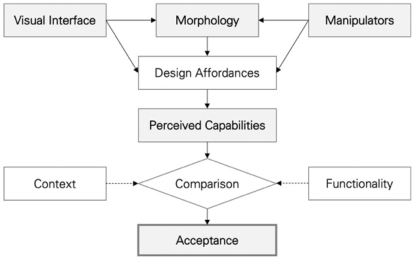
Bartneck et al. (2020) identified three types of design affordances that affect people’s understanding of robot capabilities: appearance, interaction modalities, and technical capabilities. First, the theory on appearance and its application to robot design in HRI has evolved in large part around anthro- pomorphism due to people’s tendency to anthropomorphize things around them. People attribute “human traits, emotions, or intentions to nonhuman entities” (Bartneck et al., 2020). If a robot or its part resembles a human or a human body part, people expect similar human capabilities from it. Second, interaction modalities, such as verbal communication or facial expressions, influence people’s expectations about a robot’s social and intellectual capa- bilities. As this study focuses on the visual aspects of robots, interaction modalities are limited to visual interfaces, such as a screen display on a robot through which facial expressions are communicated. Finally, techni- cal capabilities can be considered as visible functional components that aid particular tasks of a robot, such as arms to grab objects or legs to climb stairs. Together with visual interfaces, these functional components form a robot’s morphology, affect how people perceive its capabilities, and deter- mine the level of human-likeness. In the context of mobile service robots, manipulators such as arms are effective components for performing tasks such as handling or moving physical items. Therefore, manipulators are con- sidered in this study to represent technical capabilities as one of the design affordances. Figure 1 shows a conceptual framework for explaining the
Figure 1: Design elements and their effects on perception and acceptance of robots.
192 Ghim
effects of morphological elements on the perceived capabilities of a robot and its acceptance. The visual interface and manipulators are shown as design elements that also define the morphological appearance of a robot. Together with morphology, they form design affordances and affect perceived capabi- lities. Subsequently, people build their expectations of a robot and determine its acceptance if their expectations are met by the robot’s actual functionality in its use context.
DESIGN AND EVALUATION In the Fall of 2022, a range of mobile service robots was designed as a student project for an industrial design studio course at the University of Cincinnati. The design requirements were:
Design a wheeled mobile robot and its design elements, including expe- rience, aesthetics, functionality, interface, and CMF, from a larger system perspective of product, service, and infrastructure.
The robot should aid in certain activities of humans, such as transporting things, navigating, cleaning, etc., and should involve direct interaction with the users.
All individuals surrounding or interacting with the robot, including end- users (consumers or employees), non-users, and stakeholders, should be considered.
Following a Systems Thinking approach (Ghim, 2022), students designed product-service systems of mobile service robots, envisioning future applicati- ons in various public spaces, such as airports, supermarkets, football stadium suites, concert venues, and for package delivery. In the early phase of the pro- ject, students carried out research on the context by visiting the physical space of their topic, interviewing employees and stakeholders, and mapping cur- rent task flows on a spatial layout. Then, they generated ideas for the robot and its service components, including the physical appearance, features, and interface of the robot, as well as a service flow model, a mobile application, a spatial arrangement plan, and supporting artifacts. As their robot desi- gns materialized, students were continuously challenged to define form fit to the use context and consider interface elements to make the robots more understandable. They also came up with novel solutions to enhance robots’ capability of conducting tasks autonomously in complex environments, for example, a smoother hand-over of items between robots or between a robot and shelves, and integrated them into the appearance of robots.
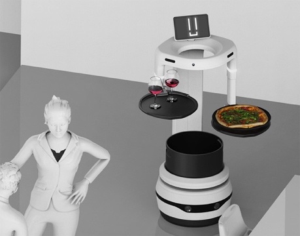
A total of five design concepts were developed and visualized in CAD ren- derings and animations. Figure 2 shows one of the final design concepts, a service robot for stadium suites. The robot’s main functions are to serve food and beverages to the guests in private suites and celebrate exciting game moments with them. The robot takes a cylindrical form overall with a large cut-out in the middle where a bucket for drink bottles is placed, and a space for two trays is reserved, which are held by two vertical arms. The arms are movable up and down, and have pivots that enable horizontal rotation of trays, so the trays can be easily transferred from one robot to another.
Designing Mobile Service Robots 193
Figure 2: A stadium suites robot (Joe Curtsinger, Bradley Hickman, James McKenzie).
A rectangular screen display is placed on the top, through which the robot communicates its intentions via facial expressions, and the guests can also order food or check information related to the game.
ONLINE SURVEY Among the five concepts, the stadium suites robot was selected to evalu- ate its understandability and examine the design elements that influence human perception. An online survey was prepared to understand how the visual interface and manipulators influence the human-likeness of a mobile service robot and how they affect people’s expectations of its functionality and approachability. Four design variations were generated as photorealistic rendering images based on the final design of the stadium suite robot: the original design with both the visual interface and manipulators, one with the interface but without manipulators, one without the interface but with manipulators, and one with neither interface nor manipulators (Table 1). To equally distribute the four different designs, participants were shown only one of these four variations based on their answers on the birthdate range.
Participants were presented with a still image of one of the four robot designs and asked to guess the robot’s utility and the place of its application
Table 1. Robot design variations used for the survey.
Table available in the original PDF paper.
Type G H I T
Robot Image
Visual Interface Facial expression No Facial expression No
Manipulator Arms Arms No No
194 Ghim
based solely on the image. The robot’s actual function and use context were then explained, and participants were asked to provide their expectations of the robot’s functional performance, approachability, and suitability to the use context on 7-point Likert scales and explain their reasoning.
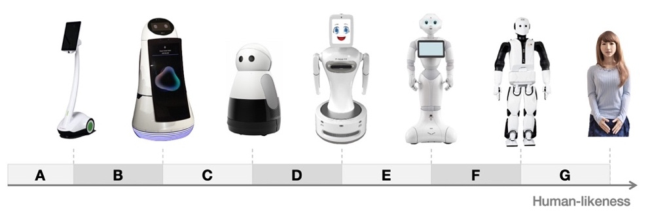
Additionally, seven robot images from the Anthropomorphic Robot Data- base (ABOT: Phillips et al., 2018) were arranged according to each robot’s overall human-likeness score (Figure 3) and presented to participants. To evenly distribute the robots along the human-likeness scale, each robot was carefully selected with the human-likeness score increasing by a range of 9 to 11, from 4.14 for the least human-like robot to 53.57 for the most human-like one, with the exception of Erica. Erica, an android robot (Glas et al., 2016), was placed on the right end of the scale with a score of 89.6, serving as a refe- rence point to help participants quickly and easily grasp the human-likeness scale since the robot design in this study has a more functional appeara- nce and is far from humanoids. Participants were asked to rate the level of human-likeness of the robot design in their survey according to this scale.
Survey Results The survey was conducted in February 2023 with a total of 65 participants (33 male, 30 female, 1 other, 1 prefer not to say). The participants were college students residing in the United States, aged between 18 and 24, with an average age of 20.2. There were 21 responses for Type G, 14 for Type H, and 15 each for Type I and T.
1) Assumptions on the intended function: The initial questions were aimed at measuring the participants’ assumptions about the robot’s intended function and application space, which was serving food or drinks at restau- rants or party venues. If the answer contained a word combination of ‘serve’ or ‘deliver’ and ‘food’ or ‘drinks’, or had similar meanings of serving peo- ple in restaurants, it was considered a correct answer for the question of the intended function. There were 85.7% correct answers for Type G, 80% for Type I, while only 42.9% answered correctly for Type H and 53.3% for Type T. As for the question about the application space, it was considered correct for the answers that contained ‘restaurants’ or meant spaces that serve food as their primary function. Similarly, 81% responded correctly for Type G, 86.7% for Type I, 57.1% for Type H, and 46.7% for Type T. Both Type G and I have a visual interface with facial expressions, while Type H and T do
Figure 3: Human-likeness scale with robots selected from ABOT (Phillips et al., 2018).
Designing Mobile Service Robots 195
not. As the presence/absence of the visual interface is the difference between these two groups, it can be considered that the visual interface affects people’s understanding of the utility of a mobile service robot for serving food.
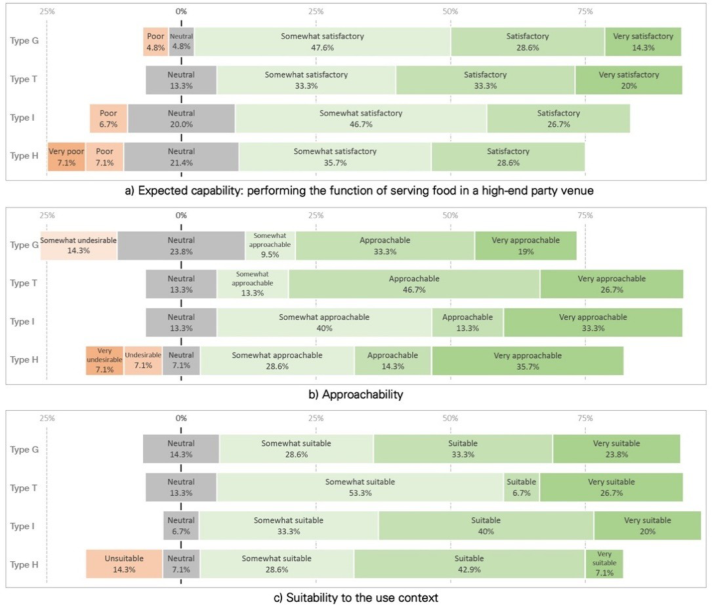
2) Expectation of capabilities and suitability to the use context: As shown in Figure 4, Type G and Type T received more positive responses (90.5% and 86.7%, respectively) than Type I (73.3%) and H (64.3%) for expected performance in a given context. This result indicates that neither the inter- face with facial expressions nor the manipulators independently influence the expectation of performance. Rather, it can be assumed that a robot with- out facial expressions but with arms negatively affects the perception of its functional performance compared to a robot with both features. On the other hand, Type G received the least positive responses (61.9%) for approacha- bility, with negative responses amounting to 14.3%, while both Type T and Type I received 86.7% positivity without negative responses. Although Type H received 78.6% positive responses, its ratio of negative responses was also 14.3%, which was the same as Type G but with a stronger severity. The pre- sence of manipulators seems to make some people uncomfortable, whereas their absence makes a robot generally more approachable. Though there were several positive opinions for Type G and I regarding their smiley face and its effect on friendliness, this study does not find that facial expressions make a
Figure 4: Responses on perceived capabilities and qualities.
196 Ghim
robot more approachable. Finally, Type I received the most positive responses for suitability to the use context (93.3%), followed by Type T (86.7%) and Type G (85.7%). Type H received 78.6% positive responses, with 14.3% negative responses. Robots without manipulators were considered slightly more suitable for this use context than robots with manipulators.
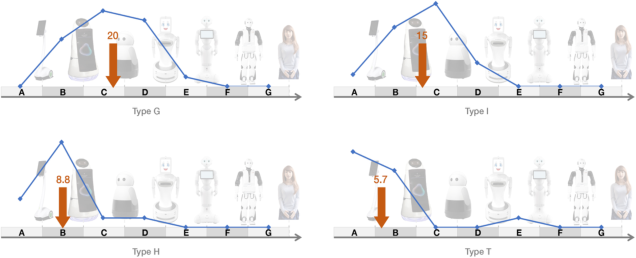
3) Human-likeness: Figure 5 shows a comparison of the level of human- likeness for the four design variations. The charts were created according to the responses on the human-likeness level in the survey, and the scores were calculated based on interpolation of the reference robots’ scores in ABOT. Among the four designs, Type G was rated most human-like, with a human- likeness score of 20. Type T was rated the lowest at 5.9. This reaffirms that the presence of a visual interface (with facial expressions) and manipulators (as arms) increases the human-likeness of a robot. At the same time, the level of contribution to human-likeness differs between the visual interface and mani- pulators. While the removal of manipulators decreases the human-likeness score by 5 (G: 20, I: 15), the removal of the visual interface decreases the score by over 11.2 (G: 20, H: 8.8). Also, the difference of scores between Type H and T is smaller than between Type I and T. It can be argued that the influence of facial expressions through a visual interface on human-likeness is greater than that of manipulators, and that human-likeness is maximized when both features are present together.
Table 2 shows a summary of the survey results, where the robot variations are arranged according to the human-likeness scores. Among the four variati- ons, two designs with facial expressions scored higher in human-likeness and conveyed their intended function and application space better than the robots without facial expressions. Though the robot design with both facial expres- sions and manipulators (Type G) was perceived as best capable of carrying out its function in a given context, the difference was small when compared to the other design (Type T) that lacked both facial expressions and manipu- lators. Additionally, no correlation was found between human-likeness and approachability across the four robot variations. Type G, the most human- like robot, received the least positive responses on approachability, whereas a robot design with the lowest human-likeness score was one of the two con- figurations that received the most positive responses. Lastly, Type H, which
Figure 5: Comparison of human-likeness scores for the four robot designs.
Designing Mobile Service Robots 197
Table 2. Summary of survey results.
Table available in the original PDF paper.
Design variation T H I G
Number of responses 15 14 15 21 Human-likeness score 5.7 8.8 15 20
53.3% 42.9% 80% 85.7%
Communication of intended function Application space 46.7% 57.1% 86.7% 81%
has manipulators without facial expressions, received low positive responses across all categories. In the context of serving food at party venues, a robot with manipulators but without a visual interface was perceived as the least capable of its intended function and least suitable.
DISCUSSION AND CONCLUSION This paper examined the influence of a visual interface and manipulators on a robot’s human-likeness and human perception. A survey was conducted with four different variations of a mobile service robot design to understand how people perceive a robot’s intended function, application space, perfor- mance, approachability, and suitability in a given use context. Each robot’s level of human-likeness was also measured and compared with the responses on the perceived qualities of the robot. The results showed that the visual interface and manipulators contribute to increasing human-likeness in the form of facial expressions and arms, respectively, with the visual interface having a more significant impact than the manipulators. The visual inter- face also helps people understand a robot’s intended function and application space accurately. However, increasing human-likeness does not always lead to favorable perceived qualities, and the combined effects of manipulators and visual interface must be carefully considered. There was no clear cor- relation found between human-likeness and approachability. It is crucial to understand the subtle nuance of people’s expectations in a particular use con- text. Designers must consider the visual interface and manipulators of a robot carefully to align the design configuration and human-likeness level with its intended function and use context.
198 Ghim
The study has some limitations. First, the sample size of the survey is rela- tively small, which lowers the reliability of the survey results. Additionally, the fact that the participants are limited to college students in their early twenties makes it difficult to generalize the study outcomes. Second, while robots exhibit dynamic behaviors, this study relied on still images, which prevented participants from fully capturing the actual effects of manipulators and the interface in actions as well as in relation to robots’ dynamic move- ments. Finally, this study lacks rigorous statistical data analysis and instead relies on rough inference. Considering these limitations, future studies with larger sample sizes and animations that better illustrate how robots move and behave in a visualized environmental context are needed.
REFERENCES
Abrams, A. M., Dautzenberg, P. S., Jakobowsky, C., Ladwig, S. and Rosenthalvon der Pütten, A. M., 2021. A theoretical and empirical reflection on tech- nology acceptance models for autonomous delivery robots. In Proceedings of the 2021 ACM/IEEE International Conference on Human-Robot Interaction (pp. 272–280). Bartneck, C., Belpaeme, T., Eyssel, F., Kanda, T., Keijsers, M. and Šabanovi´c, S.,
2020. Human-robot interaction: An introduction. Cambridge University Press. Ghim, Y. G., 2022. Designing Mobile Robots: A Systems Thinking Approach for Industrial Designers. In Proceedings of the AHFE 2022 International Conference (Vol. 48). AHFE International. Glas, D. F., Minato, T., Ishi, C. T., Kawahara, T. and Ishiguro, H., 2016. Erica: The
erato intelligent conversational android. In Proceedings of the 25th IEEE Interna- tional Symposium on Robot and Human Interactive Communication (pp. 22–29). IEEE. Goetz, J., Kiesler, S. and Powers, A., 2003. Matching robot appearance and behavior to tasks to improve human-robot cooperation. In Proceedings of the 12th IEEE International Workshop on Robot and Human Interactive Communication (pp. 55–60). IEEE. International Organization for Standardization, 2021. Robotics - Vocabulary (ISO
standard no. 8373:2021) Kunold, L., Bock, N. and Rosenthal-von der Pütten, A., 2023. Not All Robots Are Evaluated Equally: The Impact of Morphological Features on Robots’ Asses- sment through Capability Attributions. ACM Transactions on Human-Robot Interaction, 12(1), pp. 1–31. Lee, H., Kim, H. J. and Kim, C., 2007, March. Autonomous behavior design for
robotic appliance. In Proceedings of the ACM/IEEE International Conference on Human-Robot Interaction (pp. 201–208). Mori, M., 1970. The uncanny valley. Energy, 7(4), pp. 33–35. Phillips, E., Ullman, D., de Graaf, M. M. and Malle, B. F., 2017. What does a robot look like?: A multi-site examination of user expectations about robot appearance. In Proceedings of the Human Factors and Ergonomics Society Annual Meeting (Vol. 61, No. 1, pp. 1215–1219). SAGE Publications. Phillips, E., Zhao, X., Ullman, D. and Malle, B. F., 2018. What is human-like?
decomposing robots’ human-like appearance using the anthropomorphic robot (abot) database. In Proceedings of the 2018 ACM/IEEE International Conference on Human-Robot Interaction (pp. 105-113). Rosenthal-von der Pütten, A., Sirkin, D., Abrams, A. and Platte, L., 2020. The forgotten in HRI: Incidental encounters with robots in public spaces. In Companion
Designing Mobile Service Robots 199
of the 2020 ACM/IEEE International Conference on Human-Robot Interaction (pp.656–657). Wirtz, J., Patterson, P. G., Kunz, W. H., Gruber, T., Lu, V. N., Paluch, S. and Martins, A., 2018. Brave new world: service robots in the frontline. Journal of Service Management, 29(5), pp. 907–931.
LISTED IN THE AHFE DIGITAL BOOKSTORE CATALOGUE
Explore the complete digital volume
Interdisciplinary Practice in Industrial Design
Read this individual research paper free through the original publisher, or explore the full digital proceedings book.
ISBN 978-1-958651-76-6
Explore this ISBN in the AHFE Bookstore ↗Listed in the July 2026 bookstore catalogue; search by ISBN to confirm current availability · Digital book purchase optional