Yong-Gyun Ghim (2024). Exploration of Service Robot Morphology Through Generative AI Applications. In: Interdisciplinary Practice in Industrial Design. AHFE Open Access, vol. 144, pp. 46–56. https://doi.org/10.54941/ahfe1005117
Advancements in robotics and artificial intelligence (AI) are bringing service robots into various aspects of our lives, and the appearance of service robots has diversified along with their increase. While anthropomorphic design has been extensively discussed in human-robot interaction (HRI) as a way of making robots more understandable and acceptable, much remains to be investigated about the desired level of human-likeness in a robot’s design, which is also dependent on the specific context of use. This paper proposes a visual mapping method as a means of guiding the appearance and degree of human-likeness of a service robot in the corresponding use context. A service robot context map, comprising the robot’s task nature and operation environment, is constructed and translated into a morphology map regarding the level of human-likeness and aesthetic qualities. Based on these mappings, two service robot contexts were selected to create evaluation materials to measure the desired degree of human-likeness. Variations of a service robot design were created and visualized in photorealistic rendering through the utilization of generative image AI tools. Though with some unintended design changes, generative image AI is an efficient way of creating robot representations in context for an evaluation study.
The recent acceleration in the development of artificial intelligence (AI) and robotics has brought us ever closer to the widespread deployment of service robots in various areas of our lives. In the foreseeable future, it is expected that our personal and public spaces will be inundated with service robots, assisting us with a wide range of tasks. Similar to how household appli- ances have transformed our homes, service robots may take much care of the current manual tasks in homes. There is also a growing expectation that the service industry will undergo significant changes due to the integration of service robots. These robots may replace tasks traditionally performed by human employees in settings such as hotels, restaurants, hospitals, and delivery services, potentially even assuming roles requiring intuitive and empathetic intelligence (Huang and Rust, 2018). With the increase of new service robots for various purposes and different use contexts, there will be a variety of robot designs in different sizes and forms.
Exploration of Service Robot Morphology Through Generative AI Applications 47
While we still lack a clear idea of how human life co-existing with robots would look like, research on robot morphology in Human-Robot Interaction (HRI) has largely evolved around anthropomorphism. Anthropomorphic design assumes that humanlike attributes in the appearance and behavior of robots make them more understandable and enhance interaction and engage- ment with them (Bartneck et al., 2020). However, as argued in the uncanny valley theory (Mori, 1970), the correlation between a robot’s human-likeness and people’s affinity for it is not linear, with the affinity dropping sharply past a certain point as the human-likeness increases. In addition, anthropomor- phic design can create false expectations about the robot’s capabilities. People tend to perceive a robot’s capabilities based on its appearance. Human- like appearance increases expectations by attributing humanlike qualities to robots regardless of the robot’s actual capabilities. When there is an expec- tation gap, people become disappointed with the robot and they may stop using it (Lohse, 2011; De Graaf et al., 2016). There exists an optimal level for human-likeness, where a balance between the robot-ness, human- ness, and product-ness in the design of a robot is found (DiSalvo et al., 2002). Another dimension to be considered is context. People have differ- ent preferences for and expectations of a robot’s human-likeness depending on its application domain (Phillips et al., 2017; Roesler et al., 2022) or con- text of use (Goetz et al., 2003; Fink, 2012). Because the optimal level of human-likeness of a service robot varies according to the robot’s specific use context, understanding the nature of tasks and human-robot interaction in the context will help define the robot’s morphology most suitable to the context.
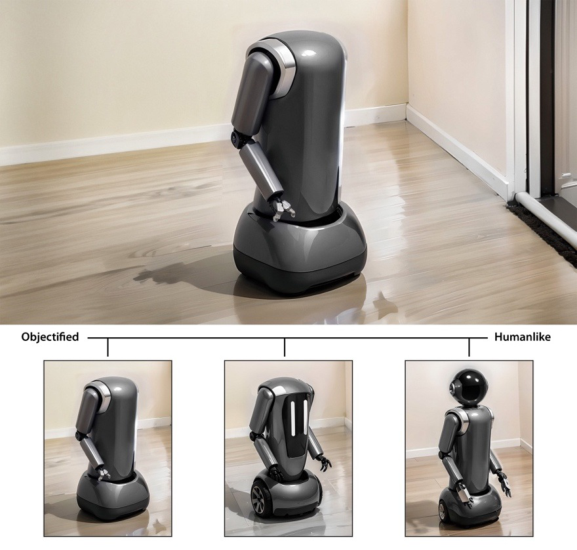
This study comprises two parts. First, it proposes a more methodical approach to determining the proper level of human-likeness for a service robot design according to the nature of the context in which the robot will operate. A visual mapping method is discussed, in which several service contexts are mapped according to the degree and frequency of interaction between humans and robots, as well as the nature of the environment where the interaction occurs. Second, this study explores a new method of creating visual representations of robot designs for HRI research, leveraging gener- ative image artificial intelligence (AI) applications. Based on the mapping introduced in the first part, two distinctive service contexts were selected. For each context, three design variations of a service robot were created and visualized through the utilization of generative image AI, which gen- erated photorealistic renderings from manual sketch drawings. Generative AI allowed the fast creation of photorealistic renderings of robot designs in varying degrees of human-likeness, which were also placed in use contexts. Such representations of robots in context are expected to aid participants in an evaluation study to grasp the appearance of the robots and their contexts better. Although a user evaluation study is not addressed in this paper, it con- tributes to HRI research and design practice by examining and mapping the relationship between robot morphology and the context and introducing an efficient method to create representation materials for evaluation studies on robot morphology.
48 Ghim
ROBOT MORPHOLOGY AND EVALUATION Effects of Context on Robot Morphology
According to Roesler et al. (2022), the degree of human-likeness is affected by the expected social functions in a particular context, which stem from the nature of the tasks: whether the tasks are associated with more human interaction or physical demands. After comparing preferences for the degree of human-likeness across three application domains of industrial, service, and social, they argued that robots should be designed according to the sociability in the respective domain. As a robot’s tasks involve closer and more frequent interaction with humans, its degree of human-likeness increases.
However, the scope of Roesler et al. (2022)’s research was rather broad. After comparing three distinct application domains, they did not reach a solid conclusion for the service domain due to the multiplicity of tasks in their description of service robots. Instead, they acknowledged a wide range of tasks and differing levels of sociability in the service domain, which could subsequently lead to various degrees of human-likeness depending on the specific service task and context. Given the current study’s focus on ser- vice robots, this paper aims to provide methods and tools for designers to determine the proper level of human-likeness for a robot in a specific service context.
The International Federation of Robotics (IFR) categorizes service robots into two groups: one for personal/consumer use and the other for profes- sional use (International Federation of Robotics, n.d.), according to the definition of service robot (International Organization for Standardization [ISO], 2021). Consumer service robots are primarily designed for domes- tic tasks, such as floor cleaning, lawn mowing, elderly care, and education, typically occurring within personal home spaces. Service robots for pro- fessional use encompass a wide range of robots designed for professional service applications, including hospitality, healthcare, transportation and logistics, professional cleaning, and agriculture. People operate, encounter, or interact with professional service robots mostly in public spaces shared by other people. The nature of the use environment differs significantly between consumer and professional robots, influencing the functional requirements of robots, people’s attitudes and behavior toward robots and the environ- ment, and their interaction with robots. Consequently, this classification affects the design of a robot, such as the appearance, size, and interactivity, depending on whether it is intended for consumer or professional use. For example, a consumer robot vacuum typically has a small, circular, and flat body with an overall simple geometry, while a professional cleaning robot is larger and taller with a more complex, functional appearance. The placement and design of the interface also vary between these two types of cleaning robots: whereas the consumer version features a minimal level of interface placed on the top, facing upward and nearly blending into the overall design, the interface on the professional one is larger, forward-facing, and more conspicuous.
Exploration of Service Robot Morphology Through Generative AI Applications 49
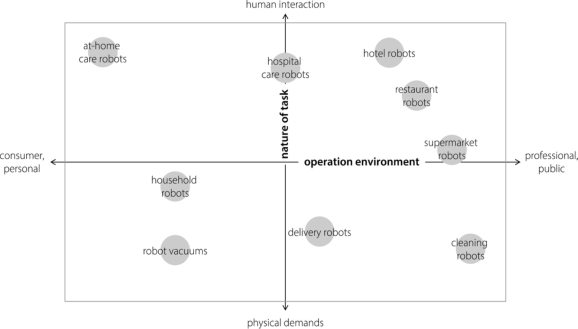
Visual Mapping of the Service Context The above discussion leads to a 2x2 map for the service robot context, which is constructed from two mutually perpendicular axes (Figure 1). The horizon- tal axis represents the operation environment, based on the classification of service robots into consumer and professional use, translating into the divi- sion between personal and public spaces. Consumer robots in personal spaces are positioned on the left half of the map, while robots for public spaces are on the right half. The vertical axis corresponds to the level of human-robot interaction, determined by the nature of a robot’s task. The more a robot’s task involves close social interaction, such as with care or hotel robots, the higher it will be positioned along the axis. Conversely, if a robot’s primary task is physical rather than social, with limited interaction with humans, such as for cleaning or delivery, it will be positioned in the lower half of the map. Subsequently, various types of service robots can be arranged on this map according to their use context. Figure 1 illustrates these arrangements based on the author’s interpretation of the corresponding use contexts.
Figure 1: Service robot context map.
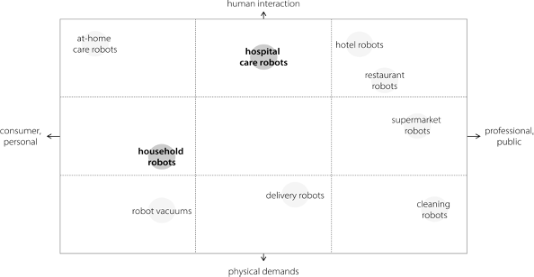
The service robot context map is segmented into a 3x3 matrix to bet- ter accommodate the types of service robots positioned between the pub- lic and personal spaces on the operation environment axis, as well as between human interaction and physical demands on the nature of task axis (Figure 2). For example, while delivery robots travel on the street (public space) most of the time, they can enter personal spaces when delivering pack- ages to users. Supermarket robots exhibit a similar duality regarding their task nature, alternating between close interaction with human users and nav- igation along aisles. As such nature of service robots makes it challenging for a clear delineation in the middle, dividing them into three segments along each axis will better accommodate this complexity. Thus, each row in the matrix represents a high, medium, and low level of interaction from top to bottom. Similarly, each column represents personal, mixed, and public spaces from left to right.
50 Ghim
Figure 2: Segmentation by use context.
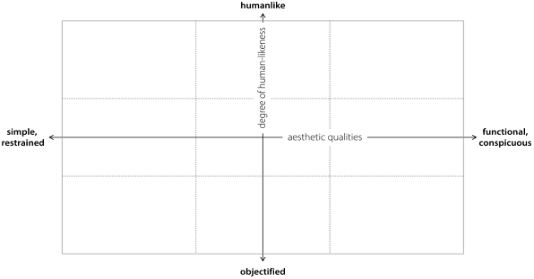
Because a robot’s functions and use context influence its appearance, this visual mapping can guide the definition of service robot morphology, such as the degree of human-likeness and aesthetic qualities. As argued in the previous section, a robot’s degree of human-likeness depends on its level of interaction with humans. Therefore, the vertical axis in Figure 1 can be interpreted as the degree of human-likeness, with the top end represent- ing humanlike and the bottom end representing objectified. The horizontal axis is translated to the overall aesthetic qualities a robot conveys, apart from anthropomorphism. For conventional products, although their func- tion may be similar, their aesthetic qualities and subsequent visual messages vary greatly between consumer products and professional ones. While con- sumer products, intended for personal spaces, typically feature simpler and more restrained aesthetics, professional products, used in open or public spaces, tend to have a more functional and conspicuous appearance: e.g., coffee machines. The same logic can be applied to the mapping for service robot morphology, as argued in the previous section by comparing consumer robot vacuums and professional cleaning robots. The left end of the hori- zontal axis points to simple, restrained aesthetics, while the right end points to functional, conspicuous aesthetics (Figure 3).
Figure 3: Service robot morphology map.
Exploration of Service Robot Morphology Through Generative AI Applications 51
GENERATIVE IMAGE AI FOR ROBOT EVALUATION Evaluation Media for Robot Design
In HRI research, photos or still images have been widely used as a proxy for user evaluations of robot perception (Phillips et al., 2018; Kunold et al., 2023). They are suitable for larger-scale, online studies and useful for early- stage design evaluations (Randall and Šabanovi´c, 2023). It has been argued that still images are appropriate for evaluating hedonic aspects, such as appearance and personality, although they are limited in capturing move- ment and interactions (Jung et al., 2021). On the other hand, Randall and Šabanovi´c (2023) found photos did not capture assessments of robot percep- tion and behavioral intentions equally as videos or GIFs except for ‘intended use’, even when the photos were accompanied by text descriptions of the robots’ tasks and context of use. Nevertheless, they concluded that photos can be appropriate media depending on the design stage, considering their availability for early evaluations in the design process.
At the same time, scenarios help provide context in evaluations and induce proper feedback from participants. As one of the components of a scenario alongside user, product, and activity, external factors like the environment and situation are significant because they mediate interactions and robots do not operate in isolation (Xu et al., 2015). Accordingly, communicat- ing the scenario is crucial for accurate evaluation. However, photos and still images are limited in fully conveying dynamic interactions and activi- ties in the scene. This further emphasizes the importance of showing robots situated in the environment, especially when the evaluation relies largely on still images without the inclusion of dynamic effects, such as sound or animations.
Generative Image AI Tools Recently, generative image AI tools have gained tremendous interest among designers and researchers alike, thanks to their capacity to facilitate design ideation (Hoggenmueller et al., 2023) and create high-fidelity, realistic images quickly (Zhang et al., 2023), while handling laborious work (Hwang, 2022). As a co-creative partner (Shi et al., 2023; Zhang et al., 2023), designers have started to utilize text-to-image tools like DALL-E, Midjourney, and Stable Diffusion, as well as sketch-to-rendering tools like Vizcom, in their design processes for early ideation, easy exploration of color, material, and finish (CMF) options, and fast and realistic visualization of early design con- cepts (Thai, 2023). Particularly, image generators using sketches as input were found to be useful in producing design variations quickly and trans- forming sketches into realistic images without requiring time-intensive tasks (Zhang et al., 2023). Design research has also recognized the potential of generative image AI as a research tool. Hoggenmueller and his colleagues explored the potential of utilizing AI tools for HRI research, creating novel robot imaginaries using generative text-to-image models. They argued that generative AI tools can be helpful in envisioning novel robot appearances, revealing current assumptions or stereotypes about robots, and situating robots in context to understand their implications early in the HRI design
52 Ghim
process (Hoggenmueller et al., 2023). This paper finds the strengths of generative image AI tools for quickly and economically creating many vari- ations of realistic images in context applicable to HRI research, particularly as a means of creating situated robot representations for evaluating robot appearances.
Creation of Evaluation Materials Among the nine segments in the matrix, two distinctive types of robots and their subsequent service contexts were selected for the current study: hospital care robots and household robots. An undergraduate senior student major- ing in industrial design was tasked to create the designs of these two types of service robots. Their tasks and operating environments were defined as follows and used as the starting point for the designs.
Hospital care robot: To operate in hospitals, aiding patients, organizing and delivering medications, and aiding patients’ mobility
Household robot: To operate in residential living spaces, aiding home- owners with general cleaning, sweeping, and household chores.
Their positioning on the service robot context map was also shown to the student on the first day of the project. Based on the mapping along with the definition of the context, the student drew manually a sketch of a robot for each context. Then, the sketches were imported to Vizcom, a generative image AI tool capable of converting sketches to realistic render- ings, and after multiple iterations and adjustments, a base model design and its variations for each context were created and visualized as realistic ren- derings and in the corresponding environment. Because the main purpose of the creation of the renderings was to evaluate people’s expected level of humanlike-ness for a service robot, the three robot designs for each con- text needed to exhibit different levels of human-likeness. With that in mind, the student adjusted the human-likeness levels and arranged them on a scale between objectified and humanlike. The least human-like robot was arranged toward the objectified end.
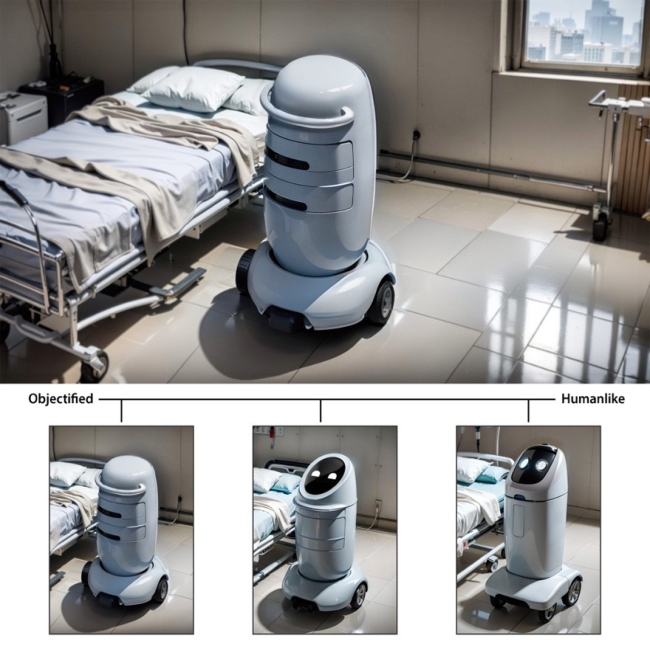
Figure 4 shows the rendering of the hospital care robot in a hospital room and its design variations according to the differing levels of human-likeness. The base model (left) and two varied models (middle, right) are positioned along the axis between objectified and humanlike. While the base model lacks facial expressions, the other two feature facial expressions on the slanted top: the middle one through a circular digital display, and the most humanlike one through eye-shaped physical lights inserted into a rectangular plate, with a subtle cue to the human head top. The overall form also changes from round to rectangular as the human-likeness increases, but the author does not find any particular correlation between the two and considers this as what AI generated by chance.
Exploration of Service Robot Morphology Through Generative AI Applications 53
Figure 4: A hospital care robot design and its variations (work by Joe Curtsinger).
All three designs are equipped with wheels, and the two variations have a sensor window in the front bottom. The front opening, where the sensor window is positioned, was intended as a space for a front wheel in the original sketch, but AI changed it to a sensor window as it created variations. AI also included a handle in the rendering of the base model, which did not exist in the sketch. However, this handle becomes less conspicuous and eventually disappears as the variations move toward the humanlike end.
Likewise, Figure 5 shows renderings of the household robot in a living room. As the design moves along the axis from objectified to humanlike, the robot’s head becomes more distinctive. While the middle one has a hint of eyes on a large display integrated into the main body, the most humanlike one has a spherical head sitting on the body. The robot’s hands also change as the design moves toward humanlike, becoming more complex and resembling human hands more. Additionally, with the increased levels of humanlike-ness, the two variations have two arms, compared to one arm in the base model. Because the original sketch, which the base model design closely resembles, features two arms, this difference may be due to AI’s inaccurate translation of the original sketch.
54 Ghim
Figure 5: A household robot design and its variations (work by Joe Curtsinger).
DISCUSSION AND CONCLUSION In this paper, a visual mapping method was introduced as a means of guiding the appearance and degree of human-likeness of a service robot in the cor- responding use context. Each type of service robot can be mapped on a 3x3 matrix according to the use context, which consists of the robot’s task nature and the operation environment. The dependence of the degree of human- likeness on the level of human-robot interaction, as well as aesthetic qualities on the environment characteristics, allows this context mapping to be trans- lated into the mapping of robot morphology. To validate this mapping and understand a service robot’s optimal level of human-likeness, service robot designs in varying contexts need to be evaluated. Accordingly, this paper explored utilizing generative image AI tools for creating representation mate- rials for robot evaluations. Design variations for a hospital care robot and a household robot were each created and visualized in the corresponding use context as photorealistic renderings. Creating these images through genera- tive image AI based on freehand sketches was an efficient and effective way to generate multiple high-fidelity image variations quickly and in context while not deviating much from the designer’s original intention. Though AI tools generated unintended changes and were not able to fully translate the orig- inal design, they still produced realistic representations of robots and their variations convincingly. Generative image AI tools are expected to aid evalu- ation participants in grasping the appearance of the robots and their contexts better.
Exploration of Service Robot Morphology Through Generative AI Applications 55
However, this study has several limitations and requires further research. Firstly, the positioning of service robot types on the context map was based on the author’s speculation, lacking a verifiable means. An in-depth study involving a more thorough analysis of the contexts and comparisons between different service robot types is needed to make this mapping more accurate and generalizable. Secondly, robot designs in this study lack a detailed depic- tion of their intended functions and interactions. For example, the household robot designs do not show components for carrying out their chores, such as cleaning or sweeping. Failing to depict the components for their primary function in renderings not only makes the represented robot design less feasi- ble but also miscommunicates their use context. Finally, an evaluation study was not conducted. The proposed methods need to be assessed and validated through actual evaluations, and this remains the next step of this study.
REFERENCES
Bartneck, C., Belpaeme, T., Eyssel, F., Kanda, T., Keijsers, M. and Šabanovi´c, S.,
2020. Human-robot interaction: An introduction. Cambridge University Press. De Graaf, M. M., Ben Allouch, S. and van Dijk, J. A., 2016. Long-term evaluation of a social robot in real homes. Interaction studies, 17(3), pp. 462–491. DiSalvo, C. F., Gemperle, F., Forlizzi, J. and Kiesler, S., 2002. All robots are not
created equal: The design and perception of humanoid robot heads. In Proceed- ings of the 4th conference on Designing interactive systems: processes, practices, methods, and techniques (pp. 321–326). Fink, J., 2012. Anthropomorphism and human likeness in the design of robots and human-robot interaction. In Social Robotics: 4th International Conference, ICSR 2012, Chengdu, China, October 29–31, 2012. Proceedings 4 (pp. 199–208). Springer. Goetz, J., Kiesler, S. and Powers, A., 2003. Matching robot appearance and behav-
ior to tasks to improve human-robot cooperation. In Proceedings of the 12th IEEE International Workshop on Robot and Human Interactive Communication (pp. 55–60). IEEE. Hoggenmueller, M., Lupetti, M. L., Van Der Maden, W. and Grace, K., 2023. Creative AI for HRI Design Explorations. In Companion of the 2023 ACM/IEEE International Conference on Human-Robot Interaction (pp. 40–50). Huang, M. H. and Rust, R. T., 2018. Artificial intelligence in service. Journal of
service research, 21(2), pp. 155–172. Hwang, A. H. C., 2022. Too late to be creative? AI-empowered tools in creative processes. In CHI Conference on Human Factors in Computing Systems Extended Abstracts (pp. 1–9). International Federation of Robotics. (n.d.). Service Robots. Available at: https://ifr.
org/service-robots/ [Accessed February 16, 2024]. International Organization for Standardization, 2021. Robotics – Vocabulary (ISO standard no. 8373:2021). Jung, M., Lazaro, M. J. S. and Yun, M. H., 2021. Evaluation of methodologies
and measures on the usability of social robots: A systematic review. Applied Sciences, 11(4), p. 1388. Kunold, L., Bock, N. and Rosenthal-von der Pütten, A., 2023. Not All Robots Are Evaluated Equally: The Impact of Morphological Features on Robots’ Assess- ment through Capability Attributions. ACM Transactions on Human-Robot Interaction, 12(1), pp. 1–31.
56 Ghim
Lohse, M., 2011. Bridging the gap between users’ expectations and system evaluations. In 2011 RO-MAN (pp. 485–490). IEEE. Mori, M., 1970. The uncanny valley. Energy, 7(4), pp. 33–35. Phillips, E., Ullman, D., de Graaf, M. M. and Malle, B. F., 2017. What does a robot
look like?: A multi-site examination of user expectations about robot appearance. In Proceedings of the Human Factors and Ergonomics Society Annual Meeting (Vol. 61, No. 1, pp. 1215–1219). SAGE Publications. Phillips, E., Zhao, X., Ullman, D. and Malle, B. F., 2018. What is human-like?
decomposing robots’ human-like appearance using the anthropomorphic robot (abot) database. In Proceedings of the 2018 ACM/IEEE international conference on human-robot interaction (pp. 105–113). Randall, N. and Šabanovi´c, S., 2023. A Picture Might Be Worth a Thousand Words, But It’s Not Always Enough to Evaluate Robots. In Proceedings of the 2023 ACM/IEEE International Conference on Human-Robot Interaction (pp. 437–445). Roesler, E., Naendrup-Poell, L., Manzey, D. and Onnasch, L., 2022. Why context
matters: the influence of application domain on preferred degree of anthropomor- phism and gender attribution in human–robot interaction. International Journal of Social Robotics, 14(5), pp. 1155–1166. Shi, Y., Gao, T., Jiao, X. and Cao, N., 2023. Understanding design collaboration between designers and artificial intelligence: A systematic literature review. In Proceedings of the ACM on Human-Computer Interaction, 7(CSCW2) (pp. 1–35). Thai, J., 2023. Adapting at the speed of AI. Innovation, 42(1), pp. 48–49. Xu, Q., Ng, J., Tan, O., Huang, Z., Tay, B. and Park, T., 2015. Methodological issues
in scenario-based evaluation of human–robot interaction. International Journal of Social Robotics, 7, pp. 279–291. Zhang, C., Wang, W., Pangaro, P., Martelaro, N. and Byrne, D., 2023. Generative Image AI Using Design Sketches as input: Opportunities and Challenges. In Proceedings of the 15th Conference on Creativity and Cognition (pp. 254–261). Zhang, M., Cheng, Z., Shiu, S. T. R., Liang, J., Fang, C., Ma, Z., Fang, L. and Wang,
S. J., 2023. Towards Human-Centred AI-Co-Creation: A Three-Level Framework for Effective Collaboration between Human and AI. In Companion Publication of the 2023 Conference on Computer Supported Cooperative Work and Social Computing (pp. 312–316).
LISTED IN THE AHFE DIGITAL BOOKSTORE CATALOGUE
Explore the complete digital volume
Interdisciplinary Practice in Industrial Design
Read this individual research paper free through the original publisher, or explore the full digital proceedings book.
ISBN 978-1-964867-20-5
Explore this ISBN in the AHFE Bookstore ↗Listed in the July 2026 bookstore catalogue; search by ISBN to confirm current availability · Digital book purchase optional