Joyce Thomas, Megan Strickfaden (2024). Designing products through the lens of the material landscape. In: Interdisciplinary Practice in Industrial Design. AHFE Open Access, vol. 144, pp. 10–20. https://doi.org/10.54941/ahfe1005113
Recognizing the value of and working with the material landscape extends well beyond the array of materials products are made from. The material landscape encompasses a broad range of considerations, such as attachments people have with objects, people’s experiences with objects, the relationships objects have within a setting, and technological aspects related to objects. This paper advances knowledge about the material landscape and industrial design through literature summaries and a series of three learning activities created specifically to support students to learn about their individual and collective material landscapes. The three aims of this paper are to: (1) outline, define and expand upon the nature of material landscapes based on literature and theories from cultural geography and material culture; (2) characterize the ways that people interact with their material landscapes; and (3) highlight how material landscapes can support novice design students to evolve from being consumers to becoming designers. Along with describing three learning activities, the results of this work provide details about the material landscape including the concepts of attachments, identify formation, collecting objects and curating objects.
While engineering is often described as the “practical application of sci- ence and math to solve problems… that is everywhere in the world around you… from the start to the end of each day” (Georgia Tech, 2017), indus- trial design can be described through a similar lens where designers create products, objects, and services. “Every object that people interact with on a daily basis is the result of a design process where myriad decisions are made by an industrial designer (and their team) that are aimed at improv- ing people’s lives through well-executed design” (Industrial Designers Society of America, January 2024). Industrial designers use a variety of methods to design products, from sketches to clay or foam moldings, to computer pro- grams developed for design. How designers develop a product depends on the type of product and who will use it. In his seminal book Design for the Real World (1971), Papanek wrote “Design has become the most powerful tool with which man shapes his tools and environments (and, by extension, society and himself” (p. 14). The power of design is even more true today as people continue to form attachments to products they purchase or are gifted, and these products that are collected and curated become a part of personal material landscapes.
Designing Products Through the Lens of the Material Landscape 11
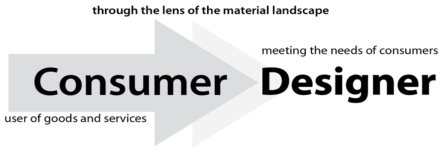
Within industrial design education the overarching goal is to shift the mindset of novice design students from being consumers who understand buying and using products to becoming designers1 of products (see Figure 1). Education helps students to acquire the skills in their designer toolkit to become designers, but also to develop nuanced thinking about the nature of designed objects and understanding how people develop connections and attachments to products. All of these skills support students to succeed as professional designers.
Figure 1: Transitioning students from being consumers to becoming designers.
Most importantly for this paper, a material landscape is indicated as revealing information about individuals and groups of individuals, which are sometimes taken for granted, especially by younger people and in this case young designers. After decades of design practice and teaching design education, we learned that most novice design students were not fully aware of significances or nuances that objects can play towards representing cul- tural and group affiliations, ethnicity, and other markers of individuality and belongingness in society. One way this is advanced is to encourage stu- dents to become aware of their individual personal material landscapes and also observing how and why others have different material landscapes from themselves. As such, the aims of this paper are to: (1) outline and define the nature of the material landscape; (2) elaborate on the ways that people engage with their material landscapes; (3) highlight how novice design stu- dents can be attuned to their personal material landscapes with the goal of shifting students’ mindsets from being consumers to becoming designers.
ADVANCING THE MATERIAL LANDSCAPE The material landscape and industrial design have been brought together in design studies in the context of empathic design (e.g., McDonagh et al., 2009; McDonagh and Thomas, 2010a; McDonagh, 2016). This literature describes the material landscape as the products that people surround them- selves with (McDonagh and Thomas, 2010b), and it’s implied that objects can provide comfort (enabling) or not (disabling). Material landscapes are all the objects, spaces and places that people encounter and possess: from portable objects that can be carried or put on the body, to furniture and fixtures in
1We acknowledge that terms ‘consumer’ and ‘designer’ are broad and don’t necessarily describe the mind- sets of novice design students. For example, consumer can broadly refer to purchasing, acquiring, using and maintaining products; and designers can be referred to as creators, innovators and producers. For the purpose of this paper we use the two terms to contrast one another and describe the social phenomena of ordinary people who relate to objects as consumers being transformed into professionals who innovate new products for consumption.
12 Thomas and Strickfaden
near environments such as homes, to street objects including bus shelters and public building, and beyond. It is obvious that a person’s material landscape is dynamic and changes across their life course.
Continued in-depth literature reviews on the material landscape resulted in material sciences on the physical materials used in landscaping residen- tial and commercial outdoor settings. Material science is acknowledged as playing an important role in industrial design; however, the material land- scape as significant to industrial design can be better elaborated upon. In order to advance the material landscape, we turn to theories from cultural geography (e.g., Hall, 1997; Blunt, 2005) and material culture (e.g., Miller, 1995; Hodder, 2012). To begin, cultural geographer Blunt positions the mate- rial landscape through the domestic space of home by indicating that “the materialities of residence has focused on two additional themes: domestic architecture and design; and the material cultures of objects and their use, dis- play and meanings within the home”(2005, p. 506). Furthermore, scholars of cultural geography indicate that landscapes are representational and imbued with meaning because landscapes form part of the medium that people make sense of things and through which they make and exchange meaning (Blunt, 2005; Hall, 1997), similar assertations made and explored by material cul- ture scholars (e.g., Miller, 1995; 2001). The study of material culture suggests that people establish social relationships with objects and that objects have a kind of social life (Appadurai, 1986). This preoccupation with people’s rela- tionships with objects has been explored extensively including: “…in relation to the interests of groups defined by gender, social status or any other type of filiation” (Sánchez, 2017 p. 18). Material culture also looks at “…three significant and overlapping aspects: consumption, mediation and produc- tion…” (Fiorentino and Strickfaden, 2022, pp. 111–112). And much like design studies, material culture scholars indicate that objects have “agency” (ibid, p. 112) and that objects act “…as intermediaries between and among people…” (ibid).
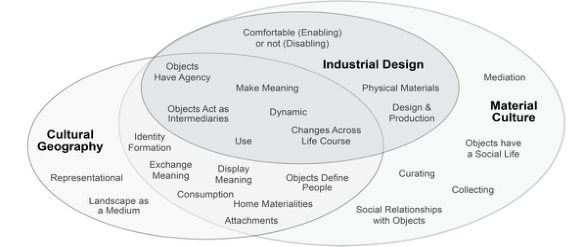
Figure 2 shows the convergences among industrial design, cultural geogra- phy and material culture related to the material landscape. For the purpose of this paper, we zoom in on three core concepts: people have deep attachments to objects, individuals and societies collect objects, and people curate objects over time that are especially relative to their life course.
Figure 2: Material landscapes concepts summarized.
Designing Products Through the Lens of the Material Landscape 13
Attachments The concept that people have deep attachments to objects is considered a mul- tidimensional property of material object possession representing linkages perceived by individuals between themselves and a particular object and can represent an intersection of the two (Schultz, 1989). Attachments to objects can be seen across people’s life course: from childhood baby blankets and teddy bears, to a Grandmother’s cherished necklace. Cherished objects can help people cultivate connections with other valued persons (such as family members who have passed) and even with how we might have seen ourselves in the past. They can be “used as symbols of what we are, what we have been, and what we are attempting to become” (Schultz et al., 1989, p. 359). Objects that are about our future selves are called aspirational objects. Aspi- rational objects can include mundane objects like books or luxury objects like designer bags and wrist watches.
When considering attachment as a concept related to the material land- scape, it is easy to identify attachment as an important person-material possession association. That is, “there are times when people hold onto objects well past their time of function or use. People develop an attach- ment to the product that they may or may not be able to explain” (Fondren, 2023, p. 30). Sentimental objects help people to connect with others, to define self and family, to fulfil obligations to others and surprisingly, to allow them to safely forget (Kirk and Sellen, 2010). Chapman (2009) describes these kinds of attachments with objects as being “emotional durability” (p. 29). Chapman further suggests that consumers can build strong attachments to products because of the meaning it conveys to them, the service it provides, and/or the information it contains (ibid, p. 33). For instance, the authors of this paper live miles apart in different countries, yet while writing this paper they each purchased unique wooden kitchen tools that represent together- ness and connectedness. According to scholars of material culture, people’s attachments to objects is complicated, multi-layered and a very basic human phenomenon.
Collecting Collecting as an individual can naturally be connected to people having attachments to objects, and collecting as a society can be best understood through museum collections that have historically collected objects for hon- orific and educational purposes. Museums have themes, for example, natural history museums collect skeletons and specimens while art museums collect drawings and painting. The rise of museum collections in the 19th and 20th
centuries may have led to individual interests in collecting.
But what are the specific purposes of collecting beyond attachment and education? Some additional motivating factors for collecting are: creating specific aesthetics, creating a sense of community, and for investment (Col- lectibles Insurance Services, 2023). Collecting as an individual can also be a way of elevating one’s social status. Individuals tend to collect as a means to grow their network of friends and to create community (Mueller, 2022), and is even “an important psychological resource that helps individuals cope
14 Thomas and Strickfaden
with life’s stressors, build strong relationships, find, and maintain meaning in life, and become more creative and inspired” (Routledge, 2021, p. 1). When relating collecting to consumption, we have entered an era where collecting is acknowledged as a kind of storytelling. For example, the company Patag- onia has put an emphasis on used items, reselling customer returns as ‘Worn Wear’. They highlight the stories that the previous owners share, giving the new owner a place to begin their own story and add to the previous one, thus adding value to the collectability of these items (Phipps, 2019, p. 1).
Collecting as related to the material environments points to an emphasis or amplification of a specific belief or value (e.g., for sustainability through used clothing), relationship or phenomena linked to an individual or group of individuals because collections involves multiples of objects. Collecting is also considered a fundamental way that people make sense of their object world and display aspects related to their interests and identities.
Curating Curating objects due to having attachments with them or curating collected objects happens over time and is relative to an individual’s life course and to historical events. Curating is “…the act or process of selecting and orga- nizing” (Merriam-Webster.com, N/D). Museums are collections of historical themes that have happened across history, and the objects in museums are elevated to be socially significant. These curated collections never represent the entirety of a phenomena, they are always partial representations of soci- ety because it’s impossible to tell every story with all historical details intact. Even so, curating is important to the material landscape because it is about what is selected, kept, discarded and organized based on judgements made by various people.
Home spaces can be thought of as a kind of curation of belongings (see various chapters in Miller 2001 for examples) and are settings for “enact- ment of self” (Hurdley, 2006, p. 718) that tells stories about individuals and families within specific contexts. Curating objects within a home space can provide a view into a person’s broader material landscape that reveals a great deal about them. For example, author 2 is a migrant who lived in many places across her lifetime. Her home is purposefully curated to represent and reflect the various places she’s lived, the multifaceted ways she’s lived, and the lay- ered identities she relates to as a consequence of these places. As a contrast, Author 1 has moved less often and remained in her home country throughout her life. She moved from a long term home of 25 years to a new place and had to curate and cull the objects within her material landscape to fit within a much smaller home. Significant research has been done on “Casser Mai- son” that reveals some of the challenges that older adults go through when they have to break up their home of personally curated objects (Marcoux, 2001). Home as a curated collection of objects that people feel some level of attachments to is commonplace in most societies.
Similarly to collecting, curating objects and homes can reveal a lot about individual identities and values. Interestingly, however, is that curating can also demonstrate the collective identities and values of a small culture (e.g.,
Designing Products Through the Lens of the Material Landscape 15
a family, couple, group of people living together). Curation of objects points to a broader understanding of the material landscape in that a curated set of objects has the potential to illuminate depth.
The details around the characteristics of attachments, collecting and curat- ing are valuable insights into the material landscape. Insights about how complicated people’s relationships are with objects provide a clearer under- standing of the material landscape. With these in mind, we’re inspired to cre- ate learning activities that aid design students towards better understanding their individual personal material landscapes.
THREE LEARNING ACTIVITIES TO ATTUNE TO MATERIAL LANDSCAPES Three learning activities are highlighted here that work towards attuning design students to their material landscapes that aid them towards shift- ing from the mindset of a consumer to the mindset of a designer. Each of these activities connect with various concepts highlighted in Figure 2; however, we focus on supporting the students towards understanding attach- ments, identity formation, collecting and curating through these activities. These activities have been used in multiple design studio teaching environ- ments with students of all levels at different colleges in multiple countries for 30+ years. The three activities each take approximately 1–3 hours and are supported with personal reflections and group discussions.
Emotional Attachments to Products The Emotional Attachments to Products activity explores students’ emo- tional connection to products they own. Students are asked to bring two personal objects to class - one that evokes a positive emotion and the other that they dislike (Thomas and McDonagh, 2013). Through a facilitated dis- cussion the group explores what roles their object performs and how and why the disliked objects remain in their collection and survived curation and culling.
Student comments: I thought that this activity was interesting because everyone interpreted the assignment in completely different ways. Some peo- ple chose products because they acted as symbols of past experiences or memories while others chose products simply based upon their functionality. Either way, this activity made me realize that aesthetics, functionality, and emotional attachment all play a role in a consumer’s reaction to a product.
The activity relates to new product design and development. New ideas and projects can come from common likes and dislikes. New ideas can either build on the likes or even solve common issues people dislike.
I think the most interesting thing about this activity was how different people approached the problem. For instance, X talked about the experiences he had with his Burger King mask which made it a fun object for him, whereas other people liked objects for their utility or comfort. I think these processes inform new product design because it shows that people interact with objects in emotional ways that go past the product features, and designers should account for these attachments.
16 Thomas and Strickfaden
Evolving Lines Evolving Lines (Ruiz and Strickfaden, 2018) is based on the fundamen- tal premise that objects embody knowledge, meaning, and personal history (Hodder, 2012). Physical interactions with an object of personal significance, along with the process of drawing and writing, help to elicit and visualize the more intangible qualities that are embodied in objects. Students engage in this activity through a front-end discussion introducing the depth and breadth of activity, and they reflect in writing on the experience, highlighting memory, emotions, and other personal information related to the object in their draw- ing (Strickfaden et al., 2023). The objective in this activity is to reveal unique and evolving reflections, and dynamic connections among people, objects, and spaces through personal memories. These examples are, in many ways, visualizations of what Ian Hodder (2012) describes as the “entanglement between humans and things” (p. 10) and “as a thing goes through its life his- tory it finds itself brought into different relations with things and humans” (ibid, p. 13). The Evolving Lines activity may also facilitate ways of outlin- ing the path/s travelled by an object as it flows, collides, and transforms in relation to other entities.
The results from Evolving Lines (for examples see Ruiz and Strickfaden, 2018; Strickfaden et al., 2023) created by students demonstrate deep attach- ments and associations that they have with an individual object. Associations point to some of the reasons why students feel attached to certain objects, whether these objects were purchased or given as gifts, while simultaneously group discussions help students to understand the values that other people place on objects. As such, students better understand how and why they consume products.
One Way Bridge The One Way Bridge is an activity created to explore the attachments stu- dents have to objects within a collection from individual and collective points of view. The stage is for students to cross a bridge going just one way. Encour- aged and directed to keep track of their questions, participants individually ‘pack’ a list of 20 essential items and categorize this into needs and desires on forms designed for this exercise. The facilitator then directs them to throw out 10 of their items. Within a small group they discuss their questions and compare items. The group then is directed to negotiate a total of 15 items among them. Once more they cull the list and throw out 5 items. Each group has an opportunity to explain to the rest the logic of their choices and the pro- cess for choosing. Ultimately the students are individually recommended to select a total of 10 items from their own individual or collective lists and use only these items over the next 24 hours. If they need to add other items, those are documented on another list. Finally they reflect on their first list of items, compare and contrast with the added items and in a 1–2 page document, reflect on learning about their choices and belief system.
The One Way Bridge highlights objects within a collection and forces students to choose cherished and meaningful objects that come along and those that get left behind. This complicated activity provides students with
Designing Products Through the Lens of the Material Landscape 17
opportunities to consider objects essential to themselves and objects that are essential when they’re part of a group. This comparison between the indi- vidual and collective is important to better understanding personal material landscapes and the interconnected between individual and collective identity.
DISCUSSING THE VALUE OF THE MATERIAL LANDSCAPE Attuning design students to the material landscape supports a shift of mindset from being consumers to becoming designers. In other words, we believe that to design products that better suit the needs of people other than themselves, students need to have a better awareness of their own experiences with objects and awareness of other people’s experiences with objects. The three learning activities outlined in this paper support students to unpack their personal material landscapes, to understand how their material landscapes are similar and different to other people’s, and to better understand how their material landscape is inherently connected to other people. Ultimately, each student’s material landscape reveals behaviours and perceptions related to complicated object encounters that students enter into.
Each of the learning activities reveal a great deal about the values and belief system of individual students. First, when students are asked to reflect on their Emotional Attachments to Objects they spontaneously made links from their positions as consumers to what they understood could be used towards designing products. They also realized that their classmates experi- ences were very different from their own, which brought in new information to their understanding of being a consumer and subsequently designing for others. Second, the Evolving Lines learning activity facilitated digging more deeply into the layered implications of one object and highlighted the social- ity of objects. Sometimes the object highlighted in evolving lines was part of a collection and it was almost always curated within the student’s home. Consequently, students contextualized their Evolving Lines objects into their personal material landscapes, which revealed patterns of consumption related to their personal objects. Based on the Evolving Lines visualizations, we noted a deep understanding of the various roles objects play in people’s lives; however, students did not automatically make the leap of how their reflec- tions could aid them as a designer. Third, the One Way Bridge was based on considering attachments within a collection of objects for individuals and when individuals are part of a collective group. This learning activity gives the students a snapshot into the most important objects within theirs and other people’s material environments. By understanding the most important objects the student moved more deeply into the needs, wants, expectations, and desires of other people. And as such, the students moved even closer to understanding the marked contrast between consumption and designing.
The three learning activities also showed students that objects play an inherent and sometimes unconscious role in identity formation. The students became acutely aware of how the objects that were deeply meaningful to them were things that represented who they were. For example, a student brought a tin of Chinese cookies to share for the Emotional Attachments to Objects activity and explained how the taste of home was very important
18 Thomas and Strickfaden
to them. Food is an essential marker for identifying with other people and continued identity formation. Another example was when one of the objects chosen for Evolving Lines was a small tourist statuette from Lisbon, the home city of one of the student’s parents. The student recognized that even though she had not visited Lisbon that her identity was imbued with the values of Portuguese culture that had been transmitted through her parents and rep- resented in the statuette. Another student talked about how they chose three different pairs of glasses to take on the One Way Bridge because they would be with other people and they wanted to be able choose different ways to present themselves and feel fashionable. In other words, by selecting multiple pairs of glasses, the student was concerned about their conjoined individual and collective identities.
CONCLUSION
Design scholars have written about the material landscape, but they have not expanded on its characteristics and nuances, or on various ways it can be used in educating industrial design students. Attachments, identify formation, collecting and curating are explored through actual objects used in the Emo- tional Attachments to Objects and Evolving Lines activities and objects that students think about are referred to in the One Way Bridge. Throughout these activities students have opportunities to explore various concepts related to material landscapes from their own and other people’s perspectives, and these also advance the idea of how the material landscape is valuable within design education. Students begin to better understand the power (and agency) of objects, and that objects make, display and help to exchange meaning. These activities, including talking about the meanings of objects (especially objects people care about), opens further opportunities to teach through objects (see Strickfaden and Thomas, 2024). Ultimately, by bringing students’ attention to their own and other people’s material landscapes, they are also given skills that help them to think in more nuanced ways about how to better design for other people.
ACKNOWLEDGMENT
The authors would like to thank the 2,500+ anonymous students who pro- vided feedback on the three learning activities highlighted in this paper. Without their generous reflections this paper would not possible.
REFERENCES
Appadurai, Arjun, 1986. The social life of things: Commodities in cultural perspective. Cambridge University Press. Blunt, A., 2005. Cultural geography: cultural geographies of home. Progress in
human geography, 29(4), pp. 505–515. Chapman, J., 2009. Design for (emotional) durability. Design Issues, 25(4), pp. 29–35. Collectibles Insurance Services, 2023. Psychology of col- lecting: Why do people collect things?, Available at: https://collectinsure.com/2023/07/06/psychology-of-collecting-why-do- people-collect-things/#: ∼: text=Nostalgia%20is%20one%20of%20the, or%20once%20desired%20to%20own. (Accessed: 18 February 2024).
Designing Products Through the Lens of the Material Landscape 19
“Curation.” Merriam-Webster.com Dictionary, Merriam-Webster, https://www.merr iam-webster.com/dictionary/curation. Accessed 18 Feb. 2024. Fondren, N., 2023. An Approach to Design for Enhancing Product Attachment Using
Collectability. https://etd.auburn.edu//handle/10415/9079 Georgia Tech, 2017.http://www.ece.gatech.edu/academics/outreach/engineering.html Hall, S. ed., 1997. Representation: Cultural representations and signifying practices (Vol. 2). Sage. Hodder, I., 2012. Entangled: An archaeology of the relationships between humans
and things. Hurdley, Rachel, 2006. Dismantling Mantelpieces: Narrating Identities and Materializing Culture in the Home. Sociology, Volume 40, Issue 4, 717–733. Industrial Designers Society of America, 2024. “What is Industrial Design” https:
//www.idsa.org/about-idsa/advocacy/what-industrial-design/. Kirk, D. S. and Sellen, A., 2010. On human remains: Values and practice in the home archiving of cherished objects. ACM Transactions on Computer-Human Interaction (TOCHI), 17(3), pp. 1–43. Marcoux, Jean-Sebastien, 2001. The ‘Casser Maison’ ritual: Constructing the self by
emptying the home. Journal of Material Culture. Volume 6, Issue 2, 213–235. McDonagh, D., 2016. How Products Satisfy Needs Beyond the Functional: Empathy Supporting Consumer-Product Relationships. The Routledge Companion to Design Studies, pp. 282–290. McDonagh, D., Thomas, J., Chen, S., He, J., Hong, Y. S., Kim, Y., Zhang, Z.
and Pena-Mora, F., 2009. Empathic design research: Disability+ relevant design. In 8th European Academy of Design Conference (pp. 1–3). McDonagh, D. and Thomas, J., 2010a. Disability+ relevant design: Empathic design strategies supporting more effective new product design outcomes. The Design Journal, 13(2), pp. 180–198. McDonagh, D. and Thomas, J., 2010b. Rethinking design thinking: Empathy
supporting innovation. Australasian Medical Journal, 3(8), pp. 458–464. Miller, Daniel, 1995. Material Culture and Mass Consumption. Blackwell. Miller, Daniel, 2001. Home Possessions: Material Culture behind Closed Doors.
Berg. National Academy of Engineering, N/D. Frequently Asked Questions, https://www.
nae.edu/20637/FAQ. Papanek, V., 1971. Design for the Real World: Human Ecology and Social Change.
New York, NY. Phipps, L,. 2019. Playing for keeps: Is designing emotional durability the key to a circular economy?. Greenbiz, March 14. https://www.greenbiz.com/article/playi ng-keeps-designing-emotional-durability-key-circular-economy Routledge, C., 2021. The surprising power of nostalgia at work. Harvard Business
Review, April 26, 2021. https://hbr.org/2021/04/the-surprising-power-of-nostal gia-at-work#:~:text=Nostalgia%20can%20be%20triggered%20by,or%20distr essed%20in%20some%20way. Ruiz, Adolfo & Strickfaden, Megan, 2018. Evolving Lines (film), website: https: //vimeo.com/298304081. Sánchez Romero, M., 2017. Landscapes of childhood: bodies, places and material
culture. Childhood in the Past, 10(1), pp. 16–37. Schultz, S. E., Kleine, R. E. and Kernan, J. B., 1989. ‘These are a few of my favorite things’: Toward an explication of attachment as a consumer behavior construct. Advances in consumer research, 16(1), pp. 359–366.
20 Thomas and Strickfaden
Strickfaden, Megan, Ruiz, Adolfo & Thomas, Joyce, 2023. (Re) storying Empathy in Design Thinking. Interdisciplinary Practice in Industrial Design, Vol. 100, 2023, 57–67. Published by AHFE Open Access. Strickfaden, Megan and Thomas, Joyce (2024). Transitional Learning through Unexpected Objects. In this volume, AHFE (2024) International Conference. Strickfaden, Megan & Thomas, Joyce, 2024. Transitional Learning through Unex-
pected Objects. In this volume, AHFE (2024) International Conference. Thomas, J. and McDonagh, D., 2013. Empathic design: Research strategies. The Australasian medical journal, 6(1), p. 1.
LISTED IN THE AHFE DIGITAL BOOKSTORE CATALOGUE
Explore the complete digital volume
Interdisciplinary Practice in Industrial Design
Read this individual research paper free through the original publisher, or explore the full digital proceedings book.
ISBN 978-1-964867-20-5
Explore this ISBN in the AHFE Bookstore ↗Listed in the July 2026 bookstore catalogue; search by ISBN to confirm current availability · Digital book purchase optional