Megan Strickfaden, Adolfo Ruiz, Joyce Thomas (2023). (Re)storying Empathy in Design Thinking. In: Interdisciplinary Practice in Industrial Design. AHFE Open Access, vol. 100, pp. 57–67. https://doi.org/10.54941/ahfe1002971
Storytelling can be associated with temporality, memory, emotion, embodied ways of individually experiencing life, and social ways of collectively experiencing the world. Storytelling is also a kind of re-storying of human experience that has the potential to drive design solutions in very significant directions. We believe that storytelling has the potential to be a cornerstone towards breaking down assumptions about others and revealing beliefs and values about the people that designers call their users or audiences; and as such, storytelling can be significant to human-centred design processes and towards building empathy in design thinking. This paper highlights some of the central ideas around storytelling, re-storying and empathy from the fields of design studies, contemporary literature, psychology, and philosophy. This includes explorations into how designers invest time into storytelling and how this can lead towards deepening empathy and understanding of others’ circumstances. Our core assumption is that storytelling and re-storying are key ways to connect one person with another and to bring together groups of people through sharing and exploring details about individual experiences including intimate and emotional qualities of the human condition. Moving from our highlighted core concepts we put these to work through three projects created by authors and presented as case studies to better understand temporality, memory, emotion and embodiment, and to explore how empathy can be enacted. The three case studies are: a self-knowing activity called Embodied Maps; an activity that has been made into a short film called Evolving Lines; and an ethnographic film created to explore low vision and the urban environment called Light in the Borderlands. Each of these case studies are examples of different types of re-storying, woven together to shed light on and facilitate deep reflection and meaningful conversations about oneself and among people who carry distinct cultural knowledge and disparate lived experiences. Storytelling and re-storying in each of these case studies are developed through sustained and respectful dialogue over hours, weeks, and months as part of design inquiries leading to and facilitating meaning-making processes. This paper promises to illuminate how storytelling and re-storying can be used as a means to being a more empathic design thinker and move towards innovative design solutions that are more suitable, functional and, ultimately, valuable to people.
Storytelling can be associated with temporality, memory, emotion, embodied ways of individually experiencing life, and social ways of collectively expe- riencing the world. Storytelling is a kind of “re-storying” or “re-authoring” (Morgan 2000, p. 5) of human experience with the potential to drive design solutions in very significant directions. Storytelling also has the potential towards breaking down assumptions and revealing beliefs and values that designers1 might have about other people (e.g., users, audiences); and as such, storytelling can be significant to design thinking and human-centered design processes.
Rather than proposing another way to develop empathy with other people, the aim of this paper is to explore a common thread among various appro- aches created and used by the authors. The common thread among our case studies is the use of storytelling as a key means to understand oneself, connect one person with another, to bring together groups of people, and to develop empathetic feelings about other people. As such, this paper presents some fundamental concepts around the notion of storytelling, which is followed by relaying details about three case studies that reveal the “will to meaning” through storytelling (Frankl 1978, p. 29).
Case study one is an activity that challenges designers to understand them- selves better through self-knowing called Embodied Maps (Strickfaden and Stielow 2023, pp. 1–2, 13–15) used extensively by authors one and three. Case study two is an object exploration activity that has been visualized into a short film called Evolving Lines (Ruiz and Strickfaden 2018) used by all authors. Case study three is a short documentary film called Light in the Bor- derlands that was co-created with participants from the Canadian National Institute for the Blind (CNIB) led by the first and second authors (Strickfaden and Ruiz 2018; Ruiz and Strickfaden 2016; 2015). These case studies offer examples of how three different kinds of activities involving storytelling faci- litate deep self-knowing and meaningful conversations between people who carry distinct cultural knowledge and disparate lived experiences. Embodied Maps supports designers to reflexively evaluate their embodied lived experi- ences over their life course. Evolving Lines uses object analysis to promote sharing personal memories collectively within diverse groups of people. Light in the Borderlands helps design researchers build understandings of, and rela- tionships with folks who have low vision about their mobility requirements. Through these case studies, designers (and research participants) uncovered recollections from the distant past that recontextualize former events within present-day circumstances. Together these case studies reveal how stories resonate over time, prompt new perspectives, and evoke new meanings along people’s life course.
A BRIEF ACCOUNT OF EMPATHY IN DESIGN THINKING Empathic design is about creating understanding and compassion for other people or groups of people. Empathy is about being kind, respectful and
1Designer/s is used throughout this paper; however, design teachers and/or students, and other professio- nals have and can engage in storytelling through the case studies highlighted.
(Re)storying Empathy in Design Thinking 59
thoughtful towards others but it is also about being perceptive, supportive and tolerant. Within the design community, in education and practice, there are various ways that empathy has been used towards the re/design of objects that better respond to peoples’ needs, desires, wants and expectations. For designers this involves spending time towards understanding oneself (Stri- ckfaden and Thomas 2022, p. 29) where they reflect on our own bias and assumptions, which is then easily followed by better understanding people who are ‘different’ from themselves from various intersectional perspectives (genders, ethnicities, age groups, abilities). This time spent is an investment towards understanding others in more than just superficial ways. This in turn results in design outcomes that are more suitable, functional and, ultimately, valuable to people. Time spent with others while designing varies significan- tly depending on a multitude of factors including the educator/s or design practitioner/s involved, the resources available, and the goal of the project at hand.
Within the design community many have advocated towards developing empathy with others and building designers’ “empathic horizon” (Thomas and Strickfaden 2023) through various human-centered methods and meth- odologies; which include, for example, creating empathy with deepening the contact among designers and others through the design process (e.g., Stri- ckfaden and Thomas 2022) and modeling specific kinds of differences such as blindness (e.g., Froyen 2006) and other impairment (e.g., Thomas et al. 2012) so that student designers, particularly, can experience what it means to ‘be in the shoes’ of another. In sum, exposure to, observing, engaging with, spending time with, and experiencing (even in limited ways) other peoples’ differences is considered to support learning how to be more empathetic.
(RE)STORYING EMPATHY Storytelling is a key means to self-reflect (through diaries and journals) and a means to connecting one person with another. Storytelling brings toge- ther groups of people and develops empathetic feelings about other people. Storytelling is about exploring details about individual experiences and sha- ring intimate and emotional qualities of the human condition. Gerbner stated that, “our arts, sciences, religions, laws and politics consist mainly of stories we tell” (Fuller 1998). Storytelling is naturally associated with physical obje- cts that are sometimes present, sometimes absent, and sometimes imagined because ‘things’ are deeply connected to daily living, spaces, places, and social relationships. People consistently represent physical things through (often intangible) memories to articulate life experiences relative to their contexts. “Our memories give meanings to things and at the same time the things exist as samples of a bygone experience. Their existence in daily life also creates new experiences” (Koskijoki 1998).
Storytelling is long respected within disciplines such as cultural anthro- pology with ethnographers spending significant time listening to anecdotes about family life and culture (Benedict 1934), and it is recognized that ethno- graphic results are another form of storytelling (Clifford and Marcus 1986). Within the design community researchers have explored concepts around
storytelling: e.g., to illustrate how people connect with objects (e.g., van Hinte 1997), as part of the design process or the design process as storytel- ling (e.g., Lloyd 2000; Martin et al. 2003; Heylighen et al. 2007), storytelling sheds light on designing as an activity (e.g., Yaneva 2009), and using story- telling aids in better engaging and understanding specific user groups and results in better designed objects (e.g., Moggridge 1993; Squires and Byrne 2002; Frank and von Sommaruga Howard 2010). According to Bateson “people think in terms of stories” (2002, p. 12) and stories are an essential part of how people make sense of life. In fact, it seems that the dominant plots of individuals’ lives are meaningfully linked to evolving narratives from the past and present. The foundational role of storytelling is rooted, according to psychologist Hillman (1983, p. 15), in the “logic of mythos.” Aristotle used the word “mythos” to describe the “plot” of an Athenian tragedy (ibid). The dominant plot of a life story can be thou- ght of as a myth that situates individuals as protagonists, while evoking the “interaction of humans and the divine” (ibid).
RELATIONSHIP BUILDING THROUGH STORY To understand people’s complex embodied ways of experiencing life relati- onship building with others is essential. Storytelling is key to relationship building and involves sustained and respectful dialogue–over hours, weeks, months, and even years–that elicit new interpretations of past occurrences. We write this paper at a significant moment in the twenty-first century, when we are in the midst of a worldwide integration and melding of cultures (Kim 2015 p. 3) and when we find increased polarity in political discourse, inflexible boundaries along ethno-cultural lines, and mythical interpretations of culture; described by Holliday (2011, p. 6) as “ideological imaginati- ons”. Often missing in the mainstream flow of information, however, is the need for meaningful conversation, and sharing of stories in a common space. As Kim writes, “Lost in the identity polemics are the ideals of diver- sity and multiculturalism, that is, people with different roots can co-exist” (2015, p. 4).
The stories that shape people’s understanding of personal life history and identity result from specific events from the past that are linked together in a particular sequence over time (Morgan 2000, p. 5). The connection betw- een various events forms the “dominant plot” of a life story “like a thread that weaves the events together” (Morgan 2000, p. 5). As such, relation- ship building through real-time storytelling has the potential to facilitate meaning-making design enquiries and processes.
THREE CASE STUDIES The following case studies offer examples of how designers can promote deep self-knowing and facilitate meaningful conversations between people who carry distinct cultural knowledge and disparate lived experiences. Embodied Maps support understanding one’s own biases and assumptions; Evolving Lines promotes a collective sharing of memories within diverse groups in multiple international settings; and Light in the Borderlands helped designers to build understandings and relationships with folks with low vision.
(Re)storying Empathy in Design Thinking 61
Through each of these case studies, designers and participants uncover recollections from the distant past—often recontextualizing former events within present-day circumstances. In the following subsections we elaborate on our three case studies as different kinds of storytelling by exploring their deeper significance, and generative and transformative power.
Embodied Maps Embodied Maps is a self-knowing activity used to probe designers’ perso- nal positions and to help to reveal information about an individual’s “body secrets”(Rice 2009, p. 246). Embodied Maps are about revealing and naming individual and personal identities and relationships to race, sexuality, gender, ability, age, capabilities, disability, change, and more. Embodied Maps also help to identify space/s of privilege, which in turn supports empathizing with and better understandings of other people’s bodies.
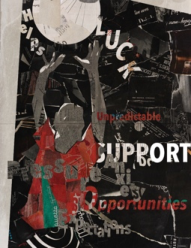
Creating an Embodied Map involves literally mapping out (in a list or otherwise) what it’s been like to be in one’s body throughout life. Throu- ghout the mapping process, designers seek out significant memories, search for forgotten things, and meditate on what might silenced. Reflecting on embodied ways of individually experiencing life is about remembering the many significant and small changes that occur over long periods of time or quite instantaneously that include things like hormonal shifts, body alterati- ons (e.g., hair removal, wearing body modifying garments, surgeries, tattoos), details related to separate body parts and senses, and deep psychological fee- lings in the past and present about one’s own body. This activity takes several days or weeks because it requires deep reflections and even consulting photo- graphs from the past to help identify key transitions. The resulting Embodied Map may be a collage (see Figure 1) or drawings/sketches of the core aspe- cts of body secrets. Writing and dialoguing about individual Embodied Maps help designers to re-story their body story collectively, which supports deeper understandings of how complicated and intersectional body stories are. The Embodied Maps activity provides a unique way to learn more about personal values, beliefs, biases and assumptions leading towards deeper self-knowing, which in turn supports designing for and with other people.
Figure 1: An example of an Embodied Map.
Evolving Lines Evolving Lines is an activity that explores a meaningful object or an object connected to a project through drawing and handwriting to explore mea- ning, memory, and information. This exploratory activity is a kind of detailed visual map with handwritten notations that link to the makers’ emotions, time periods, experiences, and knowledge in a meaningful way.
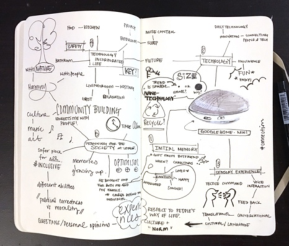
The process of engaging in Evolving Lines involves: (1) a front-end discus- sion to introduce the method and help build dialogue, familiarity, and foster a relationship among participants: (2) identify an object of personal significa- nce or one that relates to a project and explore that object through drawing and writing; and (3) engage in a written reflection on the experience and high- light memory, emotions, and other personal information related to the object. The central objective in this activity is to reveal unique and evolving refle- ctions, and dynamic connections among people, objects, and spaces through personal memories. Figure 2 shows two designers’ Evolving Lines visual sto- ries, and other examples can be viewed on a short film created by authors one and two (Ruiz and Strickfaden 2018).
Following these three steps, participants transform their reflections and connections into stories that connect the past and the present. For exam- ple, one designer wrote about the physical transformations of her teddy bear (while also personifying, and revealing an emotional connection to, the stuffed toy).
The opportunity to draw my bear has never occurred before. Even though she often sits on my desk and watches. Well, she can’t really watch: she lost her eyes long ago. And her stuffing too. But then, we all go through changes.
Similarly, another participant reflected on multiple, often conflicting emotions elicited by her object (a card written by her only sister): The initial emotions that emerged with my object were positive; all the reasons why I initially chose this object came to the fore. However, the lon- ger I spent thinking about the object and the associations I made with it, the more the negative and painful memories emerged: insecurities, uncer- tainty, resentment. I did not think that those thoughts and feelings would come about, and I am somewhat ashamed that this beautiful item contorted my attached associations into unconscious, yet still present memories and
Figure 2: Two visual stories resulting from the Evolving Lines activity.
(Re)storying Empathy in Design Thinking 63
feelings. Reflexivity can be a powerful tool – though you must be open and ready to accept anything.
The Evolving Lines reflections highlight how people and material objects are inextricably connected through memory, emotions, and stories; and the re-storying process aids in making information more tangible. The drawings themselves reveal a fragmented or unfinished story that was filled-in or parti- ally completed as part of the written reflection (step 3). Scholarly analysis of narratives (particularly within film studies) describe the incomplete nature of visual and/or written stories as an important characteristic that helps engage a reader or viewer in imagining, visualizing, filling-in or inserting what is partial or missing within a story (Branigan 1992, p. 46).
The visual stories, made up of drawings and words, that emerged from Evolving Lines reveal an incomplete quality. The final reflective part of the activity (step 3) helped participants connect disparate components from what they documented to build a meaningful and coherent story. The re-stories that resulted from Evolving Lines were produced because of the engaging, hands-on approach that explored an actual physical object connected to remembered and imagined times, places and people. Working from an object and exploring its connotations through drawing and handwriting, supports designers to share a range of subjective ideas and recollections while forging new connections between past and present.
Light in the Borderlands The idea for Light in the Borderlands emerged from the need to better understand how legally blind, low vision folks identify with mobility and transportation in urban spaces outside of the medical model of disability. The “medically constructed blindness/sightedness binary” offers a simplistic description of a complex way of being in the world (Omansky 2001, p. 184). Light in the Borderlands explores how “legally blind people move back and forth across the unique border between the sighted and blind worlds” (ibid).
As design researchers, the first and second author explored the complexity of participants’ embodied lived experiences through a participatory form of video ethnography (Pink 2007, p. 110) using a standard definition camera where the participants engaged in the filming despite having low vision (see Strickfaden and Ruiz 2018 to view the co-created film). The camera pla- yed an important role in eliciting stories that facilitated a form of “plural authorship” (Rabinow 1986, p. 246) as the visual content and narrative of the film emerged through interaction between design researchers and parti- cipants. Dialogue and stories emerged during the making of the film where relationships were built, and dialogue and embodied knowledge were sha- red. Through the interactions during and after the making of the film, the design researchers learned about how the experiences of folks with low vision are “vastly different from those of either sighted or totally blind people” (Omansky 2001, p. 5).
The first meeting took place with Shafi, a young artist involved in musical exploration and drawing. Open-ended conversations about parts of Shafi’s life story included discussions about a video he created, his thoughts on
social justice, being born in Afghanistan, being raised in India and Canada, and how at the age of 19 he speaks five languages. Specific questions about mobility, transportation and urban travel were asked that led to meeting at a local art gallery. Walking through the art gallery while Shafi filmed brought forth information linked to his embodied know-how about barriers within the space. Dim lighting, sculptures, art on the walls, stairs, and curving walls all elicited discussions around inaccessibility. At one moment Shafi briefly put his hand on a sculpture (before security personnel arrived) and he talked about his desire to explore the tactile qualities of art: When I put my hands on the art I can see more. I can feel it, I can see it is real art, it’s not just a picture. Shafi also shared and talked about some of his own artwork. He shared various sketches that not only showed his talent but also elicited new memories and anecdotes associated with each image. Through a combination of dialoguing and filming about art, stories and meaningful locations, Shafi revealed embodied know-how about the complex and dynamic borderland of blindness noted by Ormansky.
The second meeting was with Eleanor who shared a range of ideas that revolved around everyday experiences of mobility, while also describing stra- tegies and challenges related to independent travel within the city. Eleanor took us on a journey that including walking and a bus ride between her workplace and a downtown shopping mall. The shifting landscape and move- ment led to an unstructured dialogue throughout the meeting that included an unplanned stop at a department store, a walk through a large pedway, travel along escalators, and visit to a food court. Along the way, Eleanor sha- red candid stories and recorded her own movements through these spaces using a video camera. Through this journey, Eleanor shared her memories and real-time experiences of natural and artificial light, mobility, and using public transit.
The third and final meeting was with Carol who shared her feelings, memo- ries and embodied experiences about her life prior to vision loss including when she studied music in university, work she engaged in, and more recent experiences of teaching private voice lessons from her home studio. Unlike Shafi and Eleanor, Carol was fully sighted until her twenties. Stories shared by Carol juxtaposed her past and present: I lost my sight when I was twenty-seven. So I had all that independent stuff. I went away to school. I went to post-secondary, I drove a car. I did all that stuff. Not that I was pleased with it—it was a difficult transition. I mean I went through a lot of things, but on the other side of it I’m pretty okay with it. I had my chance to do those things. Through film footage and dialogue, Carol illustrated her ability to overcome obstacles by referencing recent challenges experienced during her application to a telecommunication job. She shared stories about recreation, public transportation and career in a candid manner. Carol filmed a trip to her gym, where she recorded footage while taking part in a Zumba class. The resulting footage embodies the dynamic energy that comes through in her storytelling. Later, Carol expressed the significance of sharing, she wrote: thank you for allowing me to tell my story, it was very freeing and therapeutic for me.
(Re)storying Empathy in Design Thinking 65
Situated within a cultural (rather than medical) model of disability, Light in the Borderlands evolved through co-created urban explorations and open-ended dialoguing that emphasized the description of place and story- telling. This kind of storytelling and re-storying elevates the phenomenon of low vision “to the position of something that provokes thought” and gives voice to the “many tellers of the story of blindness” (Michalko 1998, p. 4).
DISCUSSION AND CONCLUSION Storytelling has deep connections to temporality, memory, emotion, and embodied ways of experiencing life, all of which are significant to developing and creating empathy with other people. The processes of exploration high- lighted through our three case studies tell us various important things about storytelling through design thinking. First, storytelling is an innate human need that moves people into social ways of collectively experiencing and sha- ring life. According to Frankl, the “will to meaning is really a specific need not reducible to other needs, and in greater or smaller degree present in all human beings” (1978, p. 31). This “will to meaning” is a natural process for people to explore and elicit memories (often around physical objects) which means that storytelling is an excellent in-road to engaging in self-knowing and to working with participants/users/audiences. Second, storytelling naturally supports relationship building. Relationships with other people can be built and deepened through dialoguing around physical objects that are present, absent and/or imagined. Naturally designers already do this through human- centered designing; however, depth of story is often missing. Third, our three cases illustrate different ways that storytelling can be used in design thinking. Embodied Maps highlight how to focus on one’s own body story that can probe designers to better understand their personal position. This focus on embodied experiences aids designers towards understanding the value of re- storying memories, and also encourages self-knowing as an important part of the design process. Evolving Lines highlights how stories are intrinsically con- nected to physical objects, spaces, places, and people that are entwined within the social world. Evolving Lines also pushes designers to consider temporal relationships that connect the past with the present, and aid in imagining the future. Light in the Borderlands highlights how embodied life experiences can be made tangible by engaging with participants in deep and meaningful ways.
In closing, this paper contributes to the growing area of work on empathy in design thinking by offering ways that storytelling can resonate over time, evoke new meanings and prompt new perspectives in design teaching and doing.
ACKNOWLEDGEMENT
The authors would like to thank the anonymous makers of the Embodied Map and Evolving Lines examples. Written permission has been given to show these works.
REFERENCES
Benedict, R. (1934). Patterns of Culture. NY: Houghton Mifflin. Bateson, G. (2002). Mind and Nature: A Necessary Unity. Cresskill: Hampton Press. Branigan, E. (1992). Narrative Comprehension and Film. London: Routledge. Clifford, J., Marcus, G. E. (1986). Writing Culture–The Poetics and Politics of Ethnography. California and London: University of California Press. Froyen, H. (2006). Designing in the Dark: An Experimental Design Workshop. In
Devlieger P., Renders F., Froyen H. and Wildiers K. (Eds) Blindness and the Multi- sensorial City. Antwerpen: Garant, 329–338. Fuller, L. K. (1998). Saving Stories: The Goal of Cultural Environment Movement.
International Communication Gazette, 60(2), 139–153. Frankl, V. E. (1978). The Unheard Cry for Meaning: Psychotherapy and Humanism.
Simon and Schuster. Frank, K. and von Sommaruga Howard, T. (2010). Design through Dialogue: A Guide for Clients and Architects. John Wiley and Sons Ltd: UK. Heylighen, A., Martin, M., Cavallin, H. (2007). Building Stories Revisited: Unlocking
the Knowledge Capital of Architectural Practice. Architectural Engineering and Design Management, 3(1), 65–74. Hillman, J. (1983). Healing Fiction. Barrytown: Stanton Hill Press. Holliday, A. (2011). Intercultural Communication and Ideology. London, Sage Publishing. Koskijoki, M. (1998). Outi Luisvarra’s: ‘5, 918 objects=home’. Space and Culture,
2, 124–125. Kim, Y. Y. (2015). Finding a “home” beyond culture: the emergence of intercultural personhood in the globalizing world. International Journal of Intercultural relations, 46 (2015): 3–12. Lloyd, P. (2000). Storytelling and the Development of Discourse in the Engineering
Design Process. Design Studies, 21(4), 357–373. Martin, M., Heylighen, A., and Cavallin, H. (2003). Building Stories a Hermeneutic Approach to Studying Design Practice. Proceedings for the 5th European Academy of Design Conference, April 28-30, Barcelona: Online publication. Michalko, R. (1998). The Mystery of the Eye and the Shadow of Blindness. Toronto:
University of Toronto Press. Moggridge, B. (1993). Design by Story-telling. Applied Ergonomics, 24(1), 15–18. Morgan, A (2000) What is Narrative Therapy: An Easy-to-Read Introduction.
Dulwich Centre Publications. Omansky, B. (2001). Borderlands of Blindness; Lynne Reiner Publishers: Boulder, CO. Pink, S. (2007). Doing Visual Ethnography, Sage Publications: London, UK. Rabinow, P. (1986). Representations Are Social Facts: Modernity and Post- Modernity in Anthropology. In Writing Culture: The Poetics and Politics of Ethnography; Clifford, J., Marcus, G. E., Eds.; University of California Press: Berkeley, 234–261. Rice, C. (2009). Imagining the Other? Ethical Challenges of Researching and Writing
Women’s Embodied Lives, Feminism and Psychology, 19(2), 245–266. Ruiz, A. and Strickfaden, M. (2018). Evolving Lines (film), https://vimeo.com/ 298304081 Ruiz, A. and Strickfaden, M. (2016). Light in the Borderlands: A Film Created by
Three Legally Blind Urban Explorers. In Rethinking Disability: World Perspectives in Culture and Society. Garant Publishers. Antwerpen Belgium. 317–329.
(Re)storying Empathy in Design Thinking 67
Ruiz, A. and Strickfaden, M. (2015). Spatial Explorations and Digital Traces: Experiences of Legal Blindness through Filmmaking. Societies. 5, 1–19. Strickfaden, M. and Ruiz, A. (2018). Light in the Borderlands (film), https://vimeo.
com/298045348 Strickfaden, M. and Stielow, M. (2023). Self-knowing Exercise Book. Department of Human Ecology, University of Alberta, https://drive.google.com/file/d/1drYHt n3-vYTruQX7GfsWdCXuuzcX7XJ_/view?usp=sharing Strickfaden, M. and Thomas, J. (2022). Designing in the Wild: Problem-solving for
Specialized Apparel and Soft Products. In: Yong-Gyun Ghim and Cliff (Sung- soo) Shin (Eds) Interdisciplinary Practice in Industrial Design. AHFE (2022) International Conference. AHFE Open Access, vol 48, 25–33. Squires, S., Byrne, B. (Eds), (2002). Creating Breakthrough Ideas–The Collaboration of Anthropologists and Designers in the Product Development Industry. Bergin and Garvey: London. Thomas, J., McDonagh, D., and Strickfaden, M. (2012). Empathic education
in design: Strategies for healthcare practitioners? Australasian Medical Journal (AMJ), 5(5), 292–300. Thomas, J. and Strickfaden, M. (2023). Stretching and Using Designers’ Empathic Horizons. In this volume, AHFE (2023) International Conference. van Hinte, E. (1997). Eternally Yours: Visions on Product Endurance. 010 Publishers:
Rotterdam. Yaneva, A. (2009). Made by the Office for Metropolitan Architecture: An Ethnography of Design. 010 Publishers: Rotterdam.
LISTED IN THE AHFE DIGITAL BOOKSTORE CATALOGUE
Explore the complete digital volume
Interdisciplinary Practice in Industrial Design
Read this individual research paper free through the original publisher, or explore the full digital proceedings book.
ISBN 978-1-958651-76-6
Explore this ISBN in the AHFE Bookstore ↗Listed in the July 2026 bookstore catalogue; search by ISBN to confirm current availability · Digital book purchase optional