Joyce Thomas, Megan Strickfaden (2023). Stretching and Using Designers’ Empathic Horizons. In: Interdisciplinary Practice in Industrial Design. AHFE Open Access, vol. 100, pp. 46–56. https://doi.org/10.54941/ahfe1002970
This paper builds upon previous research where we discovered gaps related to how empathy is understood and how the empathic horizon is characterized within design studies. First, we offer concrete definitions of empathy through various perspectives to clarify misconceptions. Second, we offer a brief historical overview of the ‘empathic horizon’, which can be traced back to the 1960s. Third, we offer a critical analysis of empathy/empathic horizons and begin to characterize what is meant by empathic horizons through the literature reviewed. Fourth, we illustrate how designers’ empathic horizons may be unintentionally and intentionally stretched. That is, we believe that each person has an empathic horizon that evolves spontaneously, is connected to personal individual embodied experiences, and evolves dynamically across their life journey. Literature shows that a person’s empathic horizon is predominantly developed unintentionally but it can be intentionally stretched or expanded, particularly when awareness is brought to the value of doing so. Fifth, we use our Jellybeans Empathic Modeling Activity that 1145 people have participated in since 2011 to flush out the definitions we’ve established. This paper contributes information not currently found in design literature by bringing together theoretical and practical definitions and characteristics about empathy and empathic horizons that are relevant to design practitioners and design educators.
Designers are people who create things for other people. This requires they take on a role of responsibility that includes understanding, considering, and generating experiences for person-object relationships and experiences that empower the people who use the objects created. When designing for other people, it is critical to gain insights and deep understanding into other’s values and beliefs, even before the problem identification begins. Acquiring insights into and a closer understanding of real people (their expectations, wants, desi- res, needs) supports the designer’s ability to create outcomes that will resonate with the users. Designers take various approaches to better understanding the people they’re designing for through human-centred designing; howe- ver, developing empathy with one’s users is an approach that has resonated with the design community for some time (e.g., Nicolle and Maguire 2003;
Stretching and Using Designers’ Empathic Horizons 47
Buchenau and Suri 2000; Moore 1987). Furthermore, educators have used empathic modeling activities to expand student designers’ empathic horizons during design training and later during professional practice to help designers discover ways to better understand the people they are designing for and with (e.g., Thomas et al. 2012).
This paper builds upon previous research where we discovered gaps related to how empathy is understood and how the empathic horizon is chara- cterized. First, we offer concrete definitions of empathy through various perspectives to clarify misconceptions. Second, we offer a brief historical overview of the ‘empathic horizon’, which can be traced back to the 1960s. Third, we offer a critical analysis of empathy/empathic horizons and begin to characterize what is meant by empathic horizons through the literature reviewed. Fourth, we illustrate how designers’ empathic horizons may be unintentionally and intentionally stretched. Fifth and finally, we use our Jelly- beans Empathic Modeling Activity that 1145 people have participated in since 2011 to flush out the definitions we’ve established. We believe this paper contributes detailed information about empathy and the empathic horizon that is not currently found in design literature.
EMPATHY DEFINED In order to clarify misconceptions around what empathy really is, we have compiled definitions from scholars from three different perspectives (see Table 1). These philosophers, medical scholars and design studies scholars provide various ways to think about the concept of empathy.
It is not surprising that design studies scholars have latched onto the concept of empathy through ‘empathic design’ because empathy is considered to be linked to being “curious” and “creative” (Krznaric 2007; 2015), having “imagination”, being able to “imagine” (Oxley 2011; Pembroke 2007; Coplan 2011) and act towards action and social change (Krznaric 2007). Furthermore, empathy is characterized as being “complex” (Coplan 2011), imprecise (Carter 2013) and having the ability to distinguish oneself from another (Kouprie and Visser 2009; Coplan 2011; Coplan and Goldie 2011). Along with these ways of thinking about empathy, Brené Brown (a resea- rcher and storyteller who has spent the past two decades studying courage, vulnerability, shame, and empathy) tells us that empathy is not connected to experiences but is connected to the emotions that underpin an experience (Brown 2018). She continues by stating that sympathy, which is very different from empathy, provides a cognitive understanding of an experience, alth- ough it does not feature the connecting to emotions. A further distinction that Brown makes is that empathy is feeling with people, while sympathy is feeling for them. “Empathy fuels connection while sympathy drives disconnection” (Brown 2018).
Understanding empathy more concretely allows design educators and pra- ctitioners to have clarity around why empathic design is so appealing but also provides guidance towards how to practice empathic designing: (1) shift from ‘all about me’ to knowing ‘others aren’t the same as me’; (2) avoid being sympathetic and feel with people instead; (3) engage in symmetrical
48 Thomas and Strickfaden
Table 1. Empathy definitions across fields of philosophy, medicine, and design.
Table available in the original PDF paper.
Author Year Definition Krznaric 2007 Philosophy Beyond knowing and understanding another person’s worldview, empathizing with another also can encourage action and social change. Empathising will bring you unexpected insights and inspiration in your own life, and expand your curiosity, creativity and possibilities (Krznaric 2007, p. 11). Pembroke 2007 Medical
Recognizing what the suffering of the patient feels like and requires reaching out to others and imagining their inner world experience (Pembroke 2007). Kouprie and Visser
2009 Design
“Besides being a quality of the design process, empathy is described as an ability people have, and differs for individuals” (Kouprie and Visser 2009, p. 439). Coplan 2011 Philosophy
Empathy is “a complex, imaginative process through which an observer simulates another person’s situated psychological states while maintaining clear self–other differentiation” (Coplan 2011, p. 58). Coplan and Goldie
2011 Philosophy
Empathy is “a unique means for us to understand and thus experience what it is like to be another person, but identifies the affective matching, other-orientated perspective-taking and the ability to view oneself as separate” (Coplan and Goldie 2011, p. 6). Oxley 2011 Philosophy
“…feeling a congruent emotion with another person, in virtue of perceiving her emotion with some mental process such as imitation, simulation, projection or imagination” (Oxley 2011, p. 32). Carter 2013 Philosophy
“empathy is not one precise phenomenon but a range of different emotive responses that fall under a broad banner” (Carter 2013 p. 294). Krznaric 2015 Philosophy
People can begin to cultivate empathy with others by focusing on their own personal habits, by developing curiosity about strangers, and immersing oneself in their lives to help gain understanding of others. Active listening without personal agenda, challenging one’s own personal biases, and being open to recognize consensuses will promote empathy to grow (Krznaric 2015).
“active listening” (Krznaric 2015) during processes of exchange; (4) be curi- ous about others rather than concerned about not relating well to others; (5) challenge our own bias and assumptions (Krznaric 2015); and (6) be creative when bridging self with others.
In sum, although there is no agreed upon definition of empathy (Coplan 2011, p. 40) we can interpret empathy in a meaningful way that breaks away from trends and clarifies misconceptions through various scholarly sources. Building upon this, we now turn to better understanding the phrase ‘empa- thic horizon’, that has been used in design studies (e.g., Thomas et al. 2012;
Stretching and Using Designers’ Empathic Horizons 49
Jonsson et al. 2012; McDonagh et al. 2011; McDonagh-Philp and Denton 1999) but isn’t adequately defined.
A BRIEF HISTORICAL VIEW ON THE EMPATHIC HORIZON The empathic horizon is a phrase used in design studies and elsewhere that is clearly adapted from Austrian-German philosopher and mathematician Edmund Husserl who established the school of phenomenology. More than 50 years ago in the 1960s and 1970s Husserl used “empathy-horizon”(1970, p. 225). Table 2 illustrates a series of definitions related to the ‘empathic horizon’ characterized by philosophers, phenomenologists and design studies scholars.
Table 2. Empathic horizon definitions across a variety of fields.
Table available in the original PDF paper.
Author Year Definition Husserl 1970 Phenomenology
1999 Design
“within the vitally flowing intentionality in which the life of an ego-subject consists, every other ego is already intentionally implicated in advance by way of empathy and the empathy-horizon” (Husserl 1970, p. 255) McDonagh- Philp & Denton
“an individual designer has an empathic horizon…” “This horizon could be defined as the individual’s range of understanding of user experiences in different contexts” (McDonagh-Philp and Denton 1999, p. 21). Krznaric 2007 Philosophy
“When we feel paralyzed by doubt… to the extent that we do not know what to do next, we can find liberation through an act of empathetic imagining that suggest which path we should take”. We must discover ways to deepen our empathy … because in the mere act of imagining we risk imposing our own desires and biases on others. (p. 10) “Empathizing will also serve the vital purpose of helping to challenge your prejudices and assumptions” (Krznaric 2007, p. 11). Krznaric 2010 Philosophy
Empathy can transport us into other lives in ways that can illuminate our own and help to extend our empathetic imaginations to all people– those who are dispossessed or disadvantaged or whose views and actions we might oppose. This can help expose our own prejudices, uncertainties, and inconsistencies. “The lesson of empathy is that we will only discover ourselves by stepping outside ourselves” (Krznaric, 2010, p. 130). Jonsson et al. 2012 Design
“It becomes especially important for designers to meet older people so that they may comprehend their situations and expand their understanding and empathic horizon because they tend to have different experiences and expectations” (Jonsson et al. 2012 p. 64). Thomas et al. 2012 Design
“A person’s empathic horizon is defined as the boundaries of experience, knowledge and understanding in relation to other people” (Thomas et al. 2012, p. 293).
50 Thomas and Strickfaden
This brief historical view on the empathic horizon highlights Husserl’s important starting point that characterizes the “empathy-horizon” as intrin- sically related to engaging in and moving towards others through the self. Following this, we note that although others define a kind of empathic horizon, this is done through other “empathetic imagining” and “empath- etic imaginations” (Krznaric 2007; 2010), which emphasizes empathy being action-oriented and a means to challenging biases, prejudices, and assumpti- ons through people not like oneself. Although these characterizations of the empathic horizon help us in our quest, we feel further elaboration is required so that design educators and practitioners can fully engage in stretching their empathic horizons.
EMPATHIC HORIZONS CHARACTERIZED An adult human viewpoint of the world around them is frequently seen from the perspective of “how far a person can physically reach, visually see, and hear” (McDonagh et al., 2011, p. 61). These physical aspects help frame and define a person’s empathic understanding of others. Each person has an empathic horizon that seems to evolve spontaneously, is connected to per- sonal individual embodied experiences, and grows dynamically across their life journey. It seems as though a person’s empathic horizon is predominantly developed unintentionally but it can be intentionally stretched particularly when awareness is brought to the value of doing so. Krznaric describes how people’s empathic horizon can be stretched through curiosity, being creative (2007), by actively engaging in others’ lives, through active listening, and by challenging our own biases (2015). It follows then that empathic horizons are most often affected/built through extreme life experiences and situati- ons such as breakdowns, major changes, crises, and during times of survival. Reflecting upon the details of one’s own empathic horizon is naturally chal- lenging due to the extreme nature of the experiences and situations, and most people are unaware that they have an empathic horizon, let alone have any control over how it’s developed.
We can further characterize the empathic horizon as having “boundaries” (Thomas et al. 2012, p. 293) when we think about it being stretched. The boundaries of each person’s empathic horizon will vary immensely and are related to their life journey so far. For instance, all humans begin as babies with similar boundaries that define their empathic horizons. They begin to understand the nuances of their social and cultural contacts. Yet, this can change dramatically throughout a person’s life. For example, a teenager who has remained in the same school their entire life will have a very different empathic horizon from a teenager who has lived in five different countries and has attended schools taught in different languages. It could even be argued that the 2nd teenager might be more inclined to expand the boundaries around their empathic horizons, while the 1st teenager has a smaller more limited boundary. As such, people’s empathic horizons are “dynamic”, “ever- changing” (McDonagh et al., 2011, p. 61), relative to human embodied experiences (sight, sound, touch, taste, etc.), and awareness in relation to oth- ers. The empathic horizon can also be characterized as being practice-based,
Stretching and Using Designers’ Empathic Horizons 51
iterative, and linked to internal laws (e.g., beliefs, values, assumptions) that people follow. Naturally, all people’s empathic horizons are different, but according to Krznaric, all people have “empathy potential” that points to the ability to stretch the empathic horizon.
STRETCHING EMPATHIC HORIZONS Through the critical review of literature consulted, we understand that stretching designers’ empathic horizons will vary massively. It seems that empathic horizons are something like a rubber band that stretches to include other people, but can also bounce straight back. Being stretched too far might be too challenging at times, especially if these are linked to difficult past life events. At times, people may be more open, and other times they may need to protect themselves. Additionally, stretching designers’ empathic horizons can be done unintentional and intentional and seems to be accomplished through learning-in-action.
Unintentional stretching empathic horizons occur during everyday life with family, friends, in school, and in community. For example, when a person has family members with disabilities this shapes their understanding of other people with disabilities and helps them to realize that other peo- ple are different from themselves. Other ways that unintentional stretching may occur is through various social situations during childhood play, moving cities, grieving losses (pets, family, friends) and other life changes. These everyday occurrences come to people like a ‘potluck’, where people ‘get what they get’, but influence how they empathize with others.
Intentional stretching empathic horizon is when people are aware of others and choose to engage in “action and social change” (Krznaric 2007, p. 11). Formal settings include educational places (daycare, grade school, college) and less formal settings include, for example, a soup kitchen, care homes for older adults, and church. Activities that encourage intentional stretch- ing include: being part of scouts or girl guides; debating club; toastmasters international; sports; or even engaging in empathic modeling. These kinds of actions push the boundaries of empathic horizons towards more complexity.
EMPATHIC MODELING TO STRETCH EMPATHIC HORIZONS Empathic modeling strategies are used in educational and professional situ- ations (e.g., with medical doctors, designers, care workers) to help people move outside of their own personal understanding in order to develop empa- thy with others. Empathic modeling helps to encourage designers to gain insights about others (target users) and/or to help create better experiences through products and services. In order to flush out ways to stretch designers’ empathic horizon we highlight our Jellybeans Empathic Modeling Activity.
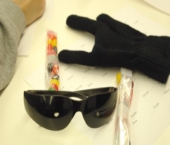
The Jellybeans Empathic Modeling Activity simulates various disabilities including a visual impairment (e.g., retinitus pigmentosa), challenges with hands (e.g., rheumatoid arthritis, amputations), and a cognitive impairment (e.g., brain injury, challenges with decision-making and problem-solving). Participants are given permission to work in teams of two and to assist each other should they wish to do so. Each participant is given a pair of ‘disability’
52 Thomas and Strickfaden
Figure 1: ‘Disability goggles’ and ‘disability gloves’ (left), goggles in use and partici- pants completing the tasks (center), visual template with colors placed across the page (right).
goggles, a pair of ‘disability’ gloves, one small bag of jellybeans, and a paper template to sort the jellybeans once they open the bag (see Figure 1).
The packaging of the jellybeans is strategically designed to be as difficult as possible while appearing straightforward. The plastic food bag with zip- per fastening is rolled tight around the 20–30 jellybeans and transparent tape secures the bag at the zipper in a thin roll. The bag of jellybeans is challenging to access, even when not impaired in any way. The goggles cause the partici- pants to struggle seeing the tape and have real difficulty figuring out how to access the zipper lock. They are directed not to tear the bag or use their teeth. The gloves keep them from feeling the edges of the tape and impede their ability to peel the tape up, ending up covered in tiny pieces of tape which go unnoticed due to limited vision.
The jellybeans are multicolored and multi-flavored, and they do not neces- sarily match the colors that are written on the paper template that offers 6 color names. This twist adds a subtle but significant challenge for the par- ticipants, introducing a level of ambiguity that we do not address initially to encourage them to set their own guidelines in terms of where or whether they place the beans on the paper template. Participants approach this ambi- guity in a variety of ways. Some sort out clusters of beans that are not in the colors listed and set them to one side and some eat the outlier jellybeans. The eating of the ‘evidence’ adds to the enjoyment for participants, but is an important discussion point about cognitive impairments. Jellybeans were chosen as they are typically associated with childhood and playfulness, and this is frequently enhanced when we give them permission to eat the jellybeans upon completion of the activity.
A wide range of people have participated in the Jellybeans Empathic Mode- ling Activity: industrial design students, graphic design students, business and engineering students, education students, design educators, healthcare practitioners (doctors, nurses), entrepreneurs, and attendees at major disa- bility conferences. Table 3 lists the distinctive groups who engaged in these empathic modeling activities.
Although the Jellybeans Empathic Modeling Activity seems very simple, it is designed to stretch participants empathic horizons in an intentional and multi-faceted manner. There are four distinct interventions related to the gloves, goggles, teamwork and ambiguities.
Gloves: Participants who consider themselves to be able bodied are requi- red to open packaging in a way that they ordinarily wouldn’t. The gloves
Stretching and Using Designers’ Empathic Horizons 53
Table 3. Population profile of sessions that involved the impairment activities from 2011 through 2023.
Table available in the original PDF paper.
Disability Goggle Sessions and Population Profiles N
818
Within Higher Education Courses at Universities in US (2), Canada (2), China (1), and Australia (1)
24
Business and Engineering students (under grad) 165 Various undergraduate academic areas across the Universities 475 Industrial Design (ID) students 133 Grad students across the Universities 45 International Health Innovation Conferences in Malaysia and China 160 Medical Professionals 160 Business Educational Workshops in US 57 Business Professionals 22 Business Executive Training 35 International Conference Workshops in US and Canada 42 Design Conference: Design Professionals, design and other edu- cators, business professionals, students
18
Disability Conference: Disability specialists, educators, people with traumatic brain injuries, visual impairment, and physical disa- bilities Student Workshops in US and Canada 68 Various undergraduate academic areas across four Universities 68
Grand Total 1145
are familiar and seem innocuous, yet they cause people obstacles they do not expect to encounter. Some fingers are missing, the knitted yarn is slick and stretchy. The choice of the soft material was twofold that simulates loss of digits and also restricts the range of motion in a minor way due to the other fingers being folded over the palm of the hand getting in the way of the finer hand movements. Participants still try to use these digits even though they are impaired. Bits of tape from opening bags sticks to them and becomes an additional obstacle along the way. The knitted gloves dramatically reduce the touch sensation and ability to read texture. Thus, there is no sensory perce- ption through the fingertips. These gloves are a lightweight low-cost solution that are easy to clean and reuse.
Goggles: Reducing a person’s eyesight has an immediate disorienting effect and rapidly immerses participants into a different mindset and (dis)comfort zone. People want to remove them right away and frequently need to be reminded to keep them on until instructed to remove them. Some experience vertigo or headaches. Quite suddenly participants recognize that not everyone sees the way they do and that their expectation of being able to see problems is not a common experience. Many develop an understanding that within their own empathic horizon they have expected they see everything, and now can only hear noise around them. This can be a powerful reminder that can promote change within a person even though they will remove the goggles at the end of the activity.
54 Thomas and Strickfaden
Teamwork: Participants can ask others for help. Everyone has embarras- sment about not being able to do what they can normally do but everyone else is in the same boat. They all have the experience at the same time and so no one person stands out. It is a safe environment. People can feel belit- tled when their partner helps too much (without asking), but they can also feel abandoned if their partner doesn’t offer to help or doesn’t help enough. This models the way people with disabilities are often treated. Some people are fiercely independent and they want to do it on their own or they don’t reach out to others and perhaps unwilling to expand their horizon. Within a workshop at a disability conference a blind man sat back aloofly and did not participate. He seemingly protected his empathic horizon.
Ambiguities: Not all the jellybeans match the names on the page which can be an intellectual challenge. Some push beans that don’t match aside. Some people get agitated. One student dealt with it on the lowest common denominator and decided brown was orange. They made decisions on their own and perhaps ate the evidence which is a playful aspect that allowed them not to feel sad or disoriented or belittled especially when they are made aware they were behaving like someone who has a cognitive impairment.
Upon completing the Jellybeans Empathic Modeling Activity participants are asked to reflect on their experience with these questions:
What feelings did you have when you put on the goggles? Did you have a reaction in your body to the idea of this? Where was this feeling in your body?
How did this affect your ability to perform the tasks given?
How did you deal with the ambiguity of colors?
Did anyone see you with your goggles on? How did this make you feel?
Tell me about your physical and emotion experience during this empathic modeling activity in a short reflection.
The reflections reveal a great deal about how the participants’ empathic horizons stretched during the activity. Participants critiqued the activity indi- cating it would have been easier if they didn’t have to wear the gloves, a participant wrote: these gloves make it difficult to grip. Participants also indicated how their prejudices, assumptions, and biases were challenged by stating that it was sometimes easier to perform tasks than imagined, which points to them beginning to think about people with disabilities having diffe- rent capabilities than they originally thought. They also indicated that their perspectives changed radically during and after the activity, for example, another participant wrote:
This changed my perspective on the world around me and gave me an idea of what it feels like to be blind. I could not perform the most simple tasks like drinking water even became difficult with the glasses on as I had no idea what I could see. my actions were purely off feel. Colors became so distorted that even though I could still see color what I was looking at was so minor to what was there that I didn’t even notice color that much.
Stretching and Using Designers’ Empathic Horizons 55
Other participants wrote about stigmas or social disconnections they felt. For example, a participant wrote: My roommates saw me with my glasses on and all of them said it made them uncomfortable. This made me feel exiled and excluded because I was not able to see nearly close to as much as them.
From our more than 1,000 written participant reflections we can begin to piece together evidence of how people’s empathic horizons are stretched. Furthermore, by tracking students who engaged in the Jellybeans Empathic Modeling Activity and by chatting with participants long after engaging in the activity, we are further able to identify how this activity intentionally and mindfully encourages deepening empathy particularly with others who are more distanced from the self.
CONCLUSION
This paper is the beginnings to digging deeper into empathy and empathic horizons. We begin by defining and characterizing concepts that have not been fully elaborated upon. We recognize that empathic modeling has limi- tations, but we also feel that empathic modeling plays an important role in stretching people’s (especially novice designers) empathic horizons as part of broader educational and intentional modes (e.g., visiting a social justice museum, spending time with potential users). One major takeaway are the six points of guidance for how to practice empathic designing. The majority of these are embedded in the Jellybean Empathic Modeling Activity and all require further exploration. In closing we quote Krznaric who states, “Gai- ning an understanding of somebody’s worldview does not require agreement with their beliefs or principles” (Krznaric 2010, p. 122). Empathic modeling gives designers a glimpse into what it’s like to have other abilities, causes them to stretch their own empathic horizon and apply this experience to the creation of shared language with their designing process.
REFERENCES
Battarbee, K. (2004). Co-experience: understanding user experience in social interaction. Doctoral dissertation. Series ILMARI A51, University of Art and Design Helsinki. Brown, B. (2018). Dare to lead: Brave work. Tough conversations. Whole hearts.
Random House. Buchenau, M. and Suri, J. F., (2000, August). Experience prototyping. In Proceedings of the 3rd conference on Designing interactive systems: processes, practices, methods, and techniques, pp. 424–433. Carter, C. (2013). Book Reviews. The Journal of Aesthetics and Art Criticism 71:3
conceptualization. The southern journal of philosophy, 49, pp. 40–65.
56 Thomas and Strickfaden
Husserl, E. (1970). The crisis of European sciences and transcendental phenomenology: An introduction to phenomenological philosophy. Northwestern University Press. Jonsson, O., Sperling, L., Östlund, B., and Hornyánszky, E. D. (2012). User Requirements of Furniture Influenced by a Move to a Senior Housing. FORMakademisk, 5(1). Kouprie, M., and Visser, F. S. (2009). A framework for empathy in design: stepping
into and out of the user’s life. Journal of Engineering Design, 20(5), pp. 437–448. Krznaric, R. (2007). Empathy. URL: https://www. romankrznaric. com/empathy-ahandbook-for-revolution. Krznaric, R. (2010). Empathy with the Enemy. The Pedestrian, 1, 117–130. Krznaric, R. (2015). Empathy: Why It Matters, and How to Get It. New York:
Perigee Books McDonagh-Philp, D. and Denton, H., (1999). Using focus groups to support the designer in the evaluation of existing products: A case study. The Design Journal, 2(2), pp. 20–31. McDonagh, D., Thomas, J., Khuri, L., Sears, S. H. and Peña-Mora, F., (2011).
Empathic design research strategies: designing for, with and by people with disa- bilities. In Handbook of Research on Trends in Product Design and Development: Technological and Organizational Perspectives, IGI Global, pp. 58–79. Moore, P. (1985). Disguised: A True Story. Word Books; 1st edition Nicolle, C. and Maguire, M., (2003, June). Empathic modelling in teaching design for all. In Proceedings of International conference on human-computer interaction; Universal access in HCI: inclusive design in the information society, pp.143–7. Oxley, J. (2011). The moral dimensions of empathy: Limits and applications in ethical
theory and practice. Springer. Pembroke, N. F. (2007). Empathy, emotion, and ekstasis in the patient–physician relationship. Journal of Religion and Health, 46, 287–298. Thomas, J., and McDonagh, D. (2013). Shared language: Towards more effective
communication. The Australasian medical journal, 6(1), 46 Thomas, J., McDonagh, D., and Strickfaden, M. (2012). Empathic Education in Design: Strategies for healthcare practitioners. Australasian Medical Journal, 5(5), 292–300. 5, 5, 292–300. https://doi.org/10.21767/AMJ.2012.1061
LISTED IN THE AHFE DIGITAL BOOKSTORE CATALOGUE
Explore the complete digital volume
Interdisciplinary Practice in Industrial Design
Read this individual research paper free through the original publisher, or explore the full digital proceedings book.
ISBN 978-1-958651-76-6
Explore this ISBN in the AHFE Bookstore ↗Listed in the July 2026 bookstore catalogue; search by ISBN to confirm current availability · Digital book purchase optional