This study explores the design of human-computer interaction (HCI) by using the movements of AI and robots. Specifically, it aims to (1) categorize the affective impact of different types of motion (e.g., gradual or sudden acceleration and deceleration or constant speed) on humans and (2) experimentally examine interactions with AI and robots that incorporate different types of motion to discuss how motion can be effectively designed in HCI. At this stage, findings suggest that motion itself is not merely a visual or mechanical feature, but a fundamental aspect of interaction design that can influence HCI.
Interactive systems, such as AI-powered interfaces, robots, and virtual/augmented reality (VR/AR), have been widely explored and developed in the field of human-computer interaction (HCI). Various studies have investigated how these interfaces facilitate HCI by incorporating motion to enhance expressiveness, engagement, and communication.
For AI-powered interfaces, prior research has explored how AI-driven movement and responsiveness affect user perception, trust, and engagement. Studies on virtual agents have shown that AI-controlled gestures and expressions enhance perceived naturalness and interaction quality. Gratch et al. (2006) found that virtual agents capable of dynamically adapting facial expressions and gestures in real-time led to higher user engagement and emotional rapport. Similarly, Bickmore and Cassell (2005) demonstrated that embodied conversational agents using coordinated verbal and nonverbal behaviors improved user trust and willingness to disclose personal information. While AI-powered interfaces have significantly advanced in generating adaptive behaviors, the impact of fine-grained motion variations—such as acceleration, deceleration, and fluidity—on user experience remains underexplored.
Moreover, in human-robot interaction (HRI), nonverbal gestures have been shown to influence user perception and interaction. Romat et al. (2016) demonstrated that head gestures effectively communicated limitations in a collaborative task, prompting quicker user responses. Yamada et al. (2013)
found that gesture characteristics, such as posture and movement speed, influenced perceptions of a robot’s confidence. Furthermore, Maehigashi et al. (2024) observed that head movements during a visual task enhanced user trust compared to static conditions, underscoring the role of gestures in trust dynamics. However, variations in movement quality, such as smoothness, speed, and consistency, remain underexplored.
Furthermore, in VR and AR environments, motion manipulation has been leveraged to create pseudo-haptic feedback, demonstrating the strong interaction between vision and touch. Pseudo-haptics (Lécuyer et al., 2000) refers to a phenomenon in which visual stimuli, such as a self-projected mouse cursor or an avatar’s arm, alter their speed and shape, thereby creating the illusion of haptic feedback. Dominjon et al. (2005) and Maehigashi et al. (2021) manipulated the control-display (C/D) ratio to alter the perceived weight of virtual objects, demonstrating that changes in movement speed could create convincing haptic illusions. Similarly, Samad et al. (2019) and Rietzler et al. (2018) manipulated the C/D ratio between real and virtual movements to simulate weight perception without requiring specialized hardware.
Based on these findings, this study examines how incorporating motion into interactive systems influences HCI. Specifically, we (1) categorize the affective impact of different types of motion (e.g., gradual or sudden acceleration and deceleration, or constant speed) on humans and (2) experimentally investigate the impact of motion differences on HRI when implemented in robots. By exploring these aspects, we aim to contribute to the design of AI interfaces and robotic systems that leverage motion for more effective human interaction.
CLASSIFYING MOTIONS
Method
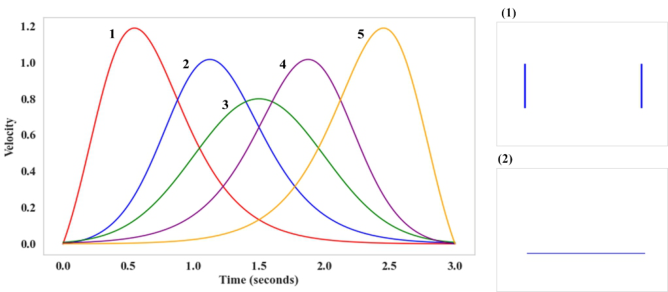
This experiment was approved by the ethics committee of Shizuoka University, Japan. A total of 200 participants were recruited through a cloud sourcing service provided by Yahoo! Japan. However, 7 participants were identified as inattentive based on the attention check items of the Directed Questions Scale (DQS) (Maniaci et al., 2014) and were excluded from analysis. As a result, data of 186 participants (145 male and 41 female from 22 to 65 y/o, M = 47.42, SD = 9.23) were used for the analysis. Participants first agreed with the informed consent and read the explanations of the experiment. After that, they performed the experimental task, an affective evaluation task (Figure 1). In this task, participants observed two lines moving as if opening and closing for one minute and rated their affective arousal and pleasure using the circumplex scale (Russell, 1980) on a 9-point scale (1: strongly disagree – 9: strongly agree). In particular, participants evaluated eight words, with two words representing each of the four quadrants of the arousal-pleasure circumplex (e.g., excited, frustrated, calm, and bored). This procedure was repeated seven times with different motion patterns, including those shown in Figure 1, as well as a constant velocity condition, where the lines moved continuously over three seconds,
Interaction Design for AI Interfaces and Robots Incorporating Motion 271
and an abrupt velocity condition, where the lines suddenly opened or closed at the 1.5-second mark.
Figure 1: Five types of motion in 3 seconds (left) and affection evaluation task (right). In the task, the 2 lines were moved as if they were opening and closing in 3 seconds, respectively, according to each type of motion.
Results
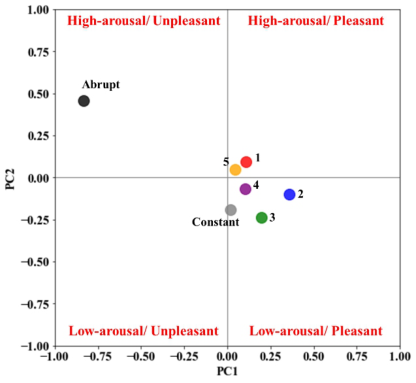
We analysed valid data from 186 participants, averaging the scores of two words for each quadrant under all conditions to obtain representative values for each quadrant. Using these representative values across all conditions, we conducted a principal component analysis (PCA). The results are shown in Figure 2.
Figure 2: Results of principal component analysis for line movements.
The validity of the PCA was assessed based on the proportion of variance explained by the first two principal components. The first component (PC1)
272 Maehigashi and Yamada
accounted for 37.07% of the variance, while the second component (PC2) accounted for 24.61%, together explaining a substantial portion of the data variance. Additionally, the third component appeared to represent a dimension related to ‘relaxation vs. stress’, capturing variations in calmness and discomfort across movements.
Additionally, the factor loadings showed that the pleasant and unpleasant quadrants were strongly associated with PC1, whereas high- and low-arousal were more closely related to PC2.
The experimental results demonstrated that even brief differences in line movement over three seconds led to variations in participants’ affective impressions. Specifically, abrupt changes in movement induced high arousal and unpleasantness, while movements like velocity1 were more associated with high arousal and pleasantness. In contrast, constant movement changes tended to result in low arousal and pleasantness.
INFLUENCE OF ROBOT MOTION ON HRI Based on the motion classification, we conducted an experiment to examine how various robot movements influence HRI. Specifically, the robot’s head movement during an apology was manipulated under three experimental conditions: human-like, constant, and abrupt movements in a trust repair scenario. The human-like motion was captured from a human and translated into a robot movement, closely resembling velocity2.
Method
This experiment was approved by the ethics committee of Shizuoka University, Japan. A total of 200 participants were recruited through a cloud sourcing service provided by Yahoo! Japan. However, 7 participants who were identified as inattentive by DQS. As a result, data of 193 participants (140 male and 53 female from 21 to 65 y/o, M = 48.93, SD = 9.92) were used for the analysis.
Participants first agreed with the informed consent and read the explanations of the experiment. After that, they performed an experimental task involving a series of arithmetic problems with two-digit addition and subtraction, using the robot Sota (Vstone Inc.).
In this task, (1) participants and the robot took turns answering a problem five times each. (2) Participants rated the Schaefer Trust Scale (Schaefer, 2016) to assess human trust in the robot by asking participants what percentage of the time the robot exhibits certain qualities, such as dependability, or performs certain actions, such as acting consistently. (3) Participants performed five more arithmetic problems with the robot where they could choose the responder for each problem. After the choice, participants or the robot answered the problem. This entire process was repeated three times, with each repetition set as one trial.
In the first trial, the robot was set to perform perfectly. However, in the second and third trials, the robot was set to answer incorrectly three times during participants and the robot answered alternately. Moreover, in the second and third trials, before completing the questionnaires, participants
Interaction Design for AI Interfaces and Robots Incorporating Motion 273
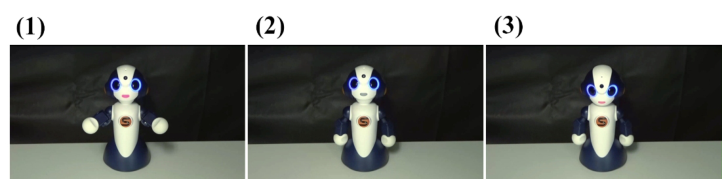
watched a 15-second video snippet of the robot’s apology, as shown in Figure 3. In the video snippet, (1) the robot said “I made a lot of mistakes.”, and (2) its arms moved and set beside its waist. After that, (3) the robot head was moved as bowing, and it said “I am sorry”. The robot’s head movement was assigned to one of three experimental conditions: human-like, constant, or abrupt movements. Additionally, a control condition was included, in which the robot apologized without any movement.
Figure 3: Robot bowing movement.
Results
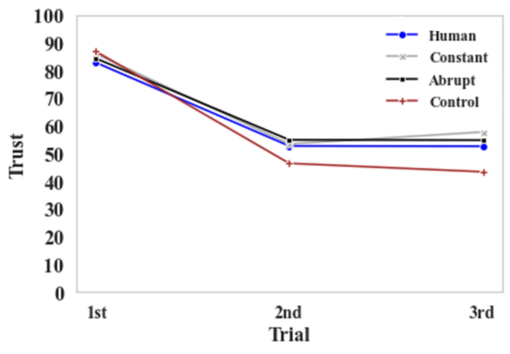
A 4 (movement) × 3 (trial) mixed-factor ANOVA revealed that trust ratings significantly decreased from the first to the second and third trials (Figure 4). Additionally, in the third trial, trust ratings were significantly higher in the constant and abrupt conditions compared to the control condition.
Figure 4: Trust rating.
These results suggest that the robot with constant or abrupt movements was more trusted than the one without movement after making repeated errors. However, human-like movement did not significantly affect trust in the robot compared to the no-movement condition.
274 Maehigashi and Yamada
GENERAL DISCUSSION The experimental results of the motion classification demonstrated that even brief differences in movement led to variations in participants’ affective impressions. Also, the experimental results of HRI showed that even brief differences in robot head movement led to variations in trust in HRI.
In particular, in the motion classification, constant and velocity2 movements (closely resembling human-like movements) tended to induce pleasantness, while abrupt movements tended to result in unpleasantness. However, trust in HRI was improved by abrupt and constant movement changes. Komatsu et al. (2012) experimentally showed that the gap between a robot’s appearance and its behavior positively or negatively influences human perception of the robot. Their study suggested that managing this gap allows for a smoother HRI. In our study, participants might perceive a gap between the robot’s appearance and its human-like head movement, whereas consistent or abrupt movements were likely to minimize this gap. As a result, the human-like head movement might negatively influence trust in the robot.
These results suggest that in HCI, the coordination between a moving entity and its movement is more important than the movement itself. In the future, we plan to examine the effects of movement in AI interfaces as well.
CONCLUSION
This study explored the role of motion in human-computer interaction by examining the affective impact of different types of motion and their influence on HRI. The results suggest that motion serves as a crucial component of interaction design, influencing user engagement in HCI. Future research should further investigate how different types of motion influence long-term interactions and whether the effects observed in HRI generalize to other domains of human-AI interaction.
ACKNOWLEDGMENT
This work was partially supported by JST, CREST (JPMJCR21D4), Japan, and JSPS KAKENHI Grant Number JP23K11722.
REFERENCES
Bickmore, T., and Cassell, J. (2005). “Social dialogue with embodied conversational agents.” Advances in Natural Multimodal Dialogue Systems, Springer, Chapter 2, 23–54. Dominjon, L., Lecuyer, A., Burkhardt, J.-M., Richard, P., and Richir, S. (2005).
“Influence of control/display ratio on the perception of mass of manipulated objects in virtual reality.” Proceedings of IEEE Virtual Reality 2005 (VR2005), 19–25. Gratch, J., Rickel, J., Andre, E., Cassell, J., Petajan, E., and Badler, N. (2006).
“Creating interactive virtual humans: Some assembly required.” IEEE Intelligent Systems, 17(4), 54–63. Komatsu, T., Kurosawa, R., and Yamada, S. (2012). “How does the difference between users’ expectations and perceptions about a robotic agent affect their behavior?” International Journal of Social Robotics, 4(1), 109–116.
Interaction Design for AI Interfaces and Robots Incorporating Motion 275
Lécuyer, A., Burkhardt, J.-M., and Coquillart, S. (2000). “Pseudo-haptic feedback: Can isometric input devices simulate force feedback?” Proceedings of IEEE Virtual Reality 2000 (VR2000), 83–90. Maehigashi, A., et al. (2024). “Empirical investigation of how robot head motion
influences acceptance of heatmap-based XAI: Designing XAI with social robot.” Proceedings of the 33rd IEEE International Conference on Robot and Human Interactive Communication (RO-MAN2024), TuCT1.4, 1–7. Maehigashi, A., Sasada, A., Matsumuro, M., Shibata, F., Kimura, A., and Niida, S.
(2021). “Virtual weight illusion: Weight perception of virtual objects using weight illusions.” Extended Abstracts of the 2021 CHI Conference on Human Factors in Computing Systems (CHI EA2021), No. 344, 1–6. Maniaci, M. R., and Rogge, R. D. (2014). “Caring about carelessness: Participant inattention and its effects on research.” Journal of Research in Personality, 48, 61–83. Rietzler, M., Geiselhart, F., Frommel, J., and Rukzio, E. (2018). “Breaking
the Tracking: Enabling Weight Perception using Perceivable Tracking Offsets.” Proceedings of ACM CHI Conference on Human Factors in Computing Systems (CHI2018), Paper 128, 1–12. Romat, H., and Rigaud, E. (2016). “The impact of robot head gestures on user interaction in collaborative tasks.” Proceedings of the 25th IEEE International Symposium on Robot and Human Interactive Communication (RO-MAN2016), 592–597. Samad, M., et al. (2019). “Pseudo-Haptic Weight: Changing the Perceived Weight of
Virtual Objects By Manipulating Control-Display Ratio.” Proceedings of the 2019 CHI Conference on Human Factors in Computing Systems (CHI2019), No. 320, 1–13. Schaefer, K. E. (2016). “Measuring trust in human-robot interactions: Development of the “Trust Perception Scale-HRI”.” In Robust Intelligence and Trust in Autonomous Systems, Springer, Chapter 10, 191–218. Yamada, S., Kanda, T., Ishiguro, H., and Hagita, N. (2013). “Expressing a robot’s
confidence with motion-based artificial subtle expressions.” Extended Abstracts on Human Factors in Computing Systems (CHI EA2013), 1023–1028.
Read this individual research paper free through the original publisher, or explore the full digital proceedings book.
ISBN 978-1-964867-71-7
Explore this ISBN in the AHFE Bookstore ↗Listed in the July 2026 bookstore catalogue; search by ISBN to confirm current availability · Digital book purchase optional