Takuma Ino, Masashi Yamada (2022). Chronicling Changes of Manzai Acts in M-1 Grand Prix and the Manzai. In: Kansei Engineering. AHFE Open Access, vol. 40, pp. 104–108. https://doi.org/10.54941/ahfe1001767
Manzai is a type of traditional stand-up comedy in Japan. In most cases of manzai acts, two performers, a fool (Boke) and a straight man (Tsukkomi), trade jokes at a high speed. Most of the jokes revolve around mutual misunderstandings, double-talk, puns and other gags. In the last two decades, manzai has become very popular thanks to two contests, M-1 Grand Prix and THE MANZAI. Both contests reward the best manzai duo for that year. M-1 Grand Prix was held between from 2001 to 2010 and from 2015 to the present, whereas THE MANZAI was from 2011 to 2014. In the final stage of the contests, several manzai duos, who won the proceeding phases of preliminary rounds, perform manzai on stage, and a panel of judges rates their manzai acts, then the best manzai duo is decided. In 2021, the number of the contestants increased to over 6,000 duos, and now, an iconic comedian and active manzai performers are criticizing the styles and techniques in recent manzai acts. In the present study, 249 manzai acts performed by the finalists on the stage of the M-1 Grand Prix and THE MANZAI were investigated to clarify how manzai styles have changed in the last two decades. Numbers in the factors of styles and types of Tsukkomi, styles and types of Boke, and structure of manzai were counted for each year, and a 19 x 174 cross-tabulation table was constructed. Then, this table was analyzed using correspondence analysis and cluster analysis. The results of the correspondence analysis showed a two-dimensional solution with the cumulative contribution ration of 36 %. The results of the cluster analysis on this two-dimensional plane showed that the manzai acts were divided into three periods, the early period of M-1 Grand Prix, the period of THE MANZAI and the late period of M-1 Grand Prix. The results also showed that the manzai acts tended to use skits and Tsukkomi developed the plots, in the early period of M-1 Grand Prix. Then, both Tsukkomi and Boke gradually came to use various skillful techniques, and the number of manzai acts increased where the Boke develops the plot. In this way, it was clarified how the styles of manzai changed and the variation of the style and types increased in the last two decades.
Manzai is a type of traditional stand-up comedy in Japan. In most manzai acts, two performers, a fool (Boke) and a straight man (Tsukkomi), trade jokes at a high speed. Most of the jokes revolve around mutual misunder- standings, double-talk, puns and other gags. In the last two decades, manzai has become very popular thanks to two contests, M-1 Grand Prix and THE MANZAI. Both contests reward the best manzai duo for that year. M-1 Grand Prix was held from 2001 to 2010 and from 2015 to the present, whereas THE MANZAI was from 2011 to 2014. In the final round of the contests, several manzai duos, who won the proceeding phases of preliminary rounds, perform manzai acts on stage for four minutes, and a panel of judges rates their manzai acts and the best three duos are decided. Then, the three duos perform another manzai acts on stage once again, and the panel finally decides the best manzai duo for that year.
In 2021, the number of the contestants increased to over 6,000 duos. Now, iconic comedians, e.g., Beat Takeshi (2022) and active manzai performers, e.g., Nobuyuki Hanawa in the duo of Nights (2019) criticize the styles and techniques in recent manzai acts.
In the present study, 249 manzai acts performed by the finalists on the stage of the M-1 Grand Prix and THE MANZAI were investigated to clarify how the styles and techniques in manzai have changed in the last two decades.
Chronicling Changes of Manzai Acts in M-1 Grand Prix and The Manzai 105
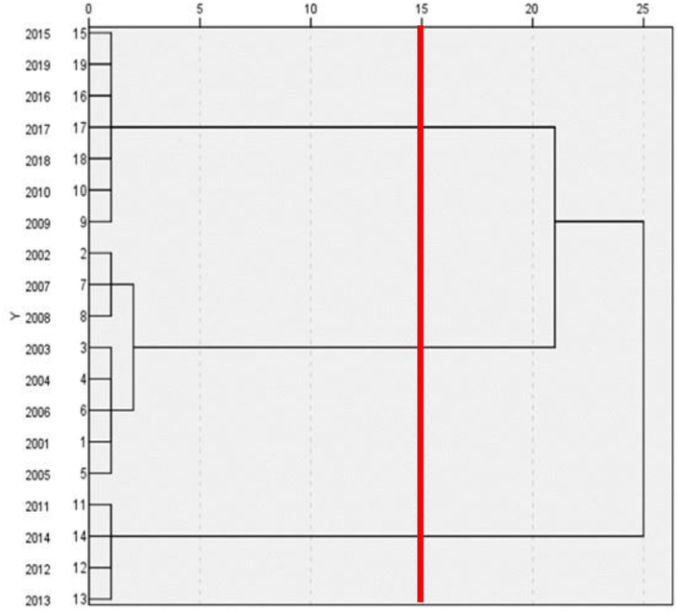
Figure 1: Results of cluster analysis for years.
METHODS
In the present study, 249 manzai acts performed by 182 duos were used for the investigation. They were performed in the final rounds in M-1 Grand Prix and THE MANZAI throughout 2001-2019. For analyzing manzai acts, 30 categories and 174 items were prepared while referring Iyama (2007). The 30 categories included style, manner, and verbal expression of Tsukkomi, for example, and the category of manner of Tsukkomi included the items of ignore, parroting, cool attitude, persuading, prompt reply, and so on. Num- bers of appearance of each item in the manzai acts were counted for each year, and a 19 × 174 cross tabulation table was constructed. The table was used for correspondence analysis and cluster analysis (Benzécri, 1992).
RESULTS AND DISCUSSION
The results of the correspondence analysis of the cross-tabulation table sho- wed that a two-dimensional solution illustrated the relationships in the table with a cumulative contribution ratio of 36 %. Each year was plotted on the two-dimensional plane, then cluster analysis was performed for the plots with Ward’s method. The results of the cluster analysis showed that the plots were divided into three periods; 2001–2008, 2011–2014, and, 2009, 2010 and
106 Ino and Yamada
Figure 2: Plots of the years.Figure 3: Plots of the manners and styles of Tsukkomi.
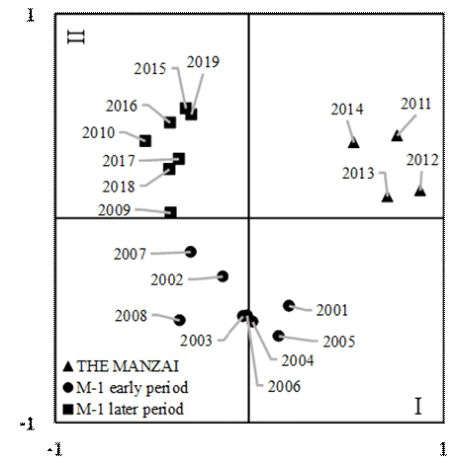
2015–2019. The three clusters almost coincided with the early period of M- 1 Grand Prix, the period of THE MANZAI and the late period of M-1 Grand Prix, respectively. Figure 1 shows the dendrogram of the cluster analysis and Figure 2 shows the plots of the years within the range of ±1. Figure 2 shows
Chronicling Changes of Manzai Acts in M-1 Grand Prix and The Manzai 107
Figure 4: Plots of the manners and styles of Boke.Figure 5: Plots of the structure of manzai acts.
that the first axis divides M-1 Grand Prix and THE MANZAI, and the second axis divides the early period and the later period.
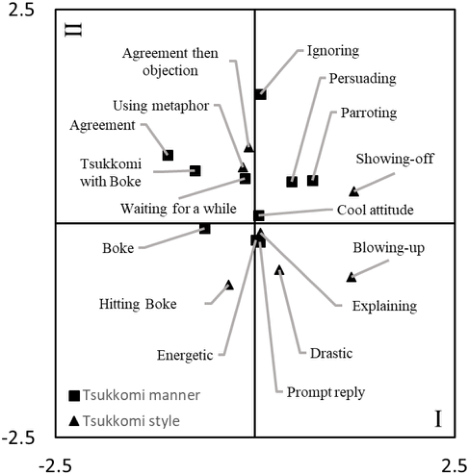
Figure 3 shows the plots of the manners and styles of Tsukkomi within the range of ±2.5. Comparing the plots of the manners of Tsukkomi in Figure 3 with the plots of years in Figure 2 shows that traditional comedic manners of
108 Ino and Yamada
energetic and prompt reply are placed in the area of the early period of M-1 Grand Prix, whereas more contemporary manners of persuading and parro- ting are placed in The MANZAI area. For the late period of M-1 Grand Prix, more technical manners of waiting for a while, and agreement are placed. This implies that the manner of Tsukkomi has come to developed technically. The plots of the styles of Tsukkomi show basic styles of drastic tsukkomi and hitting Boke’s head or body are plotted for the early period of M-1 Grand Prix, whereas a technical style of showing-off is placed for THE MANZAI and technical styles of using-metaphor and agreement are placed for the late period of M-1 Grand Prix. This implies that Tsukkomi looked on Boke as an enemy in early period, but Tsukkomi developed their style to collaborate with Boke, recently. The style of Tsukkomi also has come to develop technically.
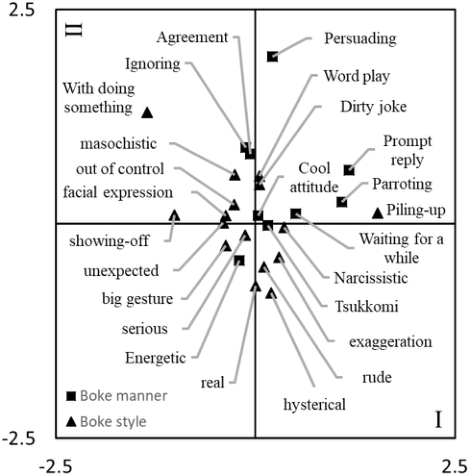
Figure 4 shows the plots of the manners and styles of Boke. Figure 4 shows that a traditional manner of energetic is placed alone in the early period, whereas various manners are placed for the late period. Moreover, powerful styles of Boke, e.g., hysterical boke and boke with big gestures placed for the early period, whereas various technical styles are placed for the late period. These results imply that Boke also looked on Tsukkomi as enemies in the early period, but they developed their manners and styles, collaborating with Tsukkomi, in the late period.
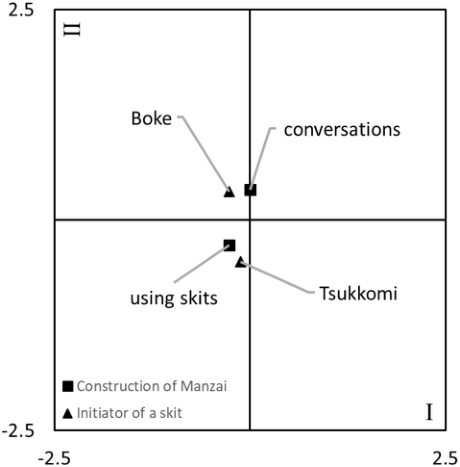
Finally, Figure 5 shows the plots of the construction of manzai acts and the plots of which of the duo starts a section. Figure 5 shows that manzai duo tended to use skits and the duos played the roles in the skits in the early period, but they tend to have conversations as themselves, in the late period. Moreover, Tsukkomi tended to initiates a section the early period, but more recently, the Boke also initiates a section, recently.
CONCLUSION
In the present study, 249 manzai acts performed in M-1 Grand Prix and The MANZAI in last two decades were investigated. The results of correspon- dence analysis and cluster analysis clarified how Tsukkomi and Boke both developed their manners and styles throughout the last two decades. The results shown in the present study must contribute to clarify our kansei of fun.
REFERENCES
Benzécri, J.-P. (1992). Correspondence analysis handbook. New York: Marcel Dekker. Hanawa, N. in Knights. (2019). Iiwake: Kanto Geinin wa naze M-1 de katenainoka?
(An excuse: Why entertainers in Kanto area can’t win M-1). Tokyo: Shueisha. Iyama, H. (2007). Waraino houteishiki: Anoneta wa naze ukerunoka? (An equation of laughing: Why could that story be created?). Tokyo: Kagaku-Dojin. Takeshi, B. in Two Beats. (March 21, 2020) “Takeshi no korega hontouno
Nihon Geinou-shi: Tsukkomi This is the true history of Japanese entertainment: Tsukkomi. NHK BS Premium, broadcasted at 19:30–21:00.
LISTED IN THE AHFE DIGITAL BOOKSTORE CATALOGUE
Explore the complete digital volume
Kansei Engineering
Read this individual research paper free through the original publisher, or explore the full digital proceedings book.
ISBN 978-1-958651-16-2
Explore this ISBN in the AHFE Bookstore ↗Listed in the July 2026 bookstore catalogue; search by ISBN to confirm current availability · Digital book purchase optional