Kyoji Hamazaki, Masashi Yamada (2025). Impressions of the Face of Female Character Produced in Computer Graphics. In: Affective and Pleasurable Design. AHFE Open Access, vol. 164, pp. 255–259. https://doi.org/10.54941/ahfe1006082
In recent decades, Japanese video games and anime, called Cool Japan Content, became very popular in the world. In the content, cute female characters, called "moe" or "kawaii" characters, frequently appear as well as beautiful matured females. The cases where the characters are produced using Computer Graphics (CG) increased recently. Especially, the facial parts are important to determine the impressions of the characters. Using CG models, it is easy to change the parameters of the parts of the face and they allow production of various faces including the faces with extreme balances. Many researchers investigated the relations between the parts of the face and the impressions in terms of real faces, but the perception of the faces was rarely investigated in terms of CG models. A study determined the best proportions of width to the length of the face, the eye opening to the width of the eye and so on, for the female faces which was perceived as "moe" and "beautiful" respectively, using a CG model. The results showed that the face of the female characters with the best "moe" and "beautiful" proportions looked young girl and matured woman, respectively. Another study showed that the angle of the eyes and eyebrows is an important factor for determining the impressions of the female characters. In the present study, two CG models; VRoid and Phantasy Star Online 2 New Genesis (PSO2) were used. VRoid allows to designate female characters in anime-like touch, while PSO2 designate realistic characters. The angle of the eyes and eyebrows were set at three levels; slanted, intermediate and droopy eyes. Two types of hair styles (long hair and short hair) were prepared. The other features were also set at three levels; young girl (moe), intermediate and matured (beautiful) according the results of the previous study. In total 36 stimuli were synthesized and presented on a computer display. Ten participants watched each stimulus and were requested to rate their impressions using semantic differential method with 21 semantic scales. The results of the factor analysis showed that the impressions of the faces were spanned by there factors; activity, potency and evaluation. The activity was largely affected by the maturity: The faces with the parameters of the young girls were perceived as active and cheerful and the faces with the parameters of the matured beautiful females were perceived as inactive and gloomy. The potency was largely affected by the angles od the eyes and eye brows: the faces with slanted eyes and eyebrows were perceived as powerful and droopy eyes and eyebrows were perceived as powerless. The evaluation was almost determined by the CG model: the anime-like touch faces produced by VRoid were perceived as pleasant and beautiful, whereas the realistic faces by PSO2 were perceived as unpleasant and ugly. The parameters used in the present study may be valid for the anime-touch faces.
In recent decades, Japanese video games and anime, called Cool Japan Content, became very popular in the world. In the content, cute female characters, called “moe” or “kawaii” characters, frequently appear as well as beautiful mature females. Recently, the cases where the characters are produced using Computer Graphics (CG) increased. Especially, the facial parts are important to determine the impressions of the characters. Using CG models, it is easy to change the parameters of the parts of the face. The models allow production of various faces including the faces with extreme balances. Many researchers investigated the relations between the parts of the face and the impressions in terms of real faces, but the perception of the faces was rarely investigated in terms of CG models. Wada et al. (2014) determined the best proportions of the width to the length of the face, the width between the two cheeks to the length of the face, the width of the eye to the width of the face and the eye opening to the width of the eye, for the female faces which was perceived as “moe” and “beautiful” respectively, using a CG model. The results showed that the face of the female characters with the best “moe” and “beautiful” proportions looked like young girl and mature woman, respectively. Tachi (2020) showed that the angle of the eyes and
eyebrows is an important factor for determining the impressions of the female characters. In the present study, various female faces with different maturity levels and different levels of angle of eyes and eyebrows were synthesized in two CG models, and the impressions of them were rated. Then, the relations between the factors of the face and the impressions were investigated.
EXPERIMENTAL METHOD In the present study, two CG models, VRoid and Phantasy Star Online 2 New Genesis (PSO2) were used for synthesizing the female faces. The two models produce quite different textures of the faces: VRoid allows to designate female characters in anime-touch, while PSO2 designate realistic female faces. The angle of the eyes and eyebrows were set at three levels; slanted, intermediate or droopy eyes, according to the study of Tachi (2020). The maturity was set at two levels; young girl intermediate or mature female: Young girl had the best proportions for “moe” and mature female had the best proportions for “beautiful”, according to the study of Wada et al. (2014). The intermediate level had just the intermediate proportions between the young girl and the mature female. The hair style was set at two levels; long hair or short hair. The color of the skin was fixed at Mongoloid type, the hair and irises were colored black, and the other parameters were fixed at the pre-set values for a female character in the CG models. In these way, two textures X three angles of eyes and eyebrows X three maturities X two hair styles = 36 faces synthesized. The 36 synthesized female faces were used as stimuli in the perceptual experiment. Each of the stimuli was presented on the screen of Eizo Flex Scan EV2785. Ten participants from Kanazawa Institute of Technology watched the stimulus and rated impressions for the stimulus using 21 bipolar seven-step SD (semantic differential) scales listed in Table 1. The experiment was conducted in a dark room. The order of the stimuli was randomized for each participant to minimize the effects of the order.
RESULTS AND DISCUSSION
The rated scores were averaged over the participants, and factor analysis with the principal factor method and varimax rotation was performed using the mean scores. The results of the factor analysis showed three factors with the cumulative contribution rate of 89 %. Table 1 shows the factor loadings. The three factors were labelled as activity, potency and evaluation, respectively, after the scales which showed large loadings for the factors.
Each stimulus was plotted on the three-dimensional space spanned by activity, potency and evaluation factors. The plots showed that the three perceptual factors were correlated with the different factors of construction of the face, respectively.
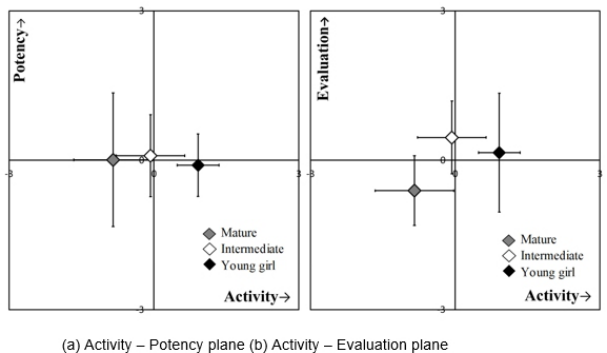
The stimuli were divided into three levels of the maturity; mature female, intermediate and young girl. Figure 1 show the centroids for the different levels of the maturity with standard deviations. Figure 1 shows that the activity is largely determined by the maturity: A mature female was perceived
Impressions of Face of Female Character Produced in Computer Graphics 257
as inactive and a young girl was perceived as active. A female with an intermediate level of maturity showed an intermediate level of activity.
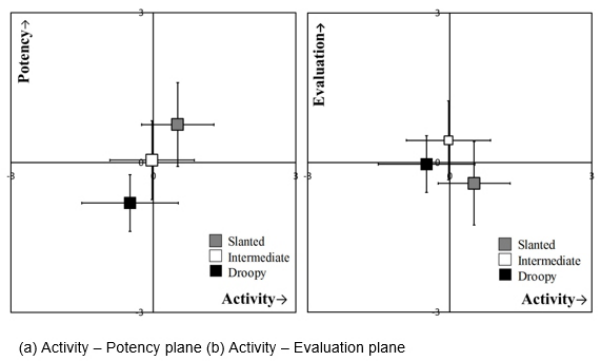
Then, the stimuli were divided into three levels of the angles of eyes and eyebrows. Figure 2 shows the centroids for different levels of the angle with standard deviations. Figure 2 shows that the potency is largely determined by the angle: A stimulus with slanted eyes and eyebrows was perceived as powerful and a stimulus with droopy eyes and eyebrows was perceived as powerless. A stimulus in the intermediate level showed an intermediate level of potency.
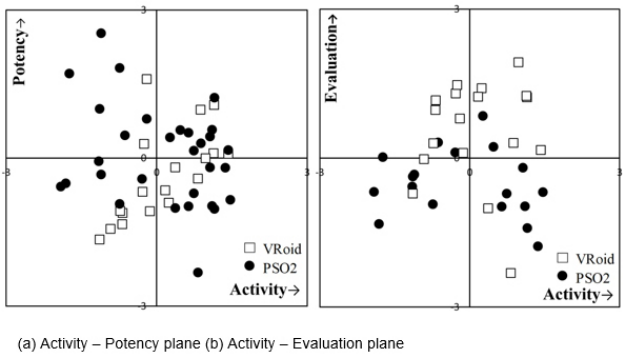
Figure 3 shows the impressions for the stimuli produced by VRoid and PSO2 respectively, with different marks. The distributions in Figure 3 show that the evaluation factor is largely affected by the texture: A female face produced by VRoid tends to be perceived as pleasant and a face produced by PSO2 tends to be unpleasant.
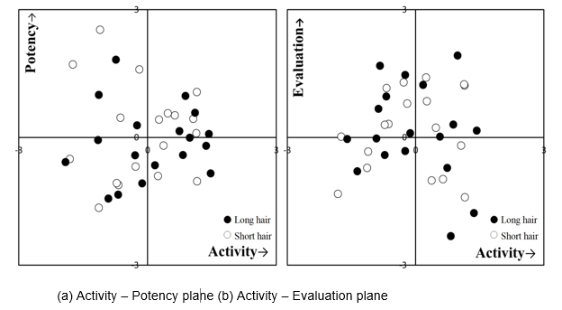
Figure 4 shows the impressions for the stimuli with long hair and short hair respectively. Fig. 4 show that the plots for long hair and short hair both distribute over wide areas in the impression space. This suggests that the hairstyle is not the important factor for determining any perceptual factors.
Table 1: Semantic differential scales and their factor loadings.
Figure 1: Impressions for the different levels of maturity of the character.Figure 2: Impressions for different levels of angle of eyes and eyebrows.Figure 3: Impressions for the different textures produced by two CG models.
Impressions of Face of Female Character Produced in Computer Graphics 259
Figure 4: Impressions for females with long hair and short hair.
CONCLUSION
In the present study, various faces of female characters were synthesized using two CG models. The faces were constructed by four factors; maturity of the character, angle of eyes and eyebrows, texture of the face and hairstyle. Ten participants rated the impressions of the synthesized faces, using SD method. The results of the factor analysis showed three perceptual factors; activity, potency and evaluation. The three perceptual factors were largely correlated with different factors of constructing the face: The activity was largely determined by the maturity and the potency was largely determined by the angle of eye and eyebrows, respectively. The evaluation was largely affected by the texture. The hairstyle did not affect any perceptual factor largely.
REFERENCES
Y. Wada, R. Yoneda, S. Kanamori and M. Yamada. A perceptual study on face design for MOE characters in Cool Japan contents, Proceedings of International Conference of Kansei Engineering and Emotion Research 35–41 (2014). Y. Tachi. A Perceptual Study on the Components which Construct Moe Characters
(In-Japanese), Master’s thesis, Graduate School of Engineering, Kanazawa Institute of Technology, (2020).
LISTED IN THE AHFE DIGITAL BOOKSTORE CATALOGUE
Explore the complete digital volume
Affective and Pleasurable Design
Read this individual research paper free through the original publisher, or explore the full digital proceedings book.
ISBN 978-1-964867-40-3
Explore this ISBN in the AHFE Bookstore ↗Listed in the July 2026 bookstore catalogue; search by ISBN to confirm current availability · Digital book purchase optional