Han Jiang, Yan Yixing, Kai Zhang, Xiaomei Nie, Yuhan Dong, Xing Sun (2025). Gamified Emotional Evaluation of Virtual Architectural Spaces:The G-SOR Framework and “Lost In Reverie”. In: Affective and Pleasurable Design. AHFE Open Access, vol. 164, pp. 106–116. https://doi.org/10.54941/ahfe1006065
With the rapid development of metaverse technology, virtual architectural spaces are playing an increasingly important role in digital experiences. However, existing emotional testing methods for virtual spaces face challenges such as insufficient immersion, lack of participant motivation, and limitations of single-variable research. This study proposes the G-SOR (Gamified Stimulus-Organism-Response) framework, which integrates environmental psychology's SOR model with game design theory, and develops the “Lost In Reverie”game testing platform based on this framework. The research first defined an emotional parameter library for four categories of spatial elements—geometry, lighting, material, and color—through a preliminary experiment (N=31). The game platform designed two core systems based on the G-SOR framework: a spatial parameter system (integrating parameterized definitions and construction methods for single elements) and a spatial immersion system (including task-driven exploration, visual illusion puzzle mechanisms, and emotional data collection). Comparative experiments (N=63) showed that, compared to traditional methods, the gamified approach significantly improved spatial immersion (28.5%, p<0.001) and testing motivation (114.3%, p<0.001). This study provides a new paradigm for virtual architectural space emotional research that combines entertainment with scientific rigor, while offering systematic methodology and parametric guidance for emotionally oriented design practice.
With the development of metaverse technology, virtual architectural spaces are evolving from visual presentations to emotional interactive platforms. World Health Organization reports indicate that 34% of adults globally experience environmental anxiety symptoms, highlighting the urgency of studying the emotional impact of virtual spaces. Mehrabian’s “environment- emotion” theory confirms that spatial elements can influence human emotions (Mehrabian and Russell, 1974), but the combined effects of multimodal elements in virtual environments have not been fully explored.
Current emotional research in virtual spaces faces three major limitations: fragmented single-element studies (neglecting interactions between elements),
Gamified Emotional Evaluation of Virtual Architectural Spaces 107
insufficient immersion due to static space navigation, and lack of participant motivation affecting data quality. Gamified methods, by integrating task- driven exploration, interactive feedback, and emotional measurement, provide a new approach to overcome these challenges.
This research proposes a gamified paradigm for measuring spatial emotions, with significance in: theoretically exploring non-linear coupling effects of multiple spatial elements; methodologically combining scientific measurement with immersive experience; and practically providing parametric guidance for emotion-based virtual environment design in the metaverse era.
THEORETICAL FOUNDATIONS OF SPATIAL EMOTION TESTING GAMES Emotional research in virtual architectural spaces is founded on multidisciplinary theoretical bases. The SOR model from environmental psychology (Mehrabian and Russell, 1974) describes the process by which environmental stimuli (S) guide behavioral responses (R) through internal emotional states (O), providing a framework for understanding how architectural elements affect user experience. Russell’s (1980) circumplex model of affect parameterizes emotions into two dimensions: valence (pleasure-displeasure) and arousal (activation-inhibition), enabling precise measurement of complex emotions.
In game design, the MDA framework (Hunicke et al., 2004) decomposes games into three levels: mechanics (rule systems), dynamics (interaction effects), and aesthetics (emotional experiences), emphasizing that designers approach from mechanics, while users first experience aesthetics. Csikszentmihalyi’s flow theory describes the immersive state produced when challenges and skills are balanced, goals are clear, and feedback is immediate.
In emotional research on virtual architectural space elements, empirical evidence demonstrates the unique influence of various elements: Geometry: Shemesh et al. (2021) discovered through EEG research that curved spaces evoke higher pleasure, while large spaces trigger positive emotions;
Lighting: Bogucka et al. (2020) confirmed that combining direct and indirect lighting enhances pleasure, while standard lighting intensity significantly reduces stress; Color: Wilms and Oberfeld (2018) found that high-saturation warm colors enhance arousal, while cool colors promote relaxation;
Materials: Natural materials like wood have been proven to reduce stress and enhance positive emotions (Bower et al., 2019).
However, existing research has obvious limitations. Methodologically, most studies employ static observation and scale assessment, with participants in passive states, making it difficult to capture authentic dynamic emotions. Content-wise, many focus on single elements, neglecting interactions between elements.
Gamified design offers new pathways to overcome these limitations. Studies have shown that VR experiences incorporating narratives can extend
user participation time; gamified mechanisms significantly enhance spatial perception and emotional memory through immediate feedback.
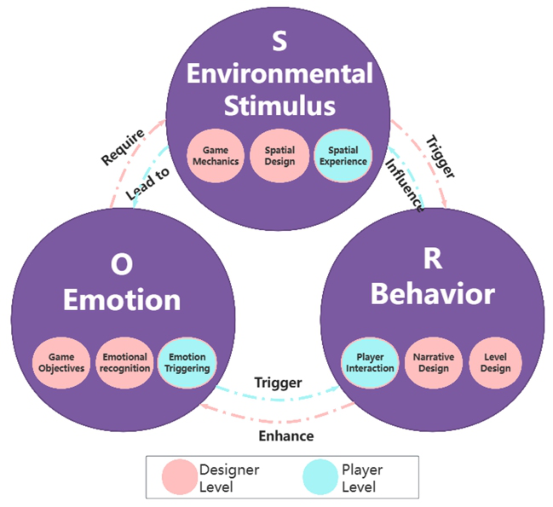
G-SOR (GAMIFIED STIMULUS-ORGANISM-RESPONSE) FRAMEWORK DEVELOPMENT The G-SOR (see Figure 1) framework proposed in this research is an innovative extension of the traditional SOR model from environmental psychology, aiming to address the insufficient immersion and lack of participant motivation in virtual architectural space emotional testing.
Figure 1: G-SOR framework construction based on SOR and MDA theories.
This framework integrates three dimensions: environmental stimuli (S), participant emotional responses (O), and participant behaviors (R), connecting them organically through game mechanics to form a closed-loop system Unlike the linear structure of the traditional SOR model, the G-SOR framework introduces a feedback loop mechanism where participants’ behavioral responses influence the presentation of environmental stimuli, creating a dynamic adaptive testing system that more closely resembles natural human-space interaction patterns in real environments (Paes et al., 2017). The G-SOR framework integrates Mehrabian and Russell’s (1974) SOR model with Hunicke et al.’s (2004) MDA (Mechanics-Dynamics-Aesthetics) game design theory. In the integration mechanism, the framework transforms environmental stimuli (S) from the SOR model into a gamified spatial parameter system; internal states (O) into an emotional response system
Gamified Emotional Evaluation of Virtual Architectural Spaces 109
integrated into the game flow; and behavioral responses (R) into a task- driven game interaction system.
The G-SOR framework consists of four core systems:
1) Spatial Parameter System: Controls elements of virtual architectural spaces including geometry, lighting, materials, and colors; 2) Emotional Measurement System: Naturally blends emotional scales with game tasks, making measurement an organic component of the game; 3) Interactive Behavior System: Guides participants to interact with spaces through mechanisms such as visual illusion puzzles, while collecting rich behavioral data; 4) Data Integration System: Integrates subjective emotional data with objective behavioral data, establishing multi-dimensional mapping relationships between emotions, spaces, and behaviors.
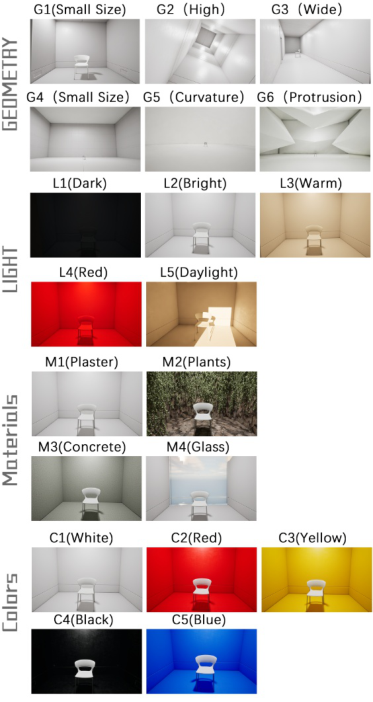
RESEARCH METHODOLOGY To systematically understand how various elements of virtual architectural spaces affect emotions, this study first constructed an emotional parameter library through a preliminary experiment. The experiment recruited 31 participants (15 males, 16 females; aged 18–29 years, average 23.6 years), who experienced and evaluated 19 single-element spaces (including 6 geometry types, 5 lighting conditions, 4 materials, and 4 colors) using traditional VE testing methods (see Figure 2). Measurements employed a modified PANAS scale, focusing on four core emotional dimensions: happiness, unhappiness, relaxation, and tension, rated on a 5-point Likert scale (1=slight or none, 5=very strong).
The experiment was conducted in a temperature and humidity controlled laboratory (22±1
C, humidity 45%–55%), using a 27-inch 4K calibrated display (Dell UP2720Q) to present VE scenes, with participants using keyboard and mouse to control viewpoint and explore spaces. Each participant first spent 5 minutes in a neutral environment to establish an emotional baseline, then successively experienced 19 single-element spaces, completing the scale rating after 60 seconds of experience in each space.
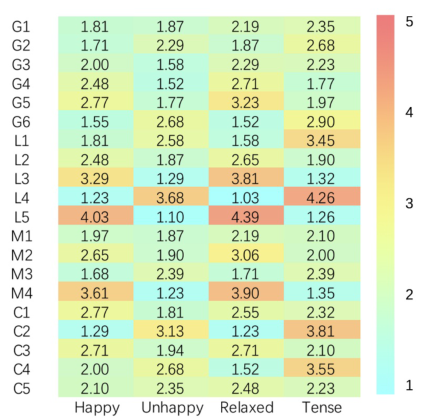
Emotional heat maps were created through descriptive statistics (see Figure 3), allowing analysis of emotions corresponding to each spatial form.
Lighting elements demonstrated the strongest emotional regulation capability, producing significant effects across all emotional dimensions (F = 32.44–127.70, p<0.001). Daylight (L5) produced the strongest positive emotional reactions, scoring highest in happiness (M = 4.03) and relaxation (M = 4.39) dimensions, while scoring lowest in unhappiness (M = 1.10) and tension (M = 1.26). Warm light (L3) similarly evoked strong positive emotions, scoring high in happiness (M = 3.29) and relaxation (M = 3.81) dimensions. In contrast, red light (L4) triggered the highest levels of tension (M = 4.26) and unhappiness (M = 3.68), exhibiting overall strong negative emotional characteristics. Post-hoc tests revealed clear hierarchical differences in emotional effects between different lighting types (L5 > L3 > L2 > L1 > L4).
Gamified Emotional Evaluation of Virtual Architectural Spaces 111
Material elements were the second most important factor influencing emotions (F = 6.97–32.40, p<0.001). The study found that glass material (M4) performed best in positive emotional dimensions, with happiness (M = 3.61) and relaxation (M = 3.90) scores significantly higher than other materials; while scoring lowest in tension (M = 1.35) and unhappiness (M = 1.23) dimensions. Plant material (M2) also exhibited positive emotional characteristics, particularly outstanding in the relaxation dimension (M = 3.06). Concrete material (M3) dominated in negative emotional dimensions, with unhappiness scores (M = 2.39) higher than other materials. Post-hoc tests showed that materials’ influence on emotions presented a clear pattern: M4 > M2 > M1 > M3.
Color elements, though overall less effective than lighting and materials, still showed significant influence in specific emotional dimensions (F = 5.84–19.47, p<0.001). White (C1) and yellow (C3) performed prominently in positive emotional dimensions, with high happiness scores (C1: M = 2.77; C3: M = 2.71) and relaxation scores (C1: M = 2.55; C3: M = 2.71). Red (C2) evoked the strongest feelings of tension (M = 3.81) and unhappiness (M = 3.13), while producing the lowest relaxation feeling (M = 1.23). Post-hoc tests showed that color’s emotional effects presented an opposing pattern: C1, C3 > C5 > C4 > C2.
Geometry elements had the weakest overall effect, but still had important influences in certain emotional dimensions (F = 4.18–9.74, p<0.001). High- curvature spaces (G5) performed best in positive emotional dimensions, scoring highest in happiness (M = 2.77) and also highest in relaxation (M = 3.23). Large-sized spaces (G4) similarly exhibited positive emotional characteristics, with relatively high relaxation scores (M = 2.71). High- protrusion forms (G6) evoked stronger negative emotions, with both unhappiness (M = 2.68) and tension (M = 2.90) scoring relatively high. Post- hoc tests indicated that the emotional effect pattern for forms was: G5 > G4 > G3 > G2, G1 > G6.
Based on the preliminary experiment results, we established a structured emotional parameter library of spatial elements for subsequent game design: Positive emotional spatial elements: Daylight (L5) and warm light (L3), glass material (M4) and plant material (M2), white (C1) and yellow (C3), high-curvature geometry (G5) and large-sized spaces (G4).
Negative emotional spatial elements: Red light (L4) and dark light (L1), concrete material (M3), red (C2) and black (C4), high-protrusion form (G6).
Neutral emotional spatial elements: Medium brightness lighting (L2), plaster material (M1), blue (C5), medium-proportioned forms (G1, G2).
To further quantify the relative influence of different spatial categories, we conducted One-way Repeated Measures ANOVA for each category (see Table 1).
Table 1: Results of one-way RM ANOVA test analysis on space categories.
Table available in the original PDF paper.
Space Categories F p η2 Geometry 4.18–9.74 p<0.01 0.26–0.40 Lighting 32.44–127.7 p<0.01 0.54–0.78 Material 6.97–32.4 p<0.01 0.19–0.59 Color 5.84–19.47 p<0.01 0.13–0.44
The results confirmed that all categories significantly affected emotional dimensions (p < 0.01), with varying effect sizes (where η2 = 0.01 is small, η2 = 0.06 medium, and η2 = 0.14 large). Lighting showed the strongest influence (η2 = 0.54 – 0.78), followed by materials (η2 = 0.19 – 0.59), colors (η2 = 0.13 – 0.44), and geometry (η2 = 0.26 – 0.40).
These findings clearly reveal the influence of spatial elements on emotions, providing scientific basis for element design in virtual environments. Our emotional parameter library was developed based on these discoveries, laying the foundation for the subsequent development of the gamified testing platform.
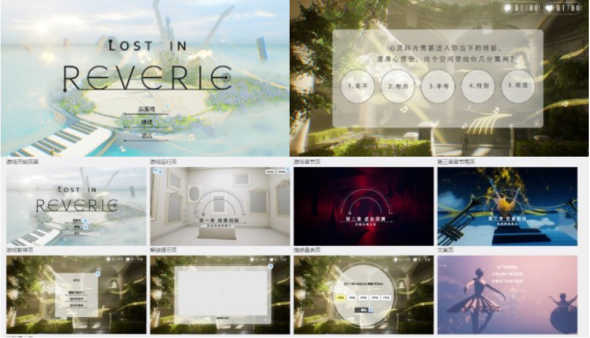
Development of Gamified Testing Platform Based on the G-SOR framework, this study developed the “Lost In Reverie” game testing platform (see Figure 4), integrating emotional testing with gaming experience. The game design follows three principles: “space experience priority,” “imperceptible measurement,” and “task-driven exploration.” The core mechanism centers on “visual illusion puzzles,” including “false-to-true” (2D images transforming into 3D objects at specific viewpoints), “true-to-false” (physical objects becoming 2D illusions), and “perspective reconstruction” (spatial elements forming new meaningful structures), encouraging participants to observe spaces from multiple angles, enhancing environmental perception and interaction.
Figure 4: Screenshots from “Lost In Reverie” game.
Gamified Emotional Evaluation of Virtual Architectural Spaces 113
The spatial parameter system, based on the emotional parameter library, employs controlled variable methods to construct single-element spaces and orthogonal design methods to create multi-element test spaces. Technical implementation uses Blender parametric modeling and Unreal Engine 5 real- time rendering, with key technologies including geometry parameterization, Lumen global illumination, PBR material systems, and calibrated color management. Multi-element spaces are divided into three groups: L1 series (geometry variables), L2 series (dark and red light), and L3 series (daylight with various materials), forming a progressive emotional experience sequence. The game consists of three main levels: Memory Corridor (stable emotions) →Void Abyss (negative emotions) →Spectrum Theater (positive emotions), with each level containing six multi-element spaces. Visual illusion puzzles are achieved through camera position and preset viewpoint calculations, creating spatial transformation effects. The system triggers transformation events when the participant’s viewpoint enters a specific range (distance error <0.8m, angle deviation <5
), ensuring participants experience different spatial environments in an immersive state.
Gamified emotional measurement is implemented by transforming the PANAS scale into an “energy resonance” mechanism, automatically recording behavioral data such as dwell time and navigation paths, and providing real-time feedback to enhance integration. Technically, an Unreal Engine blueprint system builds the data collection framework, standardizing recording of four-dimensional emotional values (happiness, unhappiness, relaxation, tension) and binding them with timestamps, spatial coordinates, and behavioral data to form structured data units. This multi-level design transforms rigorous emotional measurement into a natural gaming experience, providing an innovative tool for researching emotions in multi- element virtual architectural spaces.
Comparative Experiment Design This study employed a between-group comparative experiment to validate the effectiveness of the gamified testing method, selecting 63 valid samples from potential participants (32 in the experimental group, 31 in the control group). There were no significant differences in baseline characteristics such as gender, age, and professional background between the two groups (p>0.05). The experiment was conducted in a laboratory with controlled environment temperature (22±1
C), humidity (45%–55%), and noise level (<35dB). The experimental group used Pico 4 Pro headsets (4320×2160 pixels) to experience the “Lost In Reverie”game, exploring multi-element virtual architectural spaces; the control group used 27-inch 4K displays to experience single-element spaces.
Data collection integrated three assessment tools: modified PANAS scale (emotional response), IPQ scale (spatial immersion), and IMI scale (testing motivation). Game behavioral data were simultaneously recorded, and qualitative information was supplemented through semi-structured interviews. Data analysis primarily employed Mann-Whitney U tests (between-group comparisons), repeated measures ANOVA (element effects),
and paired-sample t-tests (element coupling), while interview data underwent frequency analysis and thematic coding, forming a multi-dimensional assessment system.
RESULTS AND DISCUSSION
The comparative experiment confirmed that the gamified testing method significantly improved emotional research effectiveness in virtual architectural spaces. Compared to traditional methods, the gamified VR approach achieved breakthroughs in three core dimensions.
In terms of spatial immersion (see Table 2), the experimental group showed a 28.5% increase in total IPQ scale scores (p<0.001, Cohen’s d = 1.88), with large effect sizes across spatial presence, involvement, and perceived realism. Participants more frequently described their experience as “immersive” (+178%), “realistic” (+152%), and “interactive” (+205%). This enhanced immersion resulted from three key features: visual illusion puzzles, first-person VR interaction, and task-driven design. Behavioral data showed participants spent 52.7% more time in high emotional intensity spaces (148.6s) than in neutral spaces (97.3s).
Table 2: Results of Mann-Whitney U test analysis on spatial immersion.
Table available in the original PDF paper.
Variable Group N SD U p Cohen’s d Spatial Presence Control 31 1.427 703 p<0.01 0.732 Experimental 32 1.335 Involvement Control 31 1.877 145 p<0.001 1.518 Experimental 32 1.93 Realism Control 31 3.059 159 p<0.001 1.433 Experimental 32 2.356
Testing motivation improvements were even more pronounced (see Table 3), with the experimental group showing increases in interest/enjoyment (114.3%, p<0.001, Cohen’s d = 2.15), autonomy (66.7%), and perceived value (100%) on the IMI scale. These improvements stemmed from gamified rating tasks, narrative frameworks, and immediate feedback systems. Interview data revealed 92.7% of participants found “the puzzle-solving process particularly engaging” and 87.5% “wanted to know what the next space would look like.”
Table 3: Results of Mann-Whitney U test analysis on testing motivation.
Table available in the original PDF paper.
Variable Group N SD U p Cohen’s d Interest/Enjoyment Control 31 3.534 77.5 p<0.001 2.153 Experimental 32 1.827 Autonomy Control 31 2.063 103 p<0.001 2.045 Experimental 32 1.417 Value Control 31 2.406 96.5 p<0.001 1.965 Experimental 32 1.224
Emotional data quality also improved: the experimental group achieved higher scale completion rates (98.4% vs. 89.6%), better internal consistency
Gamified Emotional Evaluation of Virtual Architectural Spaces 115
(α = 0.87 vs. 0.76), and stronger correlation between emotional responses and behavioral data (r = 0.76, p < 0.001).
The G-SOR framework successfully integrated environmental psychology with game design theory, creating a testing paradigm combining scientific rigor with interactivity. The research revealed both the emotional influence hierarchy of spatial elements (lighting > material > color > geometry) and three element coupling modes, providing parametric guidance for metaverse environment design.
Despite these achievements, this study has sample limitations. Future research should explore physiological mechanisms using neuroscience methods, expand population and cultural ranges, develop multimodal data collection systems, and establish AI-based adaptive space generation.
CONCLUSION
This study systematically explored the influence mechanisms of multiple elements in virtual architectural spaces on emotions by constructing the G-SOR gamified emotional testing framework and developing the “Lost In Reverie”testing platform. Major contributions include clarifying the emotional weight hierarchy of spatial elements (lighting η2 = 0.59 > material η2 = 0.29 > color η2 = 0.24 > geometry η2 = 0.15, all representing large to very large effects as η2 > 0.14), providing priority guidance for virtual environment design. Additionally, the study validates the significant advantages of gamified testing methods in enhancing spatial immersion (+28.5%) and testing motivation (+114.3%), offering a new paradigm with greater ecological validity for virtual architectural space emotional research.
These findings enrich environmental psychology theory while providing practical guidance for virtual space design in the metaverse era. Research outcomes have broad application prospects, including virtual therapeutic environment design in healthcare, virtual classroom optimization in education and training, and emotional atmosphere creation in metaverse social spaces. Future research could explore physiological mechanisms using neuroscience methods, develop multimodal data collection systems, and create emotionally adaptive environments using AI technology.
This research lays a theoretical and practical foundation for creating emotionalized and personalized virtual spaces in the metaverse era, promoting more human-centered digital environment design.
ACKNOWLEDGMENT
This research is supported in part by Shenzhen Ubiquitous Data Enabling Key Lab under grant ZDSYS20220527171406015, and in part by the Center of Interactive Media Design and Technology. The corresponding author is Dr. Yuhan Dong.
REFERENCES
Bower, I., Tucker, R. and Enticott, P. G. (2019) ‘Impact of built environment design on emotion measured via neurophysiological correlates and subjective indicators: A systematic review’, Journal of Environmental Psychology, 66, 101344. Hunicke, R., LeBlanc, M. and Zubek, R. (2004) ‘MDA: A formal approach to game
design and game research’, Proceedings of the AAAI Workshop on Challenges in Game AI, San Jose, California, July 25–26. Palo Alto: AAAI Press, pp. 1–5. Mehrabian, A. and Russell, J. A. (1974) An approach to environmental psychology.
Cambridge: MIT Press. Paes, D., Arantes, E. and Irizarry, J. (2017) ‘Immersive environment for improving the understanding of architectural 3D models: Comparing user spatial perception between immersive and traditional virtual reality systems’, Automation in Construction, 84, pp. 292–303. Russell, J. A. (1980) ‘A circumplex model of affect’, Journal of Personality and Social
Psychology, 39(6), pp. 1161–1178. Shemesh, A., Leisman, G., Bar, M. and Grobman, Y. J. (2021) ‘A neurocognitive study of the emotional impact of geometrical criteria of architectural space’, Architectural Science Review, 64(4), pp. 394–407. Tuszy´nska-Bogucka, W., Kwiatkowski, B., Chmielewska, M., Dzie´nkowski, M.,
Kocki, W., Pieczykolan, A., Skulimowski, S., Bogucki, J. and Galkowski, D. (2020) ‘The effects of interior design on wellness – Eye tracking analysis in determining emotional experience of architectural space. A survey on a group of volunteers from the Lublin Region, Eastern Poland’, Annals of Agricultural and Environmental Medicine, 27(1), pp. 113–122. Wilms, L. and Oberfeld, D. (2018) ‘Color and emotion: Effects of hue, saturation, and brightness’, Psychological Research, 82(5), pp. 896–914.
LISTED IN THE AHFE DIGITAL BOOKSTORE CATALOGUE
Explore the complete digital volume
Affective and Pleasurable Design
Read this individual research paper free through the original publisher, or explore the full digital proceedings book.
ISBN 978-1-964867-40-3
Explore this ISBN in the AHFE Bookstore ↗Listed in the July 2026 bookstore catalogue; search by ISBN to confirm current availability · Digital book purchase optional