Skip to article
AHFE AHFE Discoveries AHFE International Open Access Journal
AHFE OPEN ACCESS OPEN ACCESS CONFERENCE PROCEEDINGS PAPER

Analog Intelligence Approach to Human Augmentation

Keio University, System Design and Management Research Institute, Tokyo, 108-0075, Japan ↗
Publication year
Digital Object Identifier10.54941/ahfe1006069

Abstract

Today's world is the Industrial Society, which the Industrial Revolution introduced. Thus, it is product-centric and we have been paying efforts to increase production efficiency and product performance. But as is well know, every world changes from one to another and the Industrial Society is coming to its end. Thus many issues emerged. One of the greatest problems is the excessive use of energy.We cannot sustain the current excessive consumption. Although AI is getting wide attention these days as its potential solution, but AI consumes a large amount of energy. So Ai is not a solution at all.But if we look at things from a different side, we can have a self- sustaining society and enjoy life. If we pay attention to process, instead of product, we can create a new process and we can enjoy creation.The product-centric Society is scientific and technology-based. It is quantitative and is based on interval scale. But if we turn our eyes to process, its creation is nothing other than engineering. The basic of engineering is strategy. We perceive the environments and situations and are motivated to determine what action to take to establish our world in the realworld. If one action satisfies our emotion, then that's fine. If not, we repeat the process until we satisfy our emotions.We must remember"emotion"and"motivation"come from the same Latin word "movere". What characterizes humans is its diversity. Our body builds and how we move our bodies vary widely from person to person.But if we can satisfy such individual motivations, then our life will be rich and full of dreams for the tuture. Although we are entering an aging society, if we can provide elderly people with the dreams or expectations for the future, their life will be rich and they will do their best to make their dreams come true.Wha tcharacterizes us,humans, is growth. We grow with time. If such society can be developed, elderly people can also enjoy growing. They can live for tomorrow.In this paper, MahalhanobisDistance-Pattern approach is developed and we discuss how it canvfulfill our growth needs and make our life rich and happy for everybody including elderly people. Mahalanobis, researcher of design of experiments, developed Mahalanobis Distance to remove outliers. Most study of human factors are carried out in Euclidean Space approach. But they are scientific and quantitative. In a word, this is tactics. But we should remember that as William Wordworth pointed out in his "My heart leaps up", our heart leaps up when we are truly impressed and motivated. We need to make a decision how to fully satisfy our emotion. This is an issue of heart so that analog intelligence approach is called for. In a word, we need strategic approach and we need toprioritize our decision. Mahalanobis Distance answers to this need.We used to study detecting emotion from face, but most approaches took too much time and did not produce good results. During these challenges, we realized that we can detect emotion of a character in a cartoon at once. So, we introduced cartoon face model and compared it with a human face model. This way, we succeeded in getting emotion from face at once.Mahalanobis Distance-Pattern Approach developed here put these two successes together to increase human augmentation.
INTRODUCTION

This paper points out the increasing importance of “Heart” in the next generation. We should remember remember that even if our brain stops working, death is not sentenced. The true death comes when our heart stops and blood does not flow.

Brain processes digital information. Digital information is dicrete and scientific. And it is finite and roproducible. Heart processes, on the other hand, analog information. Analog information is continuous and infinite. It is more related to engineering. Or in other words, it is pragmatic.

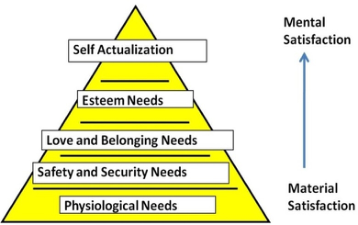
Maslow clarified human needs (Maslow, 1943), (See Figure 1).

Figure 1: Maslow’s hierarchy of human needs.
Original PDF Figure 1:

© 2025. Published by AHFE Open Access. All rights reserved. 142

Analog Intelligence Approach to Human Augmentation 143

Just as in other animals, humans tried to satisfy their materal needs first. But human need shifts to mental with time. And at the final stage, humans look for self-actualization.

But Maslow does not discriminate heart, brain and mind. Brain processes information which comes from outside, based on knowledge, which is the structured accumulation of personal experience. We should note that there are two kinds of knowledge. One is personal and the other is universal and generally applicable. The latter is associated with science and the former is associated with engineering. The former emphasizes the importance of process.

We are born to enjoy a challenge. It motivates us. In the latter, the result counts. How is important. What plays an important role in the former.

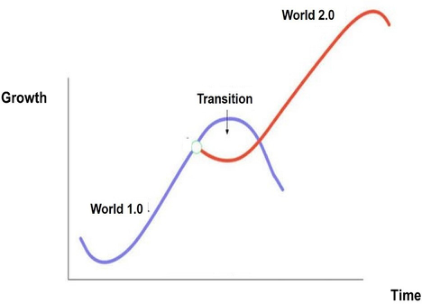
Mind is related to heart and brain. To describe it briefly, it is decision making. Both brain and heart work for decision making, although their goals are different. As everybody knows, our society changes from one to another with time (See Figure 2).

Figure 2: Society shifts with time.
Original PDF Figure 2:

The current society is the Industrial Society. It is introduced by the Industrial Revolution, which originated from our desire to relieve us from labor.

It succeeded from this standpoint. Many products have been developed to lessen our physical burdens. But this success was brought forth because changes were smooth yesterday so we could differentiate them and predict the future. But today, changes become very sharp. So we cannot differentiate them anymore. Tomorrow becomes unpredictable. In addition. The real world itself becomes unknown which we never experienced.

It is pointed out here that “Instinct” plays an important role to deal with this world.

HOW TO MAKE THE MOST OF INSTINCT Then how can we make the most of instinct to achieve this goal?

144 Fukuda

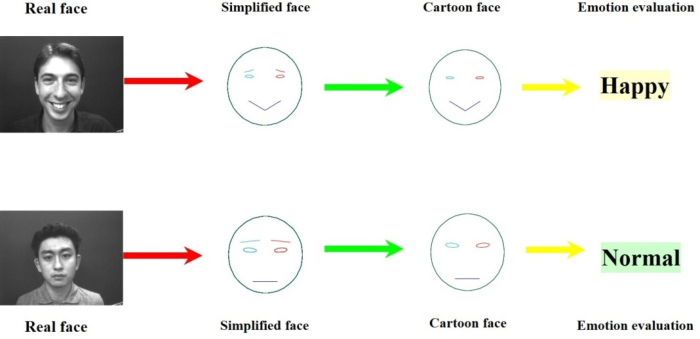
We developed an approach in our previous study of detecting emotion from face (See Fukuda et al., 2001), (See Figure 3).

Figure 3: Cartoon face model.
Original PDF Figure 3:

Mahalanobis Distance Interval Scale and Ordinal Scale In science, Euclidean Space is used. In other words, it is interval scale and orthonormaliy and distance with unit are required. But what we need to make the most of our distance is ordinal scale. We need to prioritize our decisions.

Mahalanobis Distance At first, we tried many image processing techniques. But they took too much time and did not produce satisfactory results. Then, during these challenges, Fukuda suddenly realized that when we see a cartoon, we can detect the emotions of their characters at once, even in black and white and even when only one cartoon is shown. We suddenly realized the importance of pattern. Therefore, at first, we tried many image processing techniques. But they took too much time and did not produce satisfactory results. Then, during these challenges, Fukuda suddenly realized that when we see a cartoon, we can detect the emotions of their characters at once, even in black and white and even when only one cartoon is shown. We suddenly realized the importance of pattern. Thereforewe introduced cartoon face mode based on patterns and comparing the real face with these patterns, we succeeded in detecting emotion from face without any time delay. Mahanabois developed “Mahalanobis Distance” to remove outliers from his design of experiment data sets (Malahanobis, 1936). This is ordinal scale. So, we can utilize it for prioritizing decisions.

Dynamic Pattern Matching But if we can introduce hierarchical cluster analysis, we can understand how they are different. In short, we can introduce meta-level difference between the learners. We can make it more comprehensive and we can use it as a means

Analog Intelligence Approach to Human Augmentation 145

of communication. It can be used for understanding customers expectations. We can detect what really catches their heart. Thus, we can use this approach for marketing in the broad sense.

FINAL REMARK ON HUMAN FACTORS There are two kinds of human factors. One is easily detected from outside.Thus, we can detect parameters and control them. The other is related to inside of our body such as muscles. We cannot understand how they work together. Thus, we need “Coordination” to make them work as you wish.

In fact, William Maslow made a poem “My heart leaps up when I behold a rainbow in the sky”. We cannot tell when the rainbow comes up and when we do see a rainbow, our “Heart”leaps up. It touches our “Heart”, not brain.

Once again. We should pay more attention to our “Hearts” when we discuss Human Factors.

As the current Industrial Society consumers too much energy, we cannot sustaChin it anymore. Even Ai consumes a lot of energy, so it does not solve the problem. We should pay more attention to our “Hearts” and make our life siimple to really enjoy life. Simple life, yet a great amount of enjoyment is what we need to consider as an increasingly important challenge in Human Factor.

REFERENCES

Kostov, Vlaho. Yanagisawa Hideyoshi. Johansson, Marttin. Fukuda Shuichi. (2001) JSME International Journal, Mechanical Systems, Machine Elements and Manufacturing, Volume 44, No. 2, pp. 515–526. Mahalanobis, Prasanta Chandra. (1936). On the Generalised Distance in Statistics.

The Indian Journal of Statistics. Volume 80, No. 1, pp. 1–7. Maslow, Abraham Harold. (1943). A Theory of Human Motivation, Psychological Review, Volume 50, No. 4, pp. 370–396.

Cover of the proceedings volume Affective and Pleasurable Design

Explore the complete digital volume

Affective and Pleasurable Design

Read this individual research paper free through the original publisher, or explore the full digital proceedings book.

ISBN 978-1-964867-40-3

Explore this ISBN in the AHFE Bookstore Listed in the July 2026 bookstore catalogue; search by ISBN to confirm current availability · Digital book purchase optional

Explore Related Research

Related research 8 matches

More papers from this volume

← Back to Research ExplorerBrowse the full library →