Rinka Yamaguchi, Masashi Yamada (2024). Impression Change of a Female Character in Illustration by Shadow. In: Human Factors in Virtual Environments and Game Design. AHFE Open Access, vol. 137, pp. 150–155. https://doi.org/10.54941/ahfe1004997
Recently, anime-touch illustrations became very popular as well as anime in Japan. In anime and anime-touch illustrations, shadows are used to express the emotions of characters and those which are not physically correct are frequently used. In the present study, it is examined that the impression changes of a female character by shadow expressions including the shadows physically incorrect. In the video game CUSTOM ORDER MAID 3D2, a player creates characters using 3D modeling. A female character with the simplest clothes was selected for the present study, and the shadows were produced with the 26 directions of the light sources. Then, these 3D pictures were traced as 2D illustrations. The physically incorrect shadows included the cases with the lights on the face, hair or eyes from a virtual source. Also, a stimulus with no shadow was prepared. In total 30 stimuli were prepared for a perceptual experiment. Twelve students of Kanazawa Institute of Technology participated in the experiment. Each participant sat on a chair in a darkroom and watched each stimulus presented on the display EIZO Flex Scan SX2462W. Then, the participant was requested to rate the impressions for the stimulus using 18 semantic differential scales. The rated scores were averaged and used for factor analysis. The results of the analysis showed that the impression space was spanned by friendliness, powerfulness and naturalness factors with the cumulative contribution ratio of 82.1%. The character was perceived as friendly when the shadow was produced with a light source set in front of the character. Contrarily, the character was perceived as not friendly when the light source was set behind the character.The friendliness may deeply correlate with the shadow on the face. The character became powerless when the light source was in the central position and powerful when the source was in the lateral positions. It is thought that the powerfulness correlates with the solidity of the character. The character was perceived as natural when the source was in foreground or background of the character. The naturalness may correlate with the shadow covering a part of the eyes. Among the physically incorrect shadow expressions, the stimulus with the eyes shined in the shadow was perceived as quite powerful and unnatural. The results of the present study will contribute to production of impressive illustrations and anime.
Recently, anime-touch illustrations became very popular as well as anime in Japan. In anime and anime-touch illustrations, shadows are used to express the emotions of characters and those which are not physically correct are frequently used. In the present study, it is examined that the impression changes of a female character by shadow expressions including the shadows physically incorrect.
Impression Change of a Female Character in Illustration by Shadow 151
the 26 illustrations and the face, the hair or the eyes were lighten-up to pro- duce physically incorrect illustrations. In total 30 illustrations were used as stimuli in the perceptual experiment.
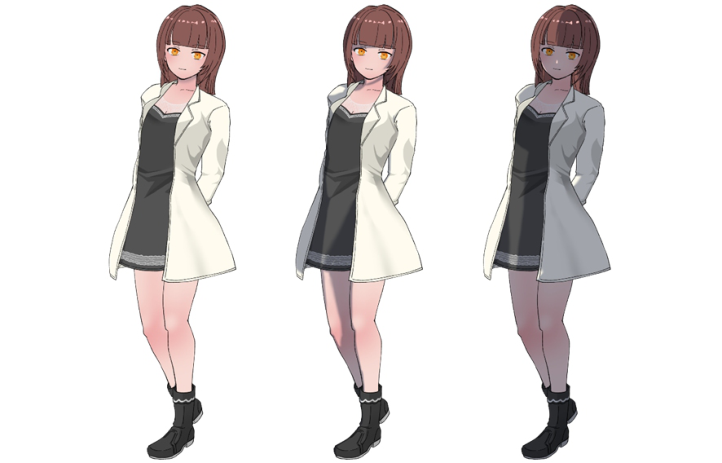
Figure 1: Examples of the illustrations used in the experiment.
Figure 1 shows examples of the illustrations used in the experiment. Twelve students of Kanazawa Institute of Technology participated in the experiment. Each participant sat on a chair in a darkroom and watched each stimulus presented on the display EIZO Flex Scan SX2462W. The participants were requested to rate their impressions for each stimulus, using 18 seven-step bipolar semantic differential (SD) scales shown in Table 1.
RESULTS AND DISCUSSION
For each SD scale, the rated scores were averaged over the participants. Using the mean scores, factor analysis was performed. The results of the analysis showed a three-factor solution with the cumulative contribution rate of 85 %. Table 1 shows the factor loadings for each SD scale. The three factors were labeled as friendliness, powerfulness and naturalness, respectively, after the scales showed large loading values. The stimuli were plotted on the impres- sion space spanned by friendliness, powerfulness and naturalness. The plots showed that the area covered by the shadow on the face was largely affected the impressions: Narrower the area became the friendliness and powerfulness increased. However, when no shadow covered the face, it was perceived as friendly but powerless. This suggested that the powerfulness related to the solidity made by the shadow. When only one eye was covered by the shadow, it was perceived as quite unnatural.
152 Yamaguchi and Yamada
Table 1. SD scales and their factor loadings.
Table available in the original PDF paper.
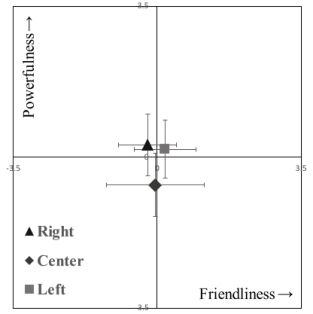
Then, the 26 stimuli with natural shadows were classified into three groups by the positions of the light source; the left side of the body (left), on the median plane (center) and the right side of the body (right). Figure 2 shows the centroids of the impressions for the different positions of the light sources on the friendliness-powerfulness plane. Figure 2 showed that the illustration was perceived as powerless when the light source was set on the median plane (center), but the illustrations were powerful when the light source was set at the lateral positions (left, right). This suggested that the solidity of the character made by the shadow on the face and body largely affected the powerfulness, again.
Figure 2: Impressions for different horizontal positions of the light source on the friendliness-powerfulness plane.
Impression Change of a Female Character in Illustration by Shadow 153
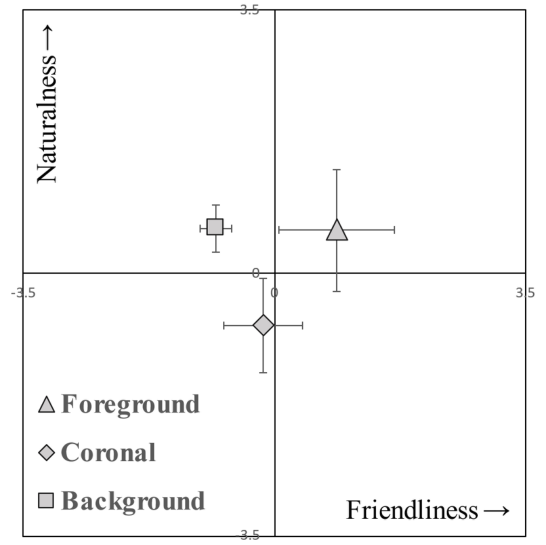
The 26 stimuli were re-classified into three groups by the positions of the light source; foreground of the body (foreground), on the coronal plane (coronal) and back ground of the body (background). Figure 3 shows the centroids of the impressions for the different positions of the light sources on the friendliness-naturalness plane. Figure 3 showed that the character was felt as friendly when the light source was set at foreground, but it was felt as unfriendly when the light source was set at background. The shadows for the foreground and background were perceived as natural, but the illustra- tion was perceived as unnatural when the light source was sat on the coronal plane.
Figure 3: Impressions for different anteroposterior positions of the light source on the friendliness–naturalness plane.
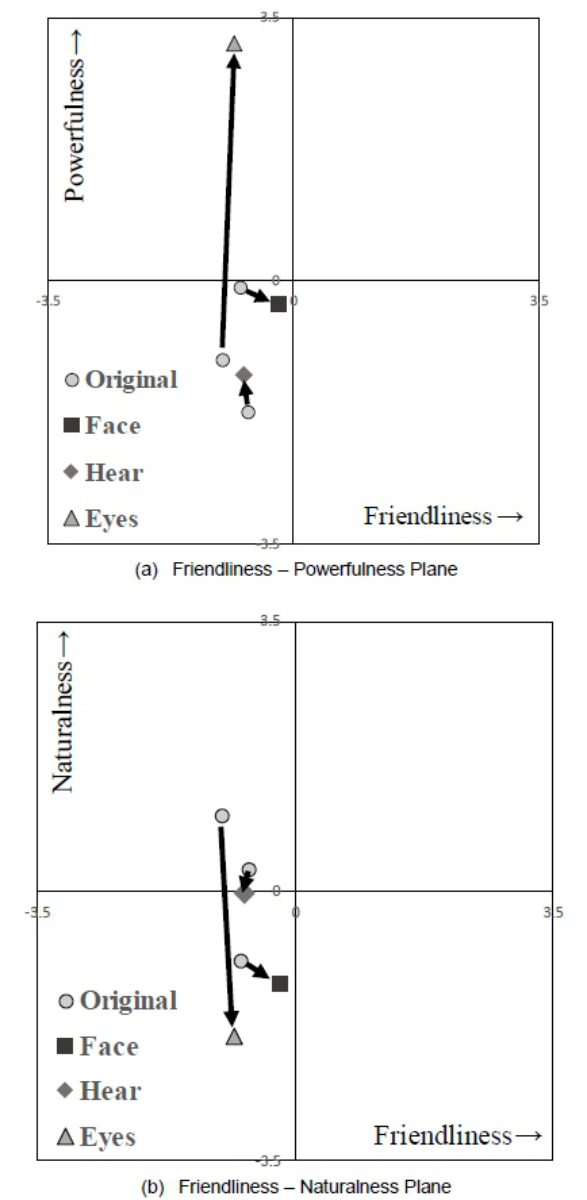
In the final step of the present study, the illustrations with no shadow and physically incorrect shadows were focused on. The character was perceived as friendly like the illustrations which no shadow was covered on the face, but it was also perceived as unnatural because the situation where no shadow existed was physically unnatural. Then, the impressions of the three illustra- tions with physically incorrect shadows were plotted with the impressions of their original natural shadows in Figure 4. Figure 4 shows that when the eyes are lighten-up, the powerfulness significantly increases but the naturalness largely decreases from the original illustration.
154 Yamaguchi and Yamada
Figure 4: Impressions for physically incorrect shadows with lighten-up parts of the face with their original shadows.
Impression Change of a Female Character in Illustration by Shadow 155
CONCLUSION
In the present study, impressions of anime-touch illustrations of a female character with various shadows were rated using SD method. The results of the factor analysis showed that the impression space was spanned by friend- liness, powerfulness and naturalness. The plots of the illustrations showed that the area of the face the shadow covered affected largely to the friend- liness and powerfulness. The illustration was perceived as powerless when the light source was set on the median plane, but they were powerful when the light source was set at the lateral positions. The female character was perceived as friendly when the shadow was produced by a light source set at foreground of the character, but it was perceived as unfriendly when the light source was set at the background. Moreover, when both eye were lighten-up in the shadow, the character was perceived as shadow was perceived as quite powerful and unnatural. The results of the present study will contribute to production of impressive illustrations and anime.
REFERENCES
Osgood, C. E., Suci, G. J., and Tannenbaum (1957); The measurement of meaning, University of Illinois Press, Illinois, p. 955. Kiss (2018), Custom Order Maid (2018) Available: https://com3d2.jp/com3d2/main
.html [Accessed: January 29, 2024] (in Japanese).
LISTED IN THE AHFE DIGITAL BOOKSTORE CATALOGUE
Explore the complete digital volume
Human Factors in Virtual Environments and Game Design
Read this individual research paper free through the original publisher, or explore the full digital proceedings book.
ISBN 978-1-964867-13-7
Explore this ISBN in the AHFE Bookstore ↗Listed in the July 2026 bookstore catalogue; search by ISBN to confirm current availability · Digital book purchase optional