Masaya Fukasawa, Masashi Yamada (2024). Impressions of Musical Pieces in the Pokémon Series. In: Human Factors in Virtual Environments and Game Design. AHFE Open Access, vol. 137, pp. 137–142. https://doi.org/10.54941/ahfe1004995
In recent years, Japanese anime and video games have been highly regarded as a part of Cool Japan content. Among them, a video game series Pokémon is standing out as globally famous content. The Pokémon series is a role-playing game developed by Game Freak Inc. and sold by The Pokémon Company. It has been popular since the release of Pokémon Red/Green in 1997, with many titles being released up to the latest. Throughout its long history, one of the important factors that has kept Pokémon popular is music.In a previous study, the character design of monsters was investigated, but there was no investigation on the music used in the Pokémon series. Pokémon includes various situations and scenes, such as battles with trainers and monsters, transfer on bicycles, walking around the towns, and visiting the hideouts of evil organizations, and so on. In the Pokémon series, corresponding musical piece is prepared for each situation and scene. The pieces are composed based on the theory and experience of musicians and it is not clarified whether they are matched to the situations or scenes. In the present study, a perceptual experiment was conducted to research the impressions of musical pieces in the Pokémon series using semantic differential method, and investigated whether the musical pieces are matched to the situations and scenes. For the experiment, 151 musical pieces used in the Pokémon series were prepared as sound stimuli. The stimuli were presented through headphones STAX SR-407 at the level of LAeq=55.9-70.4. Eighteen students of Kanazawa Institute of Technology participated as listeners. The participants listened to a stimulus and were requested to rate their impressions for the piece using 25 bipolar seven-step scales. The rated scores were averaged for each scale and used for factor analysis. The results of the factor analysis showed that the three-factor solution accounted for 86.9% of the data variance. These factors were labeled pleasantness, powerfulness and speed, respectively. The tonality of the musical piece determined the pleasantness, i.e. a piece with a major key was perceived as pleasant and a minor key was felt as unpleasant. A piece with a wide range of loudness change sounded powerful and a piece with a narrow range of loudness change sounded powerless. Contemporary game music is produced with various real sound sources and this allows realizing a wide range of loudness change. The rhythm and tempo of the musical piece determined speed. A piece with a fast rhythm and tempo sounded rapid and vice versa. Moreover, the results showed that the musical pieces were suitably composed and matched to the situations and scenes, in the Pokémon series. For example, the pieces used in the battle situations sounded powerful and rapid, the pieces used in the scene of towns sounded powerless, pleasant and slow, and so on. The results of the present study suggest how to compose for a situation or scene suitably, controlling the tonality, dynamic range of the loudness, rhythm and tempo.
In recent years, Japanese anime and video games have been highly regarded as a part of Cool Japan content. Among them, a video game series Pokémon is standing out as globally famous content. The Pokémon series is a role-playing game developed by Game Freak Inc. and sold by The Pokémon Company. It has been popular since the release of Pokémon Red/Green in 1997, with many titles being released up to the latest. Throughout its long history, one of the important factors that has kept Pokémon popular is music.
Yamada, Yanagida and Yoneda (2015) investigated the character design of monsters, but there was no investigation on the music used in the Pokémon series. Pokémon includes various situations and scenes, such as battles with trainers and monsters, transfer on a bicycle, walking around the towns, and visiting the hideouts of evil organizations, and so on. In the Pokémon series, corresponding musical piece is prepared for each situation and scene. The pieces are composed based on the theory and experience of musicians and it
is not clarified whether they are matched to the situations or scenes. In the present study, a perceptual experiment was conducted to research the impres- sions of musical pieces in the Pokémon series using SD (semantic differential) method (Osgood, Suci & Tannenbaum, 1957), and investigated whether the musical pieces are matched to the situations and scenes.
Table 1. Semantic differential scales and their factor loadings.
For the experiment, 151 musical pieces used in the Pokémon series were pre- pared as sound stimuli. The stimuli were presented through the headphones STAX SR-407 at the level of LAeq = 55.9–70.4 dB. Eighteen students of Kanazawa Institute of Technology participated as listeners. The participants listened to the stimuli and were requested to rate their impressions for the pieces using 25 bipolar seven-step scales shown in Table 1. In addition to the 25 scales, they also rated the degree of the preference in a seven-step scale. The experiment was performed in a soundproof room.
Impressions of Musical Pieces in the Pokémon Series 139
RESULTS AND DISCUSSION
For each SD scale, the rated scores were averaged over the listeners. Using the mean scores, factor analysis was performed. The results of the analy- sis showed a three-factor solution with the cumulative contribution rate of 86.9 %. Table 1 shows the factor loadings for each scale. The three factors were labeled pleasantness, powerfulness and speed, respectively, after the SD scales which showed large loading values. The stimuli were plotted on the impression space spanned by pleasantness, powerfulness and speed, based on the factor scores.
A cheerful and delightful piece was set at a high position on the pleasant- ness and a gloomy and dull piece was at a low position. This implies that the pleasantness was largely determined by the tonality, i.e. a piece with a major key was perceived as pleasant and a minor key was felt as unpleasant.
A piece with a wide range of loudness change sounded powerful and a piece with a narrow range of loudness change sounded powerless. In addition, a sound with a steep onset, like a brass or percussion sound, was salient in the powerful pieces.
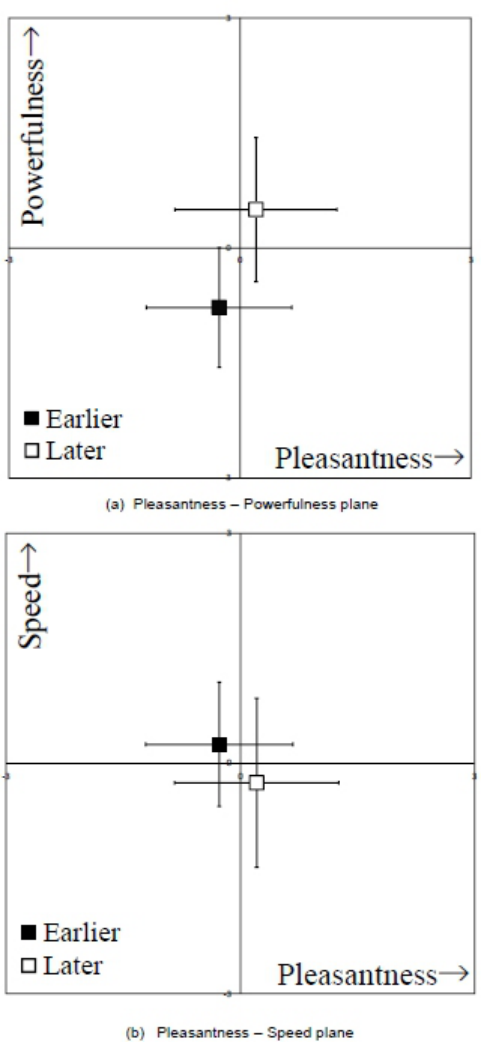
Figure 1 shows the centroids of the impressions for the earliest four titles and for the latest four titles. Figure 1 shows that the musical pieces for the later titles are perceived as powerful but the pieces for the earlier titles are perceived as powerless. This reflect the differences of the sound sources used for the pieces. For example, only several electronic sound sources like square wave, sinusoidal wave, sawtooth wave and noise were used for the earliest title “Pokémon Red/Green,” but now various real sound sources including brass sounds and percussion sounds are used for the latest title “Pokémon Brilliant Diamond/Shining Pearl.” Using these various sound sources, vari- ous expressions are performed in the “Pokémon Brilliant Diamond/Shining Pearl.” The sound sources allow realizing a wide range of loudness change for the later titles.
Speed was determined by the rhythm and tempo of the musical piece. A piece with a fast rhythm and tempo sounded rapid and vice versa.
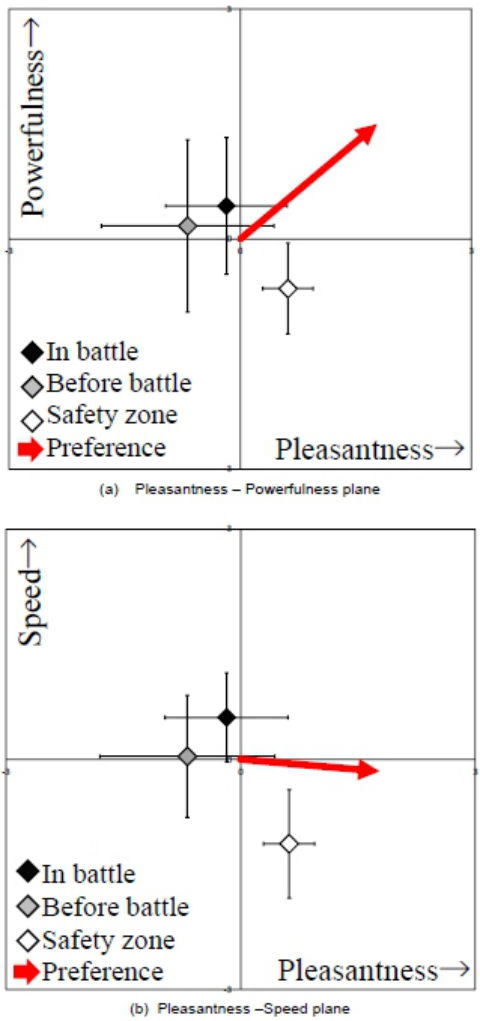
The pieces were divided into three classes by the situation and scenes the pieces used for; pieces used in battles (in battle), pieces used when a player reached in the battle field and prepared for the battle (before battle) and pieces used in safety zones (safety zone). Figure 2 shows the centroids of the impressions for the three classes. Figure 2 shows that the pieces used in the safety zones were perceived as slow and the pieces used in battles were per- ceived as rapid, and intermediate for before battles. This implies that the musical pieces are suitably composed to match the situations and scenes.
The results of the present study suggest how to compose for a situation or scene suitably, controlling the tonality, dynamic range of the loudness, rhythm and tempo.
Then, multiple-regression analysis was performed with the factor scores of the three factors as explanatory variables and the degree of the preference as criterion variable. Table 2 shows the results of the analysis. The coefficient of determination R2 showed a not enough high value of 0.601. The vector in Figure 2 shows the directions of the criterion variables on the impression
140 Fukasawa and Yamada
Figure 1: Centroids of the impressions for the earliest four titles and for the latest four titles.
space. Table 2 and Figure 2 show the tendency that a pleasant and powerful piece is preferred and the speed is not related to the preference. This implies that a piece with a major key and a wide range of loudness change gives a strong emotion of preference.
Impressions of Musical Pieces in the Pokémon Series 141
Figure 2: Centroids of the impressions for different situations and scenes. The vector shows the degree of the preference.
142 Fukasawa and Yamada
Table 2. Results of the multiple-regression analyses.
In the present study, the impression space of musical pieces used in the Pokémon series was spanned by pleasantness, powerfulness and speed. Pleas- antness was determined by the tonality. Powerfulness was related with the variety of the sound sources and the range of the loudness change in the pieces. Speed is determined by the rhythm and tempo. It was shown that the musical pieces were suitably composed for the situations and scenes in the Pokémon series.
ACKNOWLEDGMENT
The authors appreciate the listeners in the experiment and the laboratory members who cooperated to the present study.
REFERENCES
Osgood, C. E., Suci, G. J., Tannenbaum, P. H. (1957); The measurement of meaning, Urbana, IL, University of Illinois Press. Yamada, M., Yanagida, R., Yoneda, R. (2015); A study on impressions of monster
design in Pokémon, Proceedings of International Symposium of Affective Science and Technology, 1–6.
LISTED IN THE AHFE DIGITAL BOOKSTORE CATALOGUE
Explore the complete digital volume
Human Factors in Virtual Environments and Game Design
Read this individual research paper free through the original publisher, or explore the full digital proceedings book.
ISBN 978-1-964867-13-7
Explore this ISBN in the AHFE Bookstore ↗Listed in the July 2026 bookstore catalogue; search by ISBN to confirm current availability · Digital book purchase optional