Unintended Acceleration (UA) is a type of automobile accidents with automatic transmissions typically begin when the driver starts a driving cycle following to presses the one’s right foot on the brake while shifting from park to a drive or reverse gear. These accidents of UA cause extremely frightening and in the worst case have resulted in accidents which have been sometimes with injuries or death to the driver or pedestrians.The accident by UA becomes a serious issue in Japan with increasing in elderly drivers due to the aging of society. This study aims to comprehend a mechanism of pedaling misapplications to prevent a serious accident by interfaces implementing “Pedaling Depth Monitor”. The pedal misapplication prevention systems such as the automatic brakes, the suppressing accelerations and the gear lock mechanisms managed for avoiding the accident are still not spread because those system must be implemented into the hardware mechanical systems of the vehicle. In fact, the accidents of the pedal misapplication change in around from 6,000 to 7,000 cases a year in Japan. In addition, the accidents by UA cannot be completely prevented because the safe equipment is not perfect in general. This study intends to develop a system to prevent serious accidents by the interfaces implementing Pedaling Depth Monitor.This study has carried out two experiments to confirm availability of pedaling depth monitor. The first one is to examine cognitive processes of pedaling errors by Stop-signal task with dual task operations. The participants trialed stop-signal task with right foot alternative pedaling in the intervals of calculation tasks. This experiment resulted that there was an influence of time pressure to the pedaling operation. Then, the second experiment investigated awareness of notification which is displayed on the stepping depth monitor to be recognized by the participant. The results indicated the visual presentation which is easily recognized by the participants peripheral vision assuming the driving situation.
Unintended Acceleration (UA) which is a driver’s experience full and unex- pected acceleration with a pedal misapplication ends in the worst case have resulted in accidents (Schmidt, 1989). These accidents of UA cause extremely frightening which have been sometimes with injuries or death to the driver or pedestrians. The pedal misapplication prevention systems, the automatic brakes are typical, for avoiding the accident are still not spread because of problems of implement into the vehicle. Schmidt (1989) described the mech- anism of pedal misapplications that are caused by drivers producing foot placement errors. Once UA is initiated, it is hard to recover the pedaling error because lack of effective feedback processing is brought from habitual through practice. So, this study attempts to implement a system to prevent serious accidents by the interfaces presenting pedaling information. The pro- totypes of the system are examined by using a simplified driving simulator in order to develop the interfaces as the software system. This study intends to develop a system to prevent accidents by the interfaces implementing Pedaling Depth Monitor. Two stages of experiments confirmed availability of peda- ling depth monitor. The first stage is to investigate types of pedaling errors by suppression task. The participants trialed suppression task with right foot alternative pedaling in the intervals of calculation tasks to reproduce time
Availability of Pedaling Depth Monitor for Preventing Unintended Acceleration 89
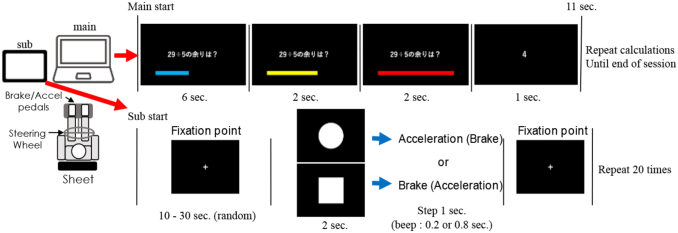
Figure 1: Dual sequential suppression tasks of one trial by calculation and discriminant of pedals from visual and auditory stimulus.
pressure. In the second stage, the interface design of pedaling depth moni- tor is considered in the meaning of availability by participants assuming the driving situation.
EFFECT OF TIME PRESSURE IN FOOT PEDAL BEHAVIOR It is necessary to explore factors to arise accident by pedaling error in order to implement vehicle safety system such as pedaling depth monitor. As the factors linking to UA, difficult situation, hypervigilance by errors of reco- gnition and time pressure can be considered as reasons. The majority of the previous studies of pedal misapplications have examined from accident reports (Schmidt, et al., 2010). However, remained reports describing scena- rios of UA are ambiguous and complex. Drivers were usually confused and couldn’t explain the situations well. McGehee, et al. (2016) have attempted to examine foot pedal behavior in naturalistic driving using a digital arti- fact recorder. The approach was worth to examine foot pedal behavior but it was difficult to identify pedal operation to arise UA. Arakawa, et al. (2017) used suppression task paradigm, one of the cognitive task paradigms used in the field of psychology, for simulating pedal misapplication scenario in a laboratory setting. The suppression task was used to perform by starting and stopping the action as desired by the user (Tsuchida, 2010). We examined pedal operations focusing the effect of time pressure condition according to the method of the previous researches.
Suppression Task under Time Pressure Fourteen university students (6 male, 8 female) participated the experiment of suppression tasks. Eleven participants have a driving license including seven with a license only. The suppression task, derived from Arakawa, et al. (2017), provided dual sequential tasks (see Figure 1). A calculation task displayed on the main screen is performed as a main task which a participant answers by speaking a result of a computed reminder to divide a two-digit integer dividend by a one-digit integer divisor. A stepping pedal task is used as a sub task which is a suppression task arranged stop-signal task (Eagle et al., 2008). A participant sat behind the wheel installed on the simulator
established as genuine driver’s sheet. The main task provided a numerical calculation each eleven seconds. A time limit was given for ten seconds as answer time and one second for presenting correct answer. A participant con- tinuously performed the main task until one trial was finished. A participant stepped the brake or the acceleration pedal by right foot as quickly as possi- ble according to a sign presented on the sub-screen. When a circle is shown, the participant steps on the accelerator and a square is shown then to step the brake. However, a participant needs to step the other pedal when a beep sounded (suppression to induce mis operation). The sub-task was presented 20 times during one trial at random 10 to 30 second intervals. Beep sounds were presented four times in a trial. The combinations of timing of a beep and a visual sign are 0.1 or 0.8 second later and a circle or a rectangle, two times two equal four combinations. Chance of presenting signs of circles and rectangles was 50% at random (10 circles and 10 rectangles are presented, 4 of 20 are suppression tasks), then 16 suppression tasks (beep) in total 80 visual signs were presented for one participant who performed four trials after enough practical trials. We examined the effect of time pressure in foot pedal behaviors by statistical analyses.
Results of Experiment First, the conditions of the experiment were examined by results of the rea- ction time and the number of mis operations removing suppression tasks (no beep tasks) for checking biases between the pedals and the participants’ fre- quencies of driving. The resulted mean reaction time of the brake pedal was significantly longer than acceleration reaction time (p < 0.05). It seems to consider the reaction time is depended on the pedal arrangement. The mean reaction time of the participants who drive a car frequently was significantly longer than the ones who don’t drive usually (p < 0.01). Depending on the driving frequency condition, the condition was not affected on the response time. The difference of reaction time was not significant on the interaction between the pedal and the driving frequency factors. With regards to the miss operation, the rate of mis pedaling were 1.3% and 0.7% by frequent drivers and the others. It seems to support that the driving skills were not made stepping speed faster and number of mis-stepping smaller.
Then, we considered the effect of time pressure. The main task which pro- vides time pressure displays a progress bar changes the color, blue to yellow and yellow to red, according to elapsed time 6 and 8 second respectively. The averages of the reaction time for each color when presented sign to indi- cate the pedal were 3.22 sec. (blue), 3.13 sec. (yellow) and 3.07 sed. (red). The red reaction time was significantly smaller than the blue (p < 0.01). The participants tend to step the pedal fast as time passes. From the subjective evaluations, seven participants answered feel time pressure in the experiment. Table 1 is a cross tabulation table of the number of pedal operations in each sign timing in each correct, miss and not noticed miss pedaling reaction. The effect of time pressure was examined by chi-square test using data without not noticed miss cases. The difference of the errors in each timing to answer
Availability of Pedaling Depth Monitor for Preventing Unintended Acceleration 91
Table 1. Cross tabulation table of the number of pedal operations in each sign timing in each correct, miss and not noticed miss pedaling reaction. (N = 1003)
Table available in the original PDF paper.
Pedal operation Timing of sign presented Total Blue Yellow Red Correct 556 172 198 926 Miss 36 12 10 58 Not noticed 16 2 1 19
the calculation task was also not supported significant. From the result of the test, it was not related between miss operations and time passes.
Tsuchida (2007) pointed out that in the simple location discrimination test, the false reaction rate by the feet was smaller than the hands. Schmidt (1989) has considered that the errors linking to UA could occur in normal, not rushed, from the episodes of foot placement errors. The results of our experiment are also support the hypothesis that extremely few errors occur caused by time pressure. Regarding with the situation of UA, the previous researches have explained some important factors linking to the pedal miss operations. It occurs when a driver is about to initiate the driving cycle. The major reason would be the right foot placement. The foot positions are pro- bably farther from the brake than if the foot were on the accelerator during the driving cycle, and the variable errors in aiming should be somewhat lar- ger as a result (Schmidt, 1989). Foot movement (wagging) to a target from a consistent place is usually very well practiced and is less variable unless the driver operates the pedal position which does not get used or the first time to ride unusual. Other possible reason is initiated at an incorrect process cau- sed by a mistake or a slip such as locking in the wrong gear. In this case, the driver perceives the gap between a recognized behavior by the mental model and the actuality from acknowledged feedback, the worst case runaway. The target of UA preventing system can be concluded as allowing the driver to recognize the foot position and the status of operation by the appropriate feedback through the interface of the system.
INTERFACE EVALUATION OF PEDALING DEPTH MONITOR To design the interface for pedaling depth monitor is a primary problem of this research. Safety systems installed in a vehicle usually employ visual and auditory presentation to notify the information. There are advantages and disadvantages with each. The most considerable problem of the visual information is difficulty to perceive. The driver usually looks at driving view carefully, so the visual information is ordinally ignored or if the information is in the view it is observed by peripheral visual field. The major disadvantage of the auditory information is not suitable to discrimination task. The auditory information is easily perceptible but it has issue to associate nervous excita- tion (Tsuchida, 2013). The design of the interface must be understandable and perceptible, so the system composed by using both visual and auditory presentations.
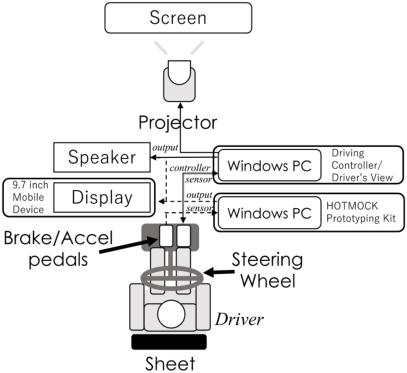
Figure 2: Driving simulator for experiment of pedaling depth monitor.
Notification Awareness of Pedaling Depth Monitor Interface A driving simulator is installed for examining notification awareness of the interface. A force feedback steering wheel and a unit of pedals are used as a simple simulator for the experiments. To provide a driver’s compartment configured the devices with a steering wheel and pedals assembled on a stand. Several kinds of sensors are attached to the brake and the acceleration pedals for sensing the stepping depth. The sensor information is also real-time pro- cessed by windows PCs to perform the prototypes of the interface. A kit of interface development, HOTMOCK (by HOLON CREAT inc.), is implemen- ted into the PC. A projection system with screen used for providing driving information, signs, drivers view and route information (see Figure 2). The operation amount of the driving devices is visibly influenced immediately and the force feedback is reflected to the devices. A monaural sound exter- nal speaker is used as an auditory output device connected with PC. iPad with 9.7-inch display presents visual information from the prototype system of PC. Participants were seated approximately 170cm from the main screen and 70cm from the interface display. The angle between driver’s eyepoint (center of the main screen) and the interface display was approximately 30 degrees. The sound volume reached approximately 50dB from the speaker.
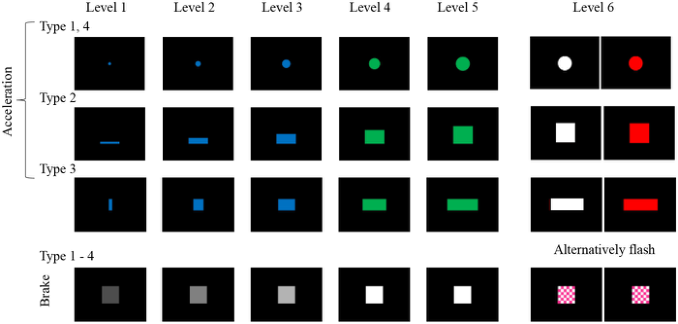
Six participants drove a training course like driver’s license center with four different types of the interface after enough trained to the simulator. First, the participants made trial a sample version without the interface as a reference for the evaluation. Then, the four interfaces with the same course were asses- sed in random order. The participants performed subjective evaluations for each type of the interface comparing with the reference trial. The variations of the interface presentations are shown in Figure 3. The visual interfaces have been prepared for a feedback presentation of pedal depth to the participant on the mobile screen. The prototype of type 1 is indicated pedal depth by a circle which the size changes according to the acceleration pedal operation.
Availability of Pedaling Depth Monitor for Preventing Unintended Acceleration 93
Figure 3: Candidates of visual presentations for four types of interfaces.
This interface is arranged from previous study to examine awareness of peri- pheral vision (Fukazawa, 2021). Type 2 represents a rectangle extending in the longitudinal direction. Type 3 is extending in the lateral direction. Type 4 is visually same as type 1, it includes separate alarm sounds when the pedal position reach to the bottom in each pedal. The color variations are same in the all types. The presentation pattern for the brake pedal is same in four types.
Evaluation of Notification by Pedaling Depth Monitor
Table 2 shows the resulted averages of subjective evaluations for each type of interface. The participants performed five questionnaires by the five points scale. Regarding with the effect of visual and auditory presentations of the interface, there were no significant differences in evaluation due to differe- nces between the types of the interface in the all questionnaires. The overall evaluations of perceptibility (Q1 : 4.0) and awareness of color change (Q3 : 3.8) were considerably large. On the other hand, usefulness (Q2 : 3.2) and awareness of shape change (Q4 : 3.3, Q5 : 3.5) were small in the averages. The participants recognized the visual stimulus, however their recognized information was ambiguously processed during the driving task. It seems to be considered that capable of evaluating recognized pedal operating amount was not having conformity to visual observation from the interface. Related to auditory stimulation, all participants evaluated 5 to Q6 (Average = 5.0, the auditory stimulus was perceived very well). However, it was suggested from Q8 (Average = 2.5, discriminate between the pedals) that the audi- tory stimulation was not effective to discriminate between the brake and the acceleration pedals.
CONCLUSION
Availability of the pedaling depth monitor which is used as a device for the vehicle in order to prevent accidents caused by unintended acceleration was considered trough the experiments. The first experiment investigated the
Table 2. Average of performed subjective evaluation of interfaces.
Table available in the original PDF paper.
Type 1 Type 2 Type 3 Type 4 Average
3.7 4.2 4.2 4.2 4.0
Q1. Did you see the visual information well?
Q2. Was the visual information useful? 3.2 2.8 3.2 3.5 3.2
3.5 3.8 4.2 3.8 3.8
Q3. Did you notice the difference in color?
3.5 2.7 3.2 3.8 3.3
Q4. Did you see changing forms with brake and acceleration?
3.0 3.5 4.0 3.7 3.5
Q5. Did you see changing form by step- ping depth of the pedal?
effect of time pressure in pedaling operation. The result suggested that the time pressure in driving situation was not significantly affected on the pedal miss operation and the e-reaction time. This supposes the results of previous studies that an accident by UA is caused by drivers producing foot placement errors happened when the driver is in normal. Other considerable reason is that it is initiated from such as the pedaling error brought from habitual through practice. The second experiment evaluated candidates of pedaling depth monitor. Four kinds of the interface were examined through the driving tasks from the view points of perceptibility and availability. The participant evaluated the visual and auditory presentations were recognized. However, it was hard to discriminate the representation of the pedaling operation using the information by the system.
REFERENCES
Arakawa, J., Kotani, K., Suzuki, S., Asao, T. (2017) “Relationship between accelerator/brake position and pedal misapplication”, The 2nd Asian Conference on Ergonomics and Design, Chiba. Eagle, D. M., Baunez, C., Hutcheson, D. M., Lehmann, O., Shah A. P. and Robbins,
T. W. (2008) Stop-Signal Reaction-Time Task Performance: Role of Prefrontal Cortex and Subthalamic Nucleus, Cerebral Cortex, Volume 18, Issue 1. Fukazawa, S. and Shimomura, Y. (2021) Effects of Various Visual Motions of Peripheral Notification on Awareness and Concentration, The Japanese Journal of Ergonomics, Vol. 57, No. 3. McGehee, D. et al. (2016) The Wagging Foot of Uncertainty: Data Collection and
Reduction Methods for Examining Foot Pedal Behavior in Naturalistic Driving, SAE Int. J. Trans. Safety 4(2). Schmidt, R. A. (1989) Unintended Acceleration: A Review of Human Factors Contributions, Human Factors, Volume 31(3). Schmidt, R. A.et al. (1979) Motor-output variability: A theory for the accuracy of
rapid motor acts. Psychological Review, 86(5). Schmidt, R. A., Young, D. E.: Cars Gone Wild: The Major Contributor to Unintended Acceleration in Automobiles is Pedal Error. Front Psychol. Vol 1:209, 1–4 (2010)
Availability of Pedaling Depth Monitor for Preventing Unintended Acceleration 95
Tsuchida, N. (2007) Classification of Inhibitory Function, Ritsumeikan Unniversity, Vol. 500. Tsuchida, N., Morikawa, S., Yoshida, H. & Okawa, I. (2013) Motor Inhibition
in Aging: Impacts of Response Type and Auditory Stimulus, Journal of Motor Behavior, 45:4. Tsuchiya T., Watanabe K., Hirano M., Kato H. (2021) Investigation into Pedaling Operation Using Driving Simulator for Preventing Unintended Acceleration. In: Shin C.S., Di Bucchianico G., Fukuda S., Ghim YG., Montagna G., Carvalho C. (eds) Advances in Industrial Design. AHFE 2021. Lecture Notes in Networks and Systems, vol. 260. Springer, Cham.
LISTED IN THE AHFE DIGITAL BOOKSTORE CATALOGUE
Explore the complete digital volume
Kansei Engineering
Read this individual research paper free through the original publisher, or explore the full digital proceedings book.
ISBN 978-1-958651-16-2
Explore this ISBN in the AHFE Bookstore ↗Listed in the July 2026 bookstore catalogue; search by ISBN to confirm current availability · Digital book purchase optional